Exam Anxiety GCSE English Language: A Calm Plan
Exam anxiety GCSE English Language support: use practical reading, writing and timing routines to feel calmer, think clearly and protect marks in exams.
The hardest moment in an English Language exam can arrive before you have written a word. You open the paper, meet an unfamiliar extract and suddenly feel as though every useful idea has disappeared.
If exam anxiety GCSE English Language is affecting you, the answer is not to memorise more ambitious vocabulary or hope that the perfect text appears. Build a repeatable process for reading, planning, writing and checking. Anxiety feeds on uncertainty; a familiar routine reduces the number of decisions you must make under pressure.
This guide focuses on the particular worries created by GCSE English Language: unseen texts, extended writing, time pressure and the fear of having no ideas. If you are balancing English with maths revision, it will also help you create a plan that protects time for both subjects.
Your calm English Language checklist
Before exploring each step, here is the central plan:
- Check which exam board and specification you are taking.
- Learn the recurring question types rather than predicting exact topics.
- Practise opening unfamiliar texts without immediately judging yourself.
- Give every extended response a short, controlled plan.
- Use question marks and suggested timings to guide your decisions.
- Develop a reset routine for moments when your mind goes blank.
- Review practice using the mark scheme, not emotion alone.
- Ask for support early if anxiety is persistent or overwhelming.
English Language papers vary across AQA, Edexcel, OCR and Eduqas. The texts, question order, marks and wording are not identical, so use current materials for your own specification rather than relying on a routine copied from someone taking another board.
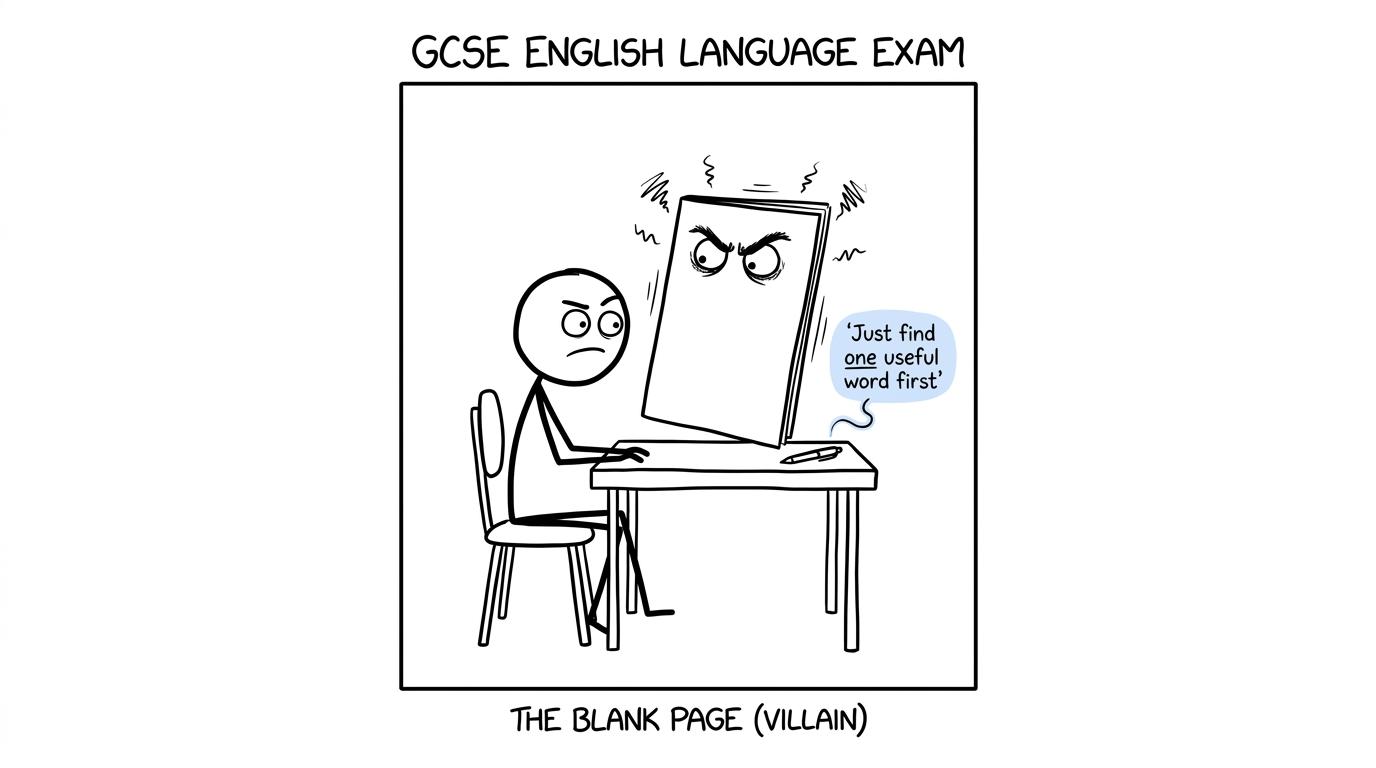 A nervous student discovers that beginning with one useful word is less frightening than defeating the entire exam paper
Why GCSE English Language can feel unpredictable
In maths, anxiety may come from seeing a difficult topic. In English Language, it often comes from not knowing the text, writing purpose or subject in advance. That uncertainty can create an unhelpful belief: “I cannot prepare because I do not know what will appear.”
But the content is only one part of the task. The process is far more predictable. You will need to read carefully, identify relevant evidence, explain effects, compare or evaluate where required, and communicate clearly in extended writing. Exact requirements depend on your exam board, but these habits are trainable.
This distinction matters. You do not need to feel certain about the extract. You need to feel familiar with what you do next.
Start by checking your school’s specification and recent official papers. Write a one-page map containing each paper, its sections, recurring question types and the skills being assessed. Do not assume that an online video using the words “English Paper One” matches your qualification.
Replace vague revision with predictable routines
“Revise English” is too broad to be reassuring. A defined task gives your attention somewhere useful to go.
Separate reading from answering
When students are anxious, they sometimes read the extract while simultaneously trying to invent a complete answer. This overloads the moment.
Instead, separate the stages:
- Read the question and identify its precise focus.
- Read the relevant part of the text.
- Mark a small number of genuinely useful details.
- Decide what each detail helps you explain.
- Begin with your clearest idea.
Annotations should support an answer, not decorate the page. Underlining almost everything makes it harder to decide what matters.
Build question-specific prompts
Prepare a short mental prompt for each recurring question type. A language question might lead you to consider word choice, imagery, sentence construction or tone. A structure question requires attention to movement and organisation across the text rather than a list of isolated quotations. An evaluation question needs a clear judgement supported by evidence and explanation.
These are not scripts to recite regardless of the question. They are starting rails. They help you move when anxiety makes the blank page feel unusually large.
Plan writing without waiting for inspiration
Creative and transactional writing can cause a particular kind of panic: the belief that a brilliant idea must arrive before writing can begin. In an exam, control is usually more useful than novelty.
For descriptive or narrative writing, choose a manageable setting, viewpoint and direction. For transactional writing, identify the form, audience, purpose and tone. Then arrange a few clear points before drafting.
A plan should be short enough to leave time for writing. Its job is to stop you wandering, not to become a second answer.
Practise uncertainty in small doses
Avoiding timed English practice can bring short-term relief, but it leaves the unfamiliar feeling intact. A better approach is gradual exposure.
Begin with one unseen paragraph and one question. Later, complete a section. Only then move towards a full paper under realistic conditions. After each attempt, record what helped and what needs changing.
A useful progression is:
- read and annotate without a timer;
- answer one question with generous time;
- answer the same type under a realistic limit;
- combine several questions;
- complete a full paper and review it carefully.
The review matters more than repeatedly sitting papers. Use your teacher’s guidance and the appropriate mark scheme to distinguish between missing knowledge, weak technique and a timing problem.
This principle also applies across your revision timetable. MathsGenie’s free GCSE maths revision lessons divide a large qualification into defined topics, while GCSE maths past papers let you rehearse complete papers when you are ready. Keeping each subject organised reduces the feeling that everything must be revised at once.
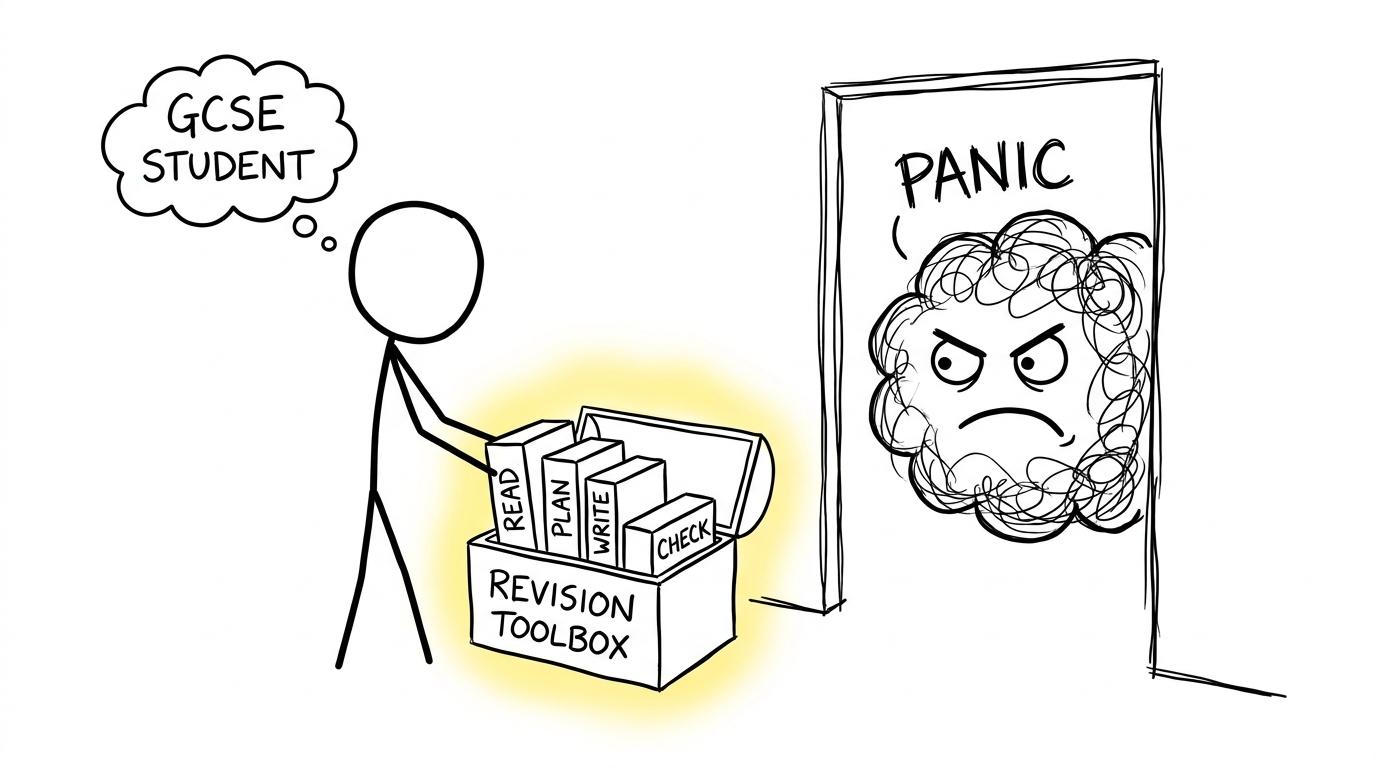 A student packs reading, planning, writing and checking into a revision toolbox while panic waits outside
Manage time without watching the clock constantly
Time anxiety often produces one of two reactions: rushing every sentence or spending too long perfecting the opening response. Neither protects marks.
Before the exam, use the instructions, marks and guidance for your particular paper to create sensible checkpoints. Suggested timings are guides rather than guarantees, but they can tell you when to move on.
During the paper:
- note the official start and finish times;
- check the clock at planned moments, not after every sentence;
- leave space and move on if one response has stalled;
- prioritise relevant, developed writing over a polished but unfinished answer;
- reserve a brief final check where the paper permits.
Do not copy timing plans from another exam board without checking them. Different papers allocate marks and tasks differently.
Predicted materials can support rehearsal, but they cannot tell you exactly what will appear. Maths students can use MathsGenie predicted papers alongside official past papers, not as a replacement for broad revision. The same principle applies to English: prepare for skills and question types rather than gambling on a predicted theme.
What to do when your mind goes blank
A blank moment is uncomfortable, but it is not proof that the whole exam has gone wrong. Treat it as a temporary interruption.
Use a simple reset:
- Put both feet on the floor and release your grip on the pen.
- Breathe out slowly, then return attention to the page.
- Underline the task’s focus words.
- Find one detail in the text that clearly relates to the question.
- Write the smallest useful statement you can defend.
For extended writing, return to form, audience and purpose. If the task is persuasive, ask what you want the reader to believe or do. If it is descriptive, choose one concrete detail and establish a viewpoint. Movement often returns after the first controlled sentence.
Avoid trying to diagnose your grade during the exam. You cannot reliably calculate how everyone else performed, how boundaries will fall or what an examiner will award while you are still writing. Your useful task is narrower: respond to the question in front of you.
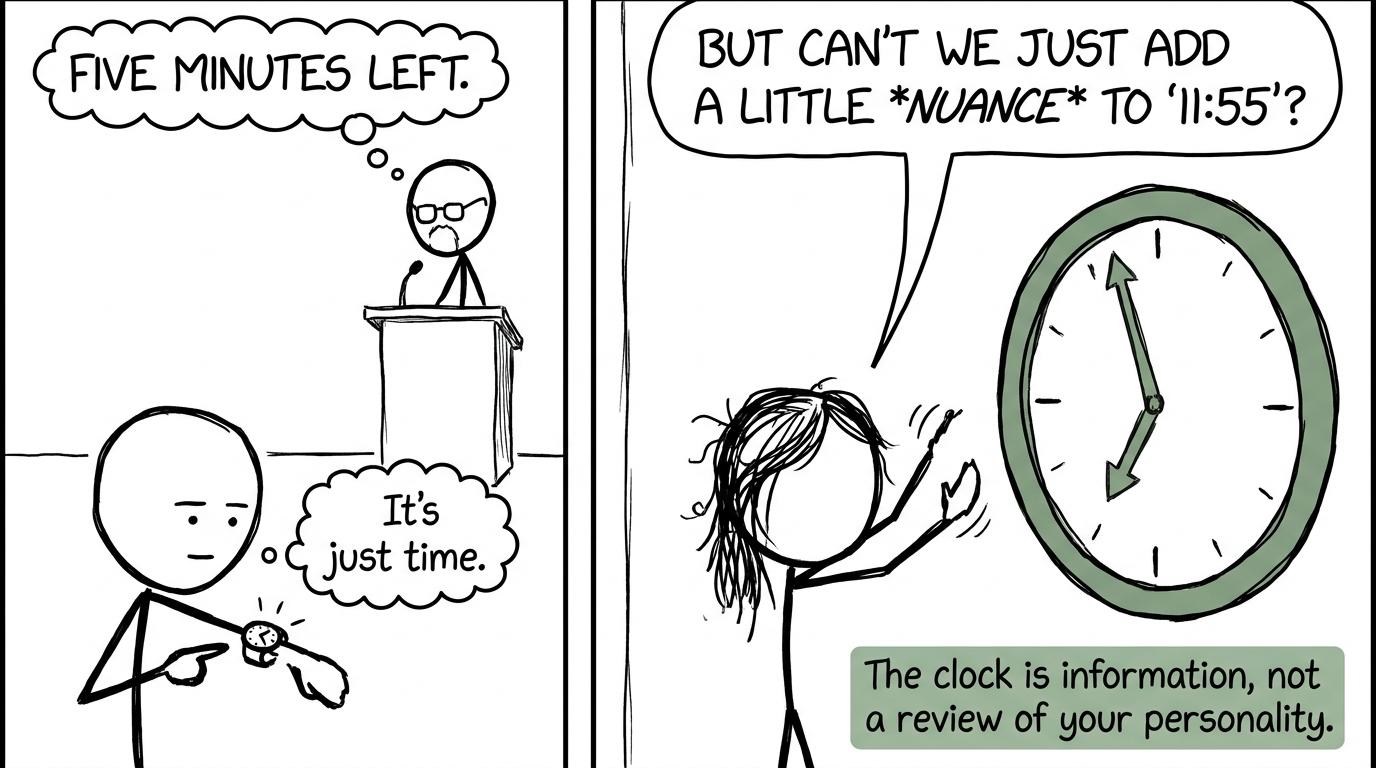 One student uses the clock as information while another attempts to negotiate for extra minutes
Create a revision week that does not amplify anxiety
Anxiety grows when revision becomes an undefined debt. Decide in advance what “done” means for each session.
An English Language session might involve annotating one extract, planning one writing task or improving one response after feedback. A maths session could focus on one lesson, a set of practice questions or part of a paper. MathsGenie’s free maths revision resources make that work easier to define, and its A Level maths revision area provides the same structured approach if you continue with maths after GCSE.
Keep the plan realistic. Doing one specific task attentively is more valuable than writing an enormous list and carrying the unfinished items into tomorrow. Include sleep, meals, movement and breaks rather than treating them as rewards you earn only after revision.
On the evening before the exam, check practical details and stop at a sensible time. Last-minute attempts to learn every technique can reinforce the message that you are not ready. Briefly review your question map and reset routine, then prepare what you need for the morning.
Common mistakes when managing English exam anxiety
Memorising a complete answer
A prepared paragraph can feel safe, but it may not answer the actual question or suit the unseen text. Memorise flexible processes and terminology, not an essay you intend to force into the paper.
Using ambitious vocabulary without control
Complex words do not automatically create effective writing. If a word is inaccurate or disrupts the tone, it can weaken communication. Choose precise vocabulary you understand and can spell confidently.
Treating every technique as equally important
Listing techniques is not analysis. Select evidence that answers the question, identify what is significant and explain its effect in context.
Completing papers without reviewing them
Practice alone can repeat the same habits. Compare your response with the assessment criteria, use the mark scheme carefully and ask your teacher what one improvement would make the greatest difference.
Letting English anxiety consume every subject
One worrying paper can take over the whole timetable. Give English regular, contained sessions while maintaining your other subjects. For maths, alternate topic revision with past-paper practice so that neither gaps nor exam technique are ignored.
Keeping serious anxiety private
If anxiety regularly affects sleep, attendance, concentration or daily life, tell a parent, carer, teacher, school pastoral lead or healthcare professional. Schools can explain what support is available and whether any formal arrangements are relevant. Raise concerns early because access arrangements follow specific evidence and approval processes; they are not automatically granted on exam day.
A calmer exam starts with a smaller next step
Confidence in GCSE English Language does not require knowing the unseen text in advance. It comes from knowing how you will meet it: identify the task, read with purpose, select useful evidence, plan briefly, write clearly and reset when necessary.
Make your next action small. Map your English paper, practise one question type and review the result. Then return to the rest of your timetable. Use MathsGenie for structured GCSE revision lessons, targeted practice questions, video solutions, mini tests, predicted papers and mark-scheme-led past-paper practice. Revision feels more manageable when every session has a purpose, and when the next step is already waiting for you.