Dividing Decimals GCSE Maths Explained
Dividing decimals GCSE maths made clear with a reliable method, step-by-step worked examples, common mistakes and exam-style practice questions.
A decimal point can feel strangely powerful. Move it incorrectly and a sensible answer becomes ten or one hundred times too large. Leave it where it is and the division may look impossible.
Imagine a student called Sam. He can divide whole numbers, but decimal division keeps going wrong. His usual approach is to move whichever decimal looks inconvenient and hope the answer seems reasonable. The solution is not a new division technique. For dividing decimals GCSE maths questions, the reliable method is to turn the divisor into a whole number by multiplying both numbers by the same power of 101010. Then complete an ordinary division.
The dividing decimals checklist
Use this process whenever the number you are dividing by contains a decimal:
- Identify the divisor, which is the number you are dividing by.
- Multiply the divisor by 101010, 100100100 or 100010001000 until it becomes a whole number.
- Multiply the dividend by exactly the same amount.
- Complete the new division.
- Check whether the size of your answer is reasonable.
The key is the third step. Changing both numbers by the same scale factor keeps the quotient unchanged.
For example,
4.8÷0.6=48÷6.4.8 \div 0.6 = 48 \div 6.4.8÷0.6=48÷6.Both numbers have been multiplied by 101010, so the value of the division has not changed.
Why multiplying both numbers works
Sam's first breakthrough comes when he stops thinking of the method as simply “moving decimal points”. That phrase is quick, but it hides the reason.
A division can be written as a fraction:
4.8÷0.6=4.80.6.4.8 \div 0.6 = \frac{4.8}{0.6}.4.8÷0.6=0.64.8.Multiplying the numerator and denominator by 101010 gives
4.8×100.6×10=486.\frac{4.8 \times 10}{0.6 \times 10} = \frac{48}{6}.0.6×104.8×10=648.The fraction's value is unchanged because both parts were multiplied by the same non-zero number. Therefore,
4.8÷0.6=48÷6=8.4.8 \div 0.6 = 48 \div 6 = 8.4.8÷0.6=48÷6=8.This is a useful distinction: you are not moving decimal points at random. You are multiplying both numbers by the same power of 101010.
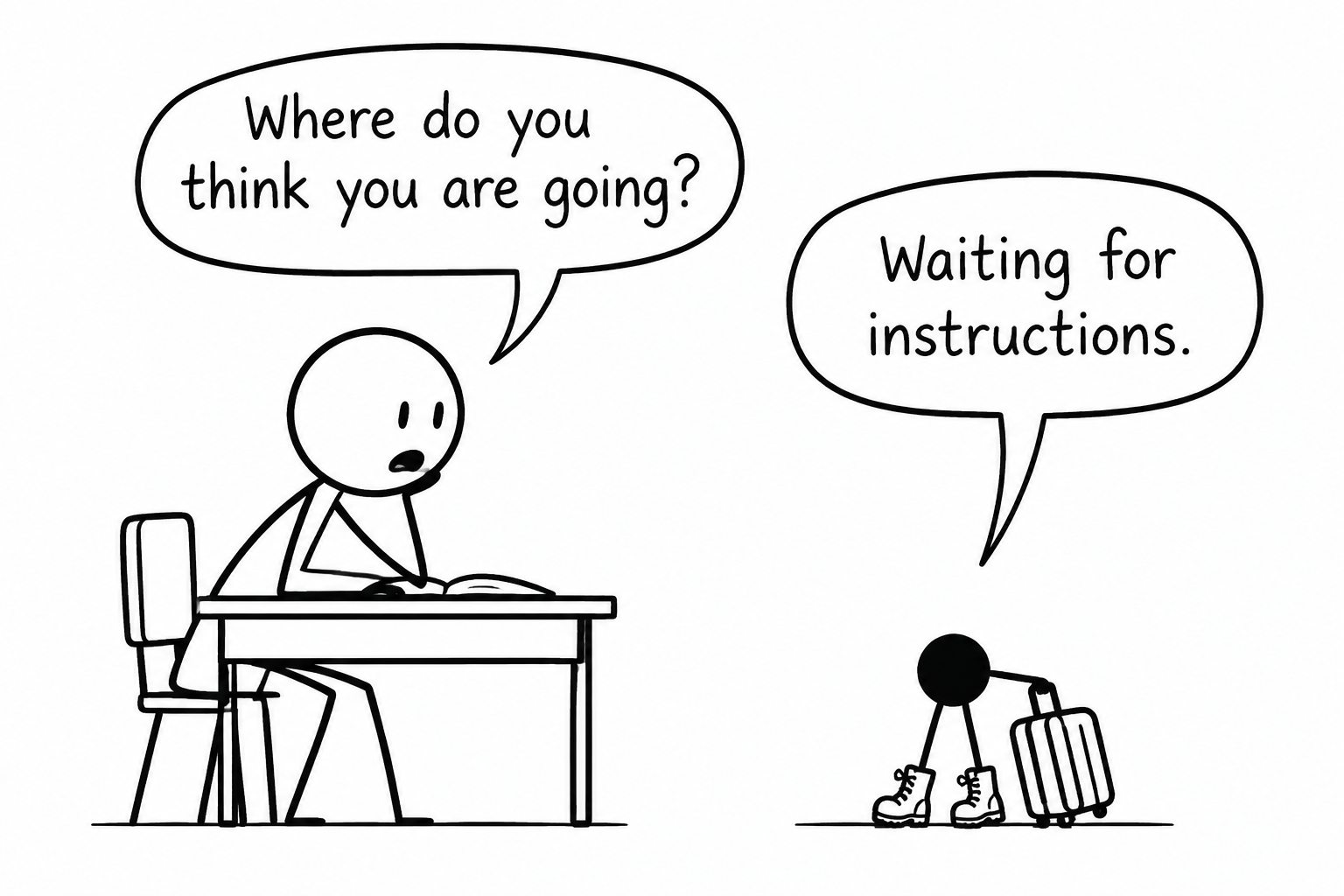 A student negotiates with an adventurous decimal point
Dividing decimals worked examples
Example: one decimal place in each number
Calculate
7.2÷0.9.7.2 \div 0.9.7.2÷0.9.The divisor is 0.90.90.9. Multiply both numbers by 101010:
7.2÷0.9=72÷9.7.2 \div 0.9 = 72 \div 9.7.2÷0.9=72÷9.Now divide:
72÷9=8.72 \div 9 = 8.72÷9=8.Therefore,
7.2÷0.9=8.7.2 \div 0.9 = 8.7.2÷0.9=8.Sam checks the result using multiplication:
8×0.9=7.2.8 \times 0.9 = 7.2.8×0.9=7.2.The check returns the original dividend, so the answer is correct.
Example: the numbers have different decimal places
Calculate
3.36÷0.8.3.36 \div 0.8.3.36÷0.8.Only the divisor determines the scale factor. Multiplying 0.80.80.8 by 101010 makes it a whole number, so multiply both numbers by 101010:
3.36÷0.8=33.6÷8.3.36 \div 0.8 = 33.6 \div 8.3.36÷0.8=33.6÷8.Now use short division:
33.6÷8=4.2.33.6 \div 8 = 4.2.33.6÷8=4.2.Therefore,
3.36÷0.8=4.2.3.36 \div 0.8 = 4.2.3.36÷0.8=4.2.Notice that 33.633.633.6 does not need to be a whole number. The aim is to make the divisor whole because dividing by a whole number is easier.
Example: multiplying by 100100100
Calculate
1.44÷0.12.1.44 \div 0.12.1.44÷0.12.Multiplying by 101010 would turn 0.120.120.12 into 1.21.21.2, which is still a decimal. Multiply both numbers by 100100100 instead:
1.44÷0.12=144÷12.1.44 \div 0.12 = 144 \div 12.1.44÷0.12=144÷12.Then
144÷12=12.144 \div 12 = 12.144÷12=12.Therefore,
1.44÷0.12=12.1.44 \div 0.12 = 12.1.44÷0.12=12.This is where the method finally clicks for Sam. He no longer asks, “How many places should I move?” He asks, “What must I multiply the divisor by to make it whole?”
You can reinforce that exact decision using the Maths Genie decimal division lesson, with the method beside you until choosing the scale factor becomes automatic.
What if only the dividend is a decimal?
If the divisor is already a whole number, there is no need to rescale the calculation. Use ordinary short division and keep the decimal point aligned.
Calculate
15.75÷5.15.75 \div 5.15.75÷5.Dividing each place value by 555 gives
15.75÷5=3.15.15.75 \div 5 = 3.15.15.75÷5=3.15.A multiplication check confirms it:
3.15×5=15.75.3.15 \times 5 = 15.75.3.15×5=15.75.Do not create extra work by multiplying both numbers when the divisor is already whole.
How to estimate the answer first
Estimation catches answers that have been distorted by an incorrect power of 101010. Before calculating
5.94÷0.3,5.94 \div 0.3,5.94÷0.3,use nearby compatible numbers:
6÷0.3=20.6 \div 0.3 = 20.6÷0.3=20.The exact answer should be close to 202020. Rescaling gives
5.94÷0.3=59.4÷3=19.8.5.94 \div 0.3 = 59.4 \div 3 = 19.8.5.94÷0.3=59.4÷3=19.8.That fits the estimate. An answer such as 1.981.981.98 or 198198198 should immediately look doubtful.
There is another useful size check. Dividing a positive number by a positive number smaller than 111 makes the answer larger. Since 0.30.30.3 fits into 5.945.945.94 many times, an answer smaller than 5.945.945.94 would not make sense.
Common mistakes when dividing decimals
Changing only one number
A student might write
4.2÷0.7=4.2÷7.4.2 \div 0.7 = 4.2 \div 7.4.2÷0.7=4.2÷7.This changes the calculation. The correct step is
4.2÷0.7=42÷7=6.4.2 \div 0.7 = 42 \div 7 = 6.4.2÷0.7=42÷7=6.Whatever happens to the divisor must also happen to the dividend.
Using the wrong power of 101010
For
6.3÷0.09,6.3 \div 0.09,6.3÷0.09,multiplying by 101010 is insufficient because 0.09×10=0.90.09 \times 10 = 0.90.09×10=0.9. Multiply both values by 100100100:
6.3÷0.09=630÷9=70.6.3 \div 0.09 = 630 \div 9 = 70.6.3÷0.09=630÷9=70.Treating division as commutative
Order matters in division:
8÷2≠2÷8.8 \div 2 \neq 2 \div 8.8÷2=2÷8.Read the calculation from left to right. In 8÷28 \div 28÷2, the dividend is 888 and the divisor is 222.
Ignoring place value in short division
When calculating 33.6÷833.6 \div 833.6÷8, keep the decimal point in the quotient aligned with the decimal point in 33.633.633.6. Poor alignment often produces a correct sequence of digits with the decimal in the wrong position.
Skipping the check
Use the inverse operation:
quotient×divisor=dividend.\text{quotient} \times \text{divisor} = \text{dividend}.quotient×divisor=dividend.This check is quick and exposes most place-value errors.
Dividing decimals questions for exam practice
Try these without a calculator. Show the rescaling step whenever the divisor is a decimal.
- Calculate 8.4÷0.78.4 \div 0.78.4÷0.7.
- Calculate 5.25÷0.55.25 \div 0.55.25÷0.5.
- Calculate 2.88÷0.122.88 \div 0.122.88÷0.12.
- Calculate 0.672÷0.080.672 \div 0.080.672÷0.08.
- A ribbon measuring 4.54.54.5 metres is cut into pieces measuring 0.30.30.3 metres. How many complete pieces are made?
Answers:
- 121212
- 10.510.510.5
- 242424
- 8.48.48.4
- 151515 pieces
Do more than mark each answer right or wrong. If an answer is incorrect, label the cause: scale factor, short division, decimal position or question order. That turns a mistake into a specific skill you can practise.
For broader number practice, use the Maths Genie GCSE revision resources and test the method in mixed questions rather than only in isolated decimal exercises.
Turn the method into marks
Sam's improvement is modest but important. He stops relying on where a decimal point appears to move and starts writing the scale factor explicitly. Knowing the rule is the first step; following it accurately under exam pressure requires practice.
Your turn. Start the Maths Genie lesson and Question Bank, write the same multiplier beside both numbers, and complete a set of dividing decimals questions today.