Common Mistakes with Rounding in GCSE Maths
Common mistakes with rounding in GCSE maths explained with clear worked examples, decimal places, significant figures and practice to help you avoid lost marks.

You finish a calculation, recognise the answer and move on. Later, the mark scheme shows something slightly different. The method was sound, but the rounding was not.
The common mistakes with rounding in GCSE maths are confusing decimal places with significant figures, counting zeros incorrectly, looking at the wrong digit and rounding too early. The solution is a repeatable routine: identify the required accuracy, mark the last digit you will keep, inspect the next digit, then check the size of your answer.
Imagine a student correcting a practice paper. Rather than labelling every error “careless”, they identify the decision that went wrong. That makes each correction useful for the next question, not just this one.
Your rounding checklist
Before writing an answer, ask:
- What accuracy is requested? Nearest hundred, decimal places or significant figures?
- Which digit stays last? Mark it before changing anything.
- What comes immediately after it? This digit determines whether to round up.
- Does the answer show the requested accuracy? Keep necessary zeros.
- Is this the final answer? Unless instructed otherwise, keep full accuracy during calculations.
For positive numbers, if the next digit is 000, 111, 222, 333 or 444, leave the retained digit unchanged. If it is 555, 666, 777, 888 or 999, increase the retained digit by one, carrying where necessary.
Use MathsGenie’s rounding revision lesson and Question Bank to practise this checklist without having to assemble your own questions.
Common mistakes with rounding in GCSE maths
Confusing decimal places with significant figures
The mistake: Our hypothetical student rounds 43.76243.76243.762 to two significant figures and writes 43.7643.7643.76.
Why it happens: They count two digits after the decimal point, which answers a different question.
The correct method: Decimal places count digits after the decimal point. Significant figures count from the first non-zero digit.
For two significant figures:
- Start at 444, the first non-zero digit.
- Keep 444 and 333.
- Inspect the next digit, 777, so round up.
By contrast:
43.762≈43.76to two decimal places43.762 \approx 43.76 \quad \text{to two decimal places}43.762≈43.76to two decimal placesThe student’s correction is not “be more careful”. It is “underline the accuracy instruction before counting”.
Counting leading zeros as significant figures
The mistake: Asked to round 0.0047860.0047860.004786 to two significant figures, the student starts counting at the first zero.
Why it happens: Zeros look like digits to count, but leading zeros only locate the number’s size.
The correct method: Start at the first non-zero digit, 444. The second significant figure is 777. The next digit is 888, so the 777 rounds up.
0.004786≈0.0048to two significant figures0.004786 \approx 0.0048 \quad \text{to two significant figures}0.004786≈0.0048to two significant figuresKeep the zeros before the 444. Ignoring them when counting does not mean deleting them from the answer.
Zeros between non-zero digits do count. In 2.0372.0372.037, the zero is the second significant figure.
Looking at the wrong digit
The mistake: The student rounds 6.24396.24396.2439 to two decimal places as 6.256.256.25, noticing the final 999.
Why it happens: A large digit near the end attracts attention. But only the digit immediately after the retained position makes the decision.
The correct method:
- The hundredths digit, 444, is the last digit to keep.
- The next digit is 333.
- Leave the 444 unchanged and remove the remaining decimal digits.
Do not round backwards through every digit. That can change the result incorrectly.
Truncating instead of rounding
The mistake: The student writes 8.378.378.37 when rounding 8.3768.3768.376 to two decimal places.
Why it happens: They remove the unwanted digits without checking whether the last retained digit changes. That is truncation, not rounding.
The correct method: Keep the hundredths digit, 777, then inspect the next digit, 666. Increase the 777 to 888.
8.376≈8.38to two decimal places8.376 \approx 8.38 \quad \text{to two decimal places}8.376≈8.38to two decimal placesThe distinction matters: truncating and rounding sometimes produce the same answer, but they are different processes.
Losing place value or necessary zeros
The mistake: Rounding 3 6723\,6723672 to the nearest hundred, the student writes 373737.
Why it happens: They correctly increase the hundreds digit but delete the place-value placeholders.
The correct method: Keep the hundreds position, inspect the tens digit, then replace the tens and units with zeros.
3 672≈3 700to the nearest hundred3\,672 \approx 3\,700 \quad \text{to the nearest hundred}3672≈3700to the nearest hundredDecimal answers can need zeros too. Rounding 7.9967.9967.996 to two decimal places gives:
7.996≈8.007.996 \approx 8.007.996≈8.00The rounding carries through the hundredths and tenths into the units. Writing 8.008.008.00 makes the requested two decimal places explicit.
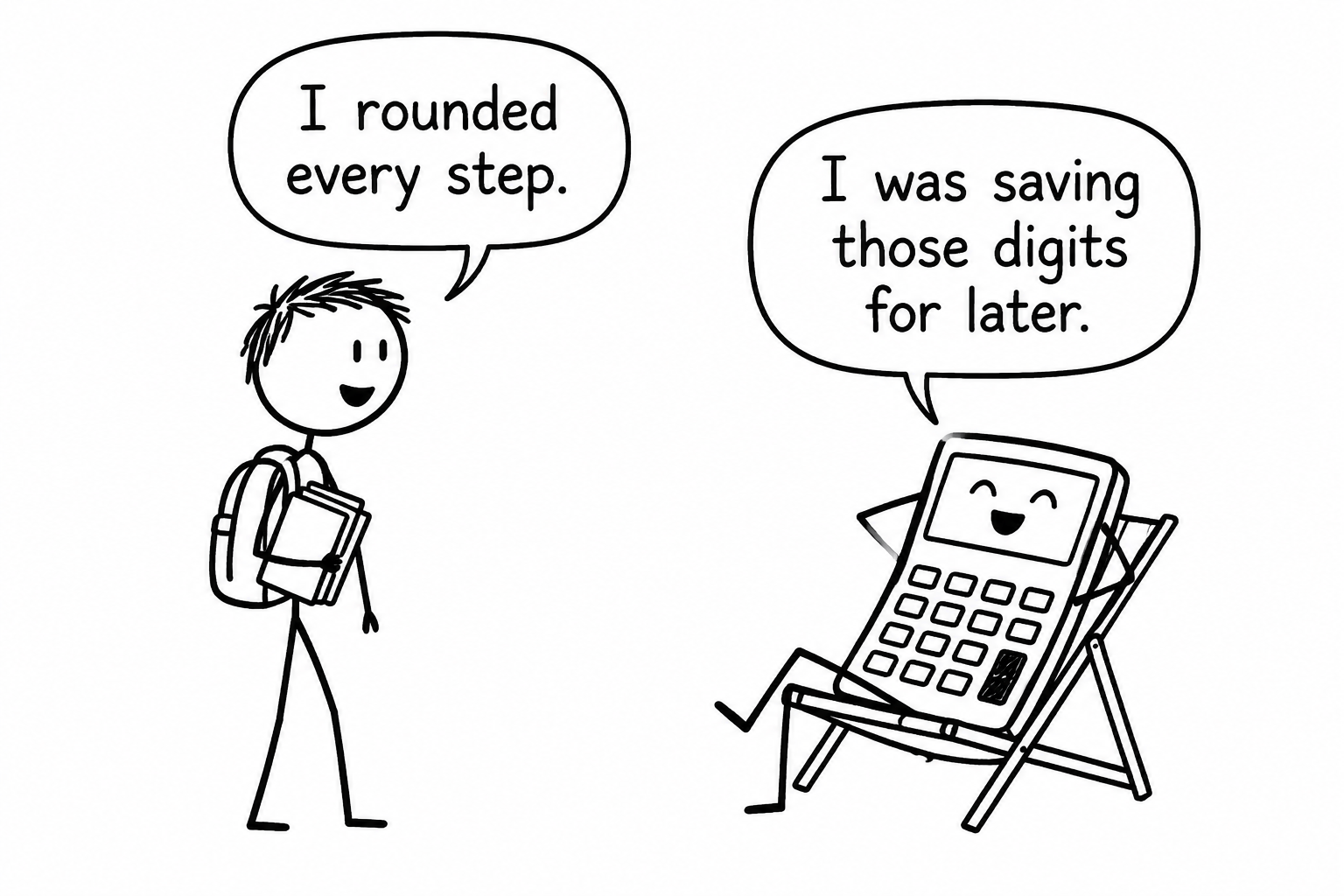
Rounding halfway through a calculation
The mistake: To calculate 23×9\frac{2}{3}\times 932×9, the student replaces 23\frac{2}{3}32 with 0.670.670.67 and gets 6.036.036.03.
Why it happens: A shorter decimal feels easier to handle, but it changes the value used in the next step.
The correct method: Keep the fraction or full calculator value:
23×9=6\frac{2}{3}\times 9=632×9=6Use the calculator’s answer function or enter the whole calculation together. Round the final result only, unless the question explicitly tells you otherwise. MathsGenie’s using a calculator lesson supports this habit.
 Stick-figure student and a relaxed calculator joke about saving digits for later
When the question asks for an estimate
Our student now notices an important exception: sometimes rounding before calculating is the task.
If asked to estimate by rounding each number to one significant figure:
19.7×4.120.493≈20×40.5=160\frac{19.7\times 4.12}{0.493} \approx \frac{20\times 4}{0.5} =1600.49319.7×4.12≈0.520×4=160This is intentional approximation, not premature rounding. Follow the accuracy instruction in the question rather than automatically rounding every number the same way.
The estimating lesson explains this distinction. It also prepares you for error intervals, where you work backwards from a rounded measurement to its possible original values.
Exam-style practice: find the decision
Try these without looking at the answers. Beside each response, identify the last retained digit and the deciding digit.
- Round 28.45628.45628.456 to two decimal places.
- Round 0.0070520.0070520.007052 to three significant figures.
- Round 6 8496\,8496849 to the nearest hundred.
- Round 9.9959.9959.995 to two decimal places.
- Calculate 56×9\frac{5}{6}\times 965×9, giving your answer to one decimal place.
Answers and checks
- 28.4628.4628.46: the deciding digit is 666, so the hundredths digit increases.
- 0.007050.007050.00705: count 777, 000, 555 as significant; the next digit is 222.
- 6 8006\,8006800: the tens digit is 444, so the hundreds digit stays unchanged.
- 10.0010.0010.00: the deciding digit is 555; carry through both retained decimal digits.
- 7.57.57.5: calculate with the fraction or full calculator value before rounding.
When checking, record the cause of an error rather than just copying the answer. Then attempt a fresh question without notes. That reveals whether the correction has become a method you can use independently.
Turn corrections into reliable marks
The student’s useful change was replacing “I know rounding” with a specific check at each decision. Knowing the rule is the start; applying it consistently takes targeted practice. Your turn: start fixing your rounding mistakes with MathsGenie’s Lessons and Question Bank, then check your answers against the worked solutions.