Common Mistakes with Fractions in GCSE Maths
Common mistakes with fractions in GCSE maths explained with clear worked examples, simple checks and exam-style practice to help you avoid losing easy marks.
Common mistakes with fractions in GCSE maths
The common mistakes with fractions in GCSE maths usually come from mixing up the rules: adding denominators, changing only half a fraction, or flipping the wrong fraction when dividing. The fix is to identify the operation first, write the appropriate method and check whether your answer makes sense.
Imagine a student looking through a marked practice paper. They recognise every topic, yet several fraction answers are wrong. Rather than starting the whole topic again, they identify exactly where each calculation went off course.
That is the approach here. Follow the errors, understand why they happen and replace each one with a dependable method. These core fraction skills matter on both foundation and higher tier.
Your fractions checklist
Before calculating, ask:
- Am I adding, subtracting, multiplying or dividing?
- Do I need equivalent fractions with a common denominator?
- Should I convert mixed numbers to improper fractions?
- Have I preserved the value of each fraction?
- Is my final answer simplified and sensible?
The numerator counts the parts; the denominator tells you their size. Keeping that distinction clear explains most of the rules below.
Adding and subtracting: the denominators are not totals
Mistake: adding the top and bottom numbers
Our imagined student adds the numerators and denominators separately, giving the incorrect answer 25\frac{2}{5}52 for 12+13\frac{1}{2}+\frac{1}{3}21+31.
Why it happens: adding whole numbers means combining their values, so combining every visible number feels natural. But halves and thirds are different-sized pieces.
Correct method: rename both fractions using the same-sized pieces, then add the numerators.
12+13=36+26=56\frac{1}{2}+\frac{1}{3}=\frac{3}{6}+\frac{2}{6}=\frac{5}{6}21+31=63+62=65First choose a common denominator, here 666. Then form equivalent fractions. Finally, add the numerators and keep the denominator unchanged.
The same principle applies to subtraction:
56−14=1012−312=712\frac{5}{6}-\frac{1}{4}=\frac{10}{12}-\frac{3}{12}=\frac{7}{12}65−41=1210−123=127Sense check: adding a positive amount to 12\frac{1}{2}21 must produce something larger than 12\frac{1}{2}21. The student's original answer fails that check immediately.
Mistake: changing only the denominator
After spotting the need for a common denominator, the student rewrites 23\frac{2}{3}32 as 212\frac{2}{12}122.
Why it happens: attention goes to making the bottom numbers match, while the numerator gets forgotten.
Correct method: multiply the numerator and denominator by the same number.
23=2×43×4=812\frac{2}{3}=\frac{2\times4}{3\times4}=\frac{8}{12}32=3×42×4=128You have changed the fraction's appearance, not its value. Multiplying only the denominator would make the fraction smaller.
If this step feels uncertain, MathsGenie's writing, simplifying and ordering fractions lesson revisits the underlying skills.
Multiplying: do not borrow the addition rule
Mistake: keeping the denominator unchanged
Next, the student multiplies 25\frac{2}{5}52 by 35\frac{3}{5}53 but keeps the denominator as 555, producing the incorrect answer 65\frac{6}{5}56.
Why it happens: they remember that matching denominators stay unchanged, but apply that addition rule to multiplication.
Correct method: multiply numerator by numerator and denominator by denominator.
25×35=2×35×5=625\frac{2}{5}\times\frac{3}{5}=\frac{2\times3}{5\times5}=\frac{6}{25}52×53=5×52×3=256There is no need to find a common denominator before multiplying fractions.
You can also simplify common factors before multiplying. This keeps the arithmetic manageable:
38×49=12×13=16\frac{3}{8}\times\frac{4}{9}=\frac{1}{2}\times\frac{1}{3}=\frac{1}{6}83×94=21×31=61Here, divide 333 and 999 by 333, then divide 444 and 888 by 444. You are cancelling common factors across a product, not deleting matching digits.
Sense check: multiplying a positive number by a positive fraction smaller than 111 makes it smaller.
Turn your first error into a focused practice session using MathsGenie's fractions Lessons and Question Bank, rather than repeating methods you already understand.
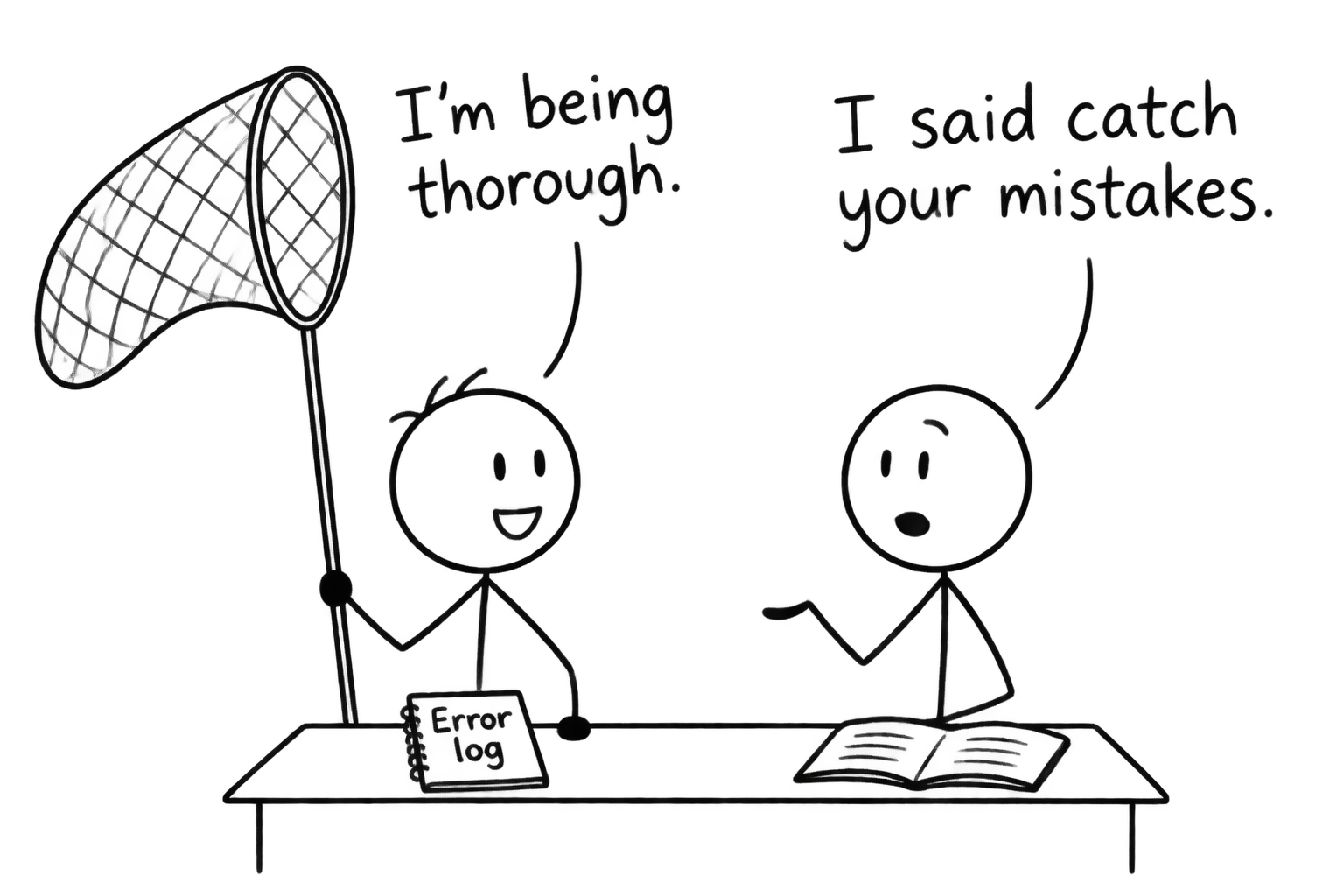 A student brings an enormous butterfly net to revision after being told to catch their mistakes.
Dividing: change the operation and the divisor
Mistake: flipping the first fraction
The student remembers that division involves a reciprocal, but flips the first fraction instead of the second.
Why it happens: a half-remembered instruction has replaced an understanding of which number is the divisor.
Correct method: keep the first fraction, change division to multiplication and take the reciprocal of the second fraction.
34÷25=34×52=158=178\frac{3}{4}\div\frac{2}{5}=\frac{3}{4}\times\frac{5}{2}=\frac{15}{8}=1\frac{7}{8}43÷52=43×25=815=187The divisor is 25\frac{2}{5}52, so that is the fraction you invert. Taking a reciprocal means swapping its numerator and denominator.
Sense check: division does not always make an answer smaller. Dividing a positive number by a positive fraction below 111 makes it larger, because you are counting smaller groups.
For another explanation of the four operations, use the fractions revision guide.
Mixed numbers: account for the whole amount
Mistake: treating a mixed number as multiplication
The student converts 2132\frac{1}{3}231 to 23\frac{2}{3}32. They have multiplied the whole number by the numerator and lost most of the original value.
Why it happens: the notation places a whole number beside a fraction, but a mixed number represents their sum.
Correct method: multiply the whole number by the denominator, add the numerator and keep the denominator.
213=2×3+13=732\frac{1}{3}=\frac{2\times3+1}{3}=\frac{7}{3}231=32×3+1=37Converting first also gives a reliable route through mixed-number subtraction:
213−134=73−74=2812−2112=7122\frac{1}{3}-1\frac{3}{4}=\frac{7}{3}-\frac{7}{4}=\frac{28}{12}-\frac{21}{12}=\frac{7}{12}231−143=37−47=1228−1221=127Sense check: an improper fraction representing 2132\frac{1}{3}231 must still have a value between 222 and 333.
Simplifying: preserve the fraction's value
Mistake: subtracting instead of dividing
Finally, the student tries simplifying 68\frac{6}{8}86 by subtracting 222 from both numbers, obtaining 46\frac{4}{6}64.
Why it happens: both numbers become smaller, which looks like simplification. But smaller numbers do not automatically form an equivalent fraction.
Correct method: divide the numerator and denominator by a common factor.
68=6÷28÷2=34\frac{6}{8}=\frac{6\div2}{8\div2}=\frac{3}{4}86=8÷26÷2=43Continue until the numerator and denominator share no common factor greater than 111. If the question requests simplest form, make this your final step.
Use the simplifying fractions practice booklet if equivalent fractions are the recurring problem.
Exam-style practice: find your remaining mistake
Try these original questions without a calculator. Show your working and give each answer in simplest form.
- A: Calculate 34+23\frac{3}{4}+\frac{2}{3}43+32.
- B: Calculate 710−14\frac{7}{10}-\frac{1}{4}107−41.
- C: Calculate 56×910\frac{5}{6}\times\frac{9}{10}65×109.
- D: Calculate 35÷910\frac{3}{5}\div\frac{9}{10}53÷109.
- E: Calculate 123−341\frac{2}{3}-\frac{3}{4}132−43.
Answers and method checks
- A: 912+812=1712\frac{9}{12}+\frac{8}{12}=\frac{17}{12}129+128=1217.
- B: 1420−520=920\frac{14}{20}-\frac{5}{20}=\frac{9}{20}2014−205=209.
- C: 4560=34\frac{45}{60}=\frac{3}{4}6045=43.
- D: 35×109=3045=23\frac{3}{5}\times\frac{10}{9}=\frac{30}{45}=\frac{2}{3}53×910=4530=32.
- E: 53−34=2012−912=1112\frac{5}{3}-\frac{3}{4}=\frac{20}{12}-\frac{9}{12}=\frac{11}{12}35−43=1220−129=1211.
For every incorrect answer, identify the first wrong line. Write the rule you needed, redo the question without looking and attempt a similar question later. That turns fractions mistakes into specific revision targets. The fractions exam-style booklet provides further practice.
Turn corrected mistakes into reliable methods
Our imagined student now has something more useful than a page of corrections: a clear reason for each error. Your next step is to practise choosing the right method without a worked solution beside you. Start with your weakest operation in MathsGenie's fractions Lessons and Question Bank.