

Common Mistakes with Density in GCSE Maths
Common mistakes with density in GCSE Maths explained clearly, with worked examples, unit conversions and practice questions to help you avoid losing marks.
Common mistakes with density in GCSE Maths
You recognise the question, remember the formula and reach for your calculator. Yet the answer still comes back wrong. The common mistakes with density in GCSE Maths usually involve dividing the wrong way round, mixing units or using the wrong volume. Fixing those decisions matters more than calculating faster.
Imagine a student reviewing a density question they got wrong. Their calculator work is accurate. The problem happened before they pressed a button: they used kilograms where the answer required grams.
That is useful information. Rather than revising everything again, they can identify the exact error and practise correcting it. This guide follows that approach, with worked examples and questions you can try yourself.
Your density checklist
Before calculating, ask:
- Am I finding density, mass or volume?
- Have I written the appropriate formula?
- Do the units match the required answer?
- Have I calculated volume rather than area?
- Have I kept full accuracy until the final answer?
Density describes mass per unit volume. The three useful forms are:
density=massvolume\text{density} = \frac{\text{mass}}{\text{volume}}density=volumemass mass=density×volume\text{mass} = \text{density} \times \text{volume}mass=density×volume volume=massdensity\text{volume} = \frac{\text{mass}}{\text{density}}volume=densitymassIf you need to revisit the explanation, the MathsGenie Speed and Density lesson brings the topic together.
Common mistakes and how to correct them
Dividing the wrong way round
Our imagined student sees two numbers and divides the larger by the smaller. This sometimes produces the correct answer, which makes the habit difficult to notice. But number size does not determine the operation. The quantity you need does.
The question: A material has mass 540 g540\text{ g}540 g and density 2.7 g/cm32.7\text{ g/cm}^32.7 g/cm3. Find its volume.
The mistake: Multiplying the two values because the student remembers that density questions involve multiplication.
The correction: Write the formula for the missing quantity first:
volume=massdensity\text{volume} = \frac{\text{mass}}{\text{density}}volume=densitymassSubstitute, then calculate:
V=5402.7=200 cm3V = \frac{540}{2.7} = 200\text{ cm}^3V=2.7540=200 cm3Finally, check backwards. Multiplying 200 cm3200\text{ cm}^3200 cm3 by 2.7 g/cm32.7\text{ g/cm}^32.7 g/cm3 gives the original mass, 540 g540\text{ g}540 g.
The repeatable method is simple: identify the unknown, choose the formula, match the units, substitute and check.
Practise that same sequence through MathsGenie's Speed and Density Lessons and Question Bank, so you can focus on correcting your method rather than finding suitable questions.
Mixing kilograms and grams
The next error is quieter. The formula is correct, but the units do not belong together.
The question: An object has mass 1.8 kg1.8\text{ kg}1.8 kg and volume 600 cm3600\text{ cm}^3600 cm3. Find its density in g/cm3\text{g/cm}^3g/cm3.
The mistake: Calculating 1.8÷6001.8 \div 6001.8÷600 and labelling the result g/cm3\text{g/cm}^3g/cm3.
That calculation uses kilograms, not grams. Writing a different unit afterwards does not convert the answer.
The correction: Read the requested unit before substituting. Convert the mass:
1.8 kg=1800 g1.8\text{ kg} = 1800\text{ g}1.8 kg=1800 gThen calculate:
density=1800600=3 g/cm3\text{density} = \frac{1800}{600} = 3\text{ g/cm}^3density=6001800=3 g/cm3The word “per” helps here. Grams per cubic centimetre means grams divided by cubic centimetres. Your numerator and denominator should match that description.
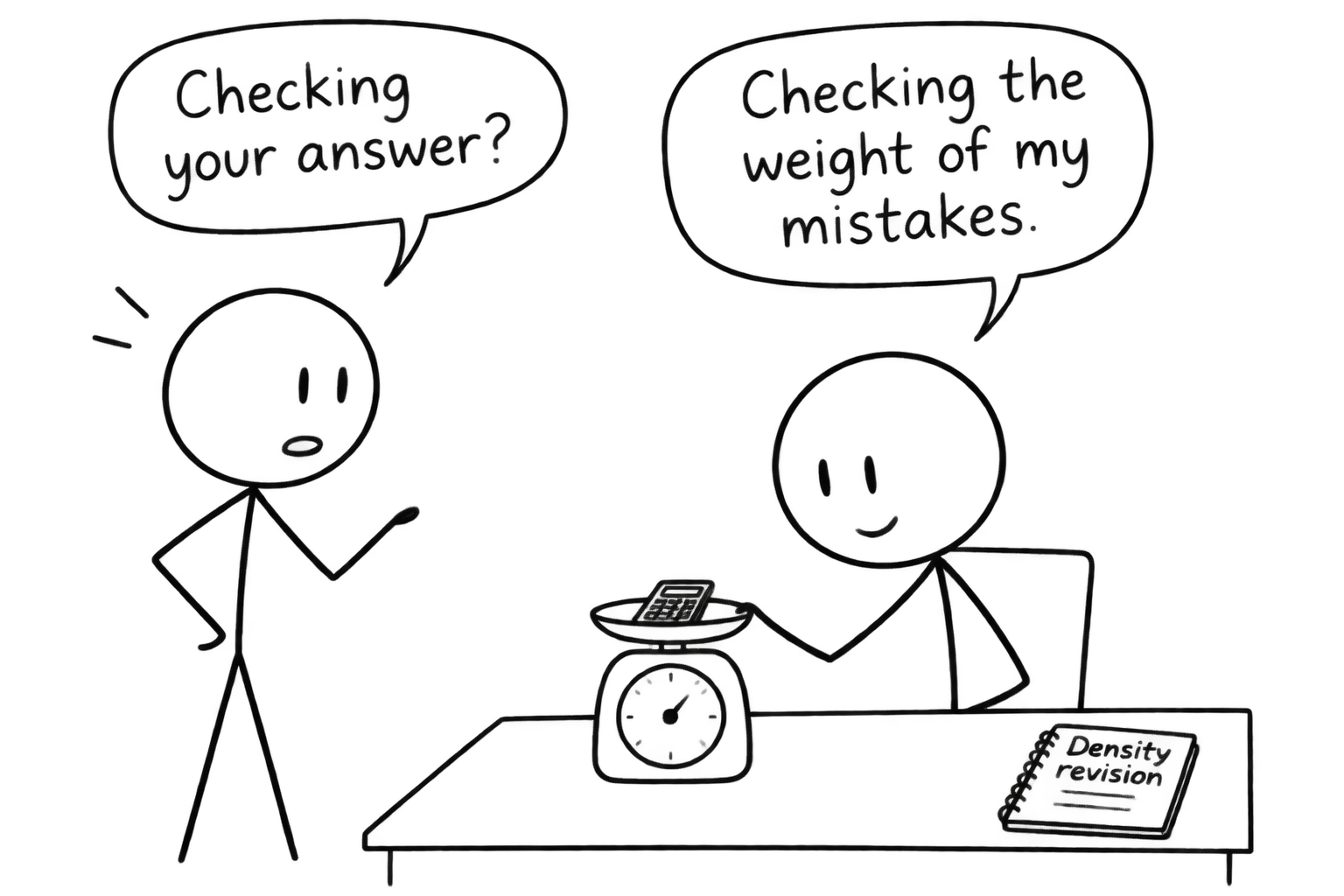 A hand-drawn stick-figure comic about a student weighing their calculator to check the weight of their density mistakes.
Using area instead of volume
Sometimes the question gives dimensions rather than volume. Our student multiplies two lengths, gets a convincing number and moves straight to density.
The missing third dimension changes everything.
The question: A solid cuboid measures 8 cm8\text{ cm}8 cm by 5 cm5\text{ cm}5 cm by 3 cm3\text{ cm}3 cm and has mass 324 g324\text{ g}324 g. Find its density.
The mistake: Using 8×5=408 \times 5 = 408×5=40 as the volume. That is the area of one face, measured in cm2\text{cm}^2cm2.
The correction: Calculate the cuboid's volume using all three dimensions:
V=8×5×3=120 cm3V = 8 \times 5 \times 3 = 120\text{ cm}^3V=8×5×3=120 cm3Now use the density formula:
density=324120=2.7 g/cm3\text{density} = \frac{324}{120} = 2.7\text{ g/cm}^3density=120324=2.7 g/cm3For other prisms, find the cross-sectional area and multiply by the prism's length. If that first stage is causing trouble, revisit volume of a prism before tackling more density questions.
Treating cubic conversions like length conversions
This density mistake often survives even when ordinary conversions feel straightforward.
Because 1 m=100 cm1\text{ m} = 100\text{ cm}1 m=100 cm, a student might assume the same conversion factor applies to cubic units. But a cube has three dimensions, and each dimension changes by that factor.
1 m3=1003 cm3=1,000,000 cm31\text{ m}^3 = 100^3\text{ cm}^3 = 1{,}000{,}000\text{ cm}^31 m3=1003 cm3=1,000,000 cm3The question: Convert 2.7 g/cm32.7\text{ g/cm}^32.7 g/cm3 into kg/m3\text{kg/m}^3kg/m3.
The mistake: Converting grams to kilograms but ignoring the volume unit underneath.
The correction: Think about a whole cubic metre. It contains 1,000,000 cm31{,}000{,}000\text{ cm}^31,000,000 cm3, so its mass is:
2.7×1,000,000=2,700,000 g2.7 \times 1{,}000{,}000 = 2{,}700{,}000\text{ g}2.7×1,000,000=2,700,000 gConvert that mass into kilograms:
2,700,000 g=2700 kg2{,}700{,}000\text{ g} = 2700\text{ kg}2,700,000 g=2700 kgTherefore:
2.7 g/cm3=2700 kg/m32.7\text{ g/cm}^3 = 2700\text{ kg/m}^32.7 g/cm3=2700 kg/m3Explaining what happens to a whole cubic metre is safer than guessing whether to multiply or divide.
Rounding before the calculation is finished
A final answer may need rounding. An intermediate value usually does not.
The question: A sample has mass 50 g50\text{ g}50 g and volume 7 cm37\text{ cm}^37 cm3. Find the mass of 12 cm312\text{ cm}^312 cm3 of the same material, to three significant figures.
The mistake: Rounding the density to 7.1 g/cm37.1\text{ g/cm}^37.1 g/cm3 first. That gives a mass of 85.2 g85.2\text{ g}85.2 g.
The correction: Keep the density as an exact fraction during the calculation:
mass=507×12=6007 g\text{mass} = \frac{50}{7} \times 12 = \frac{600}{7}\text{ g}mass=750×12=7600 gOnly round the final result:
mass=85.7 gto three significant figures\text{mass} = 85.7\text{ g}\quad\text{to three significant figures}mass=85.7 gto three significant figuresKeep the full calculator value, or use a fraction, until you reach the answer the question requests.
Exam-style density practice
Try these without looking at the answers. Write the formula and any conversion before calculating.
- Find density: A block has mass 960 g960\text{ g}960 g and volume 120 cm3120\text{ cm}^3120 cm3. Find its density in g/cm3\text{g/cm}^3g/cm3.
- Find mass: A liquid has density 0.8 g/cm30.8\text{ g/cm}^30.8 g/cm3. Find the mass of 350 cm3350\text{ cm}^3350 cm3 in grams.
- Find volume: An object has mass 2.4 kg2.4\text{ kg}2.4 kg and density 3 g/cm33\text{ g/cm}^33 g/cm3. Find its volume in cm3\text{cm}^3cm3.
Check your answers
For the block:
density=960120=8 g/cm3\text{density} = \frac{960}{120} = 8\text{ g/cm}^3density=120960=8 g/cm3For the liquid:
mass=0.8×350=280 g\text{mass} = 0.8 \times 350 = 280\text{ g}mass=0.8×350=280 gFor the object, first convert 2.4 kg2.4\text{ kg}2.4 kg into 2400 g2400\text{ g}2400 g:
volume=24003=800 cm3\text{volume} = \frac{2400}{3} = 800\text{ cm}^3volume=32400=800 cm3For another targeted question, try this density and volume question. The Speed and Density exam booklet offers further practice.
When checking, label the cause of each error: formula, units, volume or rounding. Then redo the question without copying. A corrected answer shows what went wrong; a successful second attempt checks whether your method has changed.
Turn corrections into a reliable method
Our imagined student no longer treats every wrong density answer as the same problem. You can make that distinction too: knowing the formula is the starting point, while choosing it correctly and checking units takes deliberate practice. Start correcting your density mistakes with MathsGenie's Lessons and Question Bank, using the checklist on every attempt.















