Common Mistakes with Straight Line Graphs in GCSE Maths
Common mistakes with straight line graphs in GCSE Maths explained clearly. Fix gradients, intercepts and plotting errors with worked examples and practice.
A straight line can still be the wrong line
The common mistakes with straight line graphs in GCSE Maths usually involve axis scales, negative numbers, gradients or intercepts. The fix is a repeatable routine: check the axes, calculate carefully, plot accurately and test whether your line fits its equation.
Imagine a student reviewing a marked practice paper. Their graph looks tidy. They used a ruler. Yet the line crosses the wrong place, and their gradient calculation has the wrong sign. This is a hypothetical situation, but the lesson is useful: neatness cannot replace checking.
Let’s follow that student through the errors, showing what went wrong and how to repair each one.
Your straight line graphs checklist
Before drawing or interpreting a line:
- Read the scale on each axis separately.
- Remember that coordinates are written as (x,y)(x,y)(x,y).
- Use brackets when substituting negative numbers.
- Calculate gradient as change in yyy divided by change in xxx.
- Identify the intercept where the line crosses the yyy-axis.
- Check a point against the equation before finishing.
MathsGenie’s Drawing Linear Graphs revision guide provides a matching lesson for the plotting skills behind these checks.
Mistake: counting squares instead of reading scales
Our student plots (3,4)(3,4)(3,4) by moving three squares across and four squares up. That only works when each square represents one unit on both axes.
Suppose each horizontal square represents two units, while each vertical square represents one unit.
The correct method
To plot (4,3)(4,3)(4,3):
- Find 444 on the horizontal axis, two squares from the origin.
- Find 333 on the vertical axis, three squares above the origin.
- Mark their intersection.
Coordinates describe values, not numbers of squares. Write down what one small square represents on each axis before plotting anything. The two scales do not have to match.
Mistake: losing a negative sign when plotting
The next error appears in a table of values for:
y=2x−3y=2x-3y=2x−3At x=−2x=-2x=−2, our student writes y=1y=1y=1. The negative input has effectively become positive during substitution.
This happens because substitution feels simple enough to do mentally. Brackets make the sign visible.
The correct method
Substitute first:
y=2(−2)−3y=2(-2)-3y=2(−2)−3Multiply, then subtract:
y=−4−3=−7y=-4-3=-7y=−4−3=−7The point is therefore (−2,−7)(-2,-7)(−2,−7).
Calculate several points before drawing the line. If one point sits away from the others, recheck its calculation rather than bending the graph to include it. For a linear equation, correctly calculated points lie on one straight line.
For more plotting practice, the Drawing Linear Graphs exam booklet offers a focused set of questions.
Mistake: dividing the wrong way round for gradient
Our student chooses two points, (1,2)(1,2)(1,2) and (5,10)(5,10)(5,10), but divides the horizontal change by the vertical change.
The result describes the wrong ratio. Gradient measures how much yyy changes for each unit increase in xxx.
The correct method
Use:
m=y2−y1x2−x1m=\frac{y_2-y_1}{x_2-x_1}m=x2−x1y2−y1For these points:
m=10−25−1=84=2m=\frac{10-2}{5-1}=\frac{8}{4}=2m=5−110−2=48=2Subtract the coordinates in the same order on the top and bottom. Reversing both orders gives the same gradient; reversing only one changes its sign incorrectly.
On a drawn graph, choose two clear points that are reasonably far apart. Read their coordinates using the axis scales, not just the lengths of the triangle’s sides in squares.
A useful sense check follows: a line rising from left to right has positive gradient. A falling line has negative gradient.
Turn your checks into a routine with MathsGenie’s Lessons and Question Bank practice, focusing on the straight line graphs mistakes you have identified.
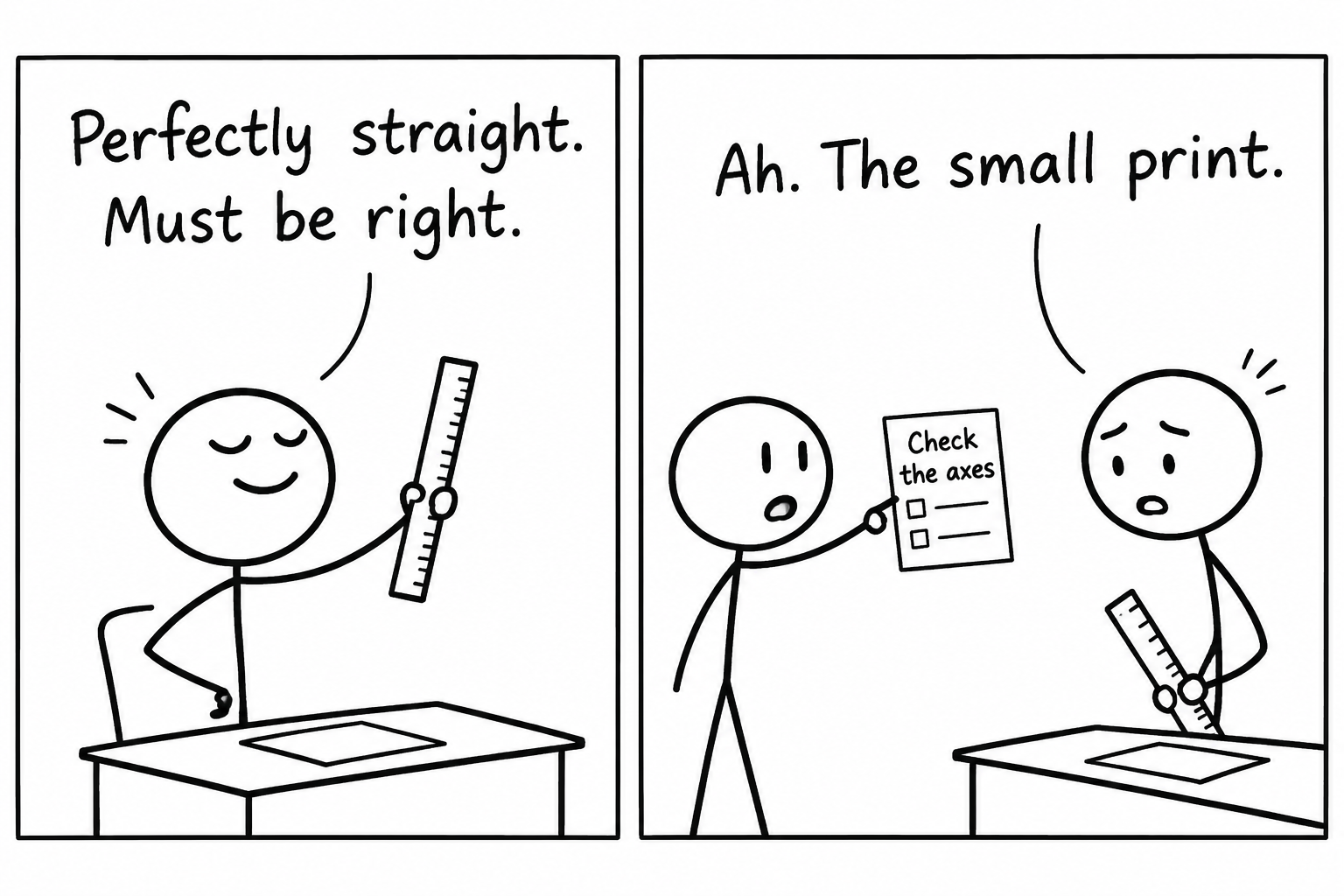 A stick figure student discovers that a perfectly straight graph still needs its axes checked
Mistake: confusing the gradient and intercept
Now our student reads:
y=3x−2y=3x-2y=3x−2They correctly recognise the familiar form but swap the jobs of the two numbers.
In:
y=mx+cy=mx+cy=mx+cmmm is the gradient, while ccc is the yyy-intercept.
The correct method
For y=3x−2y=3x-2y=3x−2:
- The gradient is 333.
- The yyy-intercept is −2-2−2.
- The line crosses the yyy-axis at (0,−2)(0,-2)(0,−2).
Start at (0,−2)(0,-2)(0,−2). A gradient of 333 means moving one unit right and three units up reaches another point, (1,1)(1,1)(1,1).
The intercept is not where the line crosses the horizontal axis. At the yyy-axis, x=0x=0x=0, which explains why substituting x=0x=0x=0 leaves y=cy=cy=c.
Mistake: reading an equation before rearranging it
The familiar pattern becomes less obvious when the equation is written differently:
2y=6x+82y=6x+82y=6x+8Our student reads the gradient as 666 and the intercept as 888. But the left-hand side is 2y2y2y, not yyy.
The correct method
Divide every term by 222:
y=3x+4y=3x+4y=3x+4Now the gradient is 333 and the yyy-intercept is 444.
Do not divide only the term containing xxx. The constant must also change. MathsGenie’s Equation of a Line worked solutions provide another way to compare your working with a complete method.
Common mistakes during the final check
Our hypothetical student now has better calculations. The last task is checking the finished answer.
Stopping the line at the plotted points. Unless the question specifies a restricted domain, extend the straight line across the relevant graph area. Your points locate the line; they are not automatically its endpoints.
Assuming every line fits the same pattern. The equation y=4y=4y=4 describes a horizontal line with gradient 000. The equation x=4x=4x=4 describes a vertical line, whose gradient is undefined.
Trusting appearance alone. A line can look plausible but fail its equation. Substitute the coordinates of a plotted point to check it.
Exam-style practice: find and fix the error
Attempt these before reading the answers.
- For y=−2x+5y=-2x+5y=−2x+5, find yyy when x=−3x=-3x=−3.
- Find the gradient through (2,7)(2,7)(2,7) and (6,−1)(6,-1)(6,−1).
- State the gradient and yyy-intercept of 3y=6x−93y=6x-93y=6x−9.
- A student says x=−2x=-2x=−2 has gradient −2-2−2. Explain the error.
Answers and checks
For the substitution:
y=−2(−3)+5=6+5=11y=-2(-3)+5=6+5=11y=−2(−3)+5=6+5=11For the gradient:
m=−1−76−2=−84=−2m=\frac{-1-7}{6-2}=\frac{-8}{4}=-2m=6−2−1−7=4−8=−2For the equation, divide every term by 333 to obtain y=2x−3y=2x-3y=2x−3. The gradient is 222 and the yyy-intercept is −3-3−3.
Finally, x=−2x=-2x=−2 is a vertical line. Its gradient is undefined; −2-2−2 gives its horizontal position.
Turn corrections into reliable habits
In our student’s next attempt, the meaningful change is not a neater ruler line. It is checking the scale, preserving signs and testing the answer. Knowing those checks is useful; remembering them without a prompt takes practice.
Your turn: start with Lessons, then use Question Bank practice to tackle the straight line graph errors you keep making.