Common Mistakes with Recurring Decimals in GCSE Maths
Common mistakes with recurring decimals in GCSE maths explained through worked examples. Fix notation, subtraction and simplifying errors, then practise.
A recurring-decimal question can feel finished when you have a fraction on the page. Then the mark scheme reveals that you repeated the wrong digits, subtracted mismatched decimals or stopped before simplifying. The common mistakes with recurring decimals in GCSE maths usually come down to one principle: identify the repeating block, then make identical decimal tails before subtracting.
Imagine a student checking a practice paper. Their algebra looks tidy, but their answers keep missing the target. Following their corrections gives you a useful way to check your own working, one decision at a time.
Your recurring-decimal checklist
Before starting a conversion:
- Write enough digits to show exactly what repeats.
- Separate any non-recurring digits from the repeating block.
- Choose powers of 101010 that produce identical decimal tails.
- Subtract both sides of your equations consistently.
- Simplify the fraction and check its size.
Converting recurring decimals into fractions is higher-tier content in the AQA GCSE specification. If ordinary decimal conversions still feel uncertain, the fractions, decimals and percentages lesson provides useful groundwork.
Common mistakes with recurring decimals in GCSE maths
Mistake: reading the dots incorrectly
Our hypothetical student's first error happens before any algebra. They read 0.12˙0.1\dot{2}0.12˙ as though the whole two-digit block repeats.
The dot applies only to the digit beneath it:
0.12˙=0.122222…0.1\dot{2}=0.122222\ldots0.12˙=0.122222…With dots over both ends of a block, everything between them repeats:
0.1˙2˙=0.121212…0.\dot{1}\dot{2}=0.121212\ldots0.1˙2˙=0.121212…For a longer block:
0.1˙23˙=0.123123123…0.\dot{1}2\dot{3}=0.123123123\ldots0.1˙23˙=0.123123123…Why it happens: the written decimals look similar, especially when copied quickly.
The correction: expand the decimal before choosing a method. That small line of working prevents you from solving the wrong question perfectly.
Mistake: treating a recurring decimal as terminating
Next, the student writes:
0.3˙=3100.\dot{3}=\frac{3}{10}0.3˙=103But 310=0.3\frac{3}{10}=0.3103=0.3, which stops. The recurring decimal continues indefinitely.
To find its exact fraction, let:
x=0.3333…x=0.3333\ldotsx=0.3333…Multiply by 101010:
10x=3.3333…10x=3.3333\ldots10x=3.3333…Subtract the original equation:
10x−x=3.3333…−0.3333…10x-x=3.3333\ldots-0.3333\ldots10x−x=3.3333…−0.3333…The matching decimal tails cancel, leaving:
9x=39x=39x=3Therefore:
x=39=13x=\frac{3}{9}=\frac{1}{3}x=93=31Why it happens: the familiar rule for terminating decimals gets applied to a different situation.
The correction: preserve the recurring notation. Replacing it with a finite string changes the number, however many digits you write.
Mistake: multiplying by the wrong power of ten
The student now understands subtraction, but tries multiplying every recurring decimal by 101010.
For 0.27‾0.\overline{27}0.27, the repeating block contains two digits. Multiplying by 101010 produces a different decimal tail:
x=0.272727…x=0.272727\ldotsx=0.272727… 10x=2.727272…10x=2.727272\ldots10x=2.727272…Those fractional parts do not match. Instead, multiply by 100100100:
100x=27.272727…100x=27.272727\ldots100x=27.272727…Now subtract:
100x−x=27100x-x=27100x−x=27 99x=2799x=2799x=27 x=2799=311x=\frac{27}{99}=\frac{3}{11}x=9927=113Why it happens: remembering “multiply and subtract” is easier than remembering why it works.
The correction: compare the digits after the decimal points. They must match throughout before the recurring parts can cancel.
Use the recurring decimals lesson and Question Bank to practise choosing multipliers until you can explain why the decimal tails match.
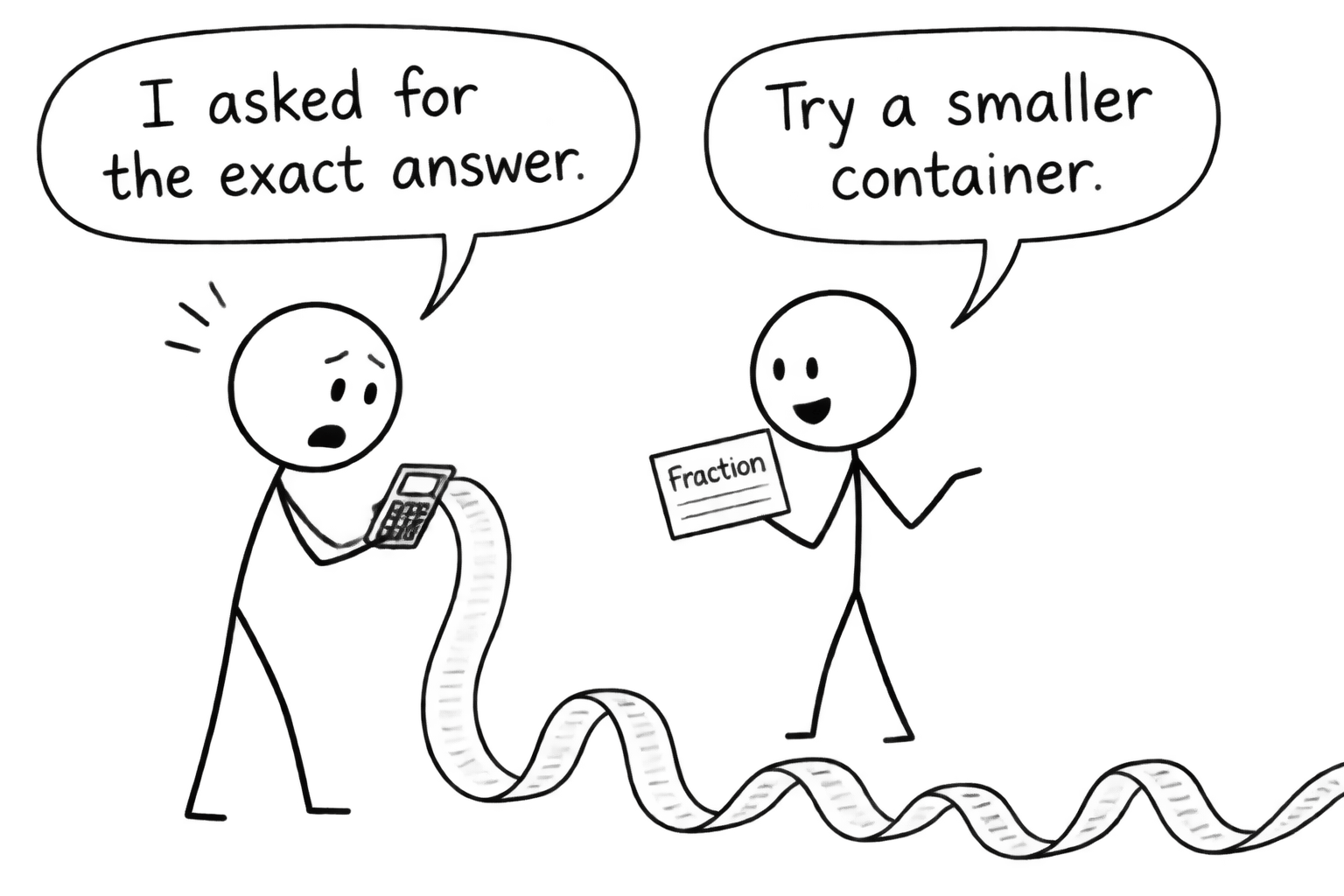 Stick-figure students compare an endlessly printing calculator with a small card labelled Fraction.
Mistake: ignoring the non-recurring part
The next question is 0.16‾0.1\overline{6}0.16. The student recognises the recurring digit but forgets that the first decimal digit does not repeat.
Writing 1699\frac{16}{99}9916 would describe 0.161616…0.161616\ldots0.161616…, a different number.
Start with:
x=0.166666…x=0.166666\ldotsx=0.166666…Multiply by 101010 to move past the non-recurring digit:
10x=1.666666…10x=1.666666\ldots10x=1.666666…Then multiply the original equation by 100100100:
100x=16.666666…100x=16.666666\ldots100x=16.666666…These tails match, so subtract:
100x−10x=16.666666…−1.666666…100x-10x=16.666666\ldots-1.666666\ldots100x−10x=16.666666…−1.666666… 90x=1590x=1590x=15 x=1590=16x=\frac{15}{90}=\frac{1}{6}x=9015=61Why it happens: the shortcut of putting the visible digits over nines is used without checking where repetition begins.
The correction: move past the non-recurring digits first, then move through one complete repeating block. Subtract those two equations.
Mistake: subtracting different equations on each side
Even with the correct multipliers, the student writes 99x=1599x=1599x=15 in the previous example.
The right-hand subtraction is correct, but the left-hand subtraction should be:
100x−10x=90x100x-10x=90x100x−10x=90xIt would be 99x99x99x only if they were subtracting xxx from 100x100x100x.
Why it happens: a familiar denominator gets written automatically.
The correction: keep the two equations vertically aligned and write the subtraction explicitly. Check the algebra separately from the decimal arithmetic.
Mistake: leaving the fraction unsimplified
The student reaches 2799\frac{27}{99}9927 and stops. It is equivalent to the recurring decimal, but it is not in simplest form.
Divide numerator and denominator by their common factor:
2799=27÷999÷9=311\frac{27}{99}=\frac{27\div9}{99\div9}=\frac{3}{11}9927=99÷927÷9=113Why it happens: cancelling the recurring digits feels like the finish line.
The correction: reread the instruction. If it asks for simplest form, simplifying is part of the task. The worked recurring-decimal solutions let you compare your complete argument with a model method.
Exam-style practice: find and fix the error
Try these original questions without looking at the answers. Show the equations you subtract, rather than writing only a fraction.
- Convert 0.45‾0.\overline{45}0.45 into a fraction in simplest form.
- Convert 0.27‾0.2\overline{7}0.27 into a fraction in simplest form.
- A student claims 0.18‾=181000.\overline{18}=\frac{18}{100}0.18=10018. Explain their error and find the correct fraction.
Answers and checks
For the first question:
100x−x=45,99x=45,x=511100x-x=45,\qquad 99x=45,\qquad x=\frac{5}{11}100x−x=45,99x=45,x=115For the second question, use matching tails after moving past the non-recurring digit:
100x−10x=27.777…−2.777…=25100x-10x=27.777\ldots-2.777\ldots=25100x−10x=27.777…−2.777…=25 90x=25,x=51890x=25,\qquad x=\frac{5}{18}90x=25,x=185For the third question, 18100=0.18\frac{18}{100}=0.1810018=0.18 terminates. The correct conversion is:
100x−x=18,x=1899=211100x-x=18,\qquad x=\frac{18}{99}=\frac{2}{11}100x−x=18,x=9918=112For another independent attempt, the recurring-decimal practice booklet provides further questions.
Turn corrections into reliable working
Our hypothetical student now has a specific check for each error: read the dots, match the tails, subtract consistently and simplify. Your next step is to make those checks part of your working when the question looks unfamiliar. Start with the recurring decimals Lessons and Question Bank, revisit the lesson where your method breaks down, and practise applying the correction independently.