

Common Mistakes with Rearranging Formulae in GCSE Maths
Common mistakes with rearranging formulae in GCSE Maths, explained through clear worked examples, correction methods and focused exam practice. Clear fixes.
A student can understand every symbol in a formula and still lose marks while rearranging it. The trouble is rarely one enormous misunderstanding. It is usually a small sign change, an incomplete division or a square root applied too soon.
The best way to avoid the common mistakes with rearranging formulae in GCSE Maths is to stop thinking of letters as objects that jump across an equals sign. Instead, treat the formula as a balanced equation. Whatever operation you perform on one side must also be performed on the other.
This guide follows a hypothetical student correcting the errors that tend to cost marks. For each one, you will see why it happens, the correct method and a way to check the result.
A reliable method for rearranging formulae
Before looking at individual errors, use this checklist whenever a question asks you to make a letter the subject:
- Identify the letter that must be isolated.
- Notice every operation attached to that letter.
- Undo those operations in reverse order.
- Perform the same operation on both sides.
- Simplify only when it is safe to do so.
- Check by rearranging backwards or substituting simple values.
The subject should finish alone on one side of the equals sign. For example, in y=3x+7y=3x+7y=3x+7, the subject is yyy. If the question asks you to make xxx the subject, your final answer must begin x=x=x=.
The process closely resembles solving equations. If that foundation needs attention, revise solving equations before attempting the more complicated examples below.
Once this checklist feels familiar, use the Changing the Subject of a Formula lesson and its Question Bank practice to turn the method into a repeatable exam habit.
Mistake: changing sides without changing the operation
Suppose the student is asked to make xxx the subject of
y=5x−8. y=5x-8. y=5x−8.A common incorrect answer is
x=y−85. x=\frac{y-8}{5}. x=5y−8.Why it happens
The student sees −8-8−8 and imagines moving it to the other side. That language encourages guesswork. The real question is: what operation will undo subtracting 888?
Correct method
Add 888 to both sides:
y+8=5x. y+8=5x. y+8=5x.Then divide both sides by 555:
y+85=x. \frac{y+8}{5}=x. 5y+8=x.Write the requested subject first:
x=y+85. x=\frac{y+8}{5}. x=5y+8.The sign changes because an inverse operation has been applied, not because the term crossed an invisible border.
Mistake: dividing only one term
Now the student tries to make aaa the subject of
p=ab+ac. p=ab+ac. p=ab+ac.An incorrect attempt might be
a=pb+c. a=\frac{p}{b}+c. a=bp+c.Why it happens
The student divides ababab by bbb but forgets that the second term also contains aaa. Dividing or cancelling part of a sum is not valid unless the division applies to the entire expression.
Correct method
Both terms on the right contain aaa, so factorise first:
p=a(b+c). p=a(b+c). p=a(b+c).Now divide both sides by the whole bracket:
a=pb+c. a=\frac{p}{b+c}. a=b+cp.This is why rearranging formulae sometimes depends on earlier algebra. The expanding and factorising lesson is useful if spotting a common factor still feels uncertain.
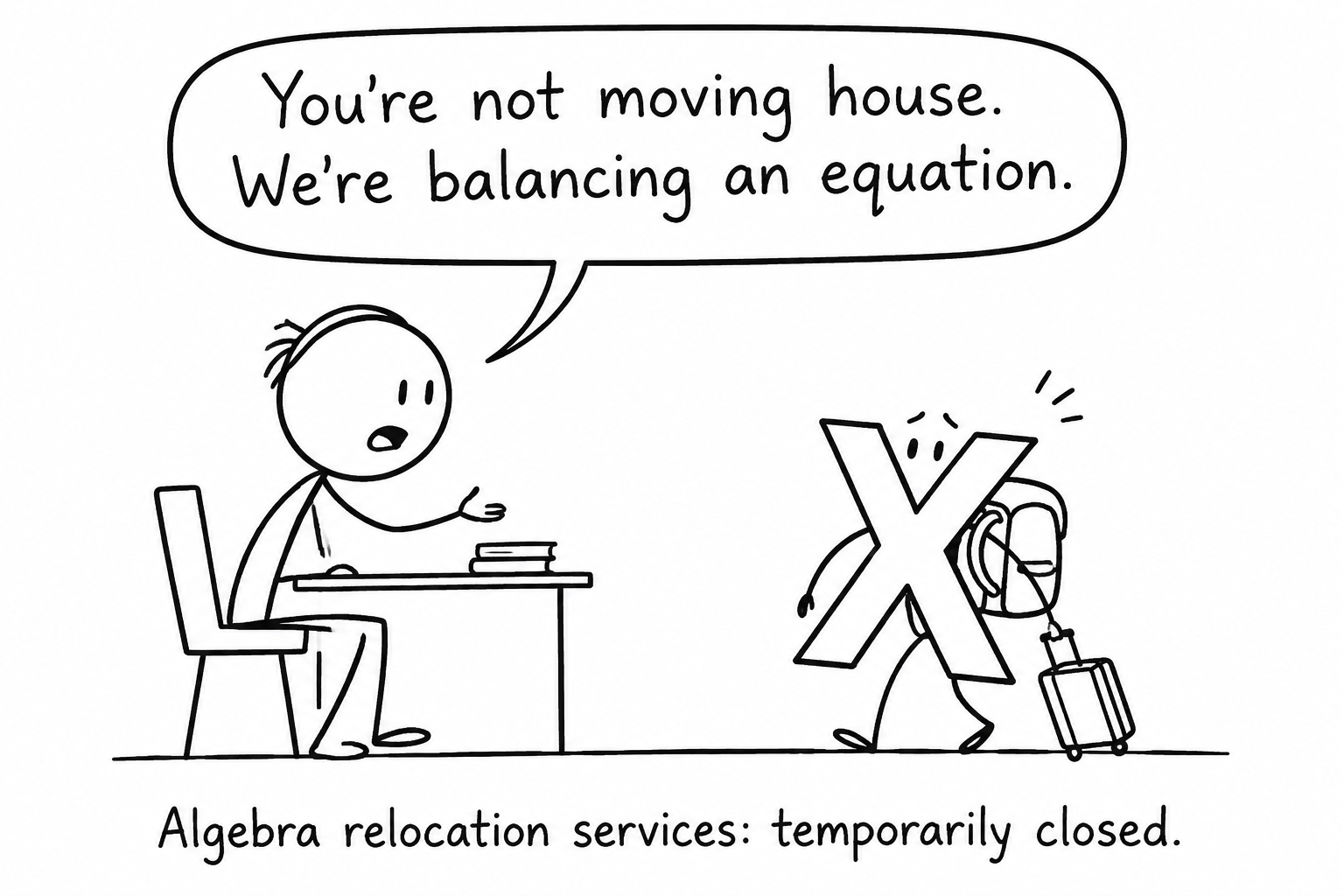 A stick-figure student explains to a walking letter x that algebra is about balancing, not moving house
Mistake: forgetting that a fraction has a whole numerator
Consider
q=x−43. q=\frac{x-4}{3}. q=3x−4.The student writes
x=3q−4. x=3q-4. x=3q−4.Why it happens
They multiply the fraction by 333 correctly, but then keep the subtraction unchanged when isolating xxx.
Correct method
Multiply both sides by 333:
3q=x−4. 3q=x-4. 3q=x−4.Add 444 to both sides:
3q+4=x. 3q+4=x. 3q+4=x.Therefore,
x=3q+4. x=3q+4. x=3q+4.Brackets can make the structure clearer. The numerator is the complete expression x−4x-4x−4, so multiplying by 333 removes the denominator from all of it.
Mistake: square rooting too early
Suppose the formula is
A=πr2 A=\pi r^2 A=πr2and the student must make rrr the subject. A frequent rearranging formulae mistake is
r=Aπ. r=\frac{\sqrt{A}}{\pi}. r=πA.Why it happens
The student notices the square and immediately takes a square root. But r2r^2r2 is still multiplied by π\piπ. The operations must be undone in reverse order.
Correct method
First divide both sides by π\piπ:
Aπ=r2. \frac{A}{\pi}=r^2. πA=r2.Then take the square root of the whole expression:
r=Aπ. r=\sqrt{\frac{A}{\pi}}. r=πA.In this geometrical context, rrr represents a radius, so the positive square root is required. In a purely algebraic equation, square rooting may require both positive and negative possibilities, depending on the question.
Mistake: treating brackets as separate pieces
The student is asked to make ttt the subject of
v=u+a(t−3). v=u+a(t-3). v=u+a(t−3).They write
t=v−ua−3. t=\frac{v-u}{a}-3. t=av−u−3.Why it happens
After dividing by aaa, the student forgets that the bracket contains t−3t-3t−3. The −3-3−3 must still be undone.
Correct method
Subtract uuu from both sides:
v−u=a(t−3). v-u=a(t-3). v−u=a(t−3).Divide both sides by aaa:
v−ua=t−3. \frac{v-u}{a}=t-3. av−u=t−3.Add 333:
t=v−ua+3. t=\frac{v-u}{a}+3. t=av−u+3.Keeping the bracket intact until its multiplier has been removed usually prevents this error.
Mistake: stopping when the subject appears twice
Harder questions may place the required subject in two terms. For example, make xxx the subject of
y=mx+nx+4. y=mx+nx+4. y=mx+nx+4.A student may subtract 444 and stop at
y−4=mx+nx. y-4=mx+nx. y−4=mx+nx.That equation is correct, but xxx is not yet the subject.
Correct method
Factorise the right-hand side:
y−4=x(m+n). y-4=x(m+n). y−4=x(m+n).Divide by the whole bracket:
x=y−4m+n. x=\frac{y-4}{m+n}. x=m+ny−4.For Edexcel, rearrangements in which the intended subject appears twice and must be taken out as a common factor are assessed at Higher tier. Requirements can vary by exam board and specification, so follow the material set by your school. Maths Genie’s Rearranging Harder Formulae lesson provides focused practice on this structure.
Common mistakes to check before finishing
Even when the main method is correct, several smaller errors can still cost marks:
- The requested letter is not alone. An answer such as 3x=y−23x=y-23x=y−2 has not made xxx the subject.
- Only part of a side is divided. Use a fraction line or brackets to show that the denominator applies to the complete numerator.
- A sign changes without an inverse operation. Write the same operation on both sides instead of relying on the phrase “move it across”.
- Factorising is skipped. If the subject appears in two terms, collect those terms and take the letter outside a bracket.
- Working is compressed into one line. Clear intermediate equations make sign and bracket errors easier to detect and may show valid method to an examiner.
- The answer is not checked. Reverse your steps or substitute sensible values into the original and rearranged formulae.
Exam-style practice
Try these without looking back at the examples. Show one valid equation for each operation.
Question 1: Make xxx the subject of
y=7x+5. y=7x+5. y=7x+5.Question 2: Make hhh the subject of
V=13Ah. V=\frac{1}{3}Ah. V=31Ah.Question 3: Make ppp the subject of
q=ap+bp−c. q=ap+bp-c. q=ap+bp−c.The answers are
x=y−57, x=\frac{y-5}{7}, x=7y−5, h=3VA, h=\frac{3V}{A}, h=A3V,and
p=q+ca+b. p=\frac{q+c}{a+b}. p=a+bq+c.For a larger set organised by topic, use the GCSE Maths Question Bank. You can also work through the GCSE Maths lessons by topic when you need the explanation before the questions.
Turn corrected working into reliable marks
The hypothetical student in this guide did not need a clever shortcut. They improved by replacing “move the letter” with a dependable routine: identify the operations, reverse their order, balance both sides and check the final subject.
Knowing the routine is only the first step. Following it under exam pressure requires deliberate practice on the exact errors that catch you out. Start the Changing the Subject of a Formula lesson, then use the Maths Genie Question Bank to practise rearranging until every operation is clear.















