Common Mistakes with Ratio in GCSE Maths
Common mistakes with ratio in GCSE Maths explained through worked examples. Fix unit, sharing and fraction errors, then practise exam questions with confidence.

Why ratio questions lose avoidable marks
The frustrating thing about ratio is that an answer can look sensible while being built on one small misunderstanding. You add when you should multiply, divide by one number instead of the total number of parts, or compare quantities before converting their units.
The common mistakes with ratio in GCSE Maths are usually method errors, not difficult arithmetic. The solution is to pause before calculating and ask three questions:
- What quantities am I comparing?
- Are they in the same units?
- Does the question give me one part, several parts or the whole amount?
Imagine a student called Sam reviewing a marked paper. The same few ratio mistakes keep returning.
A quick ratio checklist
Before starting any ratio GCSE question, use this checklist:
- Keep quantities in the order stated.
- Convert quantities into the same units.
- Simplify every part by the same factor.
- When sharing, add the ratio parts first.
- Distinguish a part-to-part ratio from a part-to-whole fraction.
- Check whether the relationship is multiplicative.
- Substitute your answer back into the original information.
Common mistakes with ratio in GCSE Maths
Reversing the order of a ratio
Sam sees that a box contains 121212 red counters and 181818 blue counters. The question asks for the ratio of red to blue, but Sam writes 18:1218:1218:12.
This happens because both numbers are correct. Their order is not.
Write short labels before forming the ratio:
red:blue=12:18\text{red}:\text{blue}=12:18red:blue=12:18Now simplify by dividing both parts by 666:
12:18=2:312:18=2:312:18=2:3The correct answer is 2:32:32:3. If the question had asked for blue to red, the answer would be 3:23:23:2.
Treat the words around “to” as instructions. The first quantity named must appear first. The Maths Genie ratio lesson gives you more opportunities to practise identifying and simplifying ratios.
Simplifying each part differently
Sam tries to simplify 24:3624:3624:36 by dividing 242424 by 444 and 363636 by 666. This produces 6:66:66:6, but it changes the relationship between the quantities.
A ratio is preserved only when every part is multiplied or divided by the same value. Find a common factor of both numbers. Here, the highest common factor is 121212:
24÷12=224\div12=224÷12=2 36÷12=336\div12=336÷12=3Therefore:
24:36=2:324:36=2:324:36=2:3A useful check is to compare the fractions:
2436=23\frac{24}{36}=\frac{2}{3}3624=32If the values are not equal, the ratio has been changed rather than simplified. Build fluency using the writing and simplifying ratio booklet.
Dividing the total by one ratio number
Sam must share £72\pounds72£72 in the ratio 5:35:35:3. Sam calculates 72÷572\div572÷5, using the first number in the ratio as the divisor.
Neither 555 nor 333 represents the whole amount. Together, they represent the total number of equal parts.
First, add the ratio parts:
5+3=85+3=85+3=8Find the value of one part:
£72÷8=£9\pounds72\div8=\pounds9£72÷8=£9Now multiply by each number in the ratio:
5×£9=£455\times\pounds9=\pounds455×£9=£45 3×£9=£273\times\pounds9=\pounds273×£9=£27Finally, check that the shares recreate the total:
£45+£27=£72\pounds45+\pounds27=\pounds72£45+£27=£72The reliable structure is add, divide, multiply, check. Use the Ratio Question Bank to turn it into a routine.
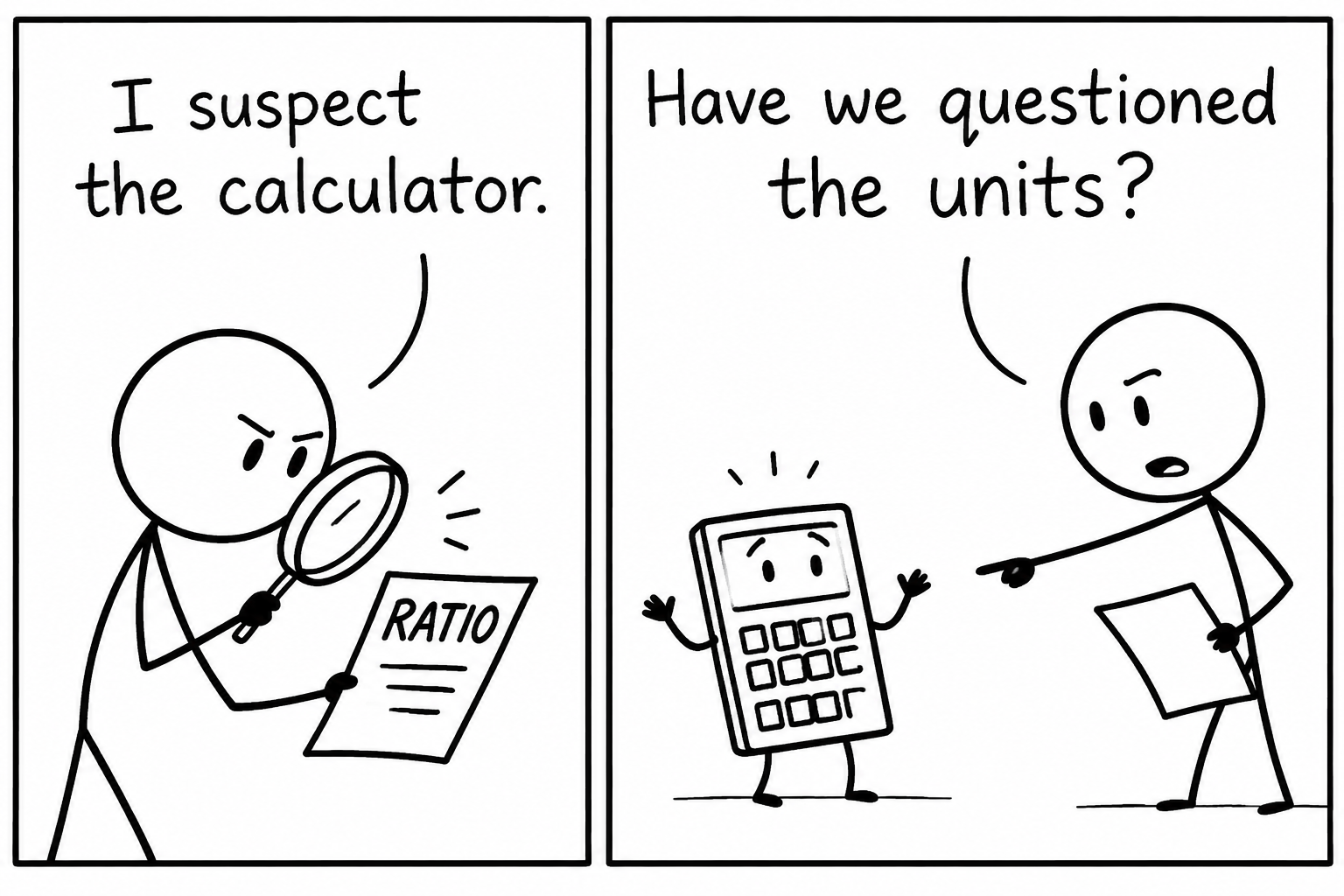 A student investigates a ratio error while an innocent calculator waits to be questioned
Confusing part-to-part ratios with fractions
A class has boys and girls in the ratio 3:53:53:5. Sam says the fraction of the class who are boys is 35\frac{3}{5}53.
The ratio compares boys with girls, so it is part-to-part. A fraction of the class compares one group with the whole class.
The total number of ratio parts is:
3+5=83+5=83+5=8Therefore, the fraction who are boys is:
38\frac{3}{8}83The fraction who are girls is:
58\frac{5}{8}85The denominator is the total number of parts, not the other side of the ratio. Explore this distinction in the writing a ratio as a fraction booklet.
Comparing different units
Sam is asked to simplify the ratio of 2 m2\text{ m}2 m to 50 cm50\text{ cm}50 cm and writes 2:502:502:50. The quantities are not yet comparable.
Convert both measurements into the same unit first:
2 m=200 cm2\text{ m}=200\text{ cm}2 m=200 cmThe ratio is therefore:
200:50=4:1200:50=4:1200:50=4:1Sam could instead convert 50 cm50\text{ cm}50 cm to 0.5 m0.5\text{ m}0.5 m:
2:0.5=4:12:0.5=4:12:0.5=4:1Both routes give the same result. Units determine the ratio itself. Review this prerequisite with the conversions and units resources.
Treating ratio as an additive relationship
Suppose orange and black paint are mixed in the ratio 2:72:72:7. If there are 888 litres of orange paint, Sam adds 666 to the black amount because 222 has increased to 888.
Ratio is multiplicative. Since 222 has been multiplied by 444, the other part must also be multiplied by 444:
2×4=82\times4=82×4=8 7×4=287\times4=287×4=28The amount of black paint is 282828 litres.
A ratio table can make the scale factor visible:
| Paint | Original parts | Actual amount |
|---|---|---|
| Orange | 222 | 888 litres |
| Black | 777 | 282828 litres |
Ask, “What multiplies the known ratio part to produce the known amount?” Then apply that multiplier to every part. The GCSE ratio worked examples guide explains how this idea appears in several question types.
How to catch ratio mistakes before moving on
For a simplified ratio, confirm that no common factor remains. For a sharing problem, add the final shares and compare the result with the original total. For a missing-value problem, check that both sides use the same scale factor. For a fraction question, confirm that the denominator represents the whole.
Circle or underline units before working. If they differ, convert first.
Write the total number of parts, the value of one part and each final share separately. If the final arithmetic goes wrong, your valid method may still be visible to the examiner.
For mixed practice, use the Edexcel GCSE Maths Question Bank. Attempt each problem before opening its worked solution or mark scheme.
Turn corrected methods into reliable marks
The next step is applying these methods independently when the wording changes. Use MathsGenie’s free revision resources while the checking routine is fresh, focusing on order, units, total parts and scale factors.
Start the ratio lesson linked above, then practise questions without looking back at the examples. Mark your answers and revisit whichever mistake still appears.