

Common Quadratic Formula Mistakes in GCSE Maths
Common mistakes with the quadratic formula in GCSE Maths explained through worked examples, sign checks and exam-style practice to help you avoid lost marks.
You recognise the question, remember the formula and reach for your calculator. Then your answer disagrees with the mark scheme. Common mistakes with the quadratic formula in GCSE Maths usually come from a few repairable habits: losing negative signs, substituting before rearranging, entering fractions incorrectly or stopping after one solution.
The answer is not simply to work more slowly. It is to give each risky step its own check.
Imagine a student reviewing a page of crossed-out answers. Rather than starting another worksheet, they trace each error back to the line where it began. Follow that approach below: identify the mistake, understand why it happens and replace it with a reliable method.
Your quadratic formula checklist
Before calculating, check that you have:
- Rearranged the equation so one side is zero.
- Identified each coefficient, including its sign.
- Put negative numbers in brackets when substituting.
- Placed the whole numerator over the denominator.
- Calculated both branches of the formula.
- Kept full calculator accuracy until the final answer.
These checks matter because the quadratic formula is a sequence of small operations. One incorrect sign can change everything that follows.
Start with the formula, not the calculator
For an equation in the form
ax2+bx+c=0,a≠0,a x^2+b x+c=0,\qquad a\ne 0,ax2+bx+c=0,a=0,the quadratic formula is
x=−b±b2−4ac2a.x=\frac{-b\pm\sqrt{b^2-4ac}}{2a}.x=2a−b±b2−4ac.At GCSE, solving equations using this formula is a higher-tier skill. If you need to rebuild the method first, use the quadratic formula revision topic.
A useful written routine is: rearrange, identify, substitute, simplify, separate, round. The writing is not decoration. It makes your reasoning visible and gives you somewhere to look when an answer seems wrong.
Common mistakes and how to fix them
Substituting before the equation equals zero
Suppose the question asks you to solve
2x2−5x=3.2x^2-5x=3.2x2−5x=3.The mistake: choosing a=2a=2a=2, b=−5b=-5b=−5 and c=3c=3c=3 immediately.
Why it happens: the coefficients look easy to read, so it feels unnecessary to rewrite the equation. But the formula assumes that every term is on one side and the other side is zero.
The correction: subtract 333 from both sides first:
2x2−5x−3=0.2x^2-5x-3=0.2x2−5x−3=0.Now identify
a=2,b=−5,c=−3.a=2,\qquad b=-5,\qquad c=-3.a=2,b=−5,c=−3.That final negative sign belongs to the constant. Keep it attached when substituting.
Losing a negative sign
Continue with the same equation.
The mistake: writing −b=−5-b=-5−b=−5, or treating (−5)2(-5)^2(−5)2 as negative.
Why it happens: students sometimes read bbb as the size of the coefficient rather than its signed value. Calculator notation can introduce another trap if a negative number is squared without brackets.
The correction: substitute the signed values visibly:
x=−(−5)±(−5)2−4×2×(−3)2×2.x=\frac{-(-5)\pm\sqrt{(-5)^2-4\times2\times(-3)}}{2\times2}.x=2×2−(−5)±(−5)2−4×2×(−3).Work through the pieces separately:
−(−5)=5,(−5)2=25,-(-5)=5,\qquad (-5)^2=25,−(−5)=5,(−5)2=25, b2−4ac=25−(−24)=49.b^2-4ac=25-(-24)=49.b2−4ac=25−(−24)=49.Therefore,
x=5±494.x=\frac{5\pm\sqrt{49}}{4}.x=45±49.Brackets are doing real work here. They show exactly which number is being squared and which signs belong to the coefficients.
Dividing only part of the numerator
The mistake: reading the fraction as
x=5±74.x=5\pm\frac{7}{4}.x=5±47.Why it happens: a long expression becomes a single calculator entry, and the fraction bar gets lost.
The correction: the entire numerator must be divided by 2a2a2a. Here, that means
x=5±74.x=\frac{5\pm7}{4}.x=45±7.If you use a fraction template, put the complete numerator in its top box. If you enter a linear calculation, bracket the whole numerator before dividing. Check the displayed expression before pressing equals.
Finding only one solution
The mistake: calculating the addition branch and stopping.
Why it happens: one plausible answer feels like a finished question. But ±\pm± represents two calculations, not a choice between signs.
The correction: write both branches explicitly:
x=5+74=3,x=\frac{5+7}{4}=3,x=45+7=3, x=5−74=−12.x=\frac{5-7}{4}=-\frac{1}{2}.x=45−7=−21.The two solutions are x=3x=3x=3 and x=−12x=-\frac{1}{2}x=−21. Substituting either into the original equation gives equal values on both sides.
For a question about a physical quantity, such as a length, check whether both solutions make sense in context. Do not discard a negative solution automatically when solving a purely algebraic equation.
Turn this checking routine into practice with MathsGenie's quadratic formula lessons and the quadratic formula Question Bank, checking the step you are trying to fix.
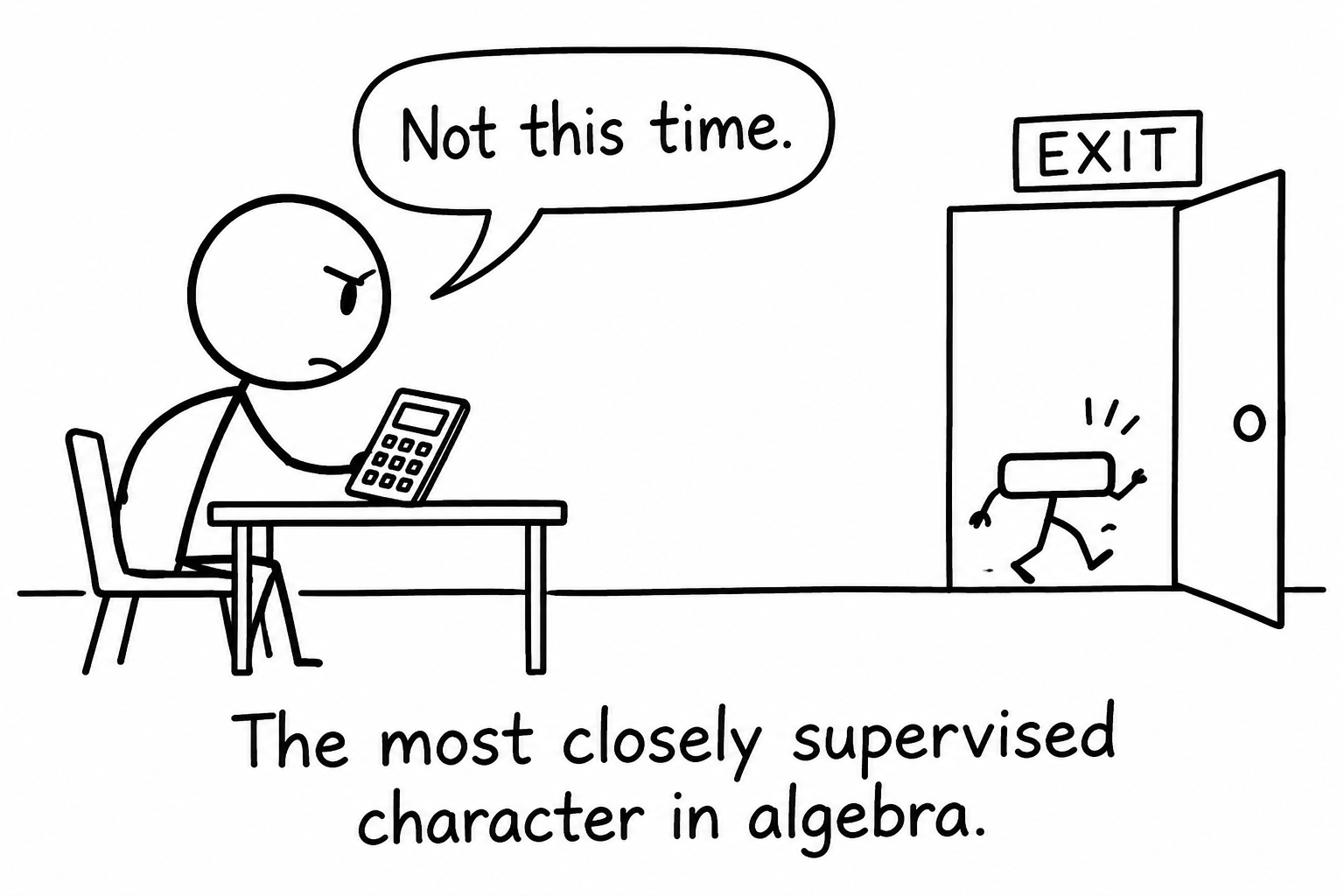 A stick-figure student catches a minus sign trying to escape during algebra revision
Rounding before the calculation is finished
Now consider an equation whose solutions are not tidy:
3x2+4x−2=0.3x^2+4x-2=0.3x2+4x−2=0.The mistake: rounding the square root before calculating either solution.
Why it happens: a long decimal looks inconvenient, so it gets shortened immediately. That changes an intermediate value and can affect the final answer.
The correction: keep the square root exact, or retain the full calculator value:
x=−4±42−4×3×(−2)6=−4±406.x=\frac{-4\pm\sqrt{4^2-4\times3\times(-2)}}{6} =\frac{-4\pm\sqrt{40}}{6}.x=6−4±42−4×3×(−2)=6−4±40.Calculate each branch without intermediate rounding:
x≈0.3874259orx≈−1.7207592.x\approx0.3874259\qquad\text{or}\qquad x\approx-1.7207592.x≈0.3874259orx≈−1.7207592.To two decimal places, the answers are
x≈0.39orx≈−1.72.x\approx0.39\qquad\text{or}\qquad x\approx-1.72.x≈0.39orx≈−1.72.Follow the accuracy requested in the question. If an exact answer is required, keep the surd form rather than replacing it with a rounded decimal.
Assuming every equation has two different real solutions
The expression under the square root is called the discriminant:
D=b2−4ac.D=b^2-4ac.D=b2−4ac.The mistake: treating a calculator error as proof that you entered the expression incorrectly.
Why it happens: after many questions with two solutions, that outcome starts to feel compulsory.
The correction: check the substitution, then interpret the discriminant:
- If D>0D>0D>0, there are two distinct real solutions.
- If D=0D=0D=0, there is one repeated real solution.
- If D<0D<0D<0, there are no real solutions.
A negative discriminant cannot produce a real square root. At GCSE, state that there are no real solutions rather than trying to force a decimal answer.
Exam-style practice: repair the method
Try these without looking at the answers. For each question, write the coefficients and the substituted formula before using your calculator.
Practise handling signs: solve 2x2−7x+3=02x^2-7x+3=02x2−7x+3=0.
Practise rearranging: solve x2+4x=1x^2+4x=1x2+4x=1, giving your answers to two decimal places.
Practise recognising a repeated solution: solve x2−6x+9=0x^2-6x+9=0x2−6x+9=0.
Check your answers
For the first question, the discriminant is 252525, giving x=3x=3x=3 or x=12x=\frac{1}{2}x=21.
For the second, rearrange to x2+4x−1=0x^2+4x-1=0x2+4x−1=0. The exact solutions are x=−2±5x=-2\pm\sqrt{5}x=−2±5, giving x≈0.24x\approx0.24x≈0.24 or x≈−4.24x\approx-4.24x≈−4.24.
For the third, the discriminant is zero, giving the repeated solution x=3x=3x=3.
If something went wrong, label the error precisely: rearranging, signs, denominator, missing branch or rounding. Then redo that question from a blank page. For a printable follow-up, use the quadratic formula question booklet. Students following OCR can use the OCR quadratic formula questions.
Turn corrections into a reliable habit
In our imagined student's next attempt, the important change is not speed: it is knowing where to check before accepting an answer. You now have that routine, but making it dependable takes repeated use on unfamiliar questions. Start fixing your own recurring error with MathsGenie's Lessons and Question Bank, using the lesson to revisit the method and the questions to practise it independently.















