GCSE Maths: Product Rule for Counting Mistakes
Common mistakes with product rule for counting in GCSE maths: fix repetition, order and restricted choices with worked examples and focused exam practice.
Common mistakes with product rule for counting in GCSE maths
The multiplication often feels easy. Deciding what to multiply is where the marks slip away. The most common mistakes with product rule for counting in GCSE maths are adding instead of multiplying, overlooking restrictions, allowing forbidden repeats and counting the same outcome twice.
The fix is to describe each choice before calculating. Ask what you are choosing, how many options remain and whether changing the order creates a different outcome.
Imagine a student checking a page of counting questions. Their arithmetic is accurate, but several answers are wrong. Rather than practising multiplication, they need to repair the decisions that come before it. We will follow that process through worked examples. MathsGenie's product rule for counting lesson provides a matching explanation.
The product rule for counting: a quick checklist
If a process has successive stages, multiply the number of choices at each stage, provided those numbers correctly describe every route being counted.
For two stages:
Total outcomes=choices at stage one×choices at stage two\text{Total outcomes}=\text{choices at stage one}\times\text{choices at stage two}Total outcomes=choices at stage one×choices at stage twoBefore using it, check:
- Are you making successive choices, or choosing between alternatives?
- Can an item be used again?
- Does order matter?
- Does a restriction change any stage?
- Does the number of later choices depend on an earlier selection?
Write a short label above each factor. This makes your reasoning visible and gives you something useful to check if the answer looks wrong.
Once you can label the choices, start using the product rule for counting Question Bank practice to test whether you recognise restrictions without a reminder.
Common mistakes and how to fix them
Adding when the choices should be multiplied
Our hypothetical student starts with an outfit question: there are four shirts and three pairs of trousers. One outfit contains one shirt and one pair of trousers.
The mistake: adding the two amounts.
4+3=74+3=74+3=7This counts the individual items, not the possible outfits. It happens because both numbers appear in the question and adding feels like finding a total.
The correct method: each shirt can be paired with every pair of trousers.
- Choose a shirt: four options.
- Choose trousers to go with it: three options.
- Multiply the successive choices.
The useful question is not simply whether the wording contains “and”. Ask whether each first choice produces a complete set of second choices.
Keeping the same number when repetition is forbidden
Next comes a three-character code using the digits 1,2,3,4,51,2,3,4,51,2,3,4,5. No digit may appear twice.
The mistake: treating every position as having five options.
5×5×5=1255\times5\times5=1255×5×5=125That calculation allows repeated digits. The student has noticed the available digits but missed the instruction controlling how they can be used.
The correct method: reduce the choices after each selection.
- First position: five choices.
- Second position: four unused digits.
- Third position: three unused digits.
The choices decrease because repetition is forbidden, not simply because there are several stages. If repetition were allowed, the original calculation would be appropriate.
Letting zero begin a number
Now the question asks for three-digit numbers made from 0,1,2,3,40,1,2,3,40,1,2,3,4, without repetition.
The mistake: using the same calculation as the previous example.
5×4×3=605\times4\times3=605×4×3=60A code may begin with zero if its rules permit it. A three-digit number cannot: a leading zero does not create a hundreds digit.
The correct method: deal with the hundreds position first.
- Hundreds: four choices, because zero is excluded.
- Tens: four choices, because one digit has been used but zero remains available.
- Units: three choices.
Notice that the first two factors are equal for different reasons. Writing their labels matters more than spotting a familiar pattern.
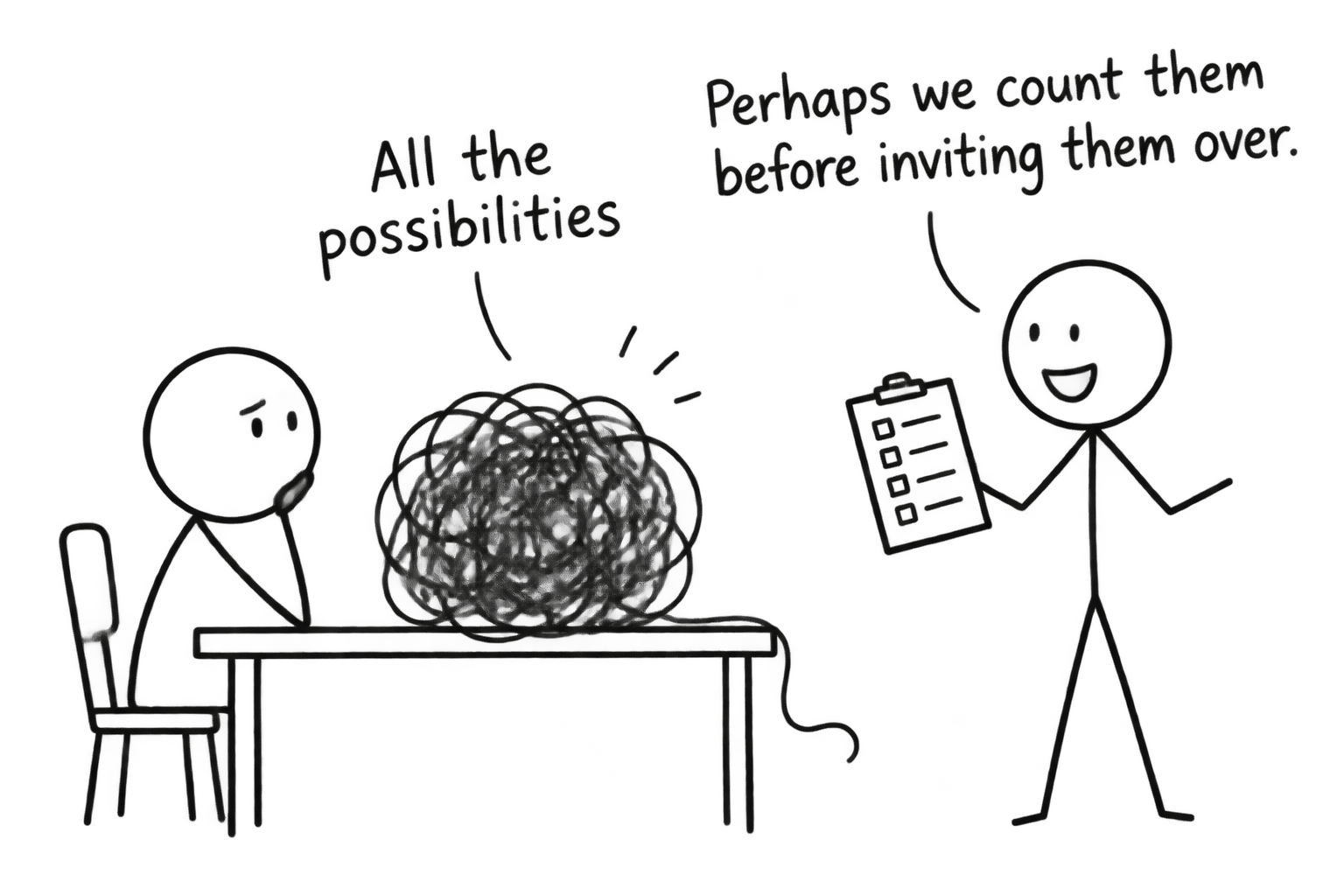 A minimalist stick-figure comic about untangling too many possibilities
Counting the same selection twice
Five students are available, and two must be selected for a team.
The mistake: choosing one student and then another, and stopping there.
5×4=205\times4=205×4=20That counts ordered selections. Choosing Alex followed by Sam produces the same team as choosing Sam followed by Alex. Each team appears twice.
The correct method: account for the duplicate counting.
5×42=10 teams\frac{5\times4}{2}=10\text{ teams}25×4=10 teamsHowever, if the roles were captain and vice-captain, swapping the students would produce a different appointment. There would then be 202020 possibilities.
Do not memorise “divide by two for pairs”. Explain why the same outcome has been counted twice. That explanation tells you whether division belongs in the method.
Multiplying across unequal branches
Suppose a café offers two meal deals. A sandwich deal has three sandwich choices and two drink choices. A salad deal has two salad choices and three drink choices. A customer chooses exactly one deal.
The mistake: combining all food and drink choices.
(3+2)×(2+3)=25(3+2)\times(2+3)=25(3+2)×(2+3)=25This allows combinations outside the stated deals. It happens when the student sees several categories but does not preserve the restrictions connecting them.
The correct method: count each separate case, then add.
Sandwich deals=3×2=6\text{Sandwich deals}=3\times2=6Sandwich deals=3×2=6 Salad deals=2×3=6\text{Salad deals}=2\times3=6Salad deals=2×3=6 Total deals=6+6=12\text{Total deals}=6+6=12Total deals=6+6=12Multiply within each route. Add the totals for distinct alternatives. This works because the cases do not overlap and together cover all permitted deals.
A checking routine before you move on
The student's turning point is not a faster calculation. It is a pause before calculating.
First, underline restrictions such as “different”, “without repetition”, “even” or “exactly one”. Next, label the stages. Finally, ask whether your calculation counts each permitted outcome exactly once.
For a small question, list a few outcomes or sketch a tree diagram. You do not always need a complete list. A short check can expose a repeated selection, an impossible starting digit or a branch with fewer options.
If you cannot explain a factor in words, revisit it before trusting the answer.
Exam-style practice
Try these without looking at the answers. Show a labelled calculation rather than only a total.
Questions
- Outfits: A student has five tops and two pairs of trousers. How many different outfits contain one of each?
- Codes: A four-character code uses the digits 1,2,3,4,5,61,2,3,4,5,61,2,3,4,5,6. Repetition is forbidden. How many codes are possible?
- Numbers: How many two-digit even numbers can be made from 0,1,2,3,40,1,2,3,40,1,2,3,4 without repeating a digit?
Answers and checks
Outfits: every top has two possible trouser partners.
5×2=105\times2=105×2=10Codes: one fewer digit is available after each choice.
6×5×4×3=3606\times5\times4\times3=3606×5×4×3=360Numbers: split according to the units digit. If it is zero, there are four choices for the tens digit. If it is 222 or 444, there are three valid tens digits for each case, because zero and the used digit are excluded.
4+(2×3)=104+(2\times3)=104+(2×3)=10The last question rewards separating cases rather than forcing one multiplication to cover unequal situations.
Turn corrected mistakes into reliable marks
You have seen how a student's wrong answers can become a checklist: check repetition, leading zeroes, order and unequal branches. Knowing that checklist is useful; applying it without prompting takes practice. Your turn: start with MathsGenie's product rule for counting Lessons, then use the matching Question Bank practice to check each factor before you multiply.