Common Mistakes with Nth Term in GCSE Maths
Common mistakes with nth term in GCSE Maths explained through worked examples, quick checks and exam-style practice, so you can protect every mark in exams.

A student can understand sequences perfectly well and still lose marks on the final line. The difference is correct, the method feels familiar, but the expression is one number out. This is why the common mistakes with nth term in GCSE Maths matter: they are usually small, repeatable and fixable.
For a linear sequence, find the common difference, use it as the coefficient of nnn, then adjust the expression so it produces the first term. Finally, substitute n=1n=1n=1, n=2n=2n=2 and n=3n=3n=3 to check it. That last step catches most nth term mistakes before they cost marks.
Your nth term checklist
For an arithmetic, or linear, sequence:
- Find the common difference.
- Write that difference in front of nnn.
- Generate the first few terms of this temporary sequence.
- Compare it with the sequence in the question.
- Add or subtract the required adjustment.
- Check your rule using at least three term numbers.
The standard form is:
an+b an+b an+bHere, aaa is the common difference and bbb is the adjustment. For instance, if the difference is 444, begin with 4n4n4n, not simply 444.
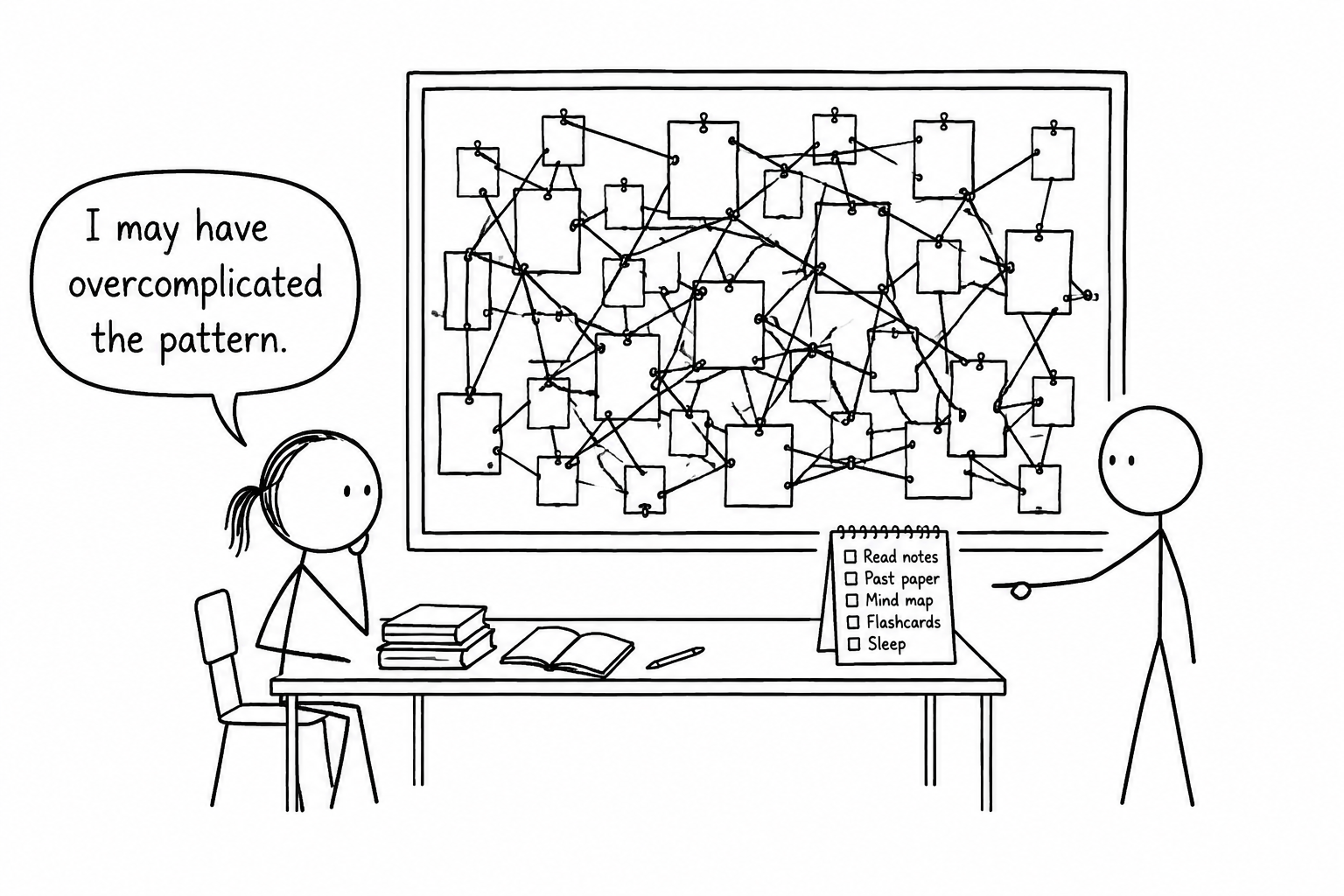 A student realises they have overcomplicated a sequence pattern
Mistake: giving the term-to-term rule
Suppose the sequence is:
5,8,11,14,… 5, 8, 11, 14, \ldots 5,8,11,14,…A student may answer “add 333”. That describes how to move from one term to the next, but it is not the nth term. An nth-term rule must calculate any term directly from its position.
Correct method
The common difference is 333, so begin with:
3n 3n 3nThis generates:
3,6,9,12,… 3, 6, 9, 12, \ldots 3,6,9,12,…Each term is 222 below the required sequence, so add 222:
3n+2 3n+2 3n+2Check the first term:
3(1)+2=5 3(1)+2=5 3(1)+2=5The answer is therefore 3n+23n+23n+2. The key question is simple: does your answer contain nnn? If it does not, you have probably written a term-to-term instruction rather than a position-to-term rule.
You can reinforce this distinction in the Sequences Nth Term lesson for Edexcel GCSE.
Mistake: using the first term as the coefficient
Consider:
7,12,17,22,… 7, 12, 17, 22, \ldots 7,12,17,22,…A common wrong answer is 7n+57n+57n+5. This happens because 777 is visually prominent: it is the first number students see. But the coefficient of nnn comes from the common difference, not the first term.
Correct method
The sequence increases by 555, so start with 5n5n5n:
5,10,15,20,… 5, 10, 15, 20, \ldots 5,10,15,20,…The required terms are always 222 greater. Therefore:
5n+2 5n+2 5n+2Check several terms:
5(1)+2=7 5(1)+2=7 5(1)+2=7 5(2)+2=12 5(2)+2=12 5(2)+2=12 5(3)+2=17 5(3)+2=17 5(3)+2=17The rule works. If AQA is your exam board, the matching AQA sequences and nth term lesson provides further guided practice.
Once this method makes sense, use the Maths Genie Lessons and Question Bank to practise spotting the difference and checking the adjustment without setting up examples yourself.
Mistake: getting the adjustment sign wrong
Now take:
10,16,22,28,… 10, 16, 22, 28, \ldots 10,16,22,28,…The difference is 666, so the rule begins with 6n6n6n. Students sometimes compare 666 with 101010, notice a gap of 444, and write 6n−46n-46n−4 without considering the direction.
Correct method
Write the temporary and required sequences together:
6n:6,12,18,24,… 6n: 6, 12, 18, 24, \ldots 6n:6,12,18,24,… Required:10,16,22,28,… \text{Required}: 10, 16, 22, 28, \ldots Required:10,16,22,28,…The required sequence is 444 greater each time, so the rule is:
6n+4 6n+4 6n+4A reliable habit is to complete the sentence: “I must add 444 to get from 666 to 101010.” This is safer than choosing a sign from memory.
Mistake: mishandling a negative difference
Descending sequences often create unnecessary doubt. Consider:
18,14,10,6,… 18, 14, 10, 6, \ldots 18,14,10,6,…The common difference is −4-4−4, not 444. Therefore, begin with:
−4n -4n −4nThis gives:
−4,−8,−12,−16,… -4, -8, -12, -16, \ldots −4,−8,−12,−16,…To turn the first term, −4-4−4, into 181818, add 222222. The nth term is:
−4n+22 -4n+22 −4n+22Checking confirms it:
−4(1)+22=18 -4(1)+22=18 −4(1)+22=18 −4(2)+22=14 -4(2)+22=14 −4(2)+22=14The negative sign belongs to the coefficient because the sequence decreases as nnn increases.
Mistake: checking only one term
One correct substitution is reassuring, but it is not enough. For the sequence
4,9,14,19,… 4, 9, 14, 19, \ldots 4,9,14,19,…a student might incorrectly propose 4n4n4n. It gives the correct first term because 4(1)=44(1)=44(1)=4, but fails immediately afterwards.
The actual difference is 555, so start with 5n5n5n:
5,10,15,20,… 5, 10, 15, 20, \ldots 5,10,15,20,…Subtracting 111 gives:
5n−1 5n-1 5n−1Check three positions:
5(1)−1=4 5(1)-1=4 5(1)−1=4 5(2)−1=9 5(2)-1=9 5(2)−1=9 5(3)−1=14 5(3)-1=14 5(3)−1=14Three substitutions take only a few seconds and test both parts of the expression. You can apply this checking routine to marked questions in the nth term exam booklet.
Mistake: assuming every sequence is linear
A constant first difference indicates a linear sequence. If the first differences change but the second differences are constant, the sequence may be quadratic.
For example:
3,8,15,24,35,… 3, 8, 15, 24, 35, \ldots 3,8,15,24,35,…The first differences are:
5,7,9,11 5, 7, 9, 11 5,7,9,11These are not constant, so a rule of the form an+ban+ban+b is unsuitable. The second differences are all 222, indicating a quadratic sequence. In fact, the rule is:
n2+2n n^2+2n n2+2nCheck it with n=3n=3n=3:
32+2(3)=9+6=15 3^2+2(3)=9+6=15 32+2(3)=9+6=15Quadratic nth terms require a separate method. Higher-tier students can study it through the quadratic nth term revision guide.
Exam-style practice
Try these without looking back at the examples:
- Find the nth term of 9,13,17,21,…9, 13, 17, 21, \ldots9,13,17,21,…
- Find the nth term of 20,17,14,11,…20, 17, 14, 11, \ldots20,17,14,11,…
- The nth term is 7n−57n-57n−5. Find the 121212th term.
- Is 838383 a term in the sequence with nth term 6n+56n+56n+5?
Answers:
- The difference is 444, so the nth term is 4n+54n+54n+5.
- The difference is −3-3−3, so the nth term is −3n+23-3n+23−3n+23.
- 7(12)−5=797(12)-5=797(12)−5=79.
- Solve 6n+5=836n+5=836n+5=83, giving 6n=786n=786n=78 and n=13n=13n=13. Since 131313 is a positive integer, 838383 is a term.
Notice that the fourth question needs more than substitution. You form and solve an equation, then check that the resulting value of nnn is a valid term position.
Turn the method into marks
Knowing the checklist is different from applying it accurately when a question is unfamiliar. Keep following the student’s corrected routine: identify the difference, build the nnn term, adjust it and check three positions. Start the matching Maths Genie nth term Lessons and Question Bank and practise fixing these exact errors before your next GCSE paper.