

Common Mistakes with Negative Numbers in GCSE Maths
Common mistakes with negative numbers in GCSE maths explained, with clear worked examples, sign checks and exam-style practice to help you avoid lost marks.
Common mistakes with negative numbers in GCSE Maths
You know how to subtract. You know your times tables. Yet a small minus sign can still turn a familiar calculation into a lost mark. The most common mistakes with negative numbers in GCSE maths come from mixing up three things: a number's sign, the operation being performed and the order of operations.
The solution is not to memorise one slogan about negatives. It is to recognise which rule belongs to which calculation.
Imagine a student checking a practice paper and finding several wrong answers involving negative numbers. Rather than writing “be more careful”, they sort each error by its cause. Follow that approach below: identify the mistake, understand why it happens and practise the correct method.
Your negative numbers checklist
Before calculating, ask:
- What is the operation? Addition, subtraction, multiplication and division need different reasoning.
- What does each minus sign mean? It might identify a negative number or tell you to subtract.
- Are there brackets or powers? These determine which parts belong together.
- Does the answer make sense? Check its sign and approximate position on a number line.
The MathsGenie GCSE maths revision overview places negative numbers alongside related number topics. For a focused explanation, use the matching negative numbers lesson.
Mistake: ordering negatives by their size without the sign
Incorrect: −8>−3-8 > -3−8>−3.
This happens when you compare the digits and forget what the negative sign means. Although 888 is greater than 333, negative numbers run in the opposite order as their distance below zero increases.
The correct method
Picture a number line. Numbers increase as you move right.
- Locate −8-8−8.
- Locate −3-3−3, which is closer to zero.
- Since −3-3−3 is further right, write −8<−3-8 < -3−8<−3.
For an ordering question, place the most negative number first when asked for ascending order:
−9<−4<−1<2-9 < -4 < -1 < 2−9<−4<−1<2“Closer to zero” helps when comparing two negative numbers. It is not a universal rule for comparing every pair of numbers.
Mistake: treating every pair of negatives as positive
Incorrect: −6+(−4)=10-6 + (-4) = 10−6+(−4)=10.
“Two negatives make a positive” is incomplete advice. It describes the sign of a product or quotient involving two negative numbers. It does not mean that adding two negative numbers gives a positive answer.
The correct method
For −6+(−4)-6 + (-4)−6+(−4):
- Start at −6-6−6.
- Adding −4-4−4 means moving four places left.
- Finish at −10-10−10.
For mixed signs, compare the magnitudes:
−9+5=−4-9 + 5 = -4−9+5=−4Five positive units cancel five of the nine negative units, leaving four negative units. You can also check by moving five places right from −9-9−9.
The important habit is to name the operation before choosing a sign rule.
Mistake: subtracting a negative as though it were positive
Incorrect: 7−(−3)=47 - (-3) = 47−(−3)=4.
Here, the student has noticed the subtraction sign but ignored the sign attached to the number being subtracted.
The correct method
Subtracting a negative is equivalent to adding its positive counterpart:
7−(−3)=7+3=107 - (-3) = 7 + 3 = 107−(−3)=7+3=10Write the intermediate step. It makes the change explicit instead of asking you to hold both signs in your head.
The same method works when the starting number is negative:
−7−(−3)=−7+3=−4-7 - (-3) = -7 + 3 = -4−7−(−3)=−7+3=−4Notice that subtracting a negative increases the starting value, but does not necessarily produce a positive answer.
Your method is now reusable: identify the operation, rewrite subtraction of a negative, then calculate. Start with the MathsGenie Lessons and Question Bank to practise that same sign-checking routine without having to assemble your own questions.
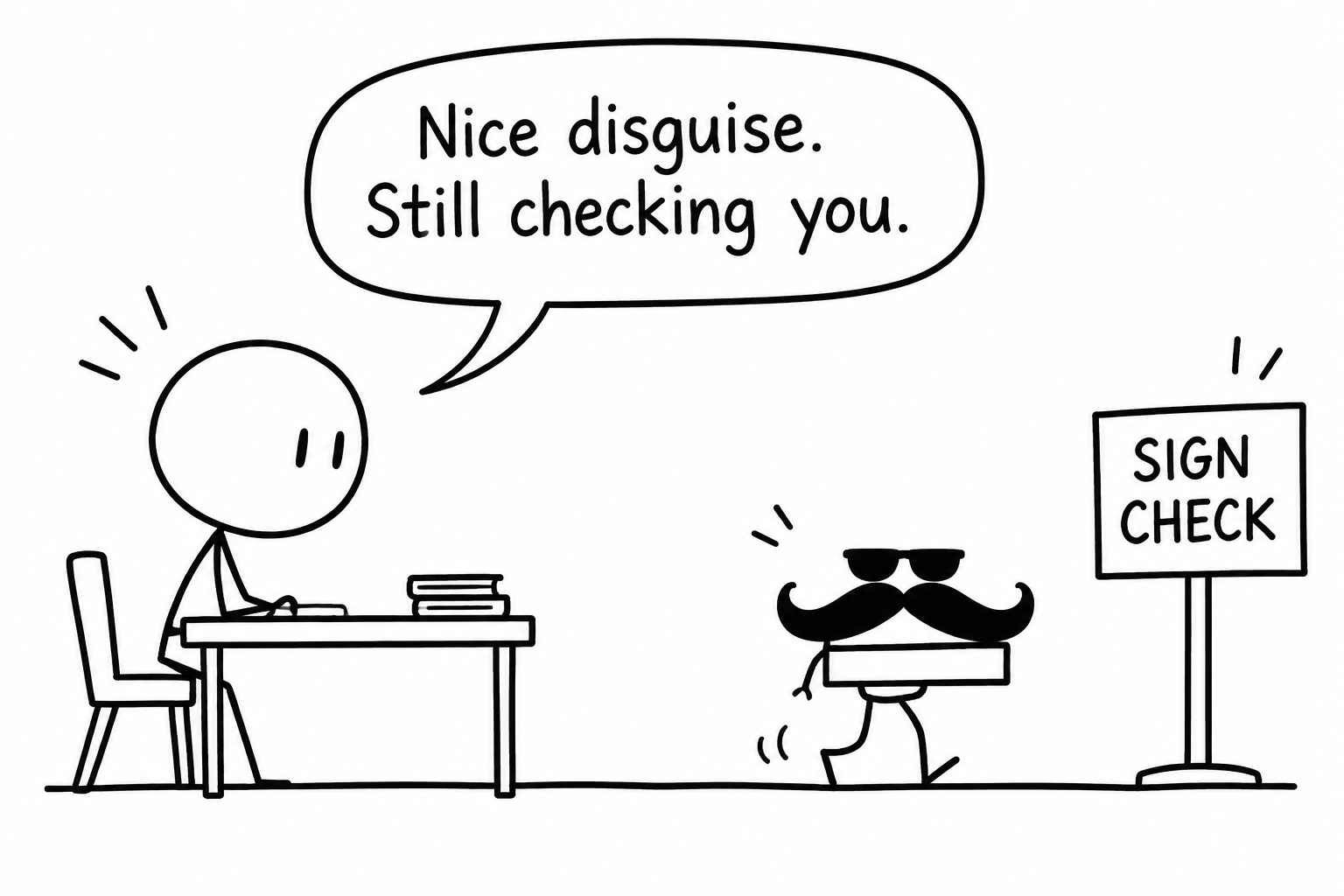 A stick-figure student spots a minus sign wearing a disguise at a sign-check checkpoint
Mistake: carrying addition rules into multiplication
Incorrect: −5×−4=−20-5 \times -4 = -20−5×−4=−20.
After practising addition, it is tempting to assume that two negative numbers must always give a negative answer. But multiplication and division use their own sign rules.
The correct method
Separate the sign from the magnitude:
- Decide the sign: matching signs give a positive product or quotient; different signs give a negative one.
- Calculate using the positive magnitudes.
- Combine the two decisions.
Therefore:
−5×−4=20-5 \times -4 = 20−5×−4=20 −24÷6=−4-24 \div 6 = -4−24÷6=−4For several factors, count the negative factors. An even number gives a positive product; an odd number gives a negative product, provided no factor is zero.
For example:
(−2)×(−3)×(−4)=6×(−4)=−24(-2) \times (-3) \times (-4) = 6 \times (-4) = -24(−2)×(−3)×(−4)=6×(−4)=−24Check this rule against multiplication, not addition. The operation is what makes it valid.
Mistake: losing brackets when squaring a negative
Incorrect: assuming (−4)2(-4)^2(−4)2 and −42-4^2−42 mean the same thing.
They look similar, but the brackets change what is being squared.
The correct method
With brackets, the entire negative number is squared:
(−4)2=(−4)×(−4)=16(-4)^2 = (-4) \times (-4) = 16(−4)2=(−4)×(−4)=16Without brackets, the power applies to the number before the leading minus sign:
−42=−(4×4)=−16-4^2 = -(4 \times 4) = -16−42=−(4×4)=−16When substituting a negative value into an expression, put it in brackets. If x=−4x = -4x=−4, then:
x2+3=(−4)2+3=19x^2 + 3 = (-4)^2 + 3 = 19x2+3=(−4)2+3=19Brackets preserve the value you are substituting. For more practice with operation order, the MathsGenie BIDMAS exam booklet covers the related calculation skill.
Mistake: confusing a final value with a change
Suppose a temperature rises from −5∘C-5^\circ\mathrm{C}−5∘C to 3∘C3^\circ\mathrm{C}3∘C.
Incorrect: the rise is 2∘C2^\circ\mathrm{C}2∘C.
This answer comes from subtracting the magnitudes without considering the journey across zero.
The correct method
Find the change by subtracting the starting value from the final value:
3−(−5)=83 - (-5) = 83−(−5)=8The temperature rises by 8∘C8^\circ\mathrm{C}8∘C. You can check by counting five degrees to zero, then another three degrees above it.
Read what the question asks: the final temperature and the temperature change are different quantities. Include the appropriate units in your answer.
Exam-style practice: check the method, not just the answer
Try these original practice questions without looking at the answers. Beside each calculation, note which rule you used.
- Put −2-2−2, −7-7−7, 111 and −5-5−5 in ascending order.
- Calculate −8+3-8 + 3−8+3.
- Calculate −6−(−9)-6 - (-9)−6−(−9).
- Calculate (−7)×(−3)(-7) \times (-3)(−7)×(−3).
- Calculate 30÷(−5)30 \div (-5)30÷(−5).
- Given a=−3a = -3a=−3, calculate a2−4a^2 - 4a2−4.
Answers and quick checks
- −7,−5,−2,1-7, -5, -2, 1−7,−5,−2,1. Read from left to right on a number line.
- −5-5−5. Move three places right from −8-8−8.
- 333. Rewrite the calculation as −6+9-6 + 9−6+9.
- 212121. Matching signs give a positive product.
- −6-6−6. Different signs give a negative quotient.
- 555. Substitute with brackets: (−3)2−4=9−4(-3)^2 - 4 = 9 - 4(−3)2−4=9−4.
If an answer is wrong, label the cause: ordering, addition, subtraction, multiplication, division or brackets. Then redo the question with the missing step written out. That gives your next revision session a specific purpose.
Turn sign checks into a habit
Our imagined student now has something more useful than “be careful”: a way to identify and repair each error. Your goal is the same, but recognising a rule once is different from applying it consistently. Start your negative numbers practice with MathsGenie's Lessons and Question Bank, using the sign-checking routine on every question.















