

Common Mistakes With Index Laws in GCSE Maths
Common mistakes with index laws in GCSE Maths, explained through clear corrections, worked examples and exam-style practice to help you protect every mark.
A student can understand indices perfectly in a lesson, then lose marks because one familiar-looking expression triggers the wrong rule. The problem is rarely difficult arithmetic. It is usually a small decision made too quickly: adding instead of multiplying, forgetting a reciprocal, or applying an index law when the bases are different.
The best way to fix the common mistakes with index laws in GCSE Maths is to diagnose each error rather than memorise more rules. This guide follows that process. You will see the mistake, understand why it happens, correct it step by step and then practise recognising the right law under exam conditions.
Your index laws checklist
Before simplifying anything, identify the structure of the expression.
- Multiplying powers with the same base: add the indices.
- Dividing powers with the same base: subtract the indices.
- Raising a power to another power: multiply the indices.
- Raising a product or fraction to a power: apply the power to every factor.
- A zero index gives 111, provided the base is non-zero.
- A negative index means take the reciprocal.
- A fractional index represents a root and possibly a power.
These laws can be summarised as:
am×an=am+n a^m \times a^n=a^{m+n} am×an=am+n am÷an=am−n a^m \div a^n=a^{m-n} am÷an=am−n (am)n=amn (a^m)^n=a^{mn} (am)n=amn a0=1 a^0=1 a0=1 a−n=1an a^{-n}=\frac{1}{a^n} a−n=an1 amn=(an)m a^{\frac{m}{n}}=\left(\sqrt[n]{a}\right)^m anm=(na)mThe first question should always be: what operation connects the powers? That single pause prevents most index laws mistakes.
Mistake: multiplying the indices when multiplying powers
A student sees x3×x4x^3 \times x^4x3×x4 and writes x12x^{12}x12. It feels plausible because the powers are being multiplied, but the operation between the powers is multiplication, so the indices must be added.
Correct method
x3×x4 x^3 \times x^4 x3×x4Write each power as repeated multiplication:
x3×x4=(x×x×x)(x×x×x×x) x^3 \times x^4=(x \times x \times x)(x \times x \times x \times x) x3×x4=(x×x×x)(x×x×x×x)There are seven factors of xxx, so:
x3×x4=x7 x^3 \times x^4=x^7 x3×x4=x7Use:
xm×xn=xm+n x^m \times x^n=x^{m+n} xm×xn=xm+nThe indices are multiplied only when one power is raised to another power.
Mistake: adding indices inside brackets
Now consider:
(y3)4 (y^3)^4 (y3)4A common incorrect answer is y7y^7y7. This imports the multiplication rule into a different structure. The expression means that y3y^3y3 appears as a factor four times:
(y3)4=y3×y3×y3×y3 (y^3)^4=y^3 \times y^3 \times y^3 \times y^3 (y3)4=y3×y3×y3×y3Therefore:
(y3)4=y3+3+3+3=y12 (y^3)^4=y^{3+3+3+3}=y^{12} (y3)4=y3+3+3+3=y12So the correct law is:
(ym)n=ymn (y^m)^n=y^{mn} (ym)n=ymnA useful verbal check is simple: times beside, add; power outside, multiply.
You can reinforce that distinction with the step-by-step Fractional and Negative Indices lesson, where the rules are applied to exam-style questions.
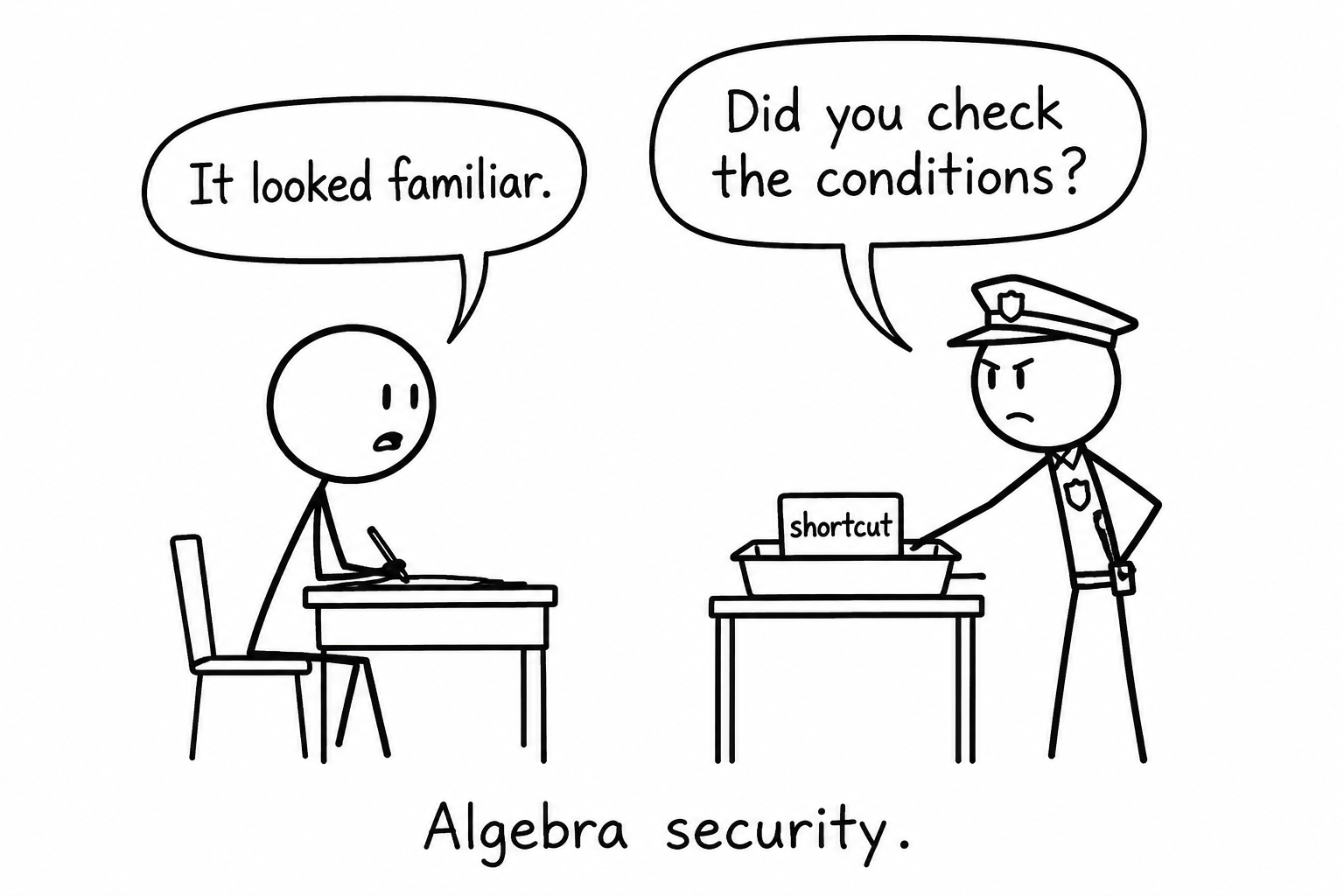 A student has an algebra shortcut inspected by a tiny security officer
Mistake: using the laws when the bases differ
The multiplication and division laws require the same base. You cannot combine 23×342^3 \times 3^423×34 by adding the indices because the bases are different.
For example:
a5×b2 a^5 \times b^2 a5×b2This cannot be simplified using an index law. It remains:
a5b2 a^5b^2 a5b2Sometimes a base can be rewritten first. Consider:
23×42 2^3 \times 4^2 23×42Since 4=224=2^24=22:
23×42=23×(22)2 2^3 \times 4^2=2^3 \times (2^2)^2 23×42=23×(22)2 =23×24 =2^3 \times 2^4 =23×24 =27 =2^7 =27The law becomes available only after both terms have the same base.
Mistake: subtracting in the wrong order when dividing
For division, subtract the index in the denominator from the index in the numerator.
Simplify:
p8÷p3 p^8 \div p^3 p8÷p3The correct calculation is:
p8−3=p5 p^{8-3}=p^5 p8−3=p5Students sometimes reverse the subtraction and write p−5p^{-5}p−5. Reading the fraction form can make the order clearer:
p8p3=p8−3=p5 \frac{p^8}{p^3}=p^{8-3}=p^5 p3p8=p8−3=p5If the larger index is in the denominator, a negative index may appear:
p3p8=p3−8=p−5=1p5 \frac{p^3}{p^8}=p^{3-8}=p^{-5}=\frac{1}{p^5} p8p3=p3−8=p−5=p51The Maths Genie explanation of fractional and negative indices gives a focused reminder of reciprocals, roots and powers.
Mistake: treating a negative index as a negative number
A negative index does not make the value negative. It tells you to take the reciprocal.
A student may incorrectly write:
3−2=−9 3^{-2}=-9 3−2=−9The correct method is:
3−2=132 3^{-2}=\frac{1}{3^2} 3−2=321 =19 =\frac{1}{9} =91With algebra:
x−4=1x4 x^{-4}=\frac{1}{x^4} x−4=x41If the negative power begins in the denominator, taking the reciprocal moves it to the numerator:
1x−3=x3 \frac{1}{x^{-3}}=x^3 x−31=x3The minus sign belongs to the index. It does not automatically belong to the final value.
Once this correction process feels clear, use the Fractional and Negative Indices Question Bank to practise spotting the same traps without setting up your own questions.
Mistake: saying that anything to the power zero is zero
The pattern behind the zero index law explains why a0=1a^0=1a0=1 for a non-zero base.
Consider:
a4a4=1 \frac{a^4}{a^4}=1 a4a4=1Using the division law gives:
a4a4=a4−4=a0 \frac{a^4}{a^4}=a^{4-4}=a^0 a4a4=a4−4=a0Therefore:
a0=1 a^0=1 a0=1For example:
70=1 7^0=1 70=1and
(3x)0=1 (3x)^0=1 (3x)0=1The whole expression inside the brackets is the base. This rule assumes that the base is not zero.
Mistake: confusing the numerator and denominator of a fractional index
In a fractional index, the denominator gives the root. The numerator gives the power.
For example:
6423 64^{\frac{2}{3}} 6432The denominator is 333, so take the cube root:
643=4 \sqrt[3]{64}=4 364=4Then apply the power of 222:
42=16 4^2=16 42=16Therefore:
6423=16 64^{\frac{2}{3}}=16 6432=16You can also square first and then take the cube root, although choosing the root first often keeps the numbers smaller. The Maths Genie revision guide for fractional and negative indices shows how the root and power fit together visually.
For AQA students, the same mathematical ideas are organised on the AQA Fractional and Negative Indices revision page. CCEA students can use the matching CCEA indices lesson.
Mistake: applying a power to only one factor
When brackets containing a product are raised to a power, every factor is affected.
Simplify:
(3x2)3 (3x^2)^3 (3x2)3Apply the power to 333 and to x2x^2x2:
(3x2)3=33(x2)3 (3x^2)^3=3^3(x^2)^3 (3x2)3=33(x2)3 =27x6 =27x^6 =27x6Writing 3x63x^63x6 misses the fact that the coefficient is also cubed. The same principle applies to fractions:
(2x5)2=(2x)252=4x225 \left(\frac{2x}{5}\right)^2=\frac{(2x)^2}{5^2}=\frac{4x^2}{25} (52x)2=52(2x)2=254x2Brackets define the entire base. Look inside them before applying the outside index.
Exam-style practice
Try these without looking back at the checklist. For each one, name the law before using it.
- Simplify a6×a3a^6 \times a^3a6×a3.
- Simplify (b4)2(b^4)^2(b4)2.
- Simplify c5c9\frac{c^5}{c^9}c9c5, giving your answer with a positive index.
- Evaluate 253225^{\frac{3}{2}}2523.
- Simplify (2x3)4(2x^3)^4(2x3)4.
- Explain why m2×n3m^2 \times n^3m2×n3 cannot be combined into one power using the multiplication law.
Answers
- a9a^9a9
- b8b^8b8
- c−4=1c4c^{-4}=\frac{1}{c^4}c−4=c41
- (25)3=53=125(\sqrt{25})^3=5^3=125(25)3=53=125
- 24(x3)4=16x122^4(x^3)^4=16x^{12}24(x3)4=16x12
- The bases are different, so the same-base multiplication law does not apply.
Do not mark only the final answers. Compare your first step with the correct law. In an exam, a reliable first step is often what separates an isolated slip from a repeated loss of marks.
Turn corrected mistakes into secure marks
Knowing the laws is not quite the same as choosing them accurately when expressions look similar. The student who improves is the one who practises that choice, checks why an error occurred and then attempts another question while the correction is still fresh. Your turn: start the matching Maths Genie Lessons and Question Bank and turn these index laws corrections into a repeatable exam method.















