Common Mistakes with Identities in GCSE Maths
Common mistakes with identities in GCSE Maths explained through worked examples, clear correction steps and exam-style practice to protect your marks in exams.
A student looks at an identity question and thinks it seems familiar. There are brackets, letters and an equals sign. They expand, rearrange and solve for xxx. The algebra may even be correct, yet the marks disappear because an identity is not an ordinary equation.
The most common mistakes with identities in GCSE Maths usually come from that single misunderstanding. An equation is true for particular values of a variable. An identity is true for every permitted value. To answer identity questions reliably, expand both sides, collect like terms and compare matching coefficients.
In the Edexcel GCSE Mathematics specification, students are expected to know the difference between an equation and an identity and use algebra to show that expressions are equivalent. The same core skills are useful across Edexcel, AQA, OCR and Eduqas questions.
The identities checklist
Before following the student through the errors, keep this method beside you:
- Look for the identity symbol ≡\equiv≡ or wording such as "for all values of xxx".
- Expand every bracket carefully.
- Collect like terms on each side.
- Write missing terms with coefficient 000 if needed.
- Compare the coefficients of matching powers, such as x2x^2x2, xxx and the constant term.
- Solve the resulting equations.
- Substitute your values back into the original identity to check them.
Secure expanding and collecting like terms first. The Expanding and Factorising practice booklet provides question-by-question practice with answers.
Mistake: treating an identity as an equation
The student sees
3(x+2)≡3x+63(x+2) \equiv 3x+63(x+2)≡3x+6and tries to solve for xxx.
Why it happens
Most algebra questions at GCSE use an equals sign and ask for one or more solutions. That familiar routine can take over. But this statement is true for every value of xxx because expanding the left-hand side produces the right-hand side exactly.
For example, when x=1x=1x=1, both sides equal 999. When x=10x=10x=10, both sides equal 363636. These are not the only solutions. They are simply two checks from infinitely many possible values.
Correct method
Expand the left-hand side:
3(x+2)=3x+63(x+2)=3x+63(x+2)=3x+6Both expressions are identical, so write:
3(x+2)≡3x+63(x+2) \equiv 3x+63(x+2)≡3x+6The symbol ≡\equiv≡ communicates that the expressions are equivalent for every value of xxx. By contrast,
3(x+2)=213(x+2)=213(x+2)=21is an equation with the particular solution x=5x=5x=5.
This distinction matters because an identity question is usually asking you to compare expressions, prove equivalence or find unknown coefficients. It is not asking you to find a value of the variable.
Mistake: comparing terms before expanding
Now the student meets:
a(x+3)+b≡4x+11a(x+3)+b \equiv 4x+11a(x+3)+b≡4x+11They compare what they can see and write a=4a=4a=4 and b=11b=11b=11.
Why it happens
The right-hand side is already simplified, while the left-hand side is not. The constant contribution from a(x+3)a(x+3)a(x+3) is still hidden inside the bracket.
Correct method
Expand the left-hand side first:
a(x+3)+b≡ax+3a+ba(x+3)+b \equiv ax+3a+ba(x+3)+b≡ax+3a+bNow compare it with:
4x+114x+114x+11The coefficient of xxx must match:
a=4a=4a=4The constant terms must also match:
3a+b=113a+b=113a+b=11Substitute a=4a=4a=4:
3(4)+b=113(4)+b=113(4)+b=11 12+b=1112+b=1112+b=11 b=−1b=-1b=−1Check these values in the original expression:
4(x+3)−1=4x+12−1=4x+114(x+3)-1=4x+12-1=4x+114(x+3)−1=4x+12−1=4x+11The expressions now match for every value of xxx.
You can use the Maths Genie Proof lesson and Question Bank to practise the same expand, compare and justify method without having to assemble the questions yourself.
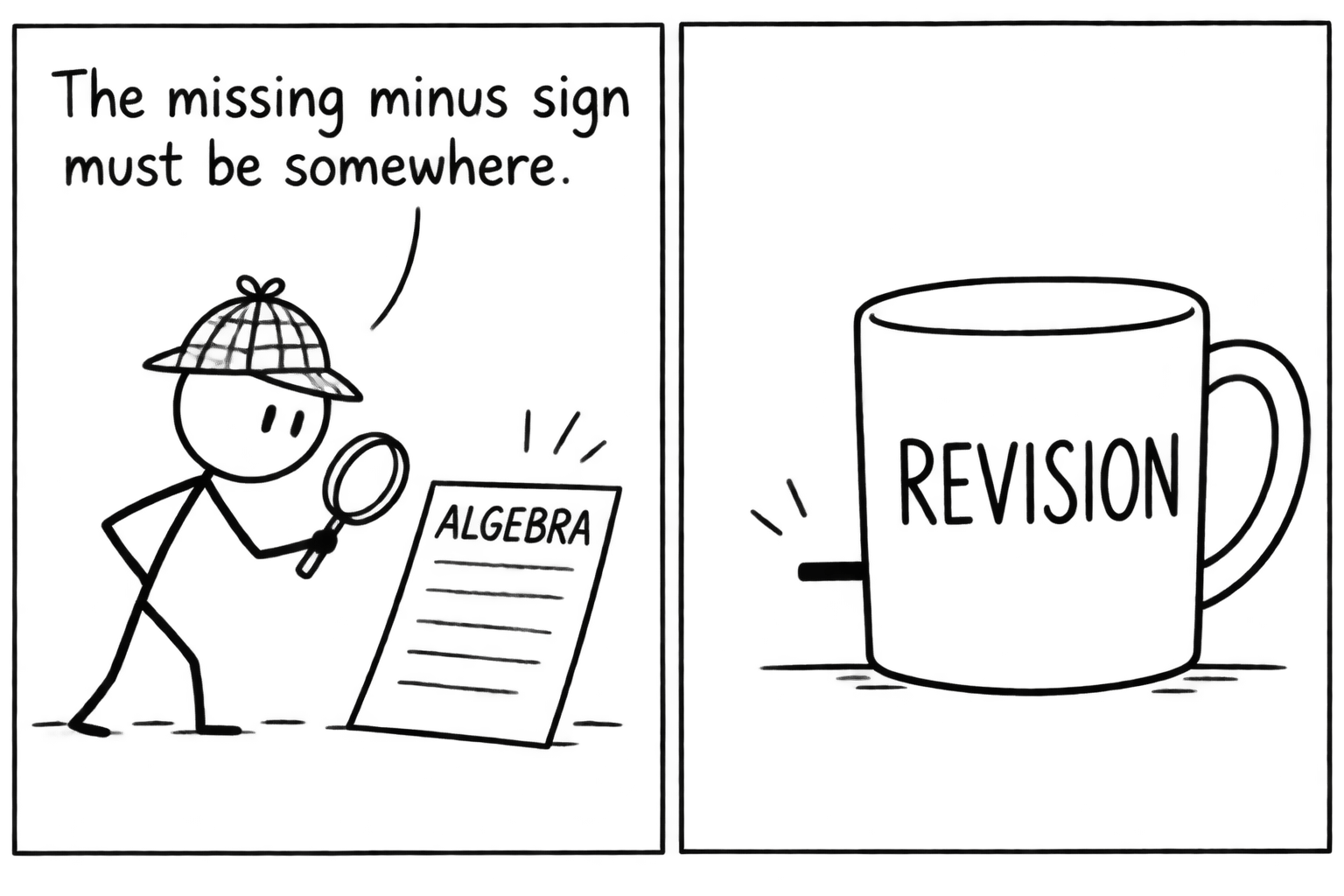 A stick-figure algebra detective searches for a missing minus sign hiding behind a revision mug
Mistake: losing a negative sign
The student is asked to find ppp and qqq when
p(x−2)+q≡5x−13p(x-2)+q \equiv 5x-13p(x−2)+q≡5x−13They expand the left-hand side as px+2p+qpx+2p+qpx+2p+q. That small sign error changes the entire problem.
Why it happens
Multiplication must apply to every term inside a bracket, including its sign. Here, multiplying ppp by −2-2−2 gives −2p-2p−2p.
Correct method
Expand accurately:
p(x−2)+q≡px−2p+qp(x-2)+q \equiv px-2p+qp(x−2)+q≡px−2p+qCompare the coefficients of xxx:
p=5p=5p=5Compare the constant terms:
−2p+q=−13-2p+q=-13−2p+q=−13Substitute p=5p=5p=5:
−2(5)+q=−13-2(5)+q=-13−2(5)+q=−13 −10+q=−13-10+q=-13−10+q=−13 q=−3q=-3q=−3Finally, check:
5(x−2)−3=5x−10−3=5x−135(x-2)-3=5x-10-3=5x-135(x−2)−3=5x−10−3=5x−13The student who checks by substitution catches many identities mistakes before moving on.
Mistake: matching the wrong coefficients
Consider:
(x+m)(x+n)≡x2+7x+12(x+m)(x+n) \equiv x^2+7x+12(x+m)(x+n)≡x2+7x+12The student writes m=7m=7m=7 and n=12n=12n=12 because those numbers appear on the right.
Why it happens
The constants inside the brackets do not become the coefficients on the right individually. Expanding shows how they combine.
Correct method
Expand the left-hand side:
(x+m)(x+n)≡x2+(m+n)x+mn(x+m)(x+n) \equiv x^2+(m+n)x+mn(x+m)(x+n)≡x2+(m+n)x+mnNow compare corresponding coefficients:
m+n=7m+n=7m+n=7and
mn=12mn=12mn=12Two numbers with sum 777 and product 121212 are 333 and 444. Therefore:
(m,n)=(3,4)(m,n)=(3,4)(m,n)=(3,4)or
(m,n)=(4,3)(m,n)=(4,3)(m,n)=(4,3)Both orders work because the two brackets can be reversed. Expanding verifies the result:
(x+3)(x+4)=x2+7x+12(x+3)(x+4)=x^2+7x+12(x+3)(x+4)=x2+7x+12For wider algebra revision, use the free GCSE Maths revision hub, where you can select your exam board and find relevant revision material. Edexcel students can also go directly to the Edexcel GCSE Maths revision page.
Mistake: ignoring a missing term
A question may state:
(x+r)2≡x2+6x+s(x+r)^2 \equiv x^2+6x+s(x+r)2≡x2+6x+sThe student focuses only on the constant sss and forgets that the middle term determines rrr.
Expand the square:
(x+r)2=x2+2rx+r2(x+r)^2=x^2+2rx+r^2(x+r)2=x2+2rx+r2Compare the coefficients of xxx:
2r=62r=62r=6 r=3r=3r=3Then compare the constant terms:
s=r2s=r^2s=r2 s=9s=9s=9A useful habit is to align expressions by descending powers:
x2+2rx+r2≡x2+6x+9x^2+2rx+r^2 \equiv x^2+6x+9x2+2rx+r2≡x2+6x+9If one side had no xxx term, its coefficient would be 000. Writing that zero explicitly can prevent you from comparing the wrong parts.
Exam-style practice
Try these without looking back at the examples. Show your expansion and coefficient comparisons because method marks may depend on visible working.
Question A
Find aaa and bbb:
a(x+4)+b≡6x+19a(x+4)+b \equiv 6x+19a(x+4)+b≡6x+19Question B
Find ppp and qqq:
(x+p)(x+q)≡x2+9x+20(x+p)(x+q) \equiv x^2+9x+20(x+p)(x+q)≡x2+9x+20Question C
Find rrr and sss:
(2x+r)(x+3)≡2x2+sx+12(2x+r)(x+3) \equiv 2x^2+sx+12(2x+r)(x+3)≡2x2+sx+12Answers
For Question A, comparing coefficients gives a=6a=6a=6. Then 4a+b=194a+b=194a+b=19, so b=−5b=-5b=−5.
For Question B, p+q=9p+q=9p+q=9 and pq=20pq=20pq=20. Therefore (p,q)=(4,5)(p,q)=(4,5)(p,q)=(4,5) or (5,4)(5,4)(5,4).
For Question C, the constant term gives 3r=123r=123r=12, so r=4r=4r=4. Expanding gives
(2x+4)(x+3)=2x2+10x+12(2x+4)(x+3)=2x^2+10x+12(2x+4)(x+3)=2x2+10x+12so s=10s=10s=10.
Turn careful working into dependable marks
The student’s progress does not come from memorising another isolated rule. It comes from slowing down at the right moments: identify the identity, expand fully, align like terms, compare coefficients and check the result. Knowing that routine is useful, but following it under exam pressure takes deliberate practice.
Start the Maths Genie Lessons and Question Bank and practise correcting the identity errors that could otherwise cost you marks.