

AQA Foundation Maths Grade Boundaries Explained
AQA foundation maths grade boundaries explained, including available grades, combined paper marks and past boundaries to guide effective GCSE revision.
AQA foundation maths grade boundaries are the minimum total marks needed for each grade. Your marks from three papers are added together, giving a total out of 240240240. Foundation tier offers grades 111-555, with grade 555 the highest available. Boundaries are not fixed percentages: they are set after the exams, when marking is nearly complete.
When you finish a practice paper, it is natural to ask what grade your mark represents. Past boundaries help answer that question, but they work best as revision benchmarks rather than promises about your eventual result.
AQA foundation grade boundaries at a glance
- There are three equally weighted papers, each worth 808080 marks.
- Each paper lasts 111 hour 303030 minutes.
- Paper 111 is non-calculator; Papers 222 and 333 allow a calculator.
- Your combined total determines your grade.
- There is no separate pass requirement for each paper.
- Boundaries can change between exam series.
The AQA GCSE Maths revision hub brings together topics, lessons and practice resources to help you prepare.
How the three paper marks combine
Each paper contributes one-third of the qualification. Your total is calculated as:
Total mark=Paper 1+Paper 2+Paper 3\text{Total mark}=\text{Paper 1}+\text{Paper 2}+\text{Paper 3}Total mark=Paper 1+Paper 2+Paper 3Compare that total with the foundation subject-level boundaries for the relevant series. A weaker non-calculator result can be balanced by stronger calculator papers, and the reverse is also true.
AQA may publish notional boundaries for individual components. These are illustrative; they do not create three separate grades that are averaged. Your qualification grade comes from the combined marks.
For comparisons with previous years, use the AQA GCSE Maths grade calculator. Select the correct tier and exam series before interpreting the result.
Which grades are available?
Foundation students can receive grades 111-555. Even an exceptionally high total cannot produce grade 666 or above; grades 666-999 require higher tier.
A total below the grade 111 boundary receives an unclassified result, shown as U.
Grade 444 is commonly described as a standard pass. However, colleges, sixth forms, apprenticeships and employers set their own entry requirements. Some ask for grade 555 or above, so check the requirement for your intended next step before choosing your revision target.
Past AQA foundation maths grade boundaries
These confirmed summer boundaries are qualification totals out of 240240240.
| Exam series | Grade 555 | Grade 444 | Grade 333 | Grade 222 | Grade 111 |
|---|---|---|---|---|---|
| June 202320232023 | 189189189 | 158158158 | 117117117 | 767676 | 353535 |
| June 202420242024 | 186186186 | 157157157 | 117117117 | 777777 | 373737 |
| June 202520252025 | 188188188 | 160160160 | 119119119 | 797979 | 393939 |
For June 202520252025, grade 444 required approximately 66.7%66.7\%66.7%, while grade 555 required approximately 78.3%78.3\%78.3%. Those percentages apply only to that series.
The table shows why a single remembered threshold can mislead. Boundaries moved by relatively few marks across these years, but even a small change matters when your total sits close to a grade threshold.
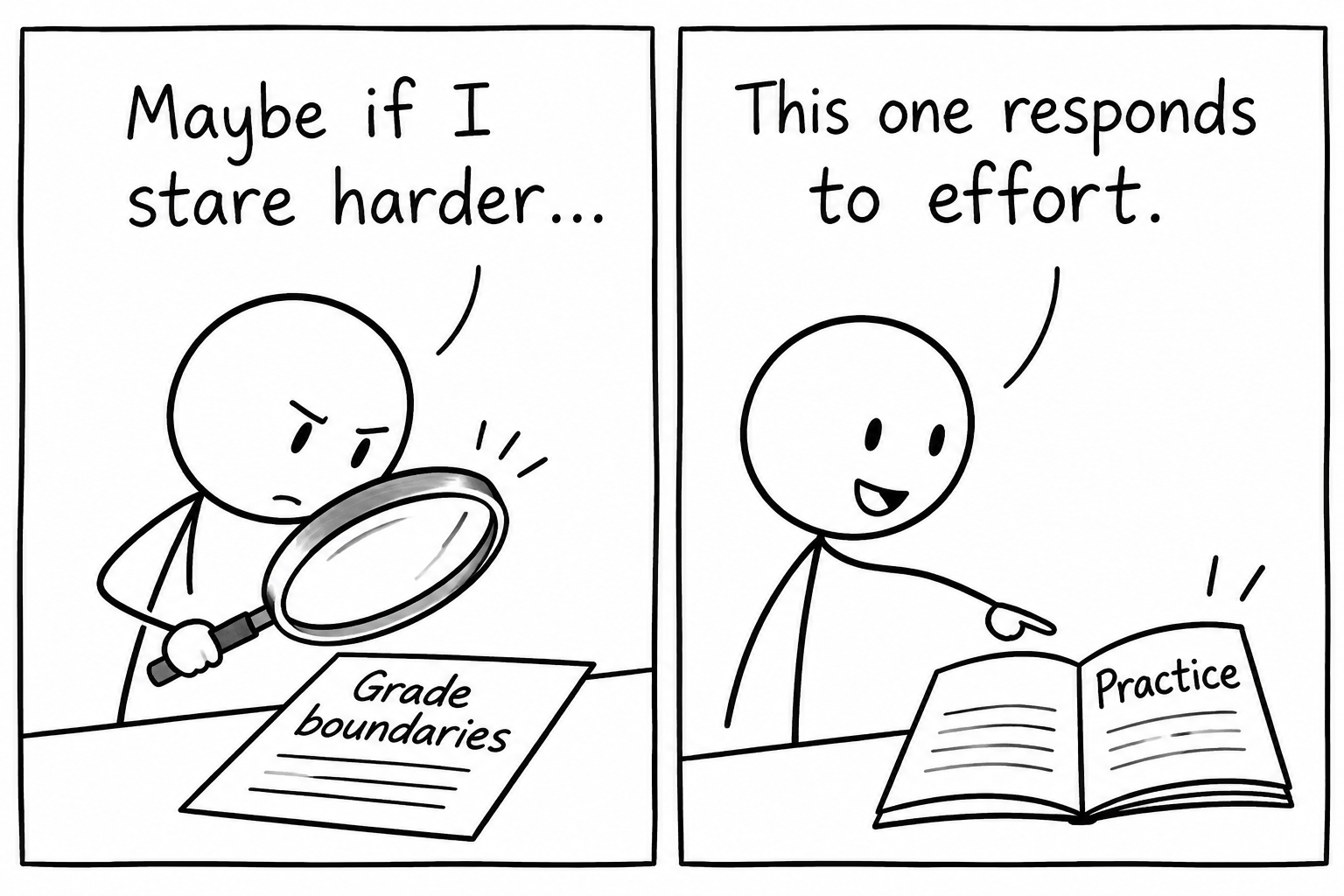 A student discovers that practice is more responsive than staring at grade boundaries
Why boundaries change
Papers assess the same specification, but their difficulty can vary. Awarding considers evidence about question difficulty, students’ work and performance across the cohort to keep grading standards comparable.
A more demanding set of papers may therefore have lower boundaries. A more accessible set may have higher ones. This does not mean that a fixed percentage of students must receive each grade.
Read how GCSE grade boundaries work for more context on the process.
Use boundaries to plan your revision
Aim to build a margin above recent boundaries rather than matching one exactly. That gives you room for unfamiliar questions and occasional mistakes. Discuss a sensible target with your teacher, using several practice results rather than one unusually strong paper.
Follow this revision cycle:
- Complete AQA GCSE Maths past papers under timed conditions.
- Mark your work carefully using the mark scheme.
- Record which topics caused lost marks.
- Revisit the relevant lesson and practise focused questions.
- Check your understanding again before attempting another full paper.
The AQA GCSE Maths question bank helps you focus on specific weaknesses. Recording why an answer went wrong is useful too: misunderstanding a method needs a different response from misreading a question or rounding too early.
Choose topics that strengthen your total
Reliable methods across common topics can recover marks throughout a paper. Fractions, percentages, ratio, algebra, graphs, measures and geometry all deserve attention.
Start with the fractions, decimals and percentages lesson, then use AQA ratio practice questions to check whether you can apply related skills independently.
MathsGenie’s revision lessons, practice questions and mini tests support this process. Mark schemes and video solutions help explain errors, while past papers and predicted papers provide broader practice. Use the revision planner to spread your priorities across manageable sessions.
Common mistakes with grade boundaries
Treating previous boundaries as guarantees
A boundary belongs to its particular exam series. Use several years as guidance and leave room for movement.
Judging your grade from one paper
Add all three marks before comparing your performance with a subject boundary.
Checking the wrong tier
Confirm that your table covers AQA specification 830083008300, foundation tier. Higher-tier boundaries cannot be applied to foundation papers.
Mixing marks and percentages
Published boundaries use raw marks. To convert your total:
Percentage=total marks240×100\text{Percentage}=\frac{\text{total marks}}{240}\times100Percentage=240total marks×100Tracking grades without reviewing errors
A grade estimate identifies your current position. Your marked answers reveal what to practise next.
Turn your result into a next step
AQA foundation maths grade boundaries give your revision direction, but the most useful information sits inside your marked papers. Identify recoverable marks, choose one weak topic and work through its MathsGenie lesson and questions. Then return to exam practice and check whether your understanding holds. Start with the resources above and make your next revision session specific.















