AI Tools to Revise GCSE German: What Really Helps
AI tools revise GCSE German best through recall, feedback and practice. Learn what genuinely helps, what misleads, and how to check every AI answer.
A blank speaking card can feel more intimidating than a crowded maths paper. You know some German, but retrieving the right phrase quickly is another matter. An AI chatbot promises instant questions, corrections and conversation. It sounds ideal.
Students asking whether AI tools revise GCSE German effectively deserve a clear answer: yes, they can help with vocabulary retrieval, conversation practice, grammar feedback and revision planning. But they can also invent rules, produce unnatural language and make weak work appear polished. AI is most useful as a practice partner, not as an examiner, mark scheme or substitute for thinking.
That distinction matters. The goal is not to make the chatbot good at German. The goal is to make you better at German when the chatbot is no longer there.
Your AI revision checklist
Before using ChatGPT or another generative AI tool, check that you can answer these questions:
- What precise skill am I practising: listening, speaking, reading, writing, grammar or vocabulary?
- Is the activity appropriate for my exam board, tier and current specification?
- Will I attempt the task before asking for help?
- How will I verify corrections against trusted classroom materials?
- Am I retrieving German from memory rather than copying generated sentences?
- Does my teacher permit AI for this task?
A productive session begins with a narrow purpose. “Help me revise German” gives the tool too much room to wander. “Test me on ten school-topic nouns, one at a time, and do not reveal the answer until I respond” is far more useful.
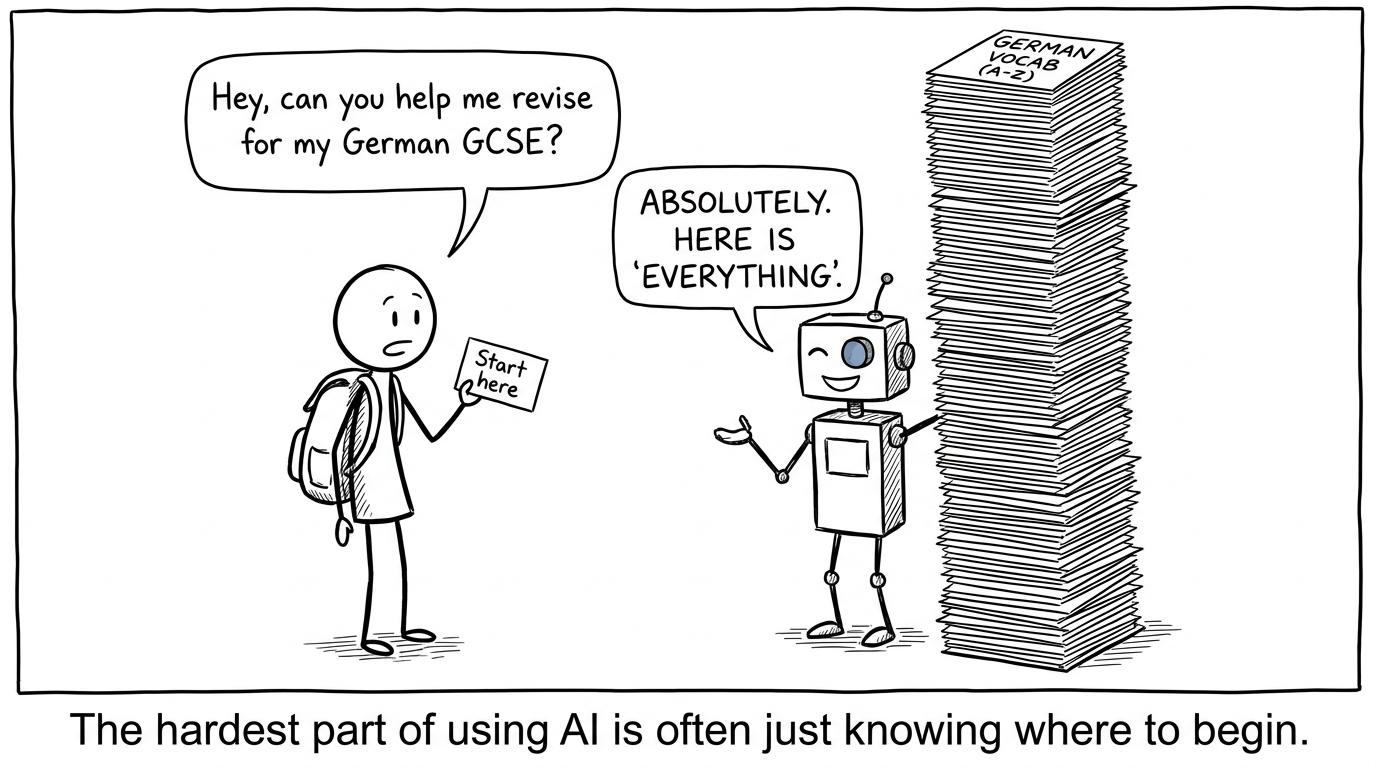 A student receives rather more AI revision help than requested
Where AI tools can help with GCSE German
Vocabulary retrieval rather than vocabulary copying
AI can turn a vocabulary list into short quizzes, matching activities, gap-fill questions or translation prompts. Ask it to present one item at a time and revisit words you miss later in the session.
This works best when you supply the vocabulary yourself from your specification, textbook or teacher. A chatbot-generated list may include words outside the course, omit required vocabulary or use a regional or unusual expression.
The important action is retrieval. Reading a list feels fluent because every answer is visible. Trying to recall die Umwelt or the correct article without looking exposes what you genuinely know.
Useful prompt instructions include:
- use only the vocabulary list I paste below;
- ask one question at a time;
- keep a record of my incorrect answers;
- repeat missed words after several other questions;
- do not accept a noun unless I include its gender.
Low-pressure speaking practice
A chatbot can simulate short role-play exchanges and generate follow-up questions on familiar GCSE themes. Voice-enabled tools may also give you more opportunities to speak aloud, especially when no practice partner is available.
However, voice recognition is not the same as an examiner's judgement. It can misunderstand a valid pronunciation or accept speech that needs improvement. Treat its reaction as a prompt to practise again, not as a reliable prediction of your speaking mark.
Ask for short, age-appropriate questions and insist that the conversation remains at GCSE level. After answering aloud, note the phrases that were difficult to retrieve. Those gaps should shape your next session.
Grammar diagnosis
AI can help identify possible problems with word order, verb position, adjective endings, cases, tense formation and agreement. It is particularly useful when you ask it to label a suspected error rather than replace your entire response.
For example, you might ask it to highlight possible word-order errors without rewriting any sentences. You can then make the corrections yourself and check them against your notes or with your teacher.
This preserves the difficult part of revision: deciding what should change. If the tool silently transforms your paragraph into sophisticated German, you receive a better paragraph but very little practice.
Creating fresh practice material
Once you have finished the questions supplied by your school, AI can generate additional short texts, comprehension questions or photo-card themes. Specify the topic, approximate difficulty and vocabulary boundaries. You can also ask for distractors that test commonly confused words.
Generated material should supplement official and teacher-approved resources, not replace them. It has not been through an exam board's quality assurance process, and its questions may not reflect the wording, timing or demand of the real assessment.
Building a balanced revision plan
German is not one skill. A student who spends every evening polishing written paragraphs may still struggle to understand speech at normal speed or answer an unexpected speaking question.
Ask AI to organise your available time across listening, speaking, reading, writing, vocabulary and grammar. Then adjust the plan around evidence: recent class assessments, teacher feedback and the mistakes you repeatedly make.
This principle also applies to maths. A plan should lead to actual questions, not become a colourful form of procrastination. Maths students can begin with the GCSE maths revision resources, then use topic results to decide what needs attention next.
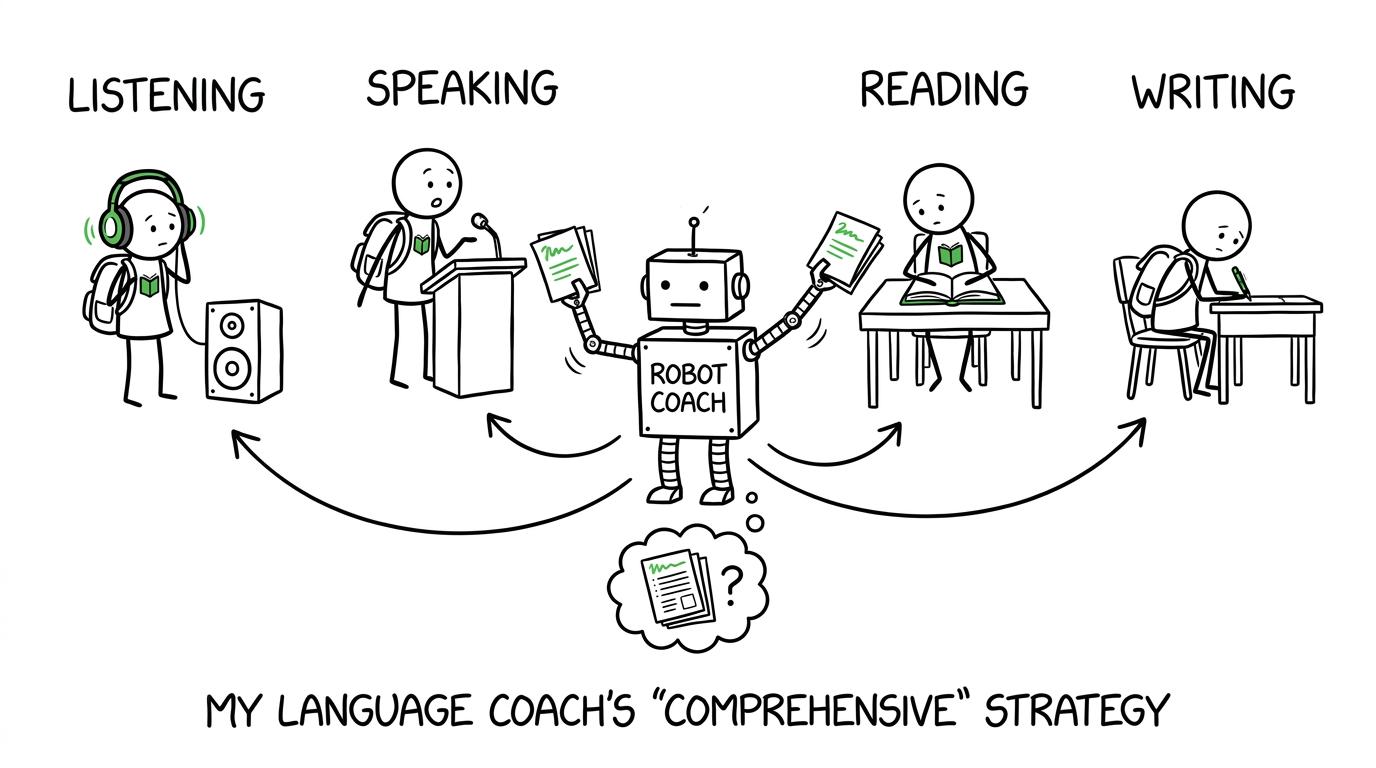 A robot attempts to coach only one of four language skills
Where AI tends to lead students astray
Confidently incorrect explanations
Generative AI predicts plausible language. It does not consult a perfect internal grammar book before every answer. It may state a false rule confidently, misidentify a case or change its explanation when challenged.
Verify important grammar against your course materials or teacher. If two answers conflict, do not ask the chatbot to vote on its own work. Find an authoritative source.
Language that does not sound like you
AI often produces writing that is longer, smoother and more advanced than a student's normal classroom work. That can hide the vocabulary and structures you actually need to practise. It may also introduce idioms you cannot explain or reproduce independently.
A useful correction should remain close to your original level. Ask for the smallest necessary changes, with each suggestion explained. Your final answer should be language you understand and could create again under timed conditions.
Unreliable marking
A chatbot can offer broad feedback, but it cannot award an official GCSE mark. Exam boards use defined assessment objectives and mark schemes, and some judgements depend on the response as a whole. AI may overlook task completion, reward irrelevant complexity or apply criteria from the wrong specification.
Use official materials to understand the real standard. In maths, the same discipline means checking work against GCSE past papers and mark schemes, rather than trusting a score generated without the official marking guidance.
Revision that feels active but is passive
There is a subtle trap in watching AI explain everything. The conversation moves quickly, so it feels productive. Yet recognition is easier than recall.
Close the explanation. Say the answer aloud. Write it from memory. Return later and try again. The small struggle is not evidence that revision has failed; it is often the part that makes revision useful.
Maths exposes the same illusion. Reading a solution to an equation is different from solving one independently. A structured solving equations revision lesson is most valuable when followed by practice without the solution in view.
A safer way to use ChatGPT for German revision
Use a simple cycle: attempt, diagnose, verify, improve and retest.
Attempt before opening AI
Complete the sentence, translation, speaking response or paragraph independently. If you need support, mark the uncertain section rather than abandoning the whole task.
Request limited feedback
Tell the tool exactly what it may do. Ask it to identify up to three likely errors, name the relevant grammar rule and avoid rewriting the response. Limited feedback makes you choose the correction.
Verify what matters
Check vocabulary, grammar rules and assessment advice against your specification, textbook, teacher materials or official mark scheme. This is especially important for students sitting revised GCSE German qualifications in England, where the applicable specification depends on the exam series and exam board. Use the documents your school has confirmed rather than assuming every online resource matches your course.
Improve the original response
Rewrite the answer yourself. Keep only expressions you understand. If you cannot explain why a correction is right, it is not yet secure knowledge.
Retest without support
Return to the same language later without AI. Can you retrieve the corrected phrase in a different context? That delayed attempt reveals whether the revision changed your memory or merely changed the page.
Using AI responsibly for assessed work
AI may be acceptable for private practice when your school allows it. It is not acceptable to submit generated work as your own or use unauthorised assistance in an assessment. Schools and awarding organisations set rules for assessed work, and your teacher's instructions take priority.
Never enter personal information, login details or confidential assessment materials into a public chatbot. Be cautious with voice recordings too. Check the tool's privacy controls and use a school-approved service where one is provided.
During formal GCSE examinations, use only the materials and equipment permitted for that assessment. AI is a revision aid before the exam, not something available inside it.
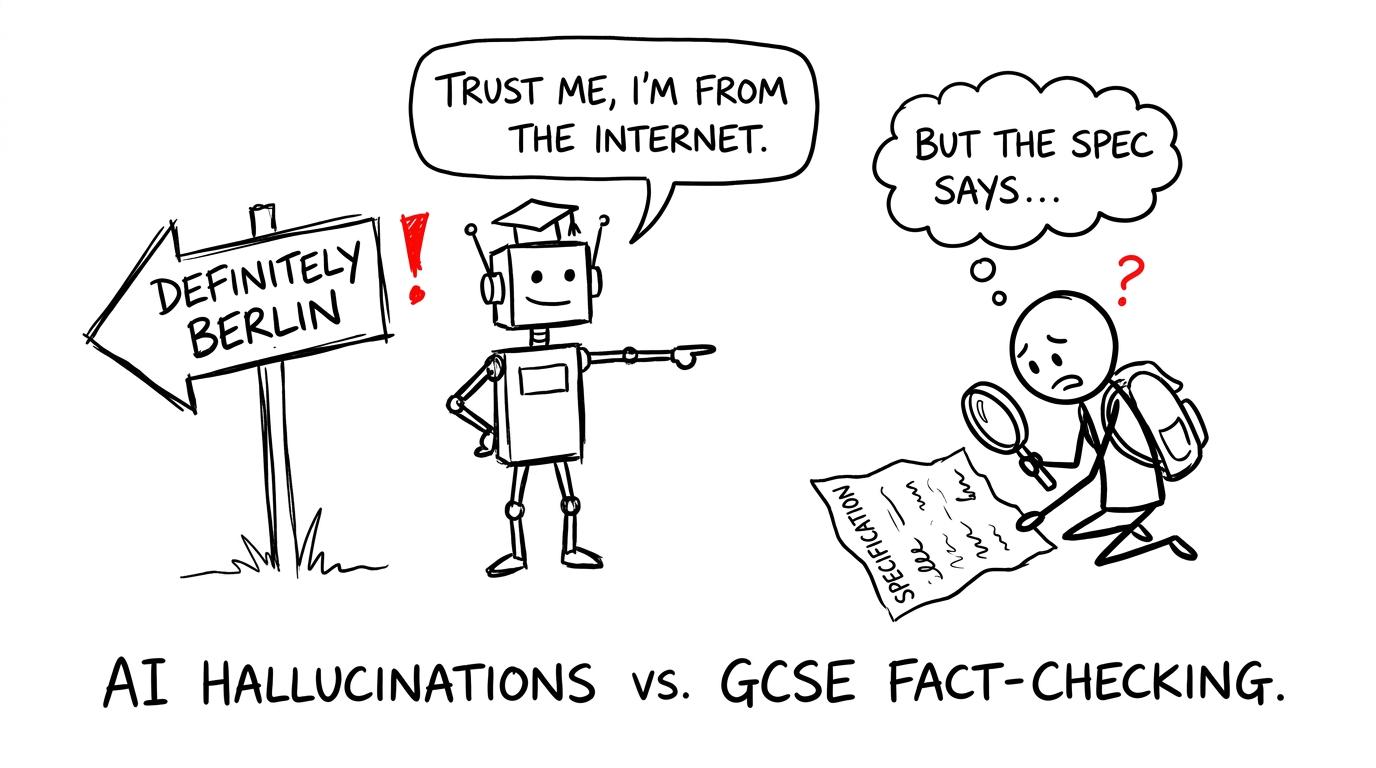 A very confident robot is checked against the specification
Common mistakes when revising with AI
Asking vague questions
A broad request produces broad material. State the skill, theme, tier, format and limits. Supply the vocabulary or text when accuracy matters.
Accepting the first correction
AI output can be wrong. Check surprising advice, especially where it contradicts your teacher or established notes.
Letting AI write every answer
Generated model answers are easy to admire and hard to reproduce. Attempt the task first, then request hints or diagnosis.
Ignoring listening and speaking
Text chat naturally pulls revision towards reading and writing. Schedule deliberate listening and spoken retrieval so all four language skills receive attention.
Confusing feedback with an official mark
Only the applicable assessment criteria and authorised marking process determine your result. Treat an AI score as an informal opinion.
Using technology instead of exam practice
The final stage of preparation should resemble the task you will sit. The equivalent in maths is moving from a revision lesson to timed questions, predicted GCSE maths papers and official past papers. Topic resources such as fractions revision and practice or probability revision questions are useful when the evidence reveals a specific weakness.
Make AI the assistant, not the author
The best AI revision is slightly inconvenient. It makes you retrieve a word, explain a correction, speak without a script and return to an error later. The least useful AI revision removes every difficult decision and leaves you with polished work you could not recreate.
Use ChatGPT for extra prompts, controlled quizzes and limited feedback. Use your teacher, current specification and official materials for authority. Most importantly, keep producing answers without assistance.
And when German revision is finished and maths is next on the timetable, switch to resources built around the real course. MathsGenie's free GCSE maths revision hub combines revision lessons, videos, practice questions and mini tests, while its past papers, mark schemes and predicted papers help turn knowledge into exam-ready performance. Students continuing beyond GCSE can also explore the A Level maths revision resources.
Let AI create another question if it helps. Then close it, attempt the question yourself, and discover what you really know.