

AI Quiz GCSE English Language: A Safe Revision Guide
AI quiz GCSE English Language revision can work well. Learn how to prompt it, check unreliable feedback, and practise safely and productively.
Revision often stalls for a simple reason: testing yourself requires more effort than rereading notes. You need questions, feedback and another attempt. An AI quiz GCSE English Language tool can provide that structure within seconds. It can test terminology, ask you to analyse a short extract, challenge your interpretation and adapt its next question to your answer.
The short answer is yes, you can use AI to quiz yourself productively. But it should be treated as a questioning partner, not an examiner. AI can produce inaccurate explanations, invent details and misapply a mark scheme while sounding completely confident. The safest approach is to use it for retrieval and discussion, then verify its advice against your exam board's specification, past papers and official mark schemes.
That distinction matters for students balancing English with GCSE maths. Good revision saves time; unreliable revision quietly wastes it.
Your AI quiz checklist
Before beginning, make sure the tool knows:
- your exam board, such as AQA, Edexcel, OCR or Eduqas;
- that you are revising GCSE English Language, not English Literature;
- the particular paper, section or skill you want to practise;
- whether you want quick recall, analysis questions or writing planning;
- that it must ask one question at a time;
- that it should wait for your answer before giving feedback;
- that uncertain claims must be identified rather than guessed;
- that you will check important feedback against official materials.
AI works better when the task has boundaries. Asking it to “quiz me on English” is rather like opening a revision guide at a random page. You may do something useful, but you have surrendered control over what that something will be.
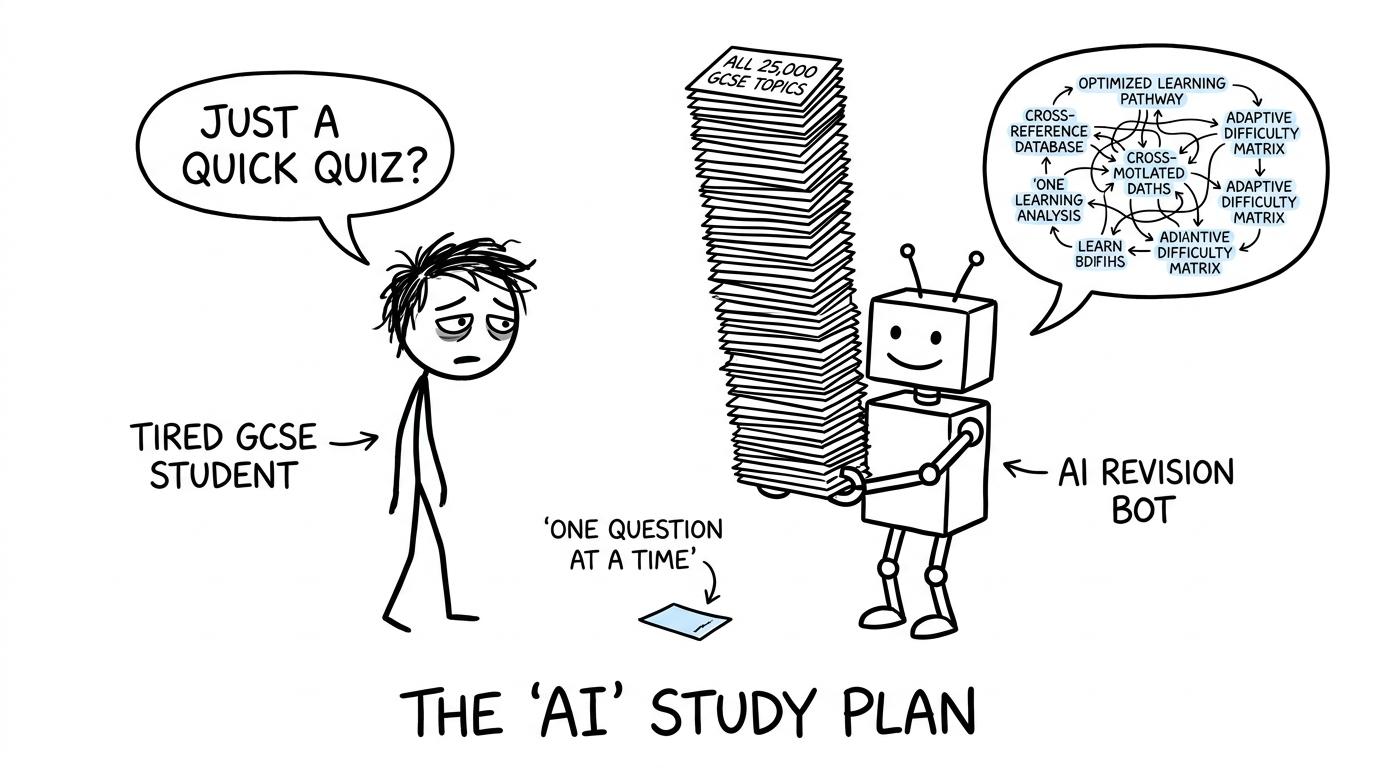 A student discovers that an AI quiz has produced far too many flashcards
How to set up an AI GCSE English Language quiz
Start by checking your exam board's current specification and the materials supplied by your school. GCSE English Language qualifications assess closely related reading and writing skills, but paper structures, question wording and assessment arrangements are not identical across boards. A generic quiz can therefore be useful for language terminology while still being poorly matched to your actual examination.
A strong opening instruction might tell the tool:
Act as a GCSE English Language retrieval coach. I study with [exam board]. Quiz me on [paper, section or skill]. Ask one question at a time and do not reveal the answer until I respond. After each answer, identify one strength, one precise improvement and the relevant skill. Do not invent quotations, mark-scheme wording or exam-board rules. Tell me when something needs checking against an official source.
This is not a magic prompt. It is simply a clear set of expectations. You should still monitor the output.
Choose the right kind of question
AI can support several distinct forms of revision:
- Retrieval questions can test terms such as metaphor, juxtaposition, tone, structure and semantic field.
- Identification questions can ask you to locate relevant details in a supplied extract.
- Analysis questions can ask how a writer's choice creates an effect.
- Comparison questions can help you consider similarities and differences between two supplied texts.
- Planning questions can prompt ideas for descriptive, narrative, persuasive or transactional writing.
- Reflection questions can ask what you would change after comparing your response with reliable criteria.
Do not combine all of these into one enormous session. A short quiz with a clear purpose makes it easier to notice what you genuinely know.
Make retrieval happen before feedback
The most important instruction is “wait for my answer”. If the tool displays the question, hints and model response together, you may recognise the explanation without being able to produce it independently.
Ask for a hint only after making a serious attempt. Then answer again before viewing a fuller explanation. The slight discomfort of trying to remember is not evidence that revision has failed; it is the part that turns passive familiarity into usable knowledge.
This principle transfers directly to maths. On MathsGenie, a student can learn a method through the GCSE maths revision resources, then close the explanation and attempt questions independently. In both subjects, the answer you can recognise is not always the answer you can produce under exam conditions.
Give the AI appropriate source material
For text-based analysis, paste or upload only material you are permitted to share. Ask the tool to base every question on that material and to quote directly from it when discussing evidence. This reduces the chance of fabricated quotations, although it does not remove the need to check them.
Avoid entering personal information, school login details, unpublished assessment material or identifying information about another student. Follow your school's rules and the platform's privacy terms. If a teacher has set work to be completed independently, using AI to generate the submitted response may breach those instructions even if the resulting prose sounds polished.
You remain responsible for work submitted as your own. A sensible boundary is to use AI to ask questions, expose gaps and suggest what to revisit. It should not quietly become the author of your answer.
Where AI feedback can help
AI is often useful when it keeps feedback narrow. Ask it to comment on one feature at a time, such as whether you selected relevant evidence, explained the effect of a language choice or maintained an appropriate tone.
You can also request questions that respond to weakness. If your answer identifies a technique but does not explain its effect, the next question might focus only on developing interpretation. That immediate adjustment is difficult to obtain from a static list of flashcards.
For students managing several subjects, this can make a short revision block productive. You might use AI for a focused English retrieval session, then move to GCSE maths past papers rather than spending the evening designing resources. The goal is not to revise continuously. It is to remove enough friction that you begin the right task.
Where AI tends to give bad information
Generative AI predicts plausible responses. It does not possess an examiner's authority, and confidence is not proof of accuracy.
Invented quotations and textual details
An AI tool may produce a quotation that sounds suitable but does not occur in the extract. It may also confuse speakers, events or structural features. Keep the source text visible and verify every quotation yourself.
Confused exam-board advice
Question formats, paper structures and assessment details can change or differ between specifications. AI may blend information from AQA, Edexcel, OCR and Eduqas, or reproduce outdated guidance. Check such claims against your current official specification, past paper and mark scheme.
Unreliable marking
AI can suggest improvements, but a precise mark or grade should be treated cautiously. English responses allow legitimate differences in interpretation, and marking depends on the wording of the question and its assessment criteria. A teacher or examiner-standard mark scheme offers stronger evidence than an unsupported AI estimate.
Overconfident terminology
A tool may label a feature incorrectly or imply that naming a technique automatically earns marks. The label matters less than a relevant explanation of how the writer's choice shapes meaning, tone or reader response.
Generic “perfect” answers
AI-generated model paragraphs often sound tidy but repetitive. They may make broad claims, force terminology into every sentence or ignore the exact question. Reading these answers can also create the illusion that you have practised when the tool has done the difficult thinking.
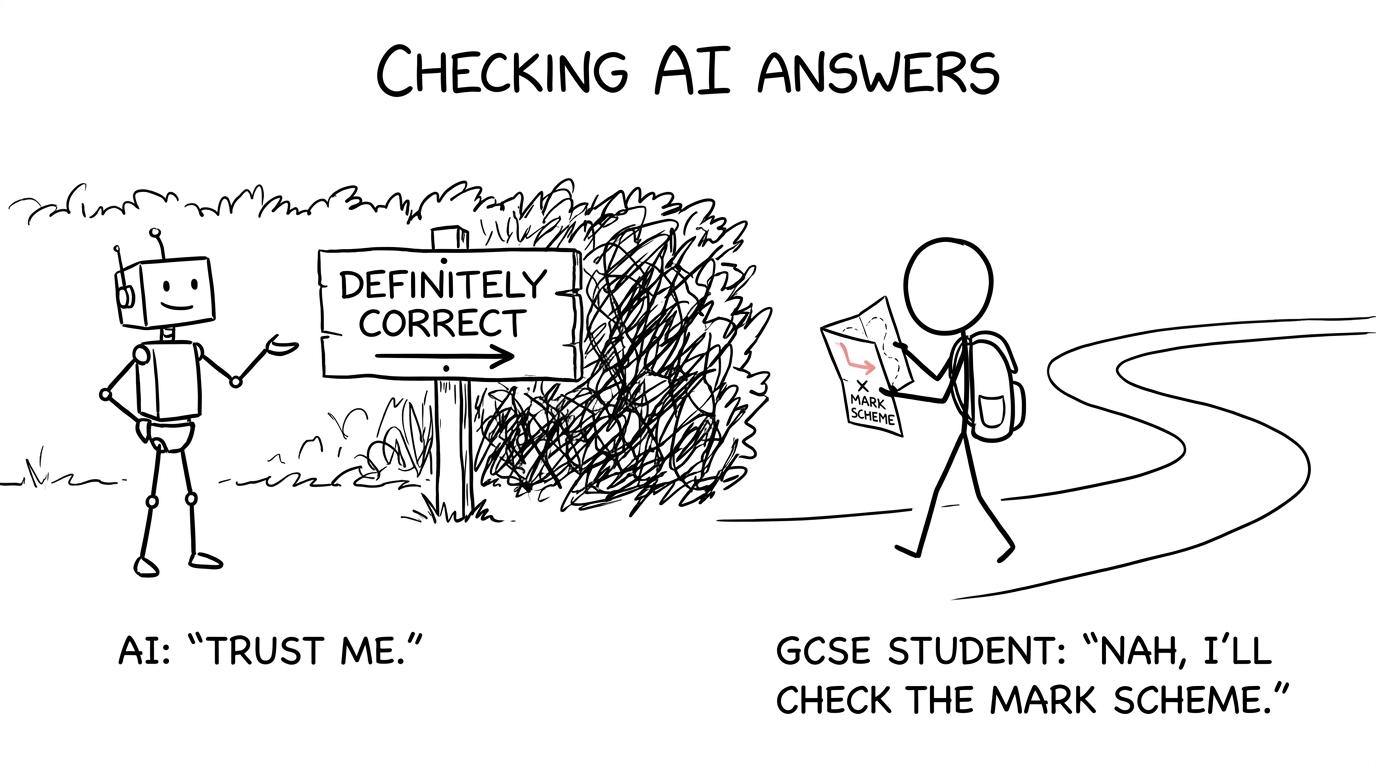 A confident robot points towards a hedge while a student checks the official map
How to check an AI answer properly
Use a simple verification ladder:
- Check the source text: Is each quotation exact and relevant?
- Check the question: Has the feedback addressed the command word and focus?
- Check official materials: Does the advice agree with the current specification and mark scheme?
- Check with a teacher: Ask when interpretations, marks or exam rules remain uncertain.
- Try again independently: Can you improve the answer without copying the AI's wording?
This is the same discipline that makes maths revision dependable. A generated question may be useful, but official examination practice tells you what the real assessment feels like. MathsGenie's predicted GCSE maths papers can support preparation, while official-style exam paper practice develops the independence required in the examination itself.
Build a revision routine that transfers to maths
English and maths can feel very different, yet effective revision in both subjects follows a similar loop:
- recall something without support;
- attempt a question;
- check the response against trustworthy criteria;
- identify one gap;
- practise that gap again later;
- finish with independent, timed work.
Use AI near the beginning of that loop, where flexible questioning and quick feedback are helpful. Move away from it near the end. In the examination, there will be no adaptive chatbot offering a hint after every sentence.
A practical weekly routine might include short AI retrieval quizzes for English, teacher-set written responses and timed past-paper sections. For maths, combine targeted MathsGenie GCSE revision lessons with full GCSE examination papers and mark schemes. Students continuing beyond GCSE can apply the same process through the A Level maths revision hub.
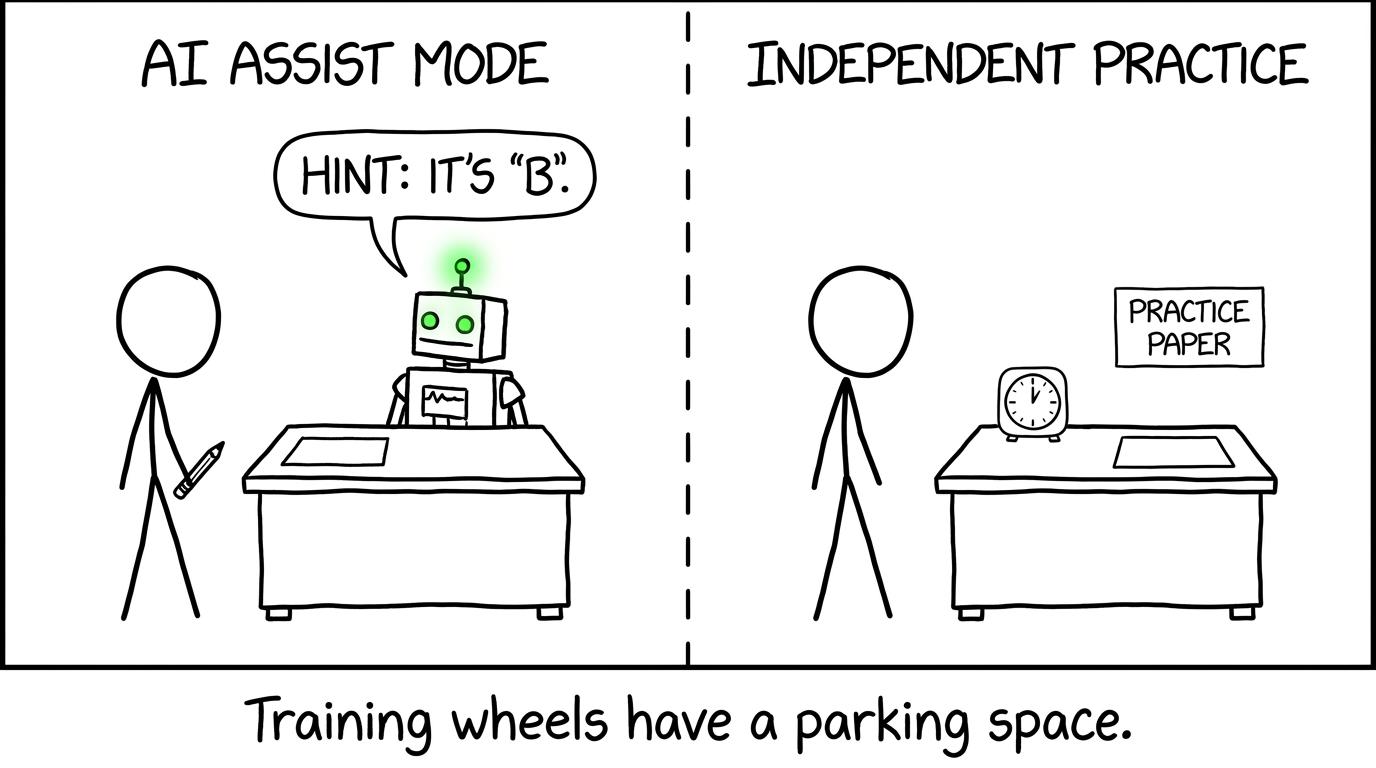 A student moves from AI hints to independent timed practice
Common mistakes when using AI quizzes
Leaving the request too vague
A broad request produces broad revision. Name the board, paper, skill, difficulty and feedback format.
Accepting every correction
AI can be wrong while sounding certain. Verify quotations, assessment language and examination rules rather than relying on tone.
Reading instead of answering
Watching the tool generate questions and explanations is not retrieval practice. Answer before revealing feedback, preferably away from your notes.
Asking for a complete response too early
If AI writes the paragraph, you lose the chance to organise your own interpretation. Ask for a question, a planning prompt or one targeted hint instead.
Treating an AI mark as official
Use the comments to locate possible weaknesses, not as a guaranteed grade prediction. Confirm important judgements through mark schemes and teacher feedback.
Never removing the support
Hints are training wheels, not the destination. Finish with an unseen extract or timed task without AI assistance.
Use AI as a coach, not a shortcut
An AI quiz can make GCSE English Language revision more active, responsive and easier to begin. Its best role is asking focused questions and helping you notice gaps. Its weakest role is acting as the final authority on quotations, marks, specifications or the quality of submitted work.
Set clear boundaries, answer before requesting help and verify important claims. Then close the tool and practise independently.
The same habit can strengthen your maths preparation. Start with the free MathsGenie revision website, choose a topic lesson, complete the practice questions and mini tests, then progress to past papers, predicted papers, mark schemes and video solutions. Technology is most valuable when it leads you back to doing the thinking yourself.










