

Active Recall GCSE English Language: Does It Work?
Active recall GCSE English Language guide: discover why retrieval practice beats rereading and how to use it for stronger reading and writing revision.
A page can look familiar without being remembered. That is the trap. You reread a list of language techniques, recognise every term and close the book feeling prepared. In the exam, however, the name of the method or the structure of an answer refuses to appear.
Active recall for GCSE English Language does work, particularly for remembering terminology, question requirements, writing structures and recurring weaknesses. It usually offers more useful revision than rereading because you must retrieve information without seeing the answer. But English Language is also a skills-based subject, so recall must be combined with unseen texts, timed writing and feedback.
This distinction matters. Active recall helps you bring the right tools into the exam; deliberate practice teaches you how to use them.
Active recall GCSE English Language checklist
A productive routine should include:
- closed-book retrieval rather than copying notes;
- short questions based on your exam board and paper;
- recall of methods, structures and question requirements;
- application to unfamiliar extracts and writing tasks;
- immediate checking against reliable notes or mark schemes;
- correction of incomplete or inaccurate answers;
- repeated retrieval after a gap;
- timed practice once your knowledge is secure.
If you are preparing for maths exams as well, the principle transfers neatly. Learning a method and applying it under exam conditions are separate jobs. MathsGenie's GCSE maths revision resources similarly combine explanations, videos and questions so that revision does not stop at recognition.
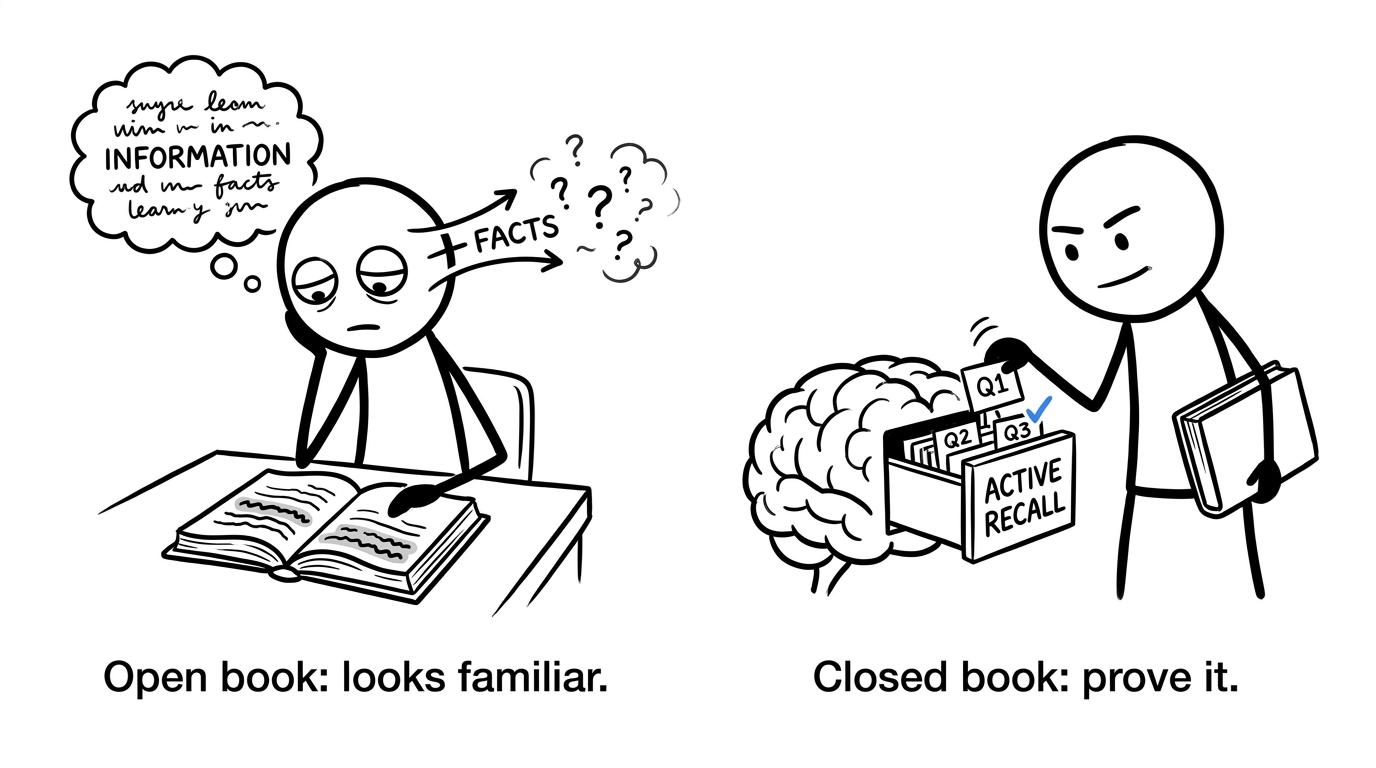 A student compares comfortable rereading with closed-book recall
Why active recall tends to beat rereading
Rereading is easy to mistake for learning because the material becomes familiar. Familiarity feels fluent: you recognise the page, the highlighted phrase and perhaps where a definition appeared. Yet an exam does not ask whether something looks familiar. It asks you to produce useful knowledge without the page in front of you.
Active recall recreates that demand. When you close your notes and answer a question from memory, you discover what is genuinely available to you. The effort involved in retrieving an answer can strengthen later access to that information, especially when recall is repeated over time and followed by feedback.
The broad evidence on retrieval practice supports this principle across many learning contexts. However, it should not be reduced to the claim that flashcards solve everything. Retrieval is most effective when questions match what students will eventually need to know, errors are corrected and practice is spaced rather than crammed into one sitting.
For English Language, that means recalling more than isolated definitions. Knowing that personification gives human qualities to something non-human may be useful, but analysis also requires you to explain what a particular choice suggests in its context. The term is a tool, not the finished answer.
What should you actively recall for GCSE English Language?
The exact paper structure and wording vary across AQA, Edexcel, OCR and Eduqas. Always build your prompts from your current specification, teacher guidance and official assessment materials rather than assuming that another exam board uses identical questions.
Question requirements
For each paper, you should be able to recall:
- what each question asks you to do;
- which reading or writing skill it assesses;
- which part of the source you need to use;
- whether comparison is required;
- how much time you intend to spend;
- what a complete response needs to contain.
A blank paper map is useful. Close your notes and reconstruct the order and purpose of the questions. Then check it carefully. This reduces the mental effort spent decoding instructions during the exam, leaving more attention for the text itself.
Language and structural methods
Recall accurate definitions of methods you can genuinely recognise and discuss. These may include imagery, contrast, sentence forms, shifts in focus, narrative perspective, tone and patterns in paragraph structure.
Avoid building an enormous collection of sophisticated labels. A smaller vocabulary used precisely is more valuable than dozens of terms you cannot connect to meaning. Your prompts should therefore ask two things: what does the method mean, and what kind of effect or idea might it help you explore?
Analytical habits
Good analysis is not a paragraph memorised in advance. It is a sequence of decisions. Recall prompts can rehearse those decisions:
- What is the writer presenting?
- Which detail supports that interpretation?
- What does a particular word suggest here?
- How does the method shape the reader's understanding?
- Is there another plausible interpretation?
- How does the response connect to the question?
These prompts preserve flexibility. You are remembering a thinking process rather than forcing every extract into the same prepared sentence frame.
Writing choices
For creative and transactional writing, retrieve adaptable choices such as audience, purpose, tone, paragraph progression, sentence control and methods of opening or closing effectively. You can also recall a personal editing checklist covering punctuation, clarity, paragraphing, tense and spelling errors that you commonly make.
Do not memorise an entire story and hope it fits the task. A prepared piece can become a burden when the prompt changes. Recall flexible planning questions and craft decisions instead.
A practical active recall routine
Start with a small set of prompts drawn from the paper you will actually sit. Attempt them without notes, even if the first answers are incomplete. Then check each answer and label it honestly:
- secure;
- partly secure;
- inaccurate;
- not yet recalled.
Correct mistakes straight away, but do not immediately repeat an answer until it merely echoes in short-term memory. Return after a gap. Prompts that remain difficult should appear more often, while secure material should still return occasionally so it is not forgotten.
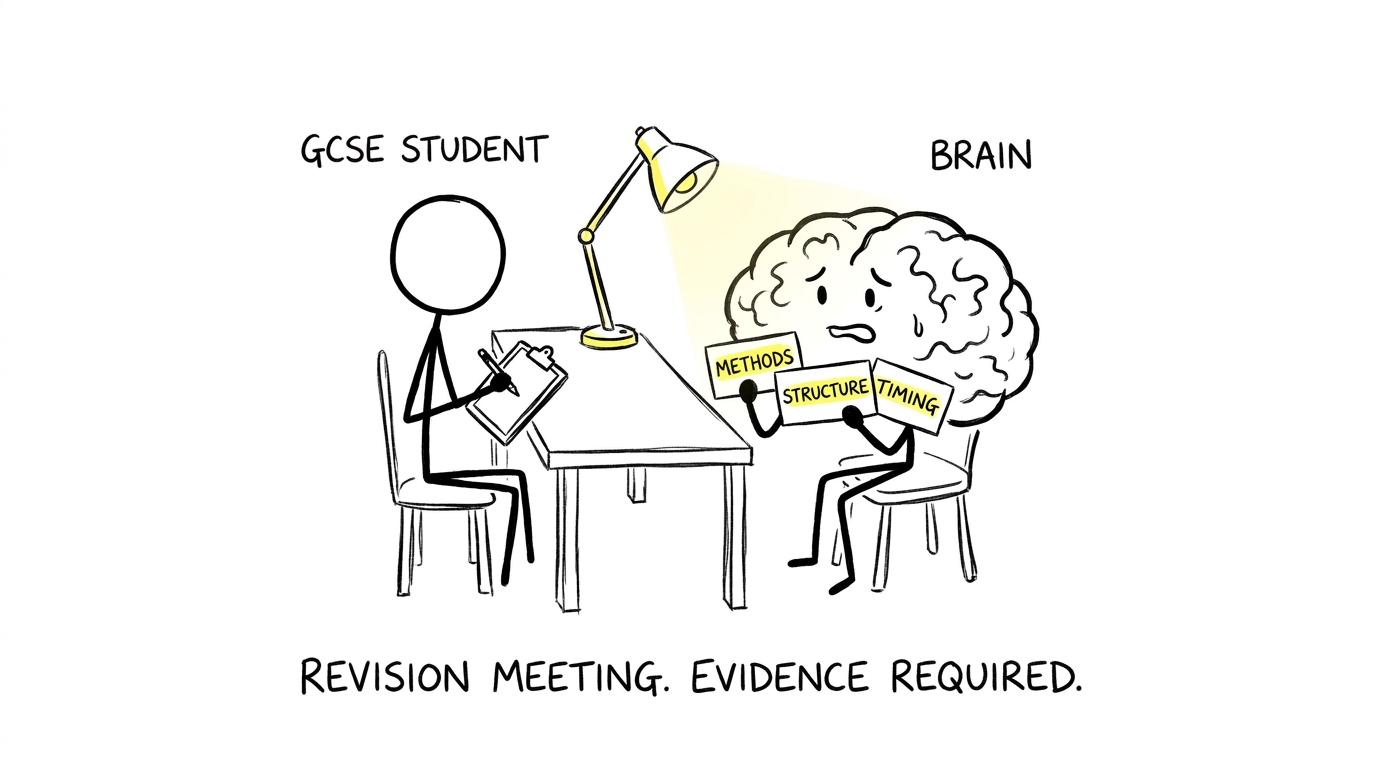 A student conducts a serious revision interview with their own brain
A balanced English Language session might move through four stages:
- retrieve knowledge about one question or skill;
- check and correct the retrieval;
- apply the knowledge to an unfamiliar extract or prompt;
- review the response using feedback or assessment criteria.
The first stage builds access. The third reveals whether that knowledge is usable. The final stage tells you what to retrieve and practise next time.
Flashcards are useful, but they are not the method
Active recall is the act of retrieving, not the stationery used to prompt it. Flashcards can work well for definitions, question purposes and editing checks. They become less useful when answers grow into dense paragraphs that you simply reread.
Other effective formats include:
- blurting everything remembered about a question onto blank paper;
- reconstructing a paper plan from memory;
- answering short verbal prompts;
- creating a blank comparison grid and completing it unaided;
- listing the steps used to approach an unseen text;
- explaining a concept aloud before checking notes.
Keep prompts specific enough to reveal a gap. A card saying Paper One is vague. A prompt asking you to identify the decisions needed before analysing structure gives you clearer evidence about what you know.
Why English Language still needs exam practice
Retrieval practice can make methods and routines easier to access, but it cannot reproduce every demand of an unseen paper. You still need to select evidence, form interpretations, organise ideas and control writing under time pressure.
This is similar to maths revision. Recalling a formula does not prove that you can identify when to use it, complete the process accurately and communicate the reasoning. MathsGenie's GCSE past papers and mark schemes allow students to test knowledge in context rather than stopping after memorisation.
The same principle should guide English revision. Move from short recall to individual questions, then to timed sections and complete papers. Use feedback to identify a narrow next step. A comment such as improve English is difficult to act on; a target such as explain the implication of the selected verb before discussing reader response is retrievable and practicable.
Combining English and maths revision
Students preparing for several GCSEs do not need a different revision philosophy for every subject. A simple cycle works across them:
- retrieve;
- apply;
- check;
- correct;
- revisit.
In maths, you might retrieve a method before answering practice questions. In English, you might retrieve the demands of a comparison question before applying them to unfamiliar sources. In both subjects, the checking stage prevents confident mistakes from becoming habits.
MathsGenie organises free material by difficulty, making it easier to choose an appropriate next challenge. Students consolidating key skills can use the Grade 4 revision resources or Grade 5 revision resources. Higher-tier students can progress through Grade 7 topics and Grade 9 revision, retrieving methods before attempting the practice questions and mini tests.
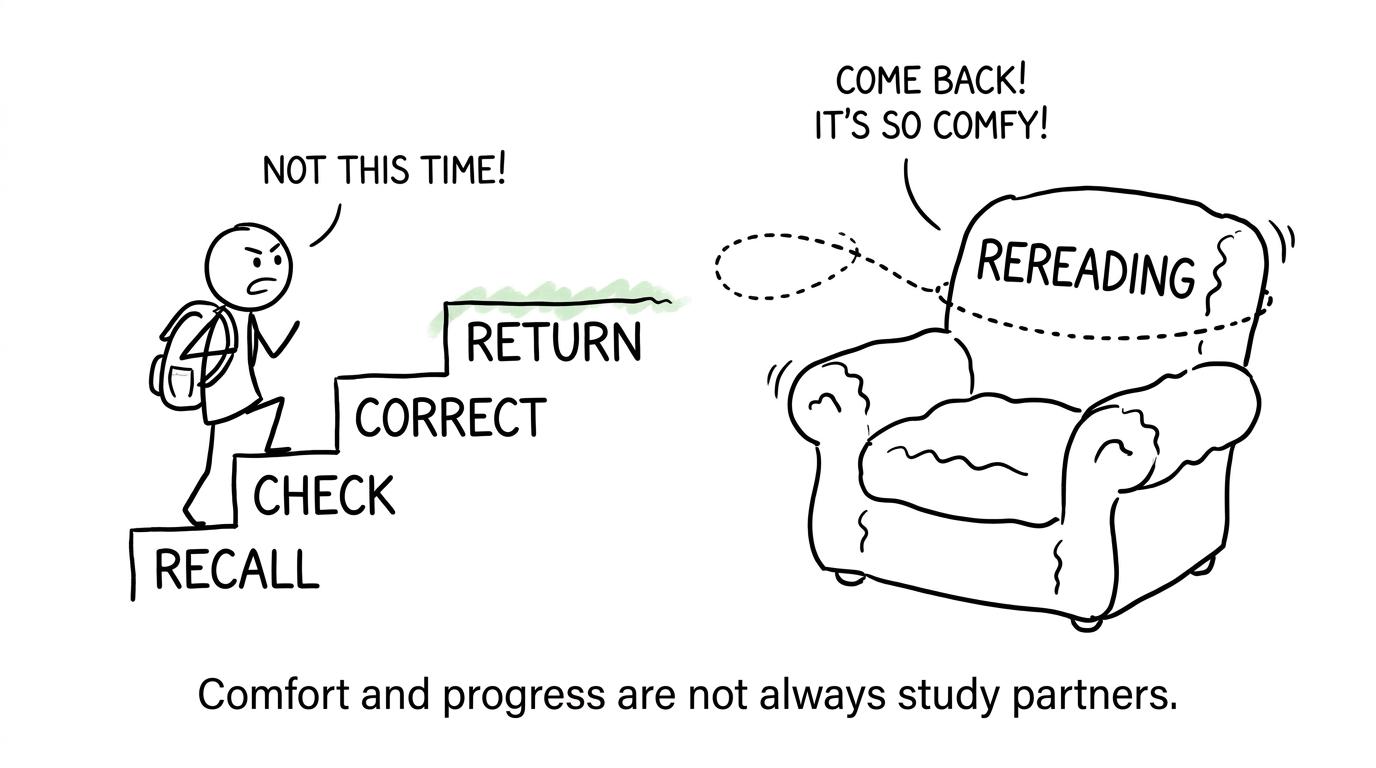 A staircase of recall, checking and correction competes with a comfortable rereading sofa
Common active recall mistakes
Recalling answers inaccurately
Retrieval without checking can reinforce an error. Keep an authoritative answer source nearby, but hidden until you have committed to a response. Correct mistakes precisely rather than giving yourself credit for something that was merely close.
Making every prompt a definition
Terminology is only one part of English Language. Include prompts about question demands, analytical decisions, comparison, planning, editing and timing. Then apply those ideas to unfamiliar material.
Turning flashcards into miniature textbooks
Long cards encourage rereading. Split broad ideas into focused prompts with answers that can be checked clearly. If a question requires an essay to answer, it may belong in written practice rather than a recall deck.
Practising only what feels easy
Students naturally return to cards they answer successfully. Improvement often sits in the uncomfortable pile. Prioritise weak areas while continuing to revisit secure knowledge at wider intervals.
Replacing writing with memory drills
English Language rewards performance on the page. If recall occupies the whole session, you are rehearsing knowledge without testing expression. Every sequence of retrieval sessions should lead towards unseen and timed practice.
Ignoring the exam board
AQA, Edexcel, OCR and Eduqas papers are not interchangeable. Generic analytical skills transfer, but paper structures and assessment details can differ. Match your recall prompts to the specification and materials used by your school.
Make active recall the start, not the finish
The best answer to whether active recall works for GCSE English Language is a qualified yes. It is usually stronger than passive rereading for making important knowledge retrievable, exposing gaps and guiding revision. It becomes powerful when paired with spacing, accurate feedback and regular application to unseen reading and writing tasks.
Use that same disciplined cycle across your maths revision. Begin with the free MathsGenie GCSE revision hub, choose a topic at the right level, retrieve the method and then prove that knowledge through practice questions, mini tests and video solutions. As exams approach, use past papers, mark schemes, predicted papers and the revision planner to turn isolated knowledge into reliable exam performance.










