A-Level Maths Pure Mock Revision Guide
A-Level maths pure mock revision made manageable: diagnose weak topics, practise under timed conditions and build a targeted paper with MathsGenie.

Mock season often arrives quietly. One week, a sixth-form student is finishing an exercise on integration. The next, a date appears on the board and the entire pure course suddenly feels like one enormous topic.
The best A-Level maths pure mock revision is not an attempt to relearn everything at once. It is a cycle: diagnose weaknesses, repair one skill at a time, complete mixed questions under pressure, and use the mark scheme to decide what happens next.
MathsGenie gives you the free revision lessons, practice questions, worked solutions and papers needed to make that cycle work. Here is the plan.
- Check exactly what your mock covers.
- Complete a short mixed assessment without notes.
- Rank topics by lost marks, not by preference.
- Relearn weak methods before attempting harder questions.
- Sit timed, mixed practice.
- Mark every attempt and record the reason for each lost mark.
- Build a targeted paper using the A Level Mock Exam Builder.
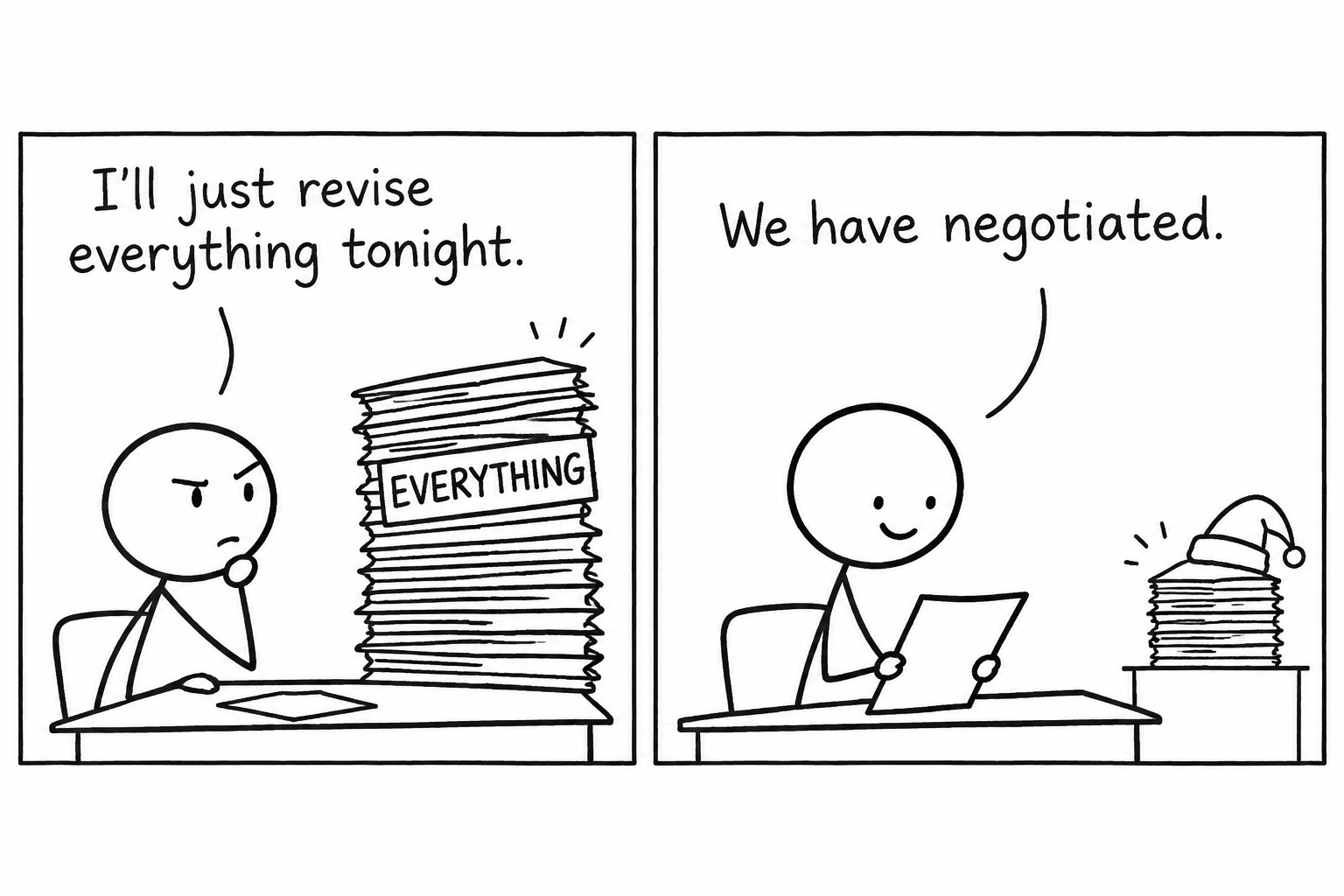 A sixth-form student negotiates with an enormous revision pile
Start with the specification, not your panic
Imagine a student called Sam. The mock is in three weeks, and Sam begins by writing “calculus” on a revision list. It looks organised, but it is too broad to guide a useful session.
Differentiation might mean the chain rule, implicit differentiation, stationary points or connected rates of change. Integration might involve standard functions, substitution, integration by parts or areas between curves. Official specifications also cover pure topics including proof, algebra and functions, coordinate geometry, sequences and series, trigonometry, exponentials and logarithms, calculus and numerical methods. The precise content in a school mock, however, depends on what has been taught.
Sam’s first useful action is therefore simple: check the teacher’s topic list and exam board. Students following Edexcel can begin with the Edexcel A Level Maths revision hub. If you follow AQA, OCR or Eduqas, use resources matched to your specification rather than assuming every paper has the same structure.
Turn each broad heading into an observable skill. Replace “revise differentiation” with tasks such as:
- apply the product, quotient and chain rules;
- find and classify stationary points;
- form equations of tangents and normals;
- differentiate implicitly or parametrically, if included;
- interpret derivatives in modelling questions.
A specific list reduces anxiety because it turns uncertainty into actions.
Diagnose where the marks are going
Sam’s temptation is to start with familiar algebra because it feels productive. But comfortable revision can create a misleading sense of progress.
Instead, attempt a mixed set in timed conditions. Use no notes and mark it honestly. For each error, record the topic and the cause.
| Cause of lost mark | Best response |
|---|---|
| Knowledge gap | Revisit the lesson and make a concise method note |
| Method gap | Complete several questions using the same technique |
| Algebra slip | Slow down and write an extra intermediate line |
| Misread condition | Underline intervals, domains and exact-form instructions |
| Time pressure | Practise mixed questions with a realistic time limit |
This matters because two incorrect answers may need different remedies. Forgetting the product rule requires relearning. Expanding brackets incorrectly requires more careful execution. Repeatedly sitting full A-Level maths mocks without making that distinction can reproduce the same mistakes.
Repair weak topics with active practice
By the end of the diagnostic, Sam has identified trigonometric equations and integration as the largest sources of lost marks. The next stage is not another complete paper. It is focused repair.
A productive topic session has four parts:
- recall the relevant facts or method without looking;
- study a short explanation or video solution;
- answer a sequence of questions independently;
- finish with one unfamiliar exam-style problem.
For calculus, the Integration A Level lesson can rebuild the central idea before you attempt questions. AQA students can then use AQA integration practice questions with worked solutions to check how methods are presented.
Worked example: recognising integration by parts
Suppose Sam must find
∫xe2x dx.\int x e^{2x}\,dx.∫xe2xdx.The integrand is a product, and differentiating xxx makes it simpler. Use
∫udvdx dx=uv−∫vdudx dx.\int u\frac{dv}{dx}\,dx=uv-\int v\frac{du}{dx}\,dx.∫udxdvdx=uv−∫vdxdudx.Choose
u=x,dvdx=e2x.u=x,\qquad \frac{dv}{dx}=e^{2x}.u=x,dxdv=e2x.Then
dudx=1,v=12e2x.\frac{du}{dx}=1,\qquad v=\frac{1}{2}e^{2x}.dxdu=1,v=21e2x.Therefore,
∫xe2x dx=x2e2x−∫12e2x dx=x2e2x−14e2x+C.\int x e^{2x}\,dx =\frac{x}{2}e^{2x}-\int \frac{1}{2}e^{2x}\,dx =\frac{x}{2}e^{2x}-\frac{1}{4}e^{2x}+C.∫xe2xdx=2xe2x−∫21e2xdx=2xe2x−41e2x+C.A quick differentiation checks the result:
ddx(x2e2x−14e2x)=xe2x.\frac{d}{dx}\left(\frac{x}{2}e^{2x}-\frac{1}{4}e^{2x}\right)=xe^{2x}.dxd(2xe2x−41e2x)=xe2x.The deeper revision lesson is method selection. Sam needs to recognise why integration by parts fits, not merely copy its formula.
Move from isolated skills to mock conditions
Once weak methods are more secure, mixed practice becomes valuable. Pure questions often combine topics. A curve problem may require algebraic manipulation, differentiation and interpretation. A trigonometric equation may depend on an identity before any solutions can be found.
Sam now completes a timed section and follows three rules:
- write enough working for method marks;
- leave an unproductive question and return later;
- preserve exact values unless a decimal answer is requested.
After marking, Sam does not write only a score. Each missed question is attempted again without the solution. If that fails, Sam studies the worked solution, closes it, and reproduces the reasoning independently.
This is the point at which the Mock Exam Builder feature becomes especially useful. It lets students build a mock from past-paper questions, sit it and have it marked. A targeted paper can contain more questions from the topics costing you marks while retaining enough mixed content to test selection and timing.
A practical week of A-Level maths revision
A revision timetable should respond to evidence rather than give every topic equal time.
| Session | Focus |
|---|---|
| Monday | Diagnostic mixed questions and marking |
| Tuesday | Weak topic one, lesson followed by focused questions |
| Wednesday | Weak topic two, lesson followed by focused questions |
| Thursday | Mixed pure questions under timed conditions |
| Friday | Correct errors and repeat unsuccessful questions |
| Weekend | Sit and mark a targeted mock paper |
Short, deliberate sessions usually reveal more than hours spent rereading notes. End each session by writing the next specific action, such as “solve trigonometric equations over a stated interval”, rather than “do more trig”. That makes restarting easier.
Common mistakes in pure mock revision
Revising only favourite topics
Confidence is pleasant, but marks usually improve fastest where understanding is weakest. Keep strong topics active with brief retrieval, then direct more time towards recurring errors.
Looking at solutions too soon
A worked solution can feel obvious once it is visible. Attempt the question first, even if the attempt is incomplete. The gap between your approach and the mark scheme contains the useful information.
Ignoring restrictions and intervals
Pure questions often specify a domain, an interval or an exact form. For example, solving a trigonometric equation means finding every valid solution in the stated interval, not stopping after the calculator’s first answer.
Dropping the constant of integration
For an indefinite integral, include CCC:
∫f′(x) dx=f(x)+C.\int f'(x)\,dx=f(x)+C.∫f′(x)dx=f(x)+C.A definite integral does not need CCC because the constants cancel when the limits are applied.
Counting papers instead of learning from them
Five hurried papers are not automatically better than two carefully reviewed ones. The mark scheme is not the end of the exercise. It is the start of the next revision decision.
Turn the mock into useful evidence
By mock morning, Sam has not mastered every possible question. That was never the realistic goal. The improvement comes from knowing more methods, recognising them faster and responding calmly when a question initially looks unfamiliar.
Begin your own A-Level maths pure mock revision with one honest diagnostic. Use MathsGenie’s free lessons, exam-style practice, mark schemes and worked solutions to repair what it reveals. Then build a targeted practice paper in the A Level Mock Exam Builder, complete it under timed conditions and let the result shape your next session.