A-Level Maths Mechanics Mock Revision Guide
A-Level maths mechanics mock revision: plan topics, avoid common errors, use worked examples and build a targeted practice paper with MathsGenie today.
Mock season has a habit of making familiar topics feel less familiar. A question about a moving particle begins simply, then adds a rough slope, a connected object and an instruction to explain the limitations of the model.
For a sixth-form student looking at that question, the problem is rarely a complete lack of knowledge. It is knowing where to begin. Effective A-Level maths mechanics mock revision therefore needs three things: secure methods, careful modelling and enough timed practice to make good decisions under pressure.
Imagine a student called Sam entering mock week. This is a hypothetical journey, but the pattern will be recognisable. Sam has revised the formulae, yet still loses marks through unclear diagrams, inconsistent directions and choosing equations before identifying the known quantities. The revision plan below is designed to change that.
Your mechanics mock revision checklist
Before attempting a full mock, check that you can:
- interpret assumptions such as a particle, light string, smooth surface and uniform rod
- use displacement, velocity and acceleration with consistent signs
- select and apply constant-acceleration formulae
- read and interpret displacement-time and velocity-time graphs
- draw clear force diagrams
- resolve forces parallel and perpendicular to a slope
- apply Newton's laws and F=maF=maF=ma
- model friction using F≤μRF\leq \mu RF≤μR
- calculate moments about a chosen point
- use conservation of momentum where appropriate
- model projectile motion horizontally and vertically
- present units, directions and conclusions clearly
Your exact content and assessment format depend on your exam board and specification. Start with board-specific resources rather than treating every A-Level course as identical. MathsGenie provides an Edexcel A-Level question bank, Edexcel exam booklets by topic and OCR A-Level exam booklets.
Start with evidence, not confidence
On Monday evening, Sam initially plans to revise projectiles because they feel difficult. Instead, Sam completes a short mixed set and marks it carefully. The results reveal something less dramatic: most lost marks come from elementary force diagrams and signs in kinematics.
This is an important distinction. The topic that feels hardest is not always the topic costing the most marks.
Begin your A-Level maths revision with a diagnostic session:
- attempt a short selection of mixed mechanics questions without notes
- mark every question using the mark scheme or worked solution
- label each error as knowledge, setup, algebra, accuracy or presentation
- record the topic and the exact skill that failed
- choose the next practice set from this evidence
Do not write only “forces” in your revision planner. Write something actionable, such as “resolve weight on inclined planes” or “choose a positive direction before using F=maF=maF=ma”. Precise diagnoses lead to precise revision.
Build mechanics around diagrams and models
Mechanics translates a physical situation into mathematics. A diagram is the bridge.
Before calculating, identify the object being modelled and include only the forces acting on that object. Weight acts vertically downwards. A normal reaction acts perpendicular to the contact surface. Friction opposes motion, or the tendency to move. Tension acts along a taut string.
The language of the model matters too. A particle has negligible dimensions. A light string has negligible mass. A smooth surface has no friction. An inextensible string has constant length. These assumptions simplify reality, but they do not remove the need to explain your reasoning.
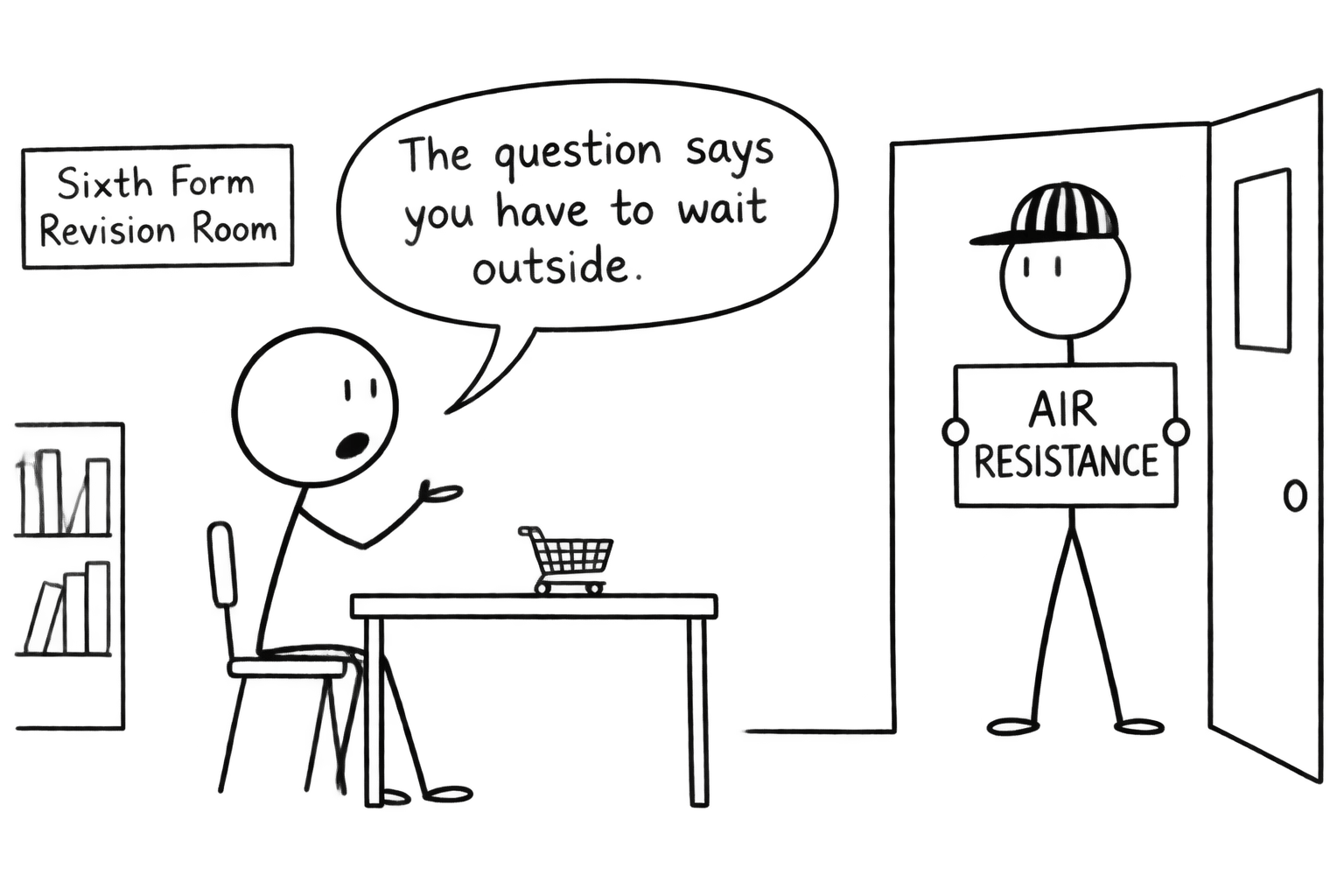 A comic about air resistance waiting outside a mechanics question
On Wednesday, Sam changes one habit: every force question begins with a diagram and an arrow showing the positive direction. The calculations do not suddenly become shorter. They become more dependable.
Practise choosing equations, not recalling them
Memorising constant-acceleration equations is useful. Knowing when they apply is more valuable. The familiar SUVAT relationships assume motion in a straight line with constant acceleration.
Worked kinematics example
A particle moves in a straight line with initial velocity 5 m s−15\text{ m s}^{-1}5 m s−1 and constant acceleration 2 m s−22\text{ m s}^{-2}2 m s−2 for 666 seconds. Find its final velocity and displacement.
List the known quantities first:
u=5,a=2,t=6.u=5,\qquad a=2,\qquad t=6. u=5,a=2,t=6.For final velocity, use:
v=u+at. v=u+at. v=u+at.Therefore:
v=5+2×6=17extms−1. v=5+2\times 6=17 ext{ m s}^{-1}. v=5+2×6=17extms−1.For displacement, use:
s=ut+12at2. s=ut+\frac{1}{2}at^2. s=ut+21at2.Hence:
s=5×6+12×2×62=66extm. s=5\times 6+\frac{1}{2}\times 2\times 6^2=66 ext{ m}. s=5×6+21×2×62=66extm.The arithmetic is straightforward. The revision value lies in identifying the assumptions, listing the variables and selecting an equation containing the required unknown.
Projectile questions use the same principles in two perpendicular directions. Horizontal acceleration is usually modelled as zero, while vertical acceleration is −g-g−g if upwards is positive. The OCR projectiles revision lesson and questions provide focused practice for this separation of motion.
Connect force diagrams to Newton's second law
A force diagram is not decoration. It determines the equation.
Worked forces example
A particle of mass 4 kg4\text{ kg}4 kg slides down a rough plane inclined at 30∘30^\circ30∘ to the horizontal. Friction of magnitude 5 N5\text{ N}5 N acts up the plane. Take g=9.8 m s−2g=9.8\text{ m s}^{-2}g=9.8 m s−2 and find the acceleration.
Choose down the plane as positive. The component of weight down the plane is:
4gsin30∘=4×9.8×12=19.6 N. 4g\sin 30^\circ=4\times 9.8\times \frac{1}{2}=19.6\text{ N}. 4gsin30∘=4×9.8×21=19.6 N.The resultant force down the plane is:
19.6−5=14.6 N. 19.6-5=14.6\text{ N}. 19.6−5=14.6 N.Using F=maF=maF=ma:
14.6=4a. 14.6=4a. 14.6=4a.Therefore:
a=3.65 m s−2. a=3.65\text{ m s}^{-2}. a=3.65 m s−2.Notice that the direction of friction was established before the equation was written. If you select a different positive direction consistently, you will reach an equivalent result with a negative acceleration value and must interpret its meaning.
Treat moments as balance around a point
Moments questions become easier when you choose the pivot strategically. Taking moments about a point removes any unknown force acting through that point because its perpendicular distance is zero.
Worked moments example
A light horizontal beam is pivoted at one end. A downward force of 120 N120\text{ N}120 N acts 1.5 m1.5\text{ m}1.5 m from the pivot. An upward force TTT acts 2 m2\text{ m}2 m from the pivot. The beam is in equilibrium.
Equate clockwise and anticlockwise moments about the pivot:
T×2=120×1.5. T\times 2=120\times 1.5. T×2=120×1.5.So:
T=90 N. T=90\text{ N}. T=90 N.Always use the perpendicular distance from the pivot to the force's line of action. Students preparing for OCR or OCR MEI can reinforce this through the MathsGenie moments revision resources.
Move from topic practice to mock conditions
By Saturday, Sam has corrected weak skills individually. Now the revision changes shape. Topic practice builds methods; timed papers train selection, pacing and recovery when a question does not immediately yield.
Use three stages:
- Targeted practice: complete questions on one specific weakness and check each solution immediately.
- Mixed practice: combine kinematics, forces, moments and projectiles so that you must identify the method yourself.
- Timed mock practice: work without notes, preserve full working and mark the paper only after finishing.
Past papers are valuable once you have enough topic knowledge to learn from them. Predicted papers and the Mock Exam Builder can then provide fresh combinations, reducing the temptation to remember a solution rather than solve the problem.
Common mechanics mock mistakes
Mixing directions halfway through
Choose a positive direction once and keep it. A negative answer is not automatically wrong; it often means the true direction is opposite to the one selected.
Using constant-acceleration equations without checking
SUVAT equations require constant acceleration. Do not apply them automatically when acceleration varies or when different stages of motion need separate models.
Resolving weight incorrectly
On a slope inclined at θ\thetaθ to the horizontal, the component of weight parallel to the slope is commonly mgsinθmg\sin\thetamgsinθ, while the perpendicular component is mgcosθmg\cos\thetamgcosθ. Derive this from your diagram rather than trusting memory alone.
Assuming friction is always μR\mu RμR
In a limiting-equilibrium situation, friction has reached its maximum value and F=μRF=\mu RF=μR. More generally, the relationship is:
F≤μR. F\leq \mu R. F≤μR.Rounding too early
Keep exact values or additional calculator digits during intermediate steps. Round only at the end, following the accuracy requested by the question.
Ignoring the final interpretation
If a question asks for a magnitude, direction, time or modelling limitation, state it explicitly. A calculator value without its unit or physical meaning may not complete the answer.
Turn your error list into the next paper
The most useful outcome of an A-Level maths mock is not the mark alone. It is the map of what to practise next.
Sam finishes the week with fewer vague intentions and a short list of precise targets: connected particles, limiting friction and projectile timing. That list can now shape the next paper rather than sitting forgotten beside the marked mock.
Use MathsGenie's revision lessons, practice questions, exam booklets, worked solutions, mini tests, past papers and revision planner to repair individual gaps. Then open the Mock Exam Builder and build a targeted practice paper around the topics that actually cost you marks. Complete it under timed conditions, check it against the available solutions or mark schemes, and use the result to choose your next round of A-Level maths mechanics mock revision.