Inequalities (A-Level) Exam Questions A-Level Maths
Inequalities (A-Level) exam questions A-Level Maths: tackle three worked examples, understand method marks and practise accurate solutions with MathsGenie.
Inequalities: find the intervals, not just the roots
You can solve the equation perfectly and still lose the final mark. That is the frustration behind many inequalities questions: finding the boundary values feels like finishing, but the examiner also needs to know which values actually work.
This guide to inequalities (A-Level) exam questions A-Level Maths shows how to turn those boundaries into complete solutions. The dependable method is to simplify, identify critical values, check signs and state the correct intervals, paying attention to whether endpoints belong.
Imagine a student working through three questions. Their algebra is reasonably secure, but they keep stopping one line too soon. We will follow that hypothetical student from a compound inequality to a quadratic and then a fraction, showing where useful working earns credit.
The questions below are original exam-style examples. Their mark allocations are illustrative teaching guides, not official exam-board mark schemes.
Your inequality checklist
Before calculating, identify what controls the solution:
- Linear inequality: isolate the variable, reversing the inequality when multiplying or dividing by a negative number.
- Compound inequality: solve both restrictions and keep their overlap.
- Quadratic inequality: rearrange to compare with zero, find roots and identify the correct intervals.
- Fraction inequality: find numerator zeros and denominator zeros, then test the resulting intervals.
- Final answer: distinguish strict inequalities from inclusive ones and use “and” or “or” correctly.
The Equations and Inequalities lesson is the matching starting point for revisiting the algebra before attempting questions independently.
Question one: a compound linear inequality
Solve:
−5<3−2x≤11.-5 < 3-2x \leq 11.−5<3−2x≤11.Our student initially tries to move everything mentally. A safer approach is to write each operation across all three parts.
Step one: subtract from every part
Subtracting 333 gives:
−8<−2x≤8.-8 < -2x \leq 8.−8<−2x≤8.Illustrative method mark: M1 for applying the same subtraction throughout.
Step two: divide and reverse both signs
Dividing by −2-2−2 reverses both inequality signs:
4>x≥−4.4 > x \geq -4.4>x≥−4.Illustrative method mark: M1 for dividing correctly and reversing the inequalities.
Rewrite the result in increasing order:
−4≤x<4.\boxed{-4 \leq x < 4}.−4≤x<4.Illustrative accuracy mark: A1 for the complete interval.
The student checks the endpoints. Substituting x=−4x=-4x=−4 makes the original expression equal to 111111, which is allowed. Substituting x=4x=4x=4 makes it equal to −5-5−5, which is excluded.
That small check catches a surprisingly costly mistake: reversing the signs correctly but attaching equality to the wrong endpoint.
Question two: a quadratic inequality
Solve:
x2−x−6>0.x^2-x-6>0.x2−x−6>0.This time, the student factorises quickly. The important decision comes afterwards.
Step one: factorise and locate the roots
x2−x−6=(x−3)(x+2).x^2-x-6=(x-3)(x+2).x2−x−6=(x−3)(x+2).Illustrative method mark: M1 for correct factorisation.
The boundary values come from:
(x−3)(x+2)=0,(x-3)(x+2)=0,(x−3)(x+2)=0,so:
x=−2orx=3.x=-2 \quad \text{or} \quad x=3.x=−2orx=3.Illustrative accuracy mark: A1 for both roots.
Step two: decide where the expression is positive
The quadratic has a positive coefficient of x2x^2x2, so its graph opens upwards. It lies above the horizontal axis outside the roots.
Alternatively, test one value in each interval. Taking x=−3x=-3x=−3, x=0x=0x=0 and x=4x=4x=4 gives expression values of 666, −6-6−6 and 666, respectively.
Illustrative method mark: M1 for a valid graph or sign argument.
Therefore:
x<−2orx>3.\boxed{x<-2 \quad \text{or} \quad x>3}.x<−2orx>3.Illustrative accuracy mark: A1 for the correct solution, excluding both roots.
Our student now sees why listing the roots was not enough. Roots describe where the expression equals zero; the question asks where it is positive.
For another representation of this decision, the Inequalities on Graphs topic connects algebraic solutions with regions and boundaries.
You now have the method: use Lessons to revisit an uncertain step, then apply it independently in the Question Bank.
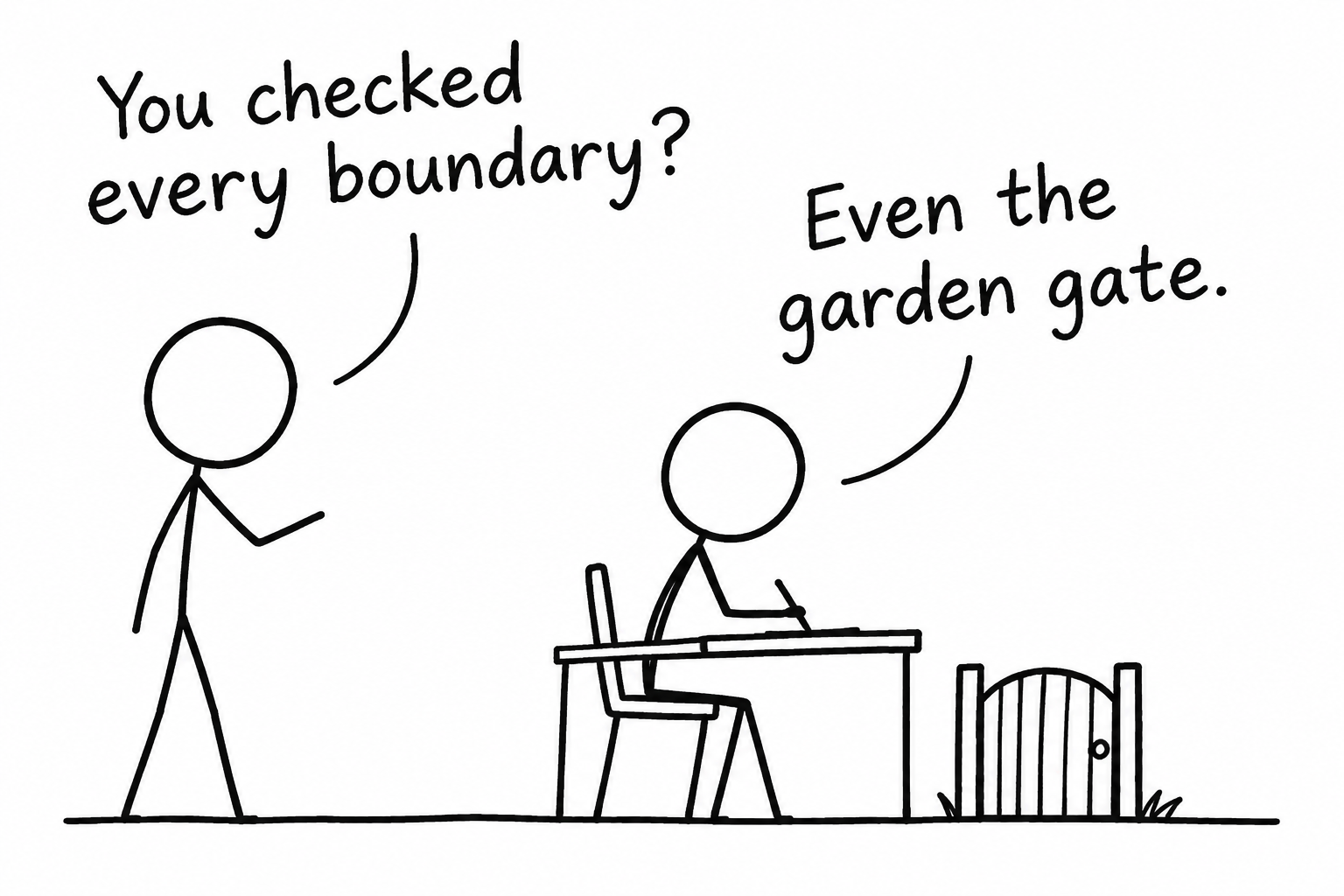 A minimalist stick-figure comic turns checking inequality boundaries into a joke about checking a garden gate.
Question three: an inequality with a fraction
Solve:
x+1x−2≥2.\frac{x+1}{x-2}\geq 2.x−2x+1≥2.The student reaches for cross-multiplication, then pauses. The denominator could be positive or negative, so multiplying by it without considering its sign could reverse the inequality unexpectedly.
Step one: put everything on one side
x+1x−2−2≥0.\frac{x+1}{x-2}-2\geq 0.x−2x+1−2≥0.Combining into one fraction gives:
x+1−2(x−2)x−2≥0,\frac{x+1-2(x-2)}{x-2}\geq 0,x−2x+1−2(x−2)≥0,hence:
5−xx−2≥0.\frac{5-x}{x-2}\geq 0.x−25−x≥0.Illustrative method mark: M1 for forming a single fraction correctly.
Step two: identify every critical value
The numerator is zero when x=5x=5x=5. The denominator is zero when x=2x=2x=2, where the original expression is undefined.
Illustrative accuracy mark: A1 for identifying both critical values and the restriction x≠2x\ne 2x=2.
Step three: test the intervals
- When x<2x<2x<2, the numerator is positive and the denominator negative, so the fraction is negative.
- When 2<x<52<x<52<x<5, both are positive, so the fraction is positive.
- When x>5x>5x>5, the numerator is negative and the denominator positive, so the fraction is negative.
Illustrative method mark: M1 for testing the intervals, followed by A1 for the correct sign pattern.
The inequality includes zero, so include x=5x=5x=5. Never include x=2x=2x=2:
2<x≤5.\boxed{2<x\leq 5}.2<x≤5.Illustrative accuracy mark: A1 for the complete solution.
The useful habit is not “always cross-multiply”. It is “understand the sign before multiplying”.
Common mistakes that cost marks
Treating an inequality like an equation. Boundary values are only the beginning. Finish by identifying the required intervals.
Choosing the interval between roots automatically. For a quadratic, that depends on its leading coefficient and whether the question asks for positive or negative values. Sketch or test rather than memorising a slogan.
Including an undefined value. An inclusive inequality can include a numerator zero, but never a denominator zero.
Using “and” instead of “or”. Separate outside intervals describe alternatives, not simultaneous requirements. The Expressing Solutions of Inequalities lesson focuses on this final communication step.
Assuming every question awards marks identically. In an inequalities (A-Level) past paper, use the actual mark scheme to check the required evidence. An inequalities (A-Level) markscheme may distribute credit differently from these teaching examples. Show your reasoning rather than trying to manufacture a particular mark code.
Exam-style practice: try before checking
Attempt these without looking back:
- Solve 7−3x≥167-3x\geq 167−3x≥16.
- Solve 2x2−5x−3≤02x^2-5x-3\leq 02x2−5x−3≤0.
- Solve x−4x+2>0\frac{x-4}{x+2}>0x+2x−4>0.
Answers: x≤−3x\leq -3x≤−3; −12≤x≤3-\frac{1}{2}\leq x\leq 3−21≤x≤3; x<−2x<-2x<−2 or x>4x>4x>4.
For each answer, explain the endpoints aloud. Then identify whether any error came from algebra, signs or notation. That diagnosis makes your next attempt purposeful.
Turn the method into reliable exam working
Our hypothetical student has changed one habit: instead of stopping at the boundaries, they now justify the intervals. Your remaining challenge is applying that routine without prompts across unfamiliar questions. Start with the matching Lessons, then practise the same boundary-and-sign method in the Question Bank.