What you'll learn
- How cognitive therapy follows from the assumptions of the cognitive approach.
- What happens in cognitive behavioural therapy (CBT) and rational emotive behaviour therapy (REBT).
- How to apply therapy techniques to a scenario.
- How to evaluate cognitive therapy for AO3, including evidence, methodology and ethics.
The starting point: the cognitive approach
The cognitive approach argues that behaviour and emotion are influenced by internal mental processes — private processes such as thinking, attention, memory, perception and interpretation.
A key idea is that people do not simply react to events. They react to what they think the event means. This is why two people can experience the same situation, such as getting a low test score, but respond very differently.
Schema
A schema is a mental framework that helps you organise and interpret information. Schemas are useful shortcuts, but they can also become biased and make someone interpret situations in an overly negative way.
In therapy, the cognitive approach focuses on cognitions: thoughts, beliefs, expectations and interpretations. If these become unrealistic or unhelpful, they can maintain distress.
Main therapy idea
Cognitive therapy aims to change unhelpful interpretations and behaviours, so the person experiences healthier emotions and can function better in everyday life.
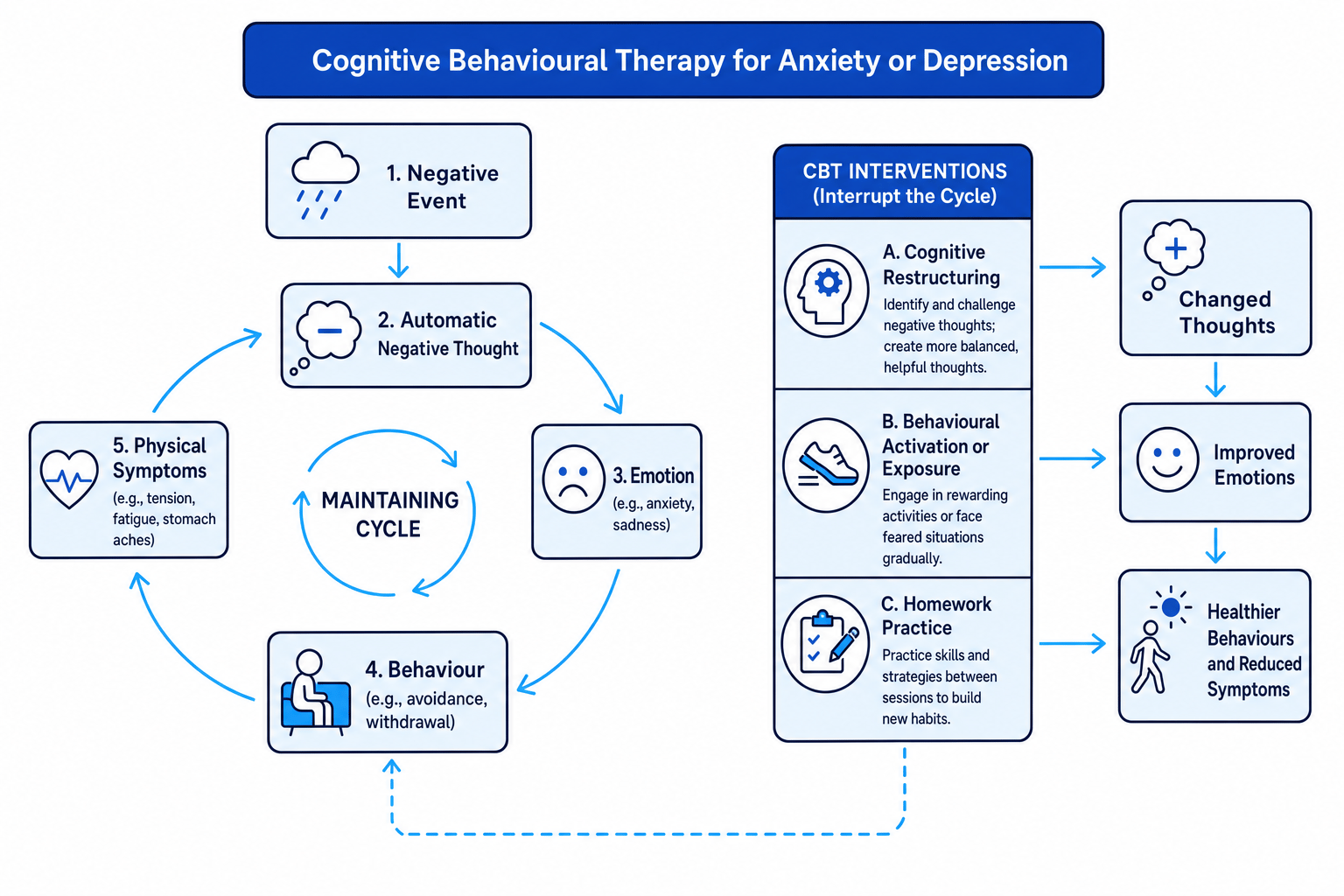
The diagram shows the basic CBT idea: thoughts, emotions, physical symptoms and behaviour can form a maintaining cycle.
Cognitive behavioural therapy: AO1 description
Eduqas allows centres to study CBT or REBT. CBT is the broader therapy; REBT is often taught as a specific form of cognitive therapy.
Cognitive behavioural therapy
Cognitive behavioural therapy (CBT) is a structured, collaborative talking therapy that aims to reduce psychological distress by identifying and changing unhelpful thoughts and behaviours.
CBT was strongly influenced by Aaron Beck’s cognitive therapy for depression. Beck argued that depression is maintained by automatic negative thoughts: quick, habitual thoughts that pop into the mind and feel believable.
Common cognitive distortions, meaning biased thinking patterns, include:
- Catastrophising — assuming the worst possible outcome.
- Overgeneralisation — drawing a broad conclusion from one event.
- All-or-nothing thinking — seeing things as total success or total failure.
- Personalisation — blaming yourself for things not fully under your control.
What happens in CBT?
CBT usually involves several linked stages.
First, the therapist and client create a formulation: a shared explanation of how the client’s thoughts, feelings, behaviours and physical symptoms maintain the problem.
Second, they use collaborative empiricism. This means therapist and client work together like investigators, testing whether beliefs are accurate and helpful.
Third, the therapist may use Socratic questioning: careful questions that help the client examine evidence for and against a belief.
Fourth, CBT includes behavioural work, such as:
- Behavioural activation — scheduling rewarding or meaningful activities, often used in depression.
- Graded exposure — gradually facing feared situations, often used in anxiety.
- Behavioural experiments — testing predictions in real life.
- Homework tasks — practising skills between sessions.
CBT is not just positive thinking
CBT does not tell people to “think happy thoughts”. It helps them develop more balanced, realistic thoughts and then test those thoughts through behaviour.
Formulating avoidance in CBT
-
Connect the situation to the thought: A student is asked to give a presentation and thinks, “Everyone will laugh at me.” This thought predicts humiliation, so anxiety increases.
-
Link emotion to behaviour: Because the student feels anxious, they avoid the presentation. Avoidance reduces anxiety in the short term, so it is negatively reinforced.
-
Identify the maintaining cycle: Avoidance prevents the student from discovering that most classmates would not laugh. The original belief remains untested.
-
Choose suitable CBT techniques: The therapist might use cognitive restructuring to challenge “Everyone will laugh”, then set a behavioural experiment such as presenting for one minute to a small group.
-
Use the result to update the belief: If the group responds normally, the student gathers evidence for a more balanced thought: “I may feel nervous, but I can cope and most people will listen politely.”
Rational emotive behaviour therapy: AO1 description
Rational emotive behaviour therapy
Rational emotive behaviour therapy (REBT) is a cognitive therapy developed by Albert Ellis (1962). It argues that emotional distress is mainly caused by irrational beliefs about events, not by the events themselves.
REBT is based on the ABC model:
- A: Activating event — something happens.
- B: Beliefs — the person interprets the event.
- C: Consequences — emotional and behavioural outcomes.
Ellis later added:
- D: Disputing — challenging irrational beliefs.
- E: Effective new beliefs — replacing them with more rational alternatives.
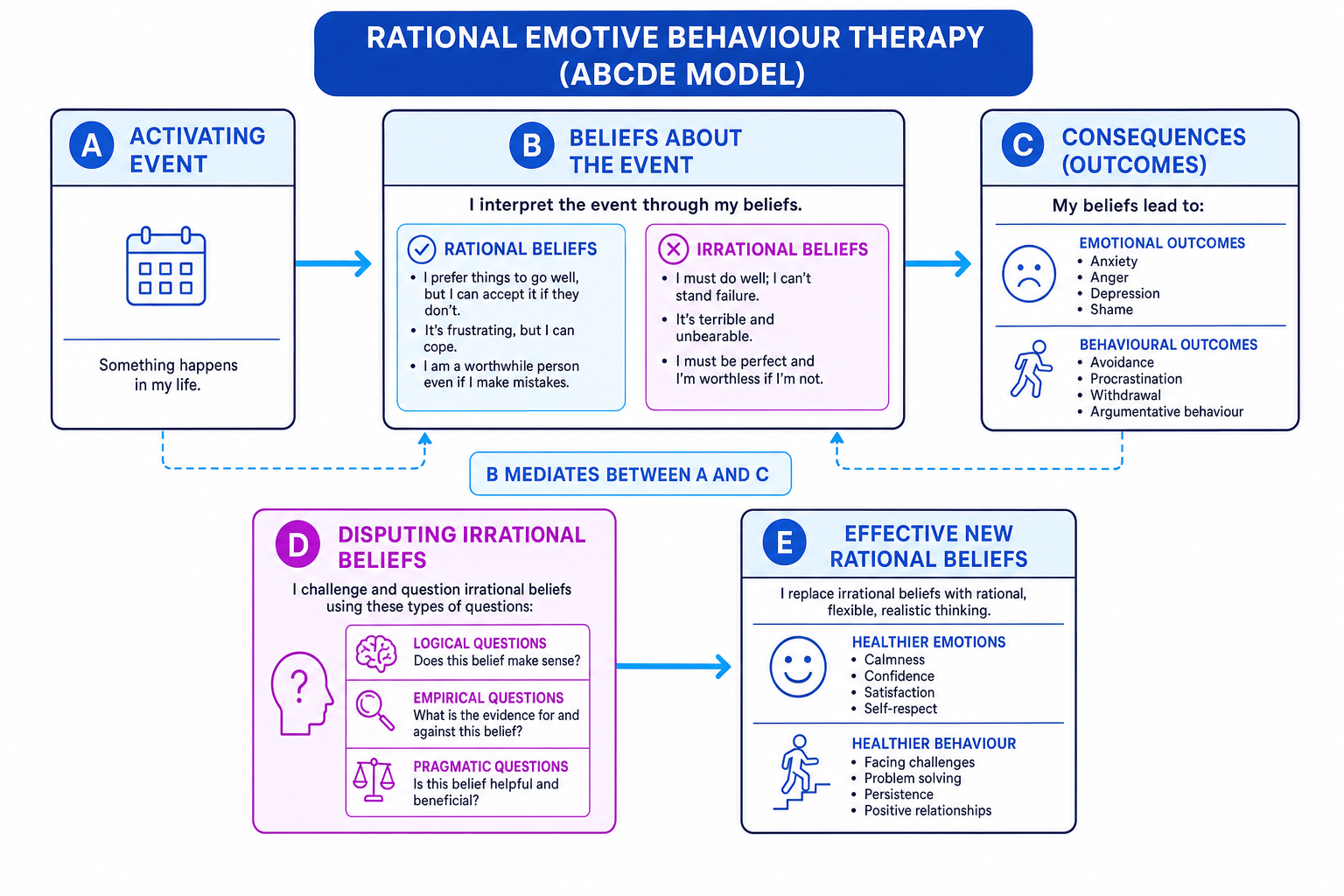
Irrational beliefs often include musts and shoulds, such as “I must succeed” or “People must approve of me”. Ellis called this rigid, demanding thinking. REBT disputes these beliefs using:
- Logical disputing — does this belief make sense?
- Empirical disputing — what evidence supports or challenges it?
- Pragmatic disputing — is this belief useful?
Using ABCDE to challenge a belief
-
Identify A, the activating event: A student gets a lower grade than expected in a mock exam.
-
Identify B, the belief: The student thinks, “I must get top grades or I am a complete failure.”
-
Identify C, the consequence: The belief leads to shame, avoidance of revision and thoughts of giving up.
-
Apply D, disputing: The therapist asks whether one grade logically proves total failure, what evidence shows the student can improve, and whether the belief helps revision.
-
Develop E, an effective new belief: The student replaces it with, “I strongly prefer high grades, but one result does not define me. I can use feedback to improve.”
ABC: B matters most
In REBT, the activating event does not directly cause the emotional consequence. The key link is the person’s belief about the event.
Evidence and links to cognitive studies
For the wider cognitive approach, Loftus and Palmer (1974) is the classic Eduqas study. They showed that leading questions changed participants’ memory of a car crash, supporting the idea that cognition is active and reconstructive.
The contemporary cognitive study often linked to this approach is Sebastián and Hernández-Gil (2012), who investigated digit span and working memory development. This supports the view that cognitive processes can be measured scientifically, although it is not a therapy study.
For therapy specifically, CBT has strong real-world application. Reviews such as Butler et al. (2006) found CBT to be effective for several disorders, including anxiety and depression. However, findings are not always simple: for example, March et al. (2004) found that combined treatment could be more effective than CBT alone for adolescent depression, suggesting CBT may sometimes work best alongside medication or other support.
AO2: applying therapy to a scenario
If a scenario describes someone saying “I always fail” or “Everyone hates me”, you can apply CBT by identifying the distorted thought and explaining how cognitive restructuring would challenge it.
If the scenario uses “must”, “should”, “awful” or “I can’t stand it”, REBT fits well. You can apply the ABCDE model and show how disputing creates a more rational belief.
Choosing CBT or REBT in an essay
Use the therapy your teacher has taught in detail. Do not blur them: CBT is broader and includes behavioural techniques, while REBT is especially focused on disputing irrational beliefs.
Research methods link
Therapy effectiveness is often tested using symptom questionnaires before and after treatment, or by comparing a CBT group with a waiting-list control group.
A strong study might use a randomised controlled trial, where participants are allocated to conditions randomly. Researchers may report mean symptom scores, standard deviations, ranges, bar charts or line graphs.
For inferential testing, the choice depends on design and data:
- Independent CBT group versus control group: unrelated t-test for interval data, or Mann-Whitney U for ordinal/non-normal data.
- Same clients before and after therapy: related t-test or Wilcoxon signed-ranks test.
- Association between homework completion and symptom improvement: Spearman’s rho.
- Recovery categories such as recovered/not recovered: chi-square.
- Direction of change in paired scores: binomial sign test.
The usual convention is statistical significance at p≤0.05p \le 0.05p≤0.05. A one-tailed test is used for a directional hypothesis; a two-tailed test is used when the direction is not predicted. Researchers compare the observed value with the critical value in a table, and must consider Type I errors and Type II errors.
AO3 evaluation
Strengths
CBT has strong practical value. It is used widely in the NHS and is recommended for several disorders. It teaches clients skills they can keep using after therapy ends, which supports relapse prevention.
CBT is also relatively scientific. It uses measurable symptoms, structured sessions and testable predictions. This fits the cognitive approach’s aim to study mental processes systematically.
Weaknesses
CBT may not work for everyone. It requires motivation, regular attendance and willingness to complete homework. Someone in severe crisis may need medication, safeguarding or more intensive support before CBT is useful.
It can also be criticised as individualistic. By focusing on thoughts, CBT may underemphasise poverty, discrimination, trauma or family problems that contribute to distress.
Methodologically, therapy research can be difficult. Improvement may be partly due to therapist warmth, expectancy effects or demand characteristics rather than the specific CBT techniques. Self-report symptom scales can also be affected by social desirability.
Ethics
Therapy and therapy research must follow the BPS Code of Ethics and Conduct. Clients should give informed consent, understand confidentiality, have the right to withdraw, and be protected from psychological harm. Deception should be avoided. If a client becomes distressed, the therapist must manage risk carefully. Confidentiality is important, but it may be limited if there is serious risk of harm to the client or others.
In the exam
-
For AO1, describe the therapy as a process: identify thoughts, challenge them, change behaviour, practise through homework.
-
For AO2, apply the technique directly to the person in the scenario rather than giving a generic description.
-
For AO3, use balanced evaluation: evidence for effectiveness, a methodological issue, an ethical issue and a clear judgement.
-
Keep CBT and REBT distinct: CBT includes cognitive and behavioural methods; REBT uses ABCDE and disputing irrational beliefs.
Check yourself
- How does CBT explain the link between thoughts, emotions and behaviour?
- What do A, B, C, D and E stand for in REBT?
- Why might CBT research show improvement even if the specific therapy technique is not the only cause?

