What you'll learn
- What Loftus and Palmer (1974) did in their classic study on eyewitness memory.
- How leading questions can affect speed estimates and later recall.
- How to evaluate the study using methodology, ethics, real-world application and contradictory evidence.
- How to apply the study to exam scenarios and research-methods questions.
The cognitive starting point: memory is active
The cognitive approach studies internal mental processes such as memory, perception, attention, thinking and language. These processes cannot be observed directly, so psychologists infer them from behaviour.
A key idea for this study is that memory is not like a video recording. Instead, memory can be reconstructed: when you remember an event, you may combine the original information with later information, expectations and schemas.
Reconstructive memory
Reconstructive memory means memory is rebuilt rather than simply replayed. What you recall can be influenced by later information, wording, expectations and prior knowledge.
A schema is a mental framework built from past experience. For example, your schema for a car crash may include broken glass, loud noises, high speed and injury. If a question strongly suggests a severe crash, that schema may affect what you report.
The big cognitive idea
Loftus and Palmer’s study supports the idea that memory is an active reconstruction, not a perfect copy of what was originally seen.
Why this study matters
The named classic cognitive study is Loftus, E. and Palmer, J. C. (1974), “Reconstruction of automobile destruction: an example of the interaction between language and memory.”
It is especially important because it investigates eyewitness testimony: evidence given by people who have witnessed an event, often a crime or accident.
Leading question
A leading question is a question that is worded in a way that suggests a particular answer or influences the respondent’s memory or judgement.
For example, “How fast was the car going when it smashed into the other car?” suggests a more violent crash than “How fast was the car going when it contacted the other car?”
AO1: Loftus and Palmer (1974)
Aim
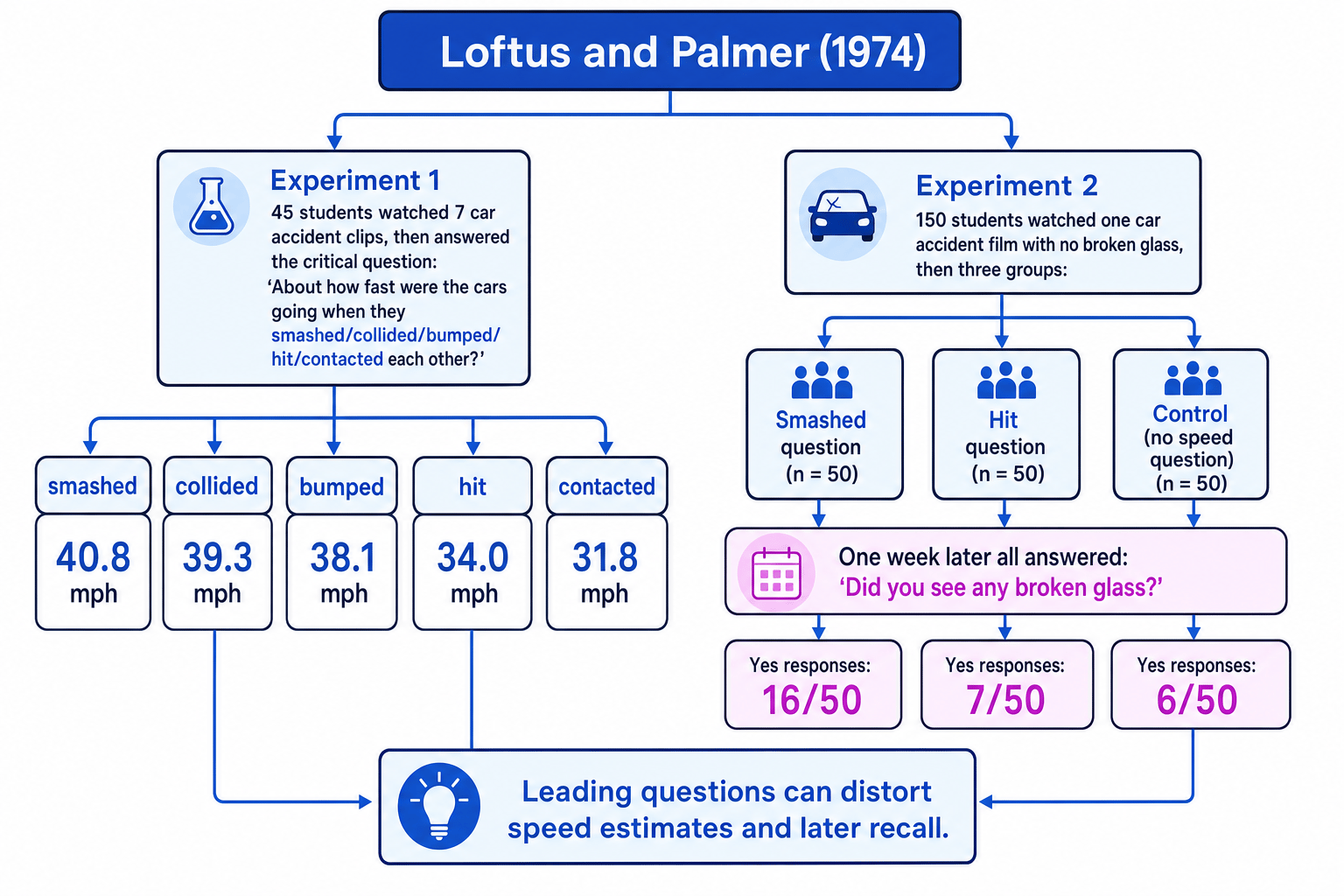
Loftus and Palmer aimed to investigate whether the wording of a question could affect participants’ memory of a car accident.
More specifically, they wanted to see whether different verbs, such as smashed, hit or contacted, would change:
- estimated speed of the cars
- later memory for details that were not actually present, such as broken glass
Experiment 1: the verb and speed estimates
Sample
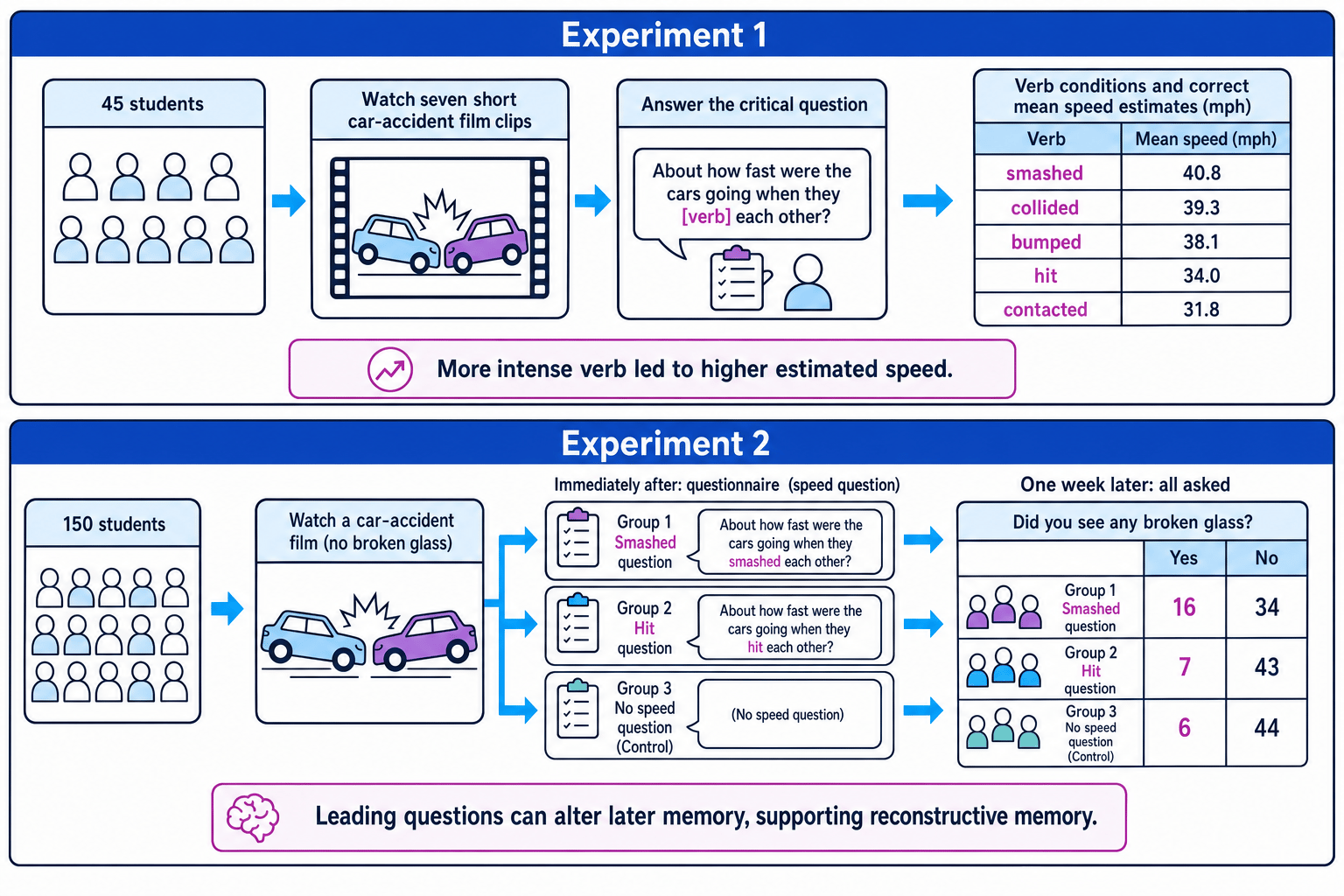
The sample was 45 university students.
This is important for evaluation because students are a specific group, so findings may not generalise to all eyewitnesses.
Procedure
Participants watched seven short film clips of car accidents. After each clip, they answered questions about what they had seen.
The critical question was:
“About how fast were the cars going when they ______ each other?”
Different groups received different verbs:
- smashed
- collided
- bumped
- hit
- contacted
Variables
Independent and dependent variables
The independent variable, or IV, is what the researcher manipulates. The dependent variable, or DV, is what the researcher measures.
In Experiment 1:
| Feature | Loftus and Palmer example |
|---|---|
| IV | Verb used in the critical question |
| DV | Estimated speed of the cars |
| Design | Independent groups, because different participants were in different verb conditions |
Findings
The more intense the verb, the higher the average speed estimate.
| Verb | Mean estimated speed |
|---|---|
| smashed | 40.8 mph |
| collided | 39.3 mph |
| bumped | 38.1 mph |
| hit | 34.0 mph |
| contacted | 31.8 mph |
Conclusion
The wording of a question affected participants’ judgements. “Smashed” produced the highest speed estimate, while “contacted” produced the lowest.
However, Experiment 1 alone does not prove memory was changed. It could be that participants remembered the same accident but gave a higher estimate because the verb encouraged them to respond differently.
Do not overclaim Experiment 1
Experiment 1 shows that wording affected speed estimates. By itself, it does not fully prove that the original memory was altered.
Experiment 2: did the question alter memory?
Experiment 2 was designed to test whether leading questions could change later memory, not just immediate estimates.
Sample
The sample was 150 students.
Procedure
Participants watched a film of a car accident. There was no broken glass in the film.
They were divided into three groups:
| Group | Question after the film |
|---|---|
| Smashed condition | “How fast were the cars going when they smashed into each other?” |
| Hit condition | “How fast were the cars going when they hit each other?” |
| Control condition | No speed question |
One week later, all participants were asked:
“Did you see any broken glass?”
Findings
| Condition | Yes | No |
|---|---|---|
| Smashed | 16 | 34 |
| Hit | 7 | 43 |
| Control | 6 | 44 |
Participants in the smashed condition were more likely to report seeing broken glass, even though there was none.
Calculating false-memory percentages
-
Work out the total number of participants in the smashed condition: 16 said yes and 34 said no, so the total is 50.
-
Convert the “yes” responses into a percentage:
1650×100=32%\frac{16}{50} \times 100 = 32\%5016×100=32% -
Compare this with the hit condition:
750×100=14%\frac{7}{50} \times 100 = 14\%507×100=14% -
The smashed group had a much higher false report rate than the hit group, suggesting the more intense verb influenced later recall.
Conclusion
Experiment 2 supports the idea that misleading post-event information can alter memory. The word “smashed” may have activated a more severe crash schema, making participants more likely to “remember” broken glass.
Response bias or memory alteration?
Loftus and Palmer discussed two possible explanations.
Response bias
Response bias means the wording influences how participants answer, without necessarily changing their memory.
For example, “smashed” may simply make participants think the researcher expects a higher speed estimate.
Memory alteration
Memory alteration means the wording changes the memory trace itself. Later information becomes integrated into the original memory.
Experiment 2 is stronger evidence for memory alteration because participants later reported a detail that was not present.
Best interpretation
Experiment 1 shows that language affects judgement. Experiment 2 gives stronger evidence that language can affect reconstructed memory.
AO2: applying the study to scenarios
In an exam, you may be given a scenario involving a police interview, a witness statement or a teacher asking a student what happened. Your job is to link the scenario to Loftus and Palmer.
Applying leading questions to a witness interview
-
Identify the wording that may influence memory. For example, “How fast was the van going when it crashed into the cyclist?” is more leading than “What did you see?”
-
Link the wording to a cognitive process. The phrase “crashed into” may activate a schema of a serious accident.
-
Predict the likely effect. The witness may give a higher speed estimate or later recall details that fit the severe-accident schema.
-
Connect it to Loftus and Palmer. This mirrors the finding that “smashed” produced higher speed estimates and more false reports of broken glass.
Research methods links
Loftus and Palmer is useful for Component 2-style thinking because it is an experiment with clear variables and quantitative data.
Levels of measurement
Levels of measurement
Nominal data are categories, such as yes/no. Ordinal data are ranked data. Interval data are numerical data with equal units between values.
In Experiment 1, estimated speed is interval-level data. In Experiment 2, “yes” or “no” to broken glass is nominal data.
Inferential test choices
For Eduqas, you should choose inferential tests using the aim, design and level of measurement:
| Test | Use when… |
|---|---|
| Mann-Whitney U | Difference test, unrelated design, ordinal data or non-parametric interval data |
| Wilcoxon signed-ranks | Difference test, related design, ordinal data or non-parametric interval data |
| Spearman’s rho | Correlation test, ordinal data or non-parametric interval data |
| Chi-square | Association or difference test using nominal category data |
| Binomial sign test | Related nominal data, often when looking at direction of change |
| Unrelated t-test | Difference test, unrelated design, interval data, parametric assumptions met |
| Related t-test | Difference test, related design, interval data, parametric assumptions met |
For Experiment 2, if you were comparing the frequency of “yes” and “no” responses across groups, chi-square would be appropriate because the data are nominal.
Observed and critical values
At A-Level, significance is usually judged at p≤0.05p \leq 0.05p≤0.05. You compare the observed value with a critical value from a table, remembering that the decision rule depends on the test.
For example, with chi-square, Spearman’s rho and t-tests, the observed value usually needs to be equal to or greater than the critical value. For Mann-Whitney U, Wilcoxon and the sign test, the observed value often needs to be equal to or less than the critical value.
A one-tailed test is used when the hypothesis predicts a specific direction. A two-tailed test is used when the hypothesis predicts a difference or relationship but not the direction.
A Type I error is a false positive: concluding there is a significant effect when there is not. A Type II error is a false negative: failing to find a significant effect when there really is one.
AO3: evaluating Loftus and Palmer
Strengths
High control
The study was carried out in a controlled setting. Participants watched the same film clips and answered standardised questions. This improves reliability because the procedure can be repeated.
It also helps establish cause and effect: the verb was manipulated, and changes in speed estimates or false memories were measured.
Quantitative data
The study produced numerical data, such as mean speed estimates and counts of “yes” responses. This makes comparisons clear and objective.
Real-world application
The findings have important applications to police interviews and court cases. They suggest interviewers should avoid leading questions and use neutral prompts such as “Tell me what happened.”
This links to the development of better interviewing practices, including encouraging free recall and reducing interviewer contamination.
Weaknesses
Low ecological validity
Watching a film clip is not the same as witnessing a real accident. Real eyewitnesses may experience fear, surprise, injury or personal involvement.
This means the findings may not fully apply to real crimes or accidents.
Sample bias
The participants were students. They may be younger, more educated and more used to psychological tasks than the general population.
This reduces population validity.
Demand characteristics
Participants may have guessed that the wording was important. If so, they may have changed their answers because they thought that was what the researcher wanted.
Demand characteristics
Demand characteristics are cues in a study that make participants guess the aim and alter their behaviour.
Contradictory evidence
Yuille and Cutshall (1986) studied witnesses to a real armed robbery. They found that eyewitness accounts were often accurate months later and were less affected by misleading questions.
This suggests Loftus and Palmer’s findings may apply more strongly to artificial laboratory situations than to all real-life eyewitness memories.
Do not say the study is useless
Low ecological validity is a limitation, but the study is still valuable because it shows a controlled cause-and-effect relationship between language and memory reports.
Ethics
Loftus and Palmer used film clips of car accidents, so there was some possible risk of mild distress. Under the BPS Code of Ethics and Conduct, key issues include:
- Consent: participants should know broadly what they are taking part in.
- Deception: full aims may not have been revealed, otherwise participants might guess the hypothesis.
- Right to withdraw: participants should be able to leave the study.
- Protection from harm: accident films should not cause excessive distress.
- Confidentiality: participants’ data should be kept anonymous or confidential.
- Debrief: participants should be told the true aim afterwards, including that there was no broken glass.
Overall, the ethical risks were relatively low, but deception and possible distress still need to be considered.
In the exam
-
For AO1, separate Experiment 1 and Experiment 2: speed estimates first, false memory for broken glass second.
-
For AO2, apply the key idea to the scenario: identify the leading wording, link it to schemas or reconstructive memory, then predict the effect on recall.
-
For AO3, balance controlled methodology and real-world usefulness against artificial materials, student samples, demand characteristics, ethics and contradictory findings.
Check yourself
- Why does Experiment 2 provide stronger evidence for reconstructive memory than Experiment 1?
- What is the difference between response bias and memory alteration?
- Which ethical issues from the BPS Code are most relevant to Loftus and Palmer?