What you'll learn
- How the cognitive approach explains behaviour through thinking, memory and perception.
- Why psychologists use the computer analogy to describe the mind.
- What schemas are and how they can help or bias us.
- How to turn these assumptions into AO1, AO2 and AO3 points for Eduqas essays.
Big picture: what is the cognitive approach?
The cognitive approach argues that behaviour is strongly influenced by what happens inside the mind. Cognitive psychologists are interested in processes such as attention, perception, memory, language, decision-making and problem-solving.
This approach developed partly as a response to behaviourism. Behaviourists focused mainly on observable stimulus-response links. Cognitive psychologists agreed that behaviour should be studied scientifically, but argued that we also need to explain the mental processes happening between a stimulus and a response.
Cognitive approach
The cognitive approach is a psychological approach that explains behaviour by studying internal mental processes, such as thinking, memory, perception and attention.
A simple cognitive explanation might look like this:
A person does not just react to an event. They notice it, interpret it, connect it to previous knowledge, make a decision, and then behave.
Assumption 1: internal mental processes matter
Internal mental processes
Internal mental processes are private mental activities that cannot be directly observed, such as memory, perception, attention, reasoning and decision-making.
You cannot directly see someone’s memory or thoughts. Instead, cognitive psychologists make an inference.
Inference
An inference is a logical conclusion about something unobservable, based on observable evidence.
For example, if a participant remembers more words in one condition than another, a psychologist may infer that encoding or retrieval was better in that condition.
This is important for A-Level because cognitive psychologists often measure behaviour indirectly: recall scores, reaction times, errors, questionnaire responses or performance on problem-solving tasks.
Inferring a mental process from behaviour
A researcher gives two groups the same list of words. Group A sees the words in random order. Group B sees the words grouped into categories such as animals, foods and tools. Group B recalls more words.
-
The observable behaviour is the number of words recalled, not the memory process itself.
-
Because Group B recalled more words, the researcher can infer that grouping helped participants organise and encode the information more effectively.
-
The cognitive explanation is that category structure helped internal mental processing, rather than simply saying “Group B tried harder”.
Core cognitive claim
Behaviour is influenced by hidden mental processes, but those processes can still be studied scientifically by measuring observable behaviour.
Assumption 2: the computer analogy
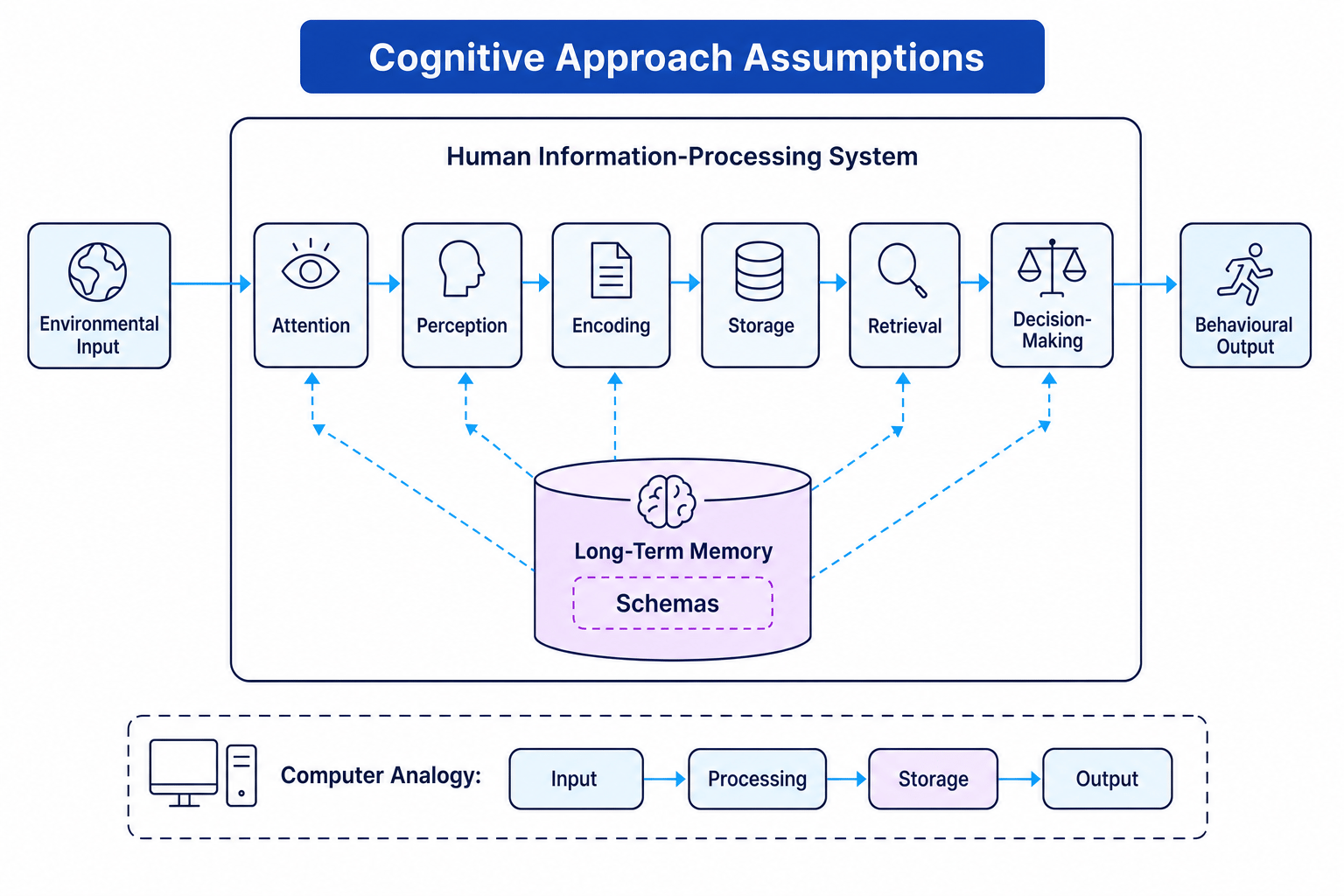
The computer analogy compares the human mind to a computer. This does not mean humans are literally computers. It means cognitive psychologists often describe the mind as an information-processing system.
A computer receives input, processes it, stores information, retrieves information and produces output. Similarly, humans receive information through the senses, attend to some of it, encode it into memory, retrieve it later, and use it to guide behaviour.
Computer analogy
The computer analogy is the idea that the human mind processes information in a way that can be compared to a computer: input, processing, storage and output.
A model is a simplified representation of how something works. Cognitive psychologists use models to explain processes that cannot be directly seen, such as memory.
A useful way to picture the cognitive assumptions is as an information-processing pathway, with schemas stored in long-term memory influencing how information is interpreted.
Why the computer analogy is useful
The analogy helps psychologists make mental processes more precise and testable. For example, memory can be broken into stages such as encoding, storage and retrieval.
Encoding, storage and retrieval
Encoding is putting information into memory. Storage is keeping information over time. Retrieval is accessing stored information when needed.
This makes it easier to design controlled experiments. For example, a study can test whether noise affects encoding, or whether context affects retrieval.
Limits of the computer analogy
Humans are not passive machines. We have emotions, motives, social experiences and biological states that affect how we process information. Human thinking is also often messy, creative and influenced by meaning.
Taking the analogy too literally
Do not write that the cognitive approach believes humans are computers. The analogy is a useful comparison, not a literal claim.
Assumption 3: schemas shape interpretation
Schema
A schema is a mental framework of knowledge and expectations built from experience, which helps us interpret and organise information.
Schemas help you deal with the world quickly. For example, you probably have a “restaurant schema”: you expect menus, ordering food, paying, and perhaps leaving a tip. This helps you know what to do without working everything out from scratch.
Schemas can also affect memory. Cognitive psychologists often argue that memory is reconstructive.
Reconstructive memory
Reconstructive memory is the idea that remembering is an active process where we rebuild past events using stored information, expectations and schemas.
This means memory is not like replaying a perfect video. It can be influenced by later information, leading questions, stereotypes or expectations.
Applying schemas to eyewitness memory
A witness sees a car accident. Later, they are asked, “How fast were the cars going when they smashed into each other?”
-
The word “smashed” activates a schema for a severe, high-impact crash.
-
That schema influences interpretation, so the witness may estimate a higher speed than if asked “How fast were the cars going when they contacted each other?”
-
Later, the witness may falsely remember broken glass because it fits the severe-crash schema, even if no glass was present.
Schema shortcut
For AO2, look for moments where a person’s previous knowledge or expectations affect what they notice, remember or decide. That is usually a schema point.
Key Eduqas study links
The assumptions are not just abstract ideas. They connect directly to the cognitive studies you meet in Component 1.
Loftus and Palmer (1974): classic study
Loftus and Palmer investigated eyewitness memory using filmed car accidents. Participants were asked questions using different verbs, such as “smashed”, “collided”, “bumped”, “hit” or “contacted”.
Participants who heard stronger verbs tended to give higher speed estimates. In a later part of the study, participants who heard “smashed” were more likely to report seeing broken glass, even though there was no broken glass.
This supports the cognitive assumption that memory is an active process influenced by schemas and post-event information.
Grant et al. (1998): contemporary study
Grant et al. investigated context-dependent memory. Participants learned meaningful material in either a silent or noisy environment, then were tested in either the same or different environment.
Recall and recognition tended to be better when the learning and testing contexts matched. This supports the idea that internal memory processes, especially retrieval, can be influenced by cues present at encoding.
AO2: applying the assumptions
In a scenario, you can apply the cognitive approach by identifying the mental process involved.
For example:
- If someone misremembers an event after being asked a leading question, apply schemas and reconstructive memory.
- If someone performs better when tested in the same room where they learned material, apply retrieval cues and information processing.
- If someone interprets a neutral comment as criticism, apply a negative schema influencing perception.
This is also useful for practical investigations. A simple cognitive practical might test whether word organisation affects recall. The independent variable could be whether the words are grouped or random. The dependent variable could be the number of words correctly recalled.
AO3: strengths of the cognitive approach
Scientific and controlled
Cognitive research often uses laboratory experiments. These allow researchers to control extraneous variables and establish cause-and-effect relationships.
For example, Loftus and Palmer controlled the wording of the critical question, so differences in speed estimates could be linked to the verb used.
Useful real-world applications
The cognitive approach has practical value. Research into eyewitness memory has helped improve police interviewing. Research into memory and retrieval cues can help students revise more effectively. Cognitive explanations also underpin therapies such as cognitive behavioural therapy, which aims to change unhelpful thought patterns.
Builds testable models
The computer analogy encourages psychologists to create models that can be tested and refined. This helps psychology appear more scientific because theories can generate clear predictions.
AO3: weaknesses of the cognitive approach
Internal processes are inferred
A major limitation is that cognitive psychologists cannot directly observe thoughts, schemas or memory traces. They infer them from behaviour. This means explanations may be less certain than direct observation.
It can be reductionist
The approach may oversimplify human behaviour by reducing it to information processing. It may underplay emotion, motivation, culture, biology and social context.
For example, a person’s memory of a traumatic event may be affected not only by schemas, but also by stress hormones, fear and later social discussion.
Laboratory tasks may lack ecological validity
Some cognitive studies use artificial tasks, such as watching film clips of accidents or learning word lists. These may not reflect real-life memory, where events are more emotional, personally meaningful and complex.
Ecological validity
Ecological validity is the extent to which research findings can be applied to real-life settings and everyday behaviour.
Ethics in cognitive research
Cognitive research often involves human participants, so the BPS Code of Ethics and Conduct is relevant. Key issues include informed consent, deception, right to withdraw, protection from harm, confidentiality and debriefing.
Loftus and Palmer involved mild deception because participants were not fully told the purpose of the leading questions. However, the study was relatively low risk and could be ethically strengthened through full debriefing and the right to withdraw.
Grant et al. was also relatively low risk, but researchers still needed informed consent, confidentiality and the right to withdraw.
Research methods link
Cognitive experiments often produce quantitative data, such as recall scores or reaction times. In Component 2, you should be able to choose an appropriate statistical test.
- If comparing two independent groups using interval-level scores, an unrelated t-test may be appropriate.
- If comparing the same participants in two conditions using interval-level scores, a related t-test may be appropriate.
- If the data are ordinal or do not meet the assumptions for a t-test, use Mann-Whitney U for independent groups or Wilcoxon signed-ranks for repeated measures.
- If testing a correlation between two variables, use Spearman’s rho.
- If using nominal categories, use chi-square.
- If looking only at the direction of change in paired data, use the binomial sign test.
Psychology normally uses p≤0.05p \le 0.05p≤0.05 as the default significance level. You compare an observed value with a critical value from a table. Remember that one-tailed tests are used only for directional hypotheses, while two-tailed tests are used for non-directional hypotheses.
A Type I error is a false positive: concluding there is a significant effect when there is not. A Type II error is a false negative: failing to find a significant effect when there really is one.
Mini essay structure
For an essay on cognitive assumptions, a strong structure could be:
- Define the cognitive approach and internal mental processes.
- Explain the computer analogy with input, processing, storage and output.
- Explain schemas and reconstructive memory.
- Support with Loftus and Palmer (1974) and/or Grant et al. (1998).
- Evaluate using scientific methods, applications, inference problems, reductionism, ecological validity and ethics.
In the exam
-
For AO1, name the three assumptions clearly: internal mental processes, computer analogy and schemas.
-
For AO2, apply the assumption to the scenario by explaining the mental process, not just naming it.
-
For AO3, balance strengths and weaknesses: scientific control and applications are strong positives, while inference, reductionism and ecological validity are key limitations.
Check yourself
- How is the cognitive approach different from the behaviourist approach?
- Why can schemas make memory both useful and inaccurate?
- How do Loftus and Palmer (1974) support the idea of reconstructive memory?
