What you'll learn
- How alpha-particle scattering provided evidence for a tiny, positively charged nucleus.
- The simple nuclear model: protons, neutrons, electrons, isotopes and nuclear notation.
- How atomic and nuclear sizes compare using powers of ten.
- How to calculate nuclear radius and mean density using R=r0A1/3R = r_0 A^{1/3}R=r0A1/3.
The Rutherford alpha-particle scattering experiment
Before this experiment, one common model was that positive charge was spread throughout the atom. Rutherford’s scattering results showed that this could not be right.
Alpha particle
An alpha particle is a helium nucleus, written 24He^{4}_{2}\text{He}24He: it contains two protons and two neutrons, so it has a positive charge.
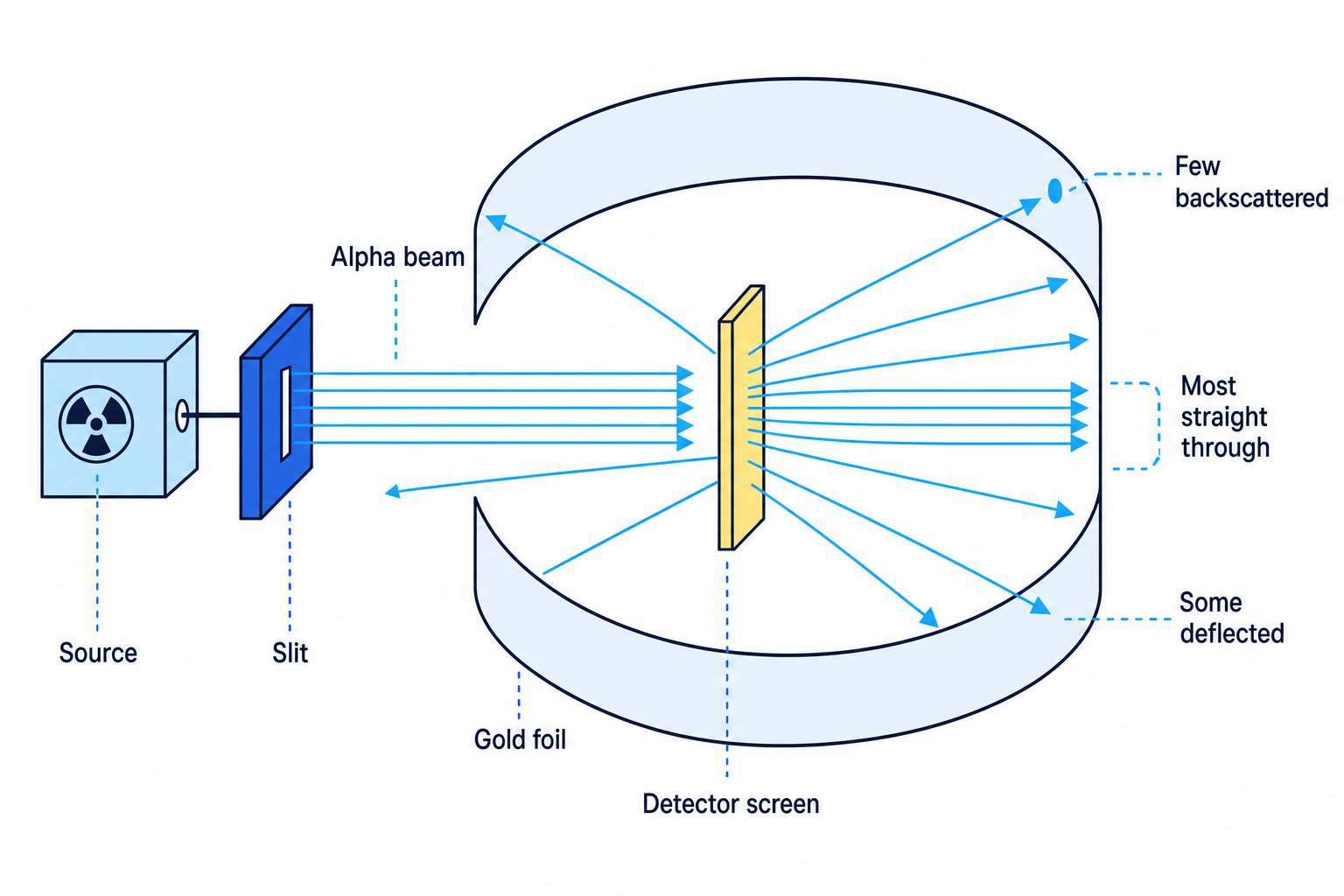
In the experiment, a narrow beam of alpha particles was fired at very thin gold foil. A detector screen showed where the alpha particles went after passing through the foil.
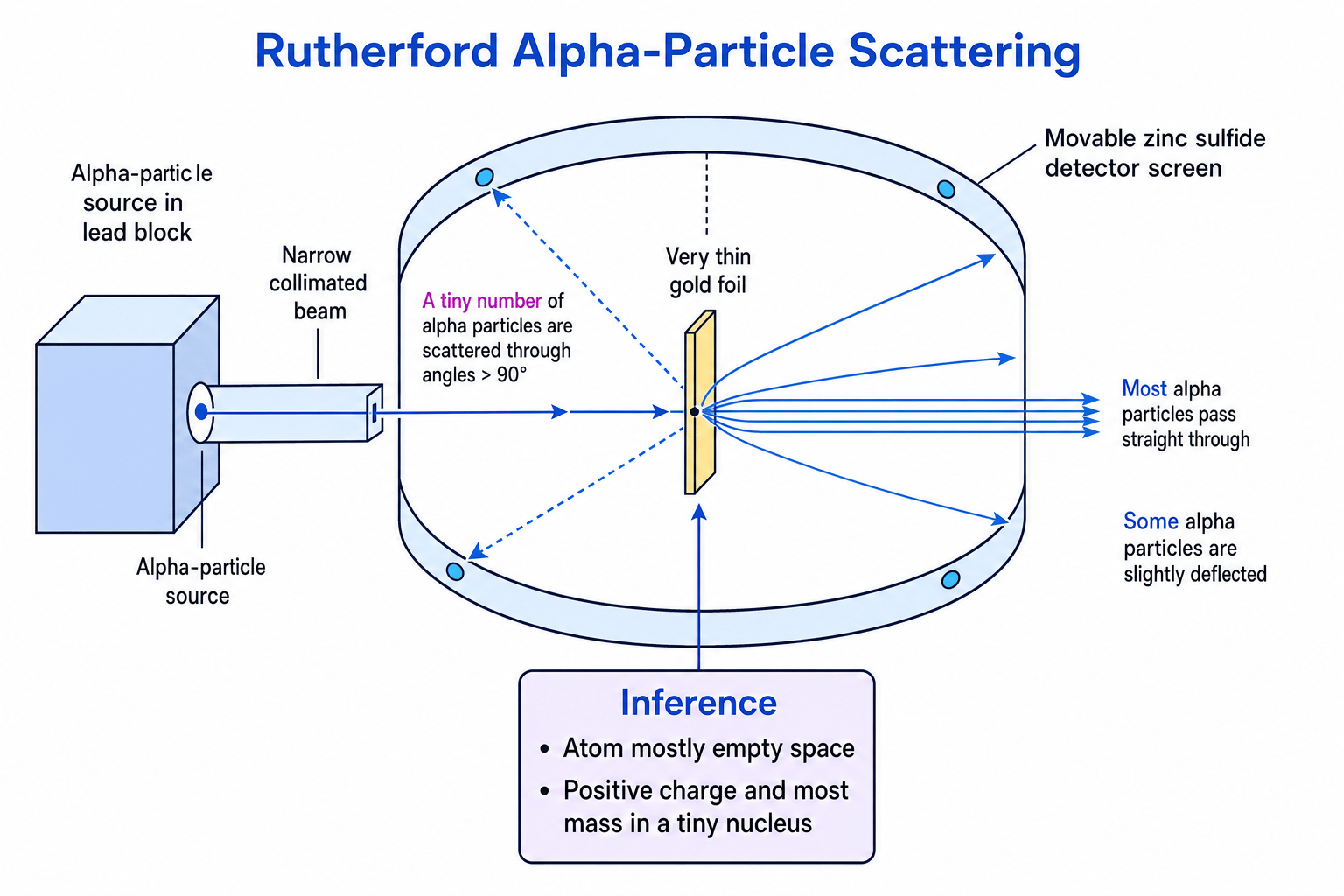
The main observations were:
- Most alpha particles passed straight through.
- Some were deflected through small angles.
- A very small number were scattered through angles greater than 90 degrees.
What the scattering showed
The atom is mostly empty space, with nearly all its positive charge and mass concentrated in a very small central nucleus.
Interpreting alpha-particle scattering
- Since most alpha particles passed straight through, most of the atom cannot contain much mass or charge. Otherwise, many more particles would collide or be deflected.
- Since alpha particles are positive, large deflections require a strong repulsive electric force from a concentrated positive region.
- Since only a tiny fraction were scattered backwards, that positive region must occupy a tiny fraction of the atom’s volume. This is evidence for a small, positively charged nucleus.
The simple nuclear model
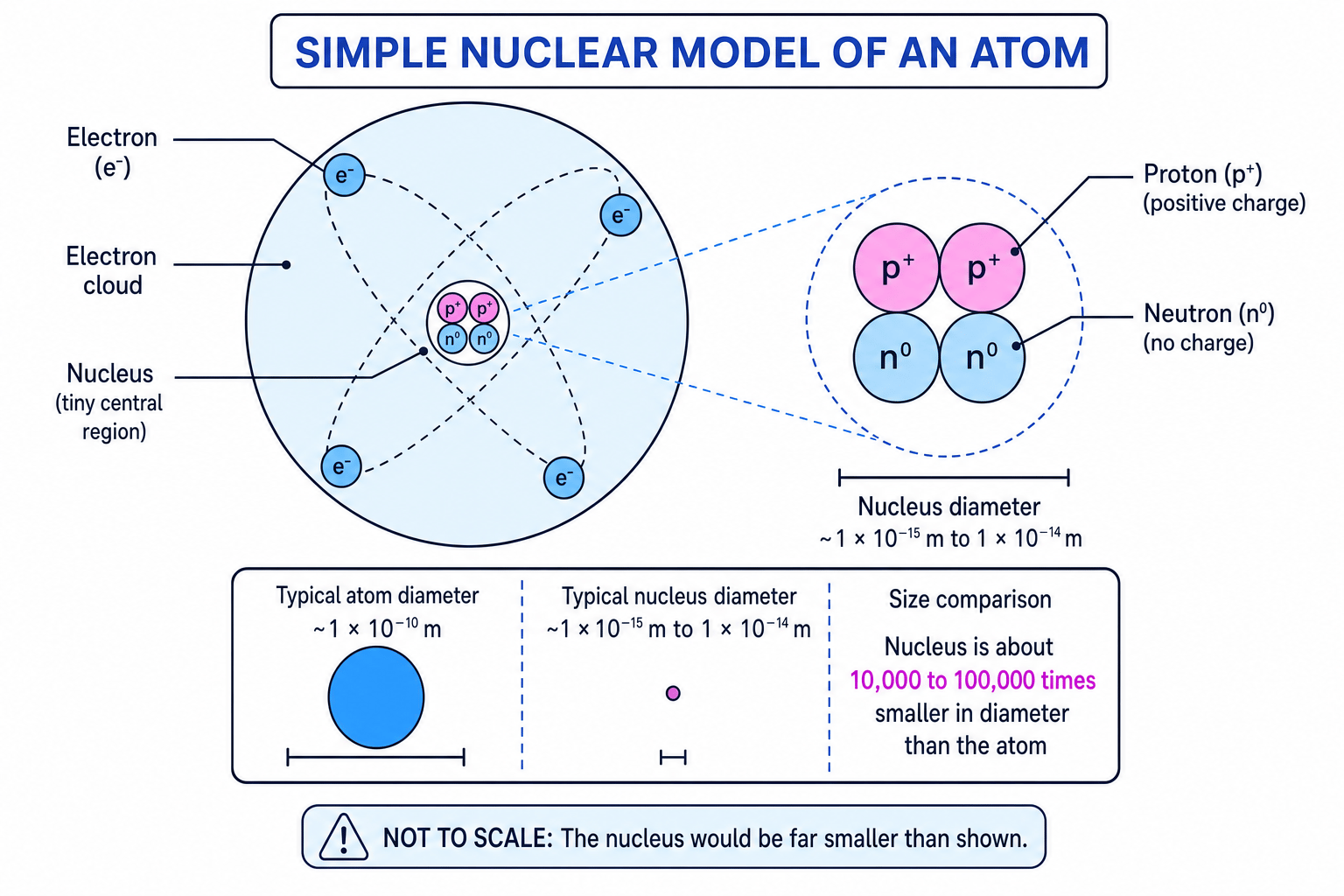
In the simple nuclear model, the atom has a tiny central nucleus surrounded by electrons. The nucleus contains protons and neutrons.
Particles in the nuclear model
- A proton is a positively charged particle found in the nucleus.
- A neutron is an uncharged particle found in the nucleus.
- An electron is a negatively charged particle found outside the nucleus.
- A nucleon is either a proton or a neutron.
For a neutral atom, the number of electrons equals the number of protons. The nucleus is positive because it contains protons, while the atom as a whole can be neutral because of its surrounding electrons.
Not to scale
Diagrams often draw the nucleus far too large. In reality, the nucleus is about 10,000 to 100,000 times smaller in diameter than the atom.
Proton number, nucleon number and isotopes
Nuclei are represented using the proton number and nucleon number.
A, Z and isotopes
- Proton number, ZZZ, is the number of protons in the nucleus. It determines the element.
- Nucleon number, AAA, is the total number of protons and neutrons.
- The number of neutrons is A−ZA - ZA−Z.
- Isotopes are nuclei of the same element with the same ZZZ but different numbers of neutrons, so they have different AAA values.
A nucleus is usually written as ZAX^{A}_{Z}XZAX, where XXX is the chemical symbol. This is the same information as writing (A,Z)X(A,Z)X(A,Z)X.
For example, 614C^{14}_{6}\text{C}614C is carbon because Z=6Z = 6Z=6, and it has 14−6=814 - 6 = 814−6=8 neutrons.
Finding particles from nuclear notation
A neutral atom is written as 2963Cu^{63}_{29}\text{Cu}2963Cu.
- The proton number is the lower number, so copper has Z=29Z = 29Z=29 protons.
- The nucleon number is the upper number, so the nucleus has A=63A = 63A=63 nucleons in total.
- The neutron number is A−Z=63−29=34A - Z = 63 - 29 = 34A−Z=63−29=34 neutrons.
- Because the atom is neutral, it has the same number of electrons as protons: 29 electrons.
Relative sizes of atoms and nuclei
A typical atom has a radius of about 1×10⁻¹⁰ m1 \times 10^{-10}\,\text{m}1×10⁻¹⁰m. A typical nucleus has a radius of about 1×10⁻¹⁵ m1 \times 10^{-15}\,\text{m}1×10⁻¹⁵m to 1×10⁻¹⁴ m1 \times 10^{-14}\,\text{m}1×10⁻¹⁴m.
That means nuclear physics uses very small distances. A useful unit is the femtometre:
1 fm=1×10⁻¹⁵ m1\,\text{fm} = 1 \times 10^{-15}\,\text{m}1fm=1×10⁻¹⁵mComparing atomic and nuclear sizes
Suppose an atom has radius 1.0×10⁻¹⁰ m1.0 \times 10^{-10}\,\text{m}1.0×10⁻¹⁰m and its nucleus has radius 5.0×10⁻¹⁵ m5.0 \times 10^{-15}\,\text{m}5.0×10⁻¹⁵m.
-
Compare the radii by dividing the larger by the smaller:
1.0×10⁻¹⁰ m5.0×10−15 m=2.0×10⁴\frac{1.0 \times 10^{-10}\,\text{m}}{5.0 \times 10^{-15}\,\text{m}} = 2.0 \times 10^{4}5.0×10⁻¹⁵m1.0×10−10m=2.0×10⁴ -
So the atom’s radius is about 20,000 times larger than the nucleus radius.
-
If both are modelled as spheres, volume scales with radius cubed:
(2.0×10⁴)3=8.0×10¹²\left(2.0 \times 10^{4}\right)^3 = 8.0 \times 10^{12}(2.0×10⁴)3=8.0×10¹² -
So the atom’s volume is about 8.0×10128.0 \times 10^{12}8.0×10¹² times larger than the nucleus volume.
The strong nuclear force
Protons repel each other electrically because they are all positively charged. The nucleus can still hold together because of the strong nuclear force.
Strong nuclear force
The strong nuclear force is the short-range force between nucleons. It is attractive between nucleons up to separations of about 3 fm, but becomes strongly repulsive below about 0.5 fm.
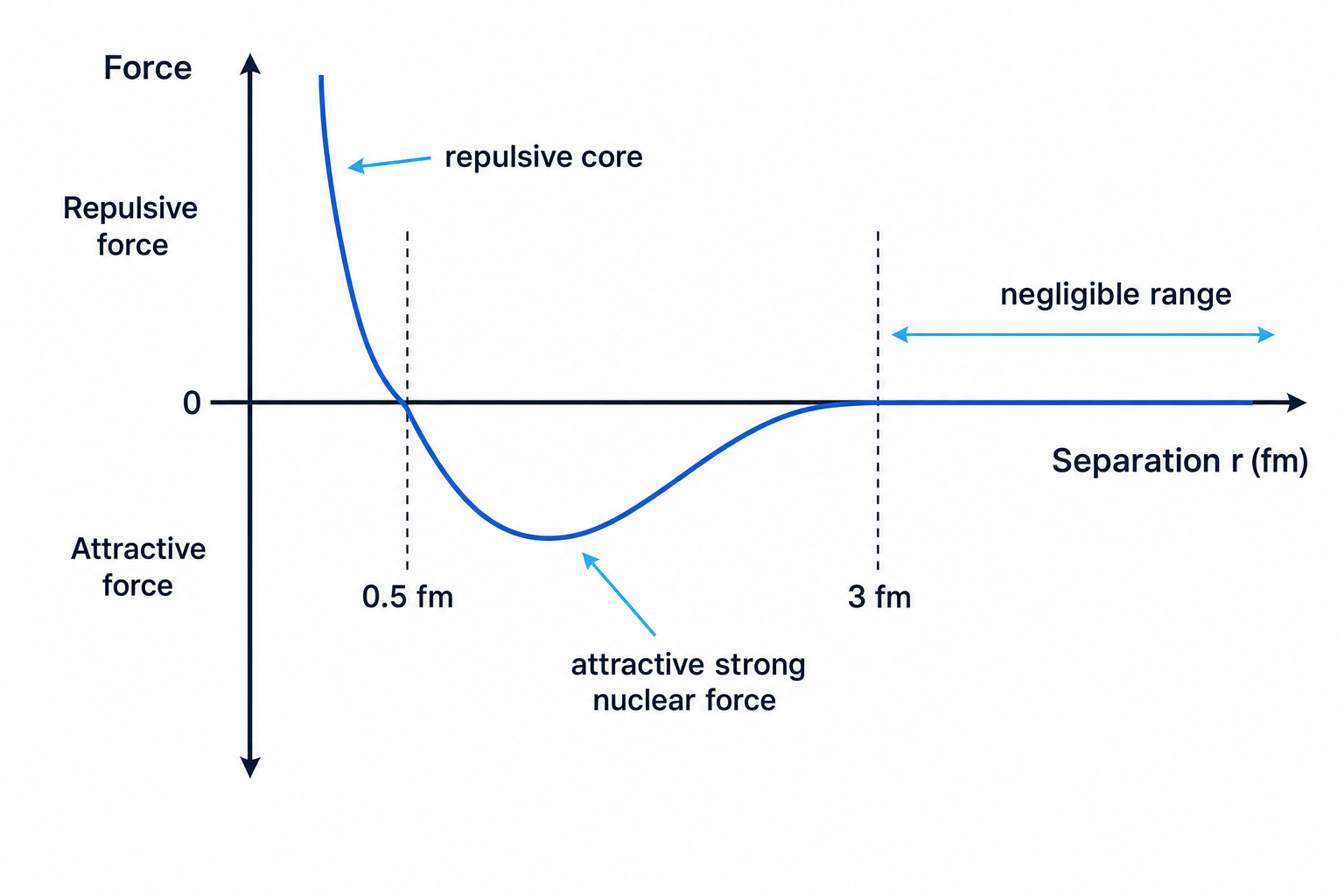
This short range matters: nucleons only strongly attract nearby nucleons. Beyond about 3 fm, the strong force is negligible.
Strong force range
Do not describe the strong nuclear force as simply “attractive”. At very small separations, below about 0.5 fm, it is repulsive; this helps stop nucleons collapsing into each other.
Nuclear radius
The radius of a nucleus depends on its nucleon number:
R=r0A1/3R = r_0 A^{1/3}R=r0A1/3where:
- RRR is the nuclear radius in metres.
- r0r_0r0 is a constant, usually around 1.2×10⁻¹⁵ m1.2 \times 10^{-15}\,\text{m}1.2×10⁻¹⁵m when needed.
- AAA is the nucleon number.
Cube-root scaling
If AAA becomes 8 times larger, A1/3A^{1/3}A1/3 becomes 2 times larger. So nuclear radius increases slowly compared with nucleon number.
The cube-root relationship makes sense because the nucleus is roughly spherical and its volume is proportional to the number of nucleons.
Mean densities of atoms and nuclei
Mean density
Mean density is mass divided by volume: ρ=mV\rho = \frac{m}{V}ρ=Vm. For a sphere, V=43πR3V = \frac{4}{3}\pi R^3V=34πR3.
Nuclear density is enormous because nearly all the atom’s mass is packed into the tiny nucleus. Atomic mean density is much smaller because the atom’s volume is mostly empty space.
Calculating nuclear and atomic mean density
Estimate the nuclear density of 82208Pb^{208}_{82}\text{Pb}82208Pb using r0=1.20×10⁻¹⁵ mr_0 = 1.20 \times 10^{-15}\,\text{m}r0=1.20×10⁻¹⁵m and nucleon mass 1.67×10⁻²⁷ kg1.67 \times 10^{-27}\,\text{kg}1.67×10⁻²⁷kg. Then compare it with an atomic mean density using atomic radius 1.8×10⁻¹⁰ m1.8 \times 10^{-10}\,\text{m}1.8×10⁻¹⁰m.
-
Calculate the nuclear radius:
R=r0A1/3=(1.20×10−15 m)(208)1/3R = r_0 A^{1/3} = \left(1.20 \times 10^{-15}\,\text{m}\right)(208)^{1/3}R=r0A1/3=(1.20×10−15m)(208)1/3Since (208)1/3≈5.92(208)^{1/3} \approx 5.92(208)1/3≈5.92,
R≈7.10×10⁻¹⁵ mR \approx 7.10 \times 10^{-15}\,\text{m}R≈7.10×10⁻¹⁵m -
Estimate the nuclear mass:
m≈208(1.67×10⁻²⁷ kg)=3.47×10⁻²⁵ kgm \approx 208 \left(1.67 \times 10^{-27}\,\text{kg}\right) = 3.47 \times 10^{-25}\,\text{kg}m≈208(1.67×10⁻²⁷kg)=3.47×10⁻²⁵kg -
Calculate the nuclear volume and density:
Vnucleus=43πR3=43π(7.10×10⁻¹⁵ m)3≈1.50×10−42 m3\begin{aligned} V_{\text{nucleus}} &= \frac{4}{3}\pi R^3 \\ &= \frac{4}{3}\pi \left(7.10 \times 10^{-15}\,\text{m}\right)^3 \\ &\approx 1.50 \times 10^{-42}\,\text{m}^3 \end{aligned}Vnucleus=34πR3=34π(7.10×10⁻¹⁵m)3≈1.50×10−42m3 ρnucleus=3.47×10⁻²⁵ kg1.50×10−42 m3≈2.3×10¹⁷ kg m−3\rho_{\text{nucleus}} = \frac{3.47 \times 10^{-25}\,\text{kg}}{1.50 \times 10^{-42}\,\text{m}^3} \approx 2.3 \times 10^{17}\,\text{kg m}^{-3}ρnucleus=1.50×10−42m33.47×10−25kg≈2.3×10¹⁷kg m−3 -
Now use the atomic radius for the whole atom:
Vatom=43π(1.8×10⁻¹⁰ m)3≈2.4×10⁻²⁹ m3V_{\text{atom}} = \frac{4}{3}\pi \left(1.8 \times 10^{-10}\,\text{m}\right)^3 \approx 2.4 \times 10^{-29}\,\text{m}^3Vatom=34π(1.8×10⁻¹⁰m)3≈2.4×10⁻²⁹m3 ρatom≈3.47×10⁻²⁵ kg2.4×10−29 m3≈1.4×10⁴ kg m−3\rho_{\text{atom}} \approx \frac{3.47 \times 10^{-25}\,\text{kg}}{2.4 \times 10^{-29}\,\text{m}^3} \approx 1.4 \times 10^{4}\,\text{kg m}^{-3}ρatom≈2.4×10⁻²⁹m33.47×10−25kg≈1.4×10⁴kg m−3 -
Compare the densities:
2.3×10171.4×104≈1.6×10¹³\frac{2.3 \times 10^{17}}{1.4 \times 10^{4}} \approx 1.6 \times 10^{13}1.4×1042.3×1017≈1.6×10¹³The nucleus has a mean density about 1.6×10131.6 \times 10^{13}1.6×10¹³ times greater than the atom in this estimate.
In the exam
- Link each scattering observation to a conclusion: “most pass through” means empty space; “some large deflections” means concentrated positive charge.
- For nuclear notation, use ZZZ for protons, AAA for protons plus neutrons, and calculate neutrons using A−ZA - ZA−Z.
- Convert femtometres carefully: 1 fm=1×10⁻¹⁵ m1\,\text{fm} = 1 \times 10^{-15}\,\text{m}1fm=1×10⁻¹⁵m. When finding density, remember to cube the radius and include units.
Check yourself
- Why did Rutherford’s results rule out a model with positive charge spread throughout the atom?
- For 1737Cl^{37}_{17}\text{Cl}1737Cl, how many protons and neutrons are in the nucleus?
- If a nucleus has 8 times as many nucleons as another nucleus, what happens to its radius?