

What you'll learn
- How particles are paired with antiparticles, including electrons, protons, neutrons and neutrinos.
- How to classify particles as hadrons or leptons using the forces they experience.
- How the simple quark model builds protons and neutrons from up and down quarks.
- How β− and β+ decay are described as quark transformations, with charge balanced.
Before we start: what “fundamental” means
In particle physics, a particle is a tiny constituent of matter or radiation. Some particles are treated as having no smaller internal parts; others are built from smaller particles.
Fundamental particle
A fundamental particle is a particle that is not made from smaller particles in the model being used. In this OCR section, quarks and leptons are treated as fundamental, while protons and neutrons are hadrons made from quarks.
The word “fundamental” is slightly historical here: the topic includes protons and neutrons because they are important particles, even though the quark model says they are not fundamental.
Particles and antiparticles
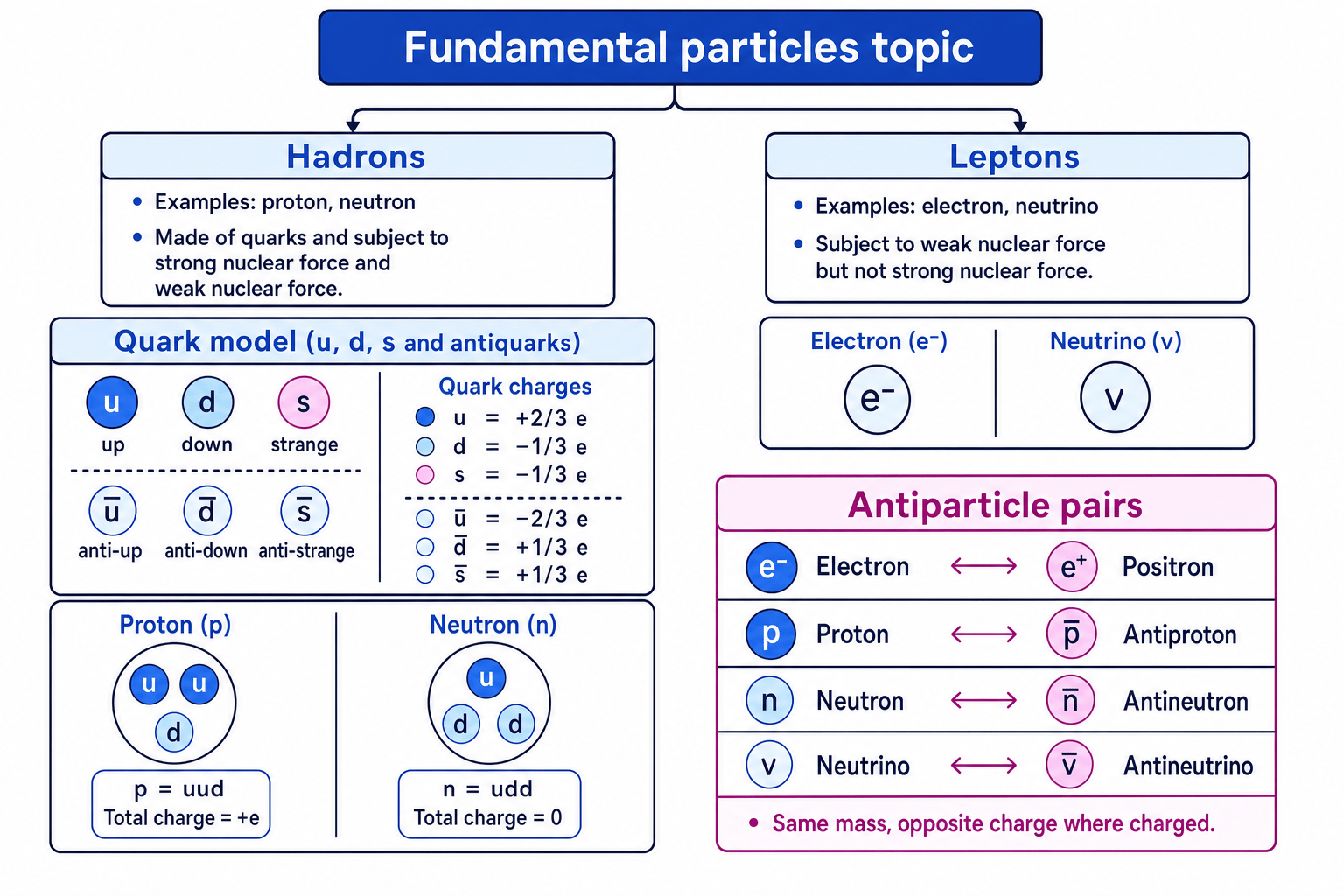
Every particle in this section has a corresponding antiparticle. A particle and its antiparticle have the same mass. If the particle is charged, the antiparticle has the opposite charge.
Important pairs you need to know are:
- electron and positron
- proton and antiproton
- neutron and antineutron
- neutrino and antineutrino
Antiparticle
An antiparticle is the partner of a particle with the same mass but with opposite values of some properties. For charged particles in this topic, that means opposite electric charge.
For example, the electron has charge −e-e−e, while the positron has charge +e+e+e. The proton has charge +e+e+e, while the antiproton has charge −e-e−e.
The neutron and antineutron are both electrically neutral. The neutrino and antineutrino are also electrically neutral. They are still different particle–antiparticle partners, even though you cannot distinguish them by electric charge alone.
Particle–antiparticle pairs
A particle and its antiparticle always have the same mass. For the charged pairs you meet here, their charges are equal in size and opposite in sign.
Hadrons and leptons
Particles in this section are classified into two key families: hadrons and leptons.
A hadron is a particle made from quarks. Protons and neutrons are examples of hadrons.
A lepton is a fundamental particle that is not made from quarks. Electrons and neutrinos are examples of leptons.
The force rule is very important:
- All hadrons are subject to the strong nuclear force and the weak nuclear force.
- All leptons are subject to the weak nuclear force, but not the strong nuclear force.
Strong and weak nuclear forces
The strong nuclear force is the interaction associated with quarks and hadrons. The weak nuclear force is the interaction responsible for beta decay processes such as β− and β+ decay.
The summary below puts the particle families, antiparticle pairs and quark charges in one place.
Calling protons fundamental
A proton is not fundamental in the quark model. It is a hadron made from three quarks: uuduuduud.
The simple quark model
For OCR H556 here, you only need the simple model using:
- up quark: uuu
- down quark: ddd
- strange quark: sss
- anti-up quark: uˉ\bar{u}uˉ
- anti-down quark: dˉ\bar{d}dˉ
- anti-strange quark: sˉ\bar{s}sˉ
The elementary charge is eee, with magnitude 1.60×10⁻¹⁹ C1.60 \times 10^{-19}\ \text{C}1.60×10⁻¹⁹ C. Quark charges are fractions of eee.
The quark charges are:
- up quark: +23e+\frac{2}{3}e+32e
- down quark: −13e-\frac{1}{3}e−31e
- strange quark: −13e-\frac{1}{3}e−31e
- anti-up quark: −23e-\frac{2}{3}e−32e
- anti-down quark: +13e+\frac{1}{3}e+31e
- anti-strange quark: +13e+\frac{1}{3}e+31e
Antiquark charges
An antiquark has the opposite charge to the corresponding quark. So if ddd has charge −13e-\frac{1}{3}e−31e, then dˉ\bar{d}dˉ has charge +13e+\frac{1}{3}e+31e.
Protons and neutrons in the quark model
The proton and neutron are both hadrons made from three quarks.
- Proton: uuduuduud
- Neutron: udduddudd
The total charge of the hadron is found by adding the charges of its quarks.
Calculating proton and neutron charge
- For the proton uuduuduud, add the quark charges:
- For the neutron udduddudd, add the quark charges:
- Compare with the known particle charges: the proton has charge +e+e+e, and the neutron has charge zero, so the quark model is consistent.
Fast charge check
For three-quark hadrons, add the numerators first and keep the denominator as 3. For uuduuduud, the numerator is 2+2−1=32 + 2 - 1 = 32+2−1=3, giving +33e=+e+\frac{3}{3}e = +e+33e=+e.
Beta decay: the nuclear picture
Beta decay is a radioactive decay process involving the weak nuclear force.
In β− decay, a neutron changes into a proton, and an electron and antineutrino are emitted:
n→p+−10e+νˉ n \to p + {}^{0}_{-1}e + \bar{\nu} n→p+−10e+νˉIn β+ decay, a proton changes into a neutron, and a positron and neutrino are emitted:
p→n++10e+ν p \to n + {}^{0}_{+1}e + \nu p→n++10e+νHere, −10e{}^{0}_{-1}e−10e represents an electron emitted in beta decay, and +10e{}^{0}_{+1}e+10e represents a positron. The top number is zero because the beta particle has negligible nucleon number in this notation; the lower number gives the charge relative to eee.
Mixing up the beta particles
β− decay emits an electron and an antineutrino. β+ decay emits a positron and a neutrino.
Beta decay in the quark model
Beta decay happens because one quark changes type through the weak interaction. The other quarks in the hadron are often called spectator quarks because they do not change.
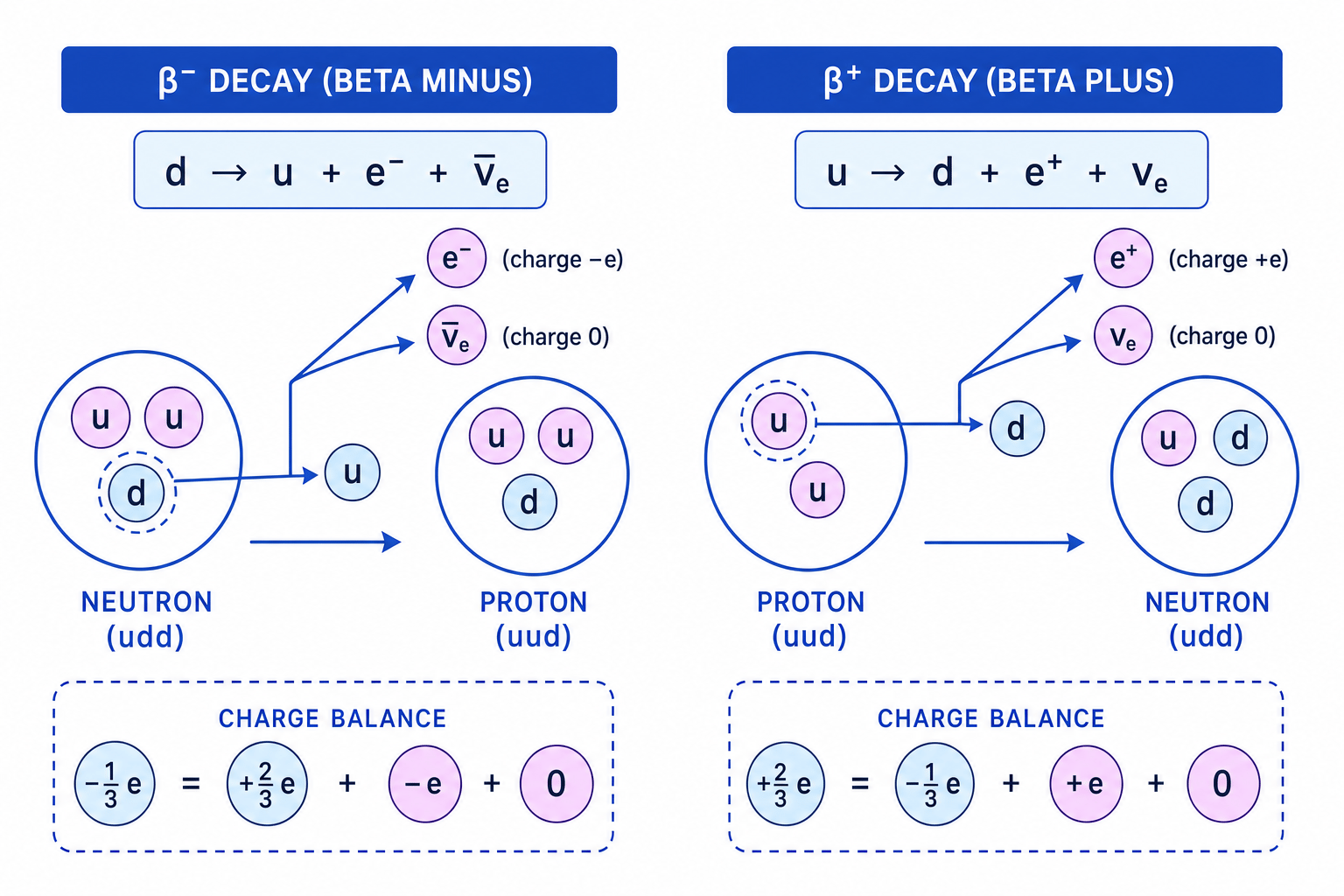
For β− decay, a down quark changes into an up quark:
d→u+−10e+νˉ d \to u + {}^{0}_{-1}e + \bar{\nu} d→u+−10e+νˉFor β+ decay, an up quark changes into a down quark:
u→d++10e+ν u \to d + {}^{0}_{+1}e + \nu u→d++10e+νThis explains why a neutron can become a proton, and why a proton can become a neutron.
The diagram below shows the quark-level changes and the charge balance for both beta decays.
Balancing beta decay quark transformations
-
For β− decay, check the charge before the decay. A down quark has charge −13e-\frac{1}{3}e−31e.
-
Add the charges after the β− transformation:
The charge is balanced, so d→u+−10e+νˉd \to u + {}^{0}_{-1}e + \bar{\nu}d→u+−10e+νˉ is allowed by charge conservation.
-
For β+ decay, check the charge before the decay. An up quark has charge +23e+\frac{2}{3}e+32e.
-
Add the charges after the β+ transformation:
The charge is balanced, so u→d++10e+νu \to d + {}^{0}_{+1}e + \nuu→d++10e+ν is allowed by charge conservation.
Charge does not choose neutrino or antineutrino
Neutrinos and antineutrinos both have charge zero, so charge conservation alone does not tell you which one appears. For OCR, learn the two beta decay equations exactly: β− gives an antineutrino, β+ gives a neutrino.
Decays of particles using the quark model
When you describe a particle decay using the quark model, you are doing careful bookkeeping:
- Write the quark content of the starting particle.
- Identify which quark changes.
- Leave the spectator quarks unchanged.
- Add the emitted beta particle and neutrino or antineutrino.
- Check total charge before and after.
For a neutron, the quark content is udduddudd. In β− decay, one ddd changes into a uuu:
udd→uud+−10e+νˉ udd \to uud + {}^{0}_{-1}e + \bar{\nu} udd→uud+−10e+νˉSo:
n→p+−10e+νˉ n \to p + {}^{0}_{-1}e + \bar{\nu} n→p+−10e+νˉFor a proton, the quark content is uuduuduud. In β+ decay, one uuu changes into a ddd:
uud→udd++10e+ν uud \to udd + {}^{0}_{+1}e + \nu uud→udd++10e+νSo:
p→n++10e+ν p \to n + {}^{0}_{+1}e + \nu p→n++10e+νIdentifying the changing quark
A neutron undergoes β− decay. Identify the quark that changes.
- Write the quark content before and after the nuclear change:
-
Compare the two sets of quarks. One ddd in the neutron has become a uuu in the proton, while the other uuu and ddd are unchanged.
-
Add the emitted particles for β− decay:
Therefore the changing quark is a down quark changing into an up quark.
In the exam
- For classification questions, decide whether the particle is a hadron or lepton first; hadrons experience the strong nuclear force, leptons do not.
- For quark-charge questions, add charges as fractions of eee and simplify at the end.
- For beta decay, memorise the two quark transformations: d→u+−10e+νˉd \to u + {}^{0}_{-1}e + \bar{\nu}d→u+−10e+νˉ and u→d++10e+νu \to d + {}^{0}_{+1}e + \nuu→d++10e+ν.
Check yourself
- Why is a proton classed as a hadron rather than a fundamental particle?
- What are the charges of uuu, ddd, uˉ\bar{u}uˉ and dˉ\bar{d}dˉ in terms of eee?
- In β+ decay, which quark changes, and which lepton is emitted?

