Fig. 20 illustrates a device used to determine the relative abundance of potassium-40 ions.
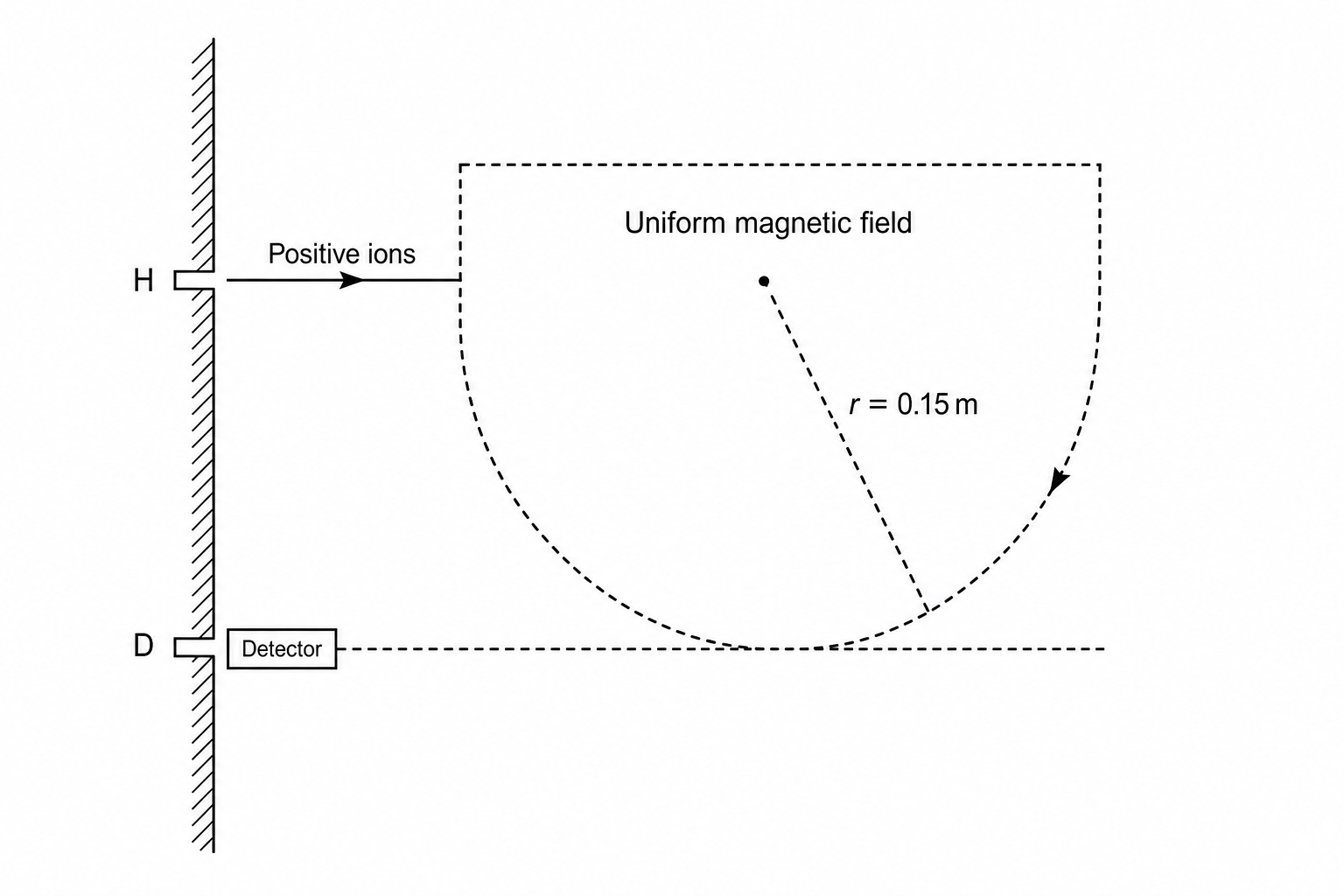
A uniform magnetic field is applied to an evacuated chamber. The direction of the magnetic field is perpendicular to the plane of the paper.
A beam of positive potassium-40 ions enters the chamber through a hole at H. The ions travel in a semi-circular path in the magnetic field. The ions are detected at point D.
Each potassium-40 ion has charge +1.6×10⁻¹⁹ C+1.6 \times 10^{-19}\text{ C}+1.6×10⁻¹⁹ C and speed 5.2×10⁴ m s−15.2 \times 10^4\text{ m s}^{-1}5.2×10⁴ m s−1. The radius of the semi-circular path of the ions is 0.15 m0.15\text{ m}0.15 m. The mass of a potassium-40 ion is 6.6×10⁻²⁶ kg6.6 \times 10^{-26}\text{ kg}6.6×10⁻²⁶ kg.
Calculate the magnitude of the magnetic flux density BBB of the magnetic field.
The chemical composition of ancient rocks found on the Earth can be used to estimate the age of the Earth. Nuclei of rhenium-187 ( 75187Re^{187}_{\;\;75}\text{Re}75187Re) decay spontaneously into nuclei of osmium-187 ( 76187Os^{187}_{\;\;76}\text{Os}76187Os). The half-life of rhenium-187 is 41 billion years41\text{ billion years}41 billion years.
(i) Name the two leptons emitted in the decay of a rhenium-187 nucleus.
The percentage of rhenium-187 left in a sample of an ancient rock is 93%93\%93%. Estimate the age of the rock (and hence the Earth) in billion years.