A team of astrophysicists has calculated the luminosity LLL and radius rrr of several main sequence stars. They plan to use Stefan's law to estimate the surface temperature TTT of these stars. \nExplain\nExplain\nExplain whether the astrophysicists should attempt to measure rrr or LLL more precisely to minimize the percentage uncertainty in the calculated value of TTT.
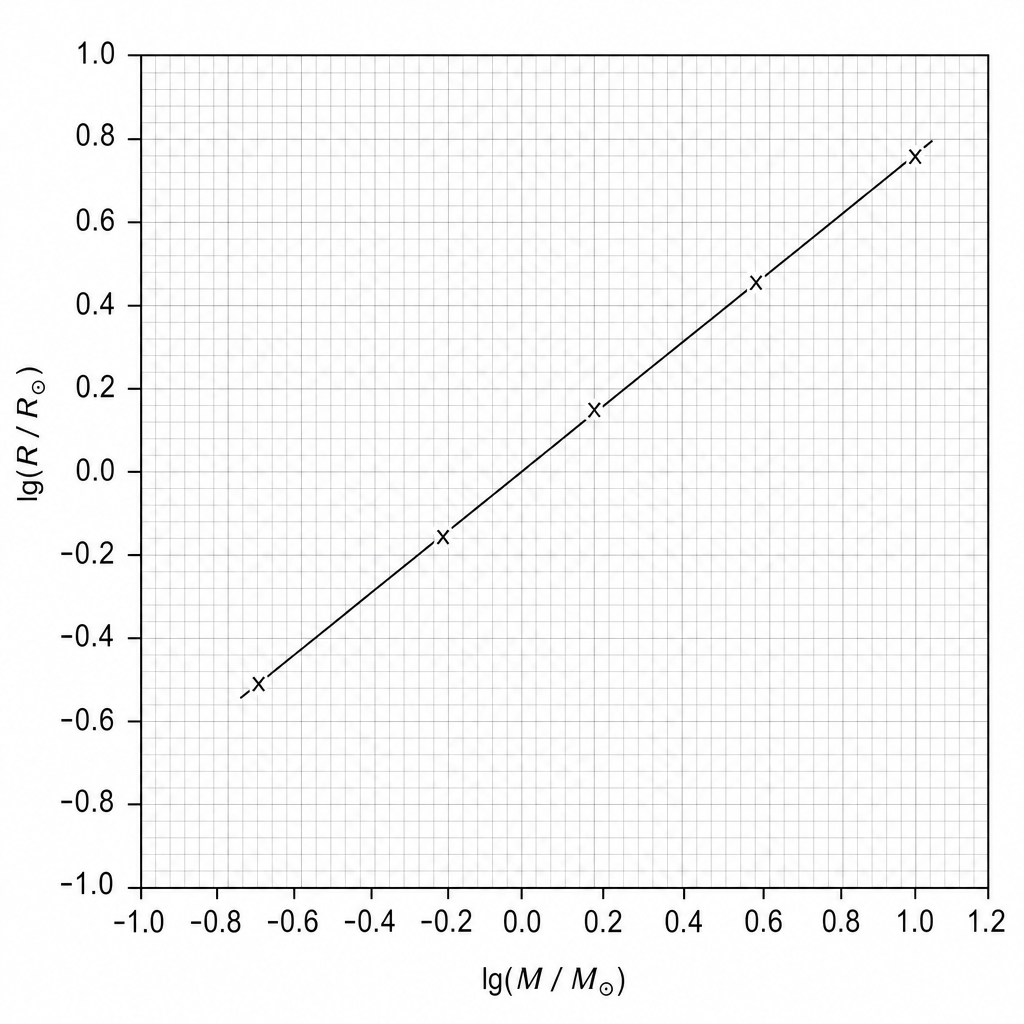
It is suggested that the radius RRR and the mass MMM of a main sequence star can be compared to the Sun by the equation:
RR⊙=(MM⊙)α \frac{R}{R_\odot} = \left(\frac{M}{M_\odot}\right)^\alpha R⊙R=(M⊙M)α\nwhere\nwhere\nwhere R⊙R_\odotR⊙ is the radius of the Sun and M⊙M_\odotM⊙ is the mass of the Sun. \nTable\nTable\nTable 1 shows some data of five main sequence stars:
| Main sequence star | MM⊙\frac{M}{M_\odot}M⊙M | RR⊙\frac{R}{R_\odot}R⊙R |
|---|---|---|
| Ross 128 | 0.200.200.20 | 0.300.300.30 |
| Lacaille 9352 | 0.600.600.60 | 0.680.680.68 |
| Sirius A | 1.51.51.5 | 1.41.41.4 |
| Regulus | 4.04.04.0 | 2.82.82.8 |
| Achernar | 10.010.010.0 | 5.65.65.6 |
| \nThe\nThe\nThe graph below shows the plot of lg(RR⊙)\lg\left(\frac{R}{R_\odot}\right)lg(R⊙R) against lg(MM⊙)\lg\left(\frac{M}{M_\odot}\right)lg(M⊙M) for these stars. |
 \nThe\nThe\nThe average density of a star is inversely proportional to its volume, meaning ρ∝MR3\rho \propto \frac{M}{R^3}ρ∝R3M.
\nUse\nUse\nUse the graph to determine α\alphaα and use your knowledge of stellar properties to deduce how the average density of more massive main sequence stars compares with the average density of less massive main sequence stars.
\nThe\nThe\nThe average density of a star is inversely proportional to its volume, meaning ρ∝MR3\rho \propto \frac{M}{R^3}ρ∝R3M.
\nUse\nUse\nUse the graph to determine α\alphaα and use your knowledge of stellar properties to deduce how the average density of more massive main sequence stars compares with the average density of less massive main sequence stars.

