

What you'll learn
- What internal energy means, and how it links to temperature.
- How heat and work transfer energy into or out of a system.
- How to use U=32nRTU = \frac{3}{2}nRTU=23nRT, W=pΔVW = p\Delta VW=pΔV, ΔU=Q−W\Delta U = Q - WΔU=Q−W, and Q=mcΔθQ = mc\Delta\thetaQ=mcΔθ.
- How the specified practicals estimate absolute zero and measure specific heat capacity.
Systems, molecules and internal energy
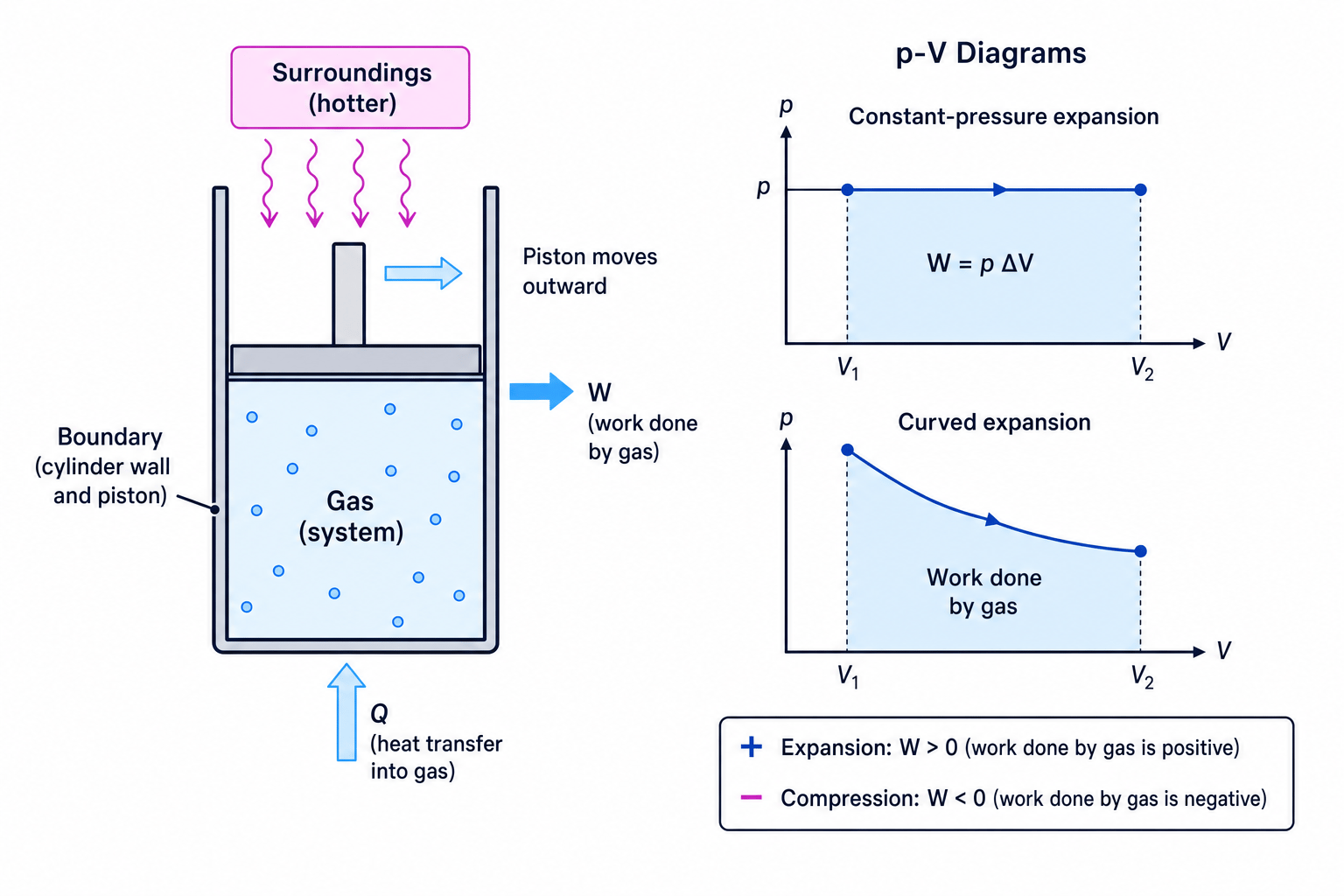
In thermal physics, a system is the object or substance you choose to study. Everything outside it is the surroundings. The boundary is the wall or surface through which energy may pass.
For example, gas inside a cylinder can be the system. Its boundary is the cylinder wall and piston.
Internal energy
The internal energy of a system is the sum of the random kinetic energies and potential energies of its molecules.
The kinetic energy part comes from molecules moving randomly. The potential energy part comes from forces between molecules, especially important in solids and liquids where particles interact strongly.
Internal energy is microscopic
Internal energy is not the energy of the whole object moving across the room. It is the energy stored in the random motion and interactions of the particles inside it.
Temperature and absolute zero
Temperature tells you about the average random kinetic energy of particles. In A-Level Physics, thermodynamic temperature is measured in kelvin (K), not degrees Celsius.
The link between Celsius temperature θ\thetaθ and kelvin temperature TTT is:
T=θ+273.15T = \theta + 273.15T=θ+273.15Absolute zero
Absolute zero is the temperature of a system when it has minimum internal energy. It is 0 K, which is approximately -273 degrees Celsius.
This does not mean “no heat”. Heat is energy being transferred, not something contained in the system.
Internal energy of an ideal monatomic gas
An ideal gas is a model gas whose particles have negligible volume and no intermolecular forces except during collisions.
A monatomic gas has one atom per particle, such as helium or neon.
For an ideal monatomic gas, there is no intermolecular potential energy, so the internal energy is wholly kinetic:
U=32nRTU = \frac{3}{2}nRTU=23nRTwhere:
- UUU is internal energy in joules (J)
- nnn is amount of substance in moles (mol)
- RRR is the molar gas constant, 8.31 J mol−1K−18.31\ \text{J mol}^{-1}\text{K}^{-1}8.31 J mol−1K−1
- TTT is thermodynamic temperature in kelvin (K)
Finding the internal energy of helium
A sealed container holds 0.250 mol0.250\ \text{mol}0.250 mol of helium at 300 K300\ \text{K}300 K. Estimate its internal energy.
-
Helium is monatomic, so use the ideal monatomic gas equation:
U=32nRTU = \frac{3}{2}nRTU=23nRT -
Substitute the values:
U=32×0.250 mol×8.31 J mol−1K−1×300 KU = \frac{3}{2} \times 0.250\ \text{mol} \times 8.31\ \text{J mol}^{-1}\text{K}^{-1} \times 300\ \text{K}U=23×0.250 mol×8.31 J mol−1K−1×300 K -
Calculate and cancel units:
U=935 JU = 935\ \text{J}U=935 J
So the internal energy is about 9.35×10² J9.35 \times 10^2\ \text{J}9.35×10² J.
Using Celsius in gas equations
Equations involving gas temperature, such as U=32nRTU = \frac{3}{2}nRTU=23nRT, require temperature in kelvin. Never substitute degrees Celsius directly.
Specified practical: estimating absolute zero
At constant volume and fixed amount of gas, gas pressure is proportional to kelvin temperature:
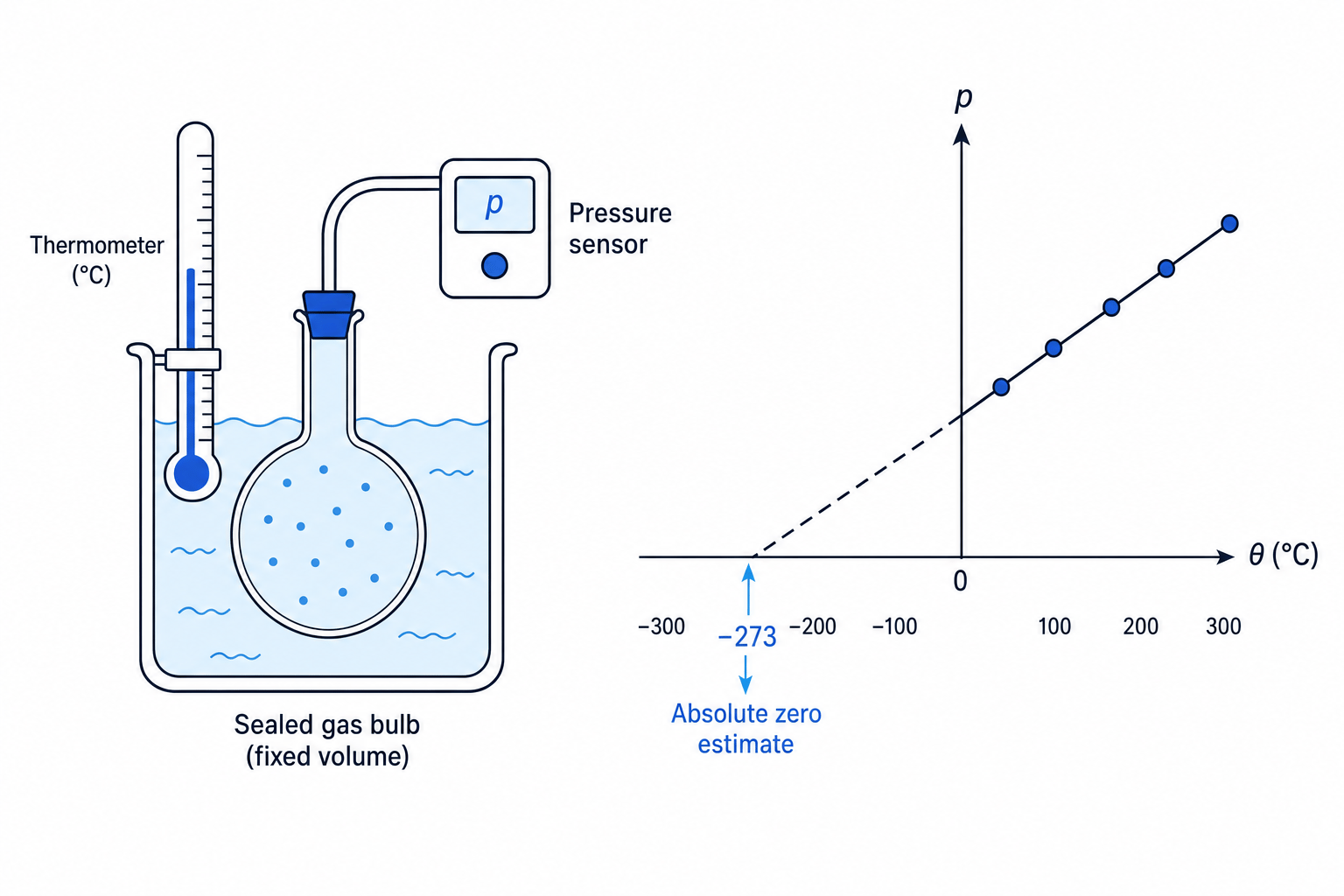
p∝Tp \propto Tp∝TSince T=θ+273.15T = \theta + 273.15T=θ+273.15, a graph of pressure ppp against Celsius temperature θ\thetaθ should be a straight line. If extended backwards, it meets the temperature axis at about -273 degrees Celsius.
The experiment uses a fixed-volume gas bulb connected to a pressure sensor. The bulb is placed in water baths at different temperatures, and pressure is recorded once the gas has reached thermal equilibrium.
Estimating absolute zero from a pressure graph
A best-fit line for pressure against Celsius temperature has gradient 0.339 kPa °C−10.339\ \text{kPa °C}^{-1}0.339 kPa °C−1 and pressure-axis intercept 92.5 kPa92.5\ \text{kPa}92.5 kPa.
-
The line has the form:
p=mθ+cp = m\theta + cp=mθ+cwhere m=0.339 kPa °C−1m = 0.339\ \text{kPa °C}^{-1}m=0.339 kPa °C−1 and c=92.5 kPac = 92.5\ \text{kPa}c=92.5 kPa.
-
Absolute zero is estimated where pressure would become zero:
0=mθ+c0 = m\theta + c0=mθ+c -
Rearrange and substitute:
θ=−cm=−92.5 kPa0.339 kPa °C−1=−273 ∘C\theta = -\frac{c}{m} = -\frac{92.5\ \text{kPa}}{0.339\ \text{kPa °C}^{-1}} = -273\ ^\circ\text{C}θ=−mc=−0.339 kPa °C−192.5 kPa=−273 ∘C
The estimate is -273 degrees Celsius, close to 0 K.
Practical graph strategy
Use a large temperature range and draw a best-fit line. The intercept is more reliable than using one pair of readings, because random errors are spread across all the data.
Pressure must be absolute
If a sensor gives gauge pressure, you must add atmospheric pressure before plotting. Gas laws use absolute pressure, not pressure above atmospheric pressure.
Heat, thermal equilibrium and energy transfer
Heat is energy transferred because of a temperature difference. It enters or leaves a system through the boundary.
If the surroundings are hotter than the system, heat transfers into the system. If the system is hotter than the surroundings, heat transfers out.
Thermal equilibrium
Two systems in contact are in thermal equilibrium when no heat flows between them. They are at the same temperature.
Heat is not stored
A system contains internal energy. It does not “contain heat”. Heat is energy in transit across a boundary due to a temperature difference.
Work done by a gas
Energy can also enter or leave a system by work. Work is energy transferred by a force moving through a distance.
For a gas in a cylinder, expansion pushes the piston outwards. The gas does work on the surroundings.
For constant pressure:
W=pΔVW = p\Delta VW=pΔVwhere:
- WWW is work done by the gas in joules (J)
- ppp is pressure in pascals (Pa)
- ΔV\Delta VΔV is change in volume in cubic metres (m³)
If pressure changes during the process, the work done by the gas is the area under the p−Vp - Vp−V graph.
Calculating work done during expansion
A gas expands at constant pressure 1.20×10⁵ Pa1.20 \times 10^5\ \text{Pa}1.20×10⁵ Pa from 2.00×10⁻³ m32.00 \times 10^{-3}\ \text{m}^32.00×10⁻³ m3 to 5.50×10⁻³ m35.50 \times 10^{-3}\ \text{m}^35.50×10⁻³ m3. Find the work done by the gas.
-
Find the volume change:
ΔV=5.50×10⁻³ m3−2.00×10⁻³ m3=3.50×10⁻³ m3\Delta V = 5.50 \times 10^{-3}\ \text{m}^3 - 2.00 \times 10^{-3}\ \text{m}^3 = 3.50 \times 10^{-3}\ \text{m}^3ΔV=5.50×10⁻³ m3−2.00×10⁻³ m3=3.50×10⁻³ m3 -
Use the constant-pressure work equation:
W=pΔVW = p\Delta VW=pΔV -
Substitute:
W=1.20×105 Pa×3.50×10−3 m3=420 JW = 1.20 \times 10^5\ \text{Pa} \times 3.50 \times 10^{-3}\ \text{m}^3 = 420\ \text{J}W=1.20×105 Pa×3.50×10−3 m3=420 J
The gas does 420 J420\ \text{J}420 J of work on its surroundings.
Forgetting the graph area
When pressure is not constant, do not use one pressure value blindly. The work done is the area under the p−Vp - Vp−V graph.
The first law of thermodynamics
The first law is an energy conservation statement for thermal systems:
ΔU=Q−W\Delta U = Q - WΔU=Q−Wwhere:
- ΔU\Delta UΔU is the change in internal energy of the system
- QQQ is heat transferred into the system
- WWW is work done by the system on the surroundings
Signs matter:
- Q>0Q > 0Q>0: heat enters the system
- Q<0Q < 0Q<0: heat leaves the system
- W>0W > 0W>0: system does work on surroundings, usually expansion
- W<0W < 0W<0: work is done on the system, usually compression
- ΔU>0\Delta U > 0ΔU>0: internal energy increases
- ΔU<0\Delta U < 0ΔU<0: internal energy decreases
Using the first law with signs
A gas receives 650 J650\ \text{J}650 J of heat and expands, doing 240 J240\ \text{J}240 J of work on its surroundings. Find the change in internal energy.
-
Identify the signs: heat enters the gas, so Q=+650 JQ = +650\ \text{J}Q=+650 J. The gas does work, so W=+240 JW = +240\ \text{J}W=+240 J.
-
Apply the first law:
ΔU=Q−W\Delta U = Q - WΔU=Q−W -
Substitute:
ΔU=650 J−240 J=410 J\Delta U = 650\ \text{J} - 240\ \text{J} = 410\ \text{J}ΔU=650 J−240 J=410 J
The internal energy increases by 410 J410\ \text{J}410 J.
Sanity check for expansion
If a gas expands and does work, some energy leaves the gas by work. So Q−WQ - WQ−W should be smaller than QQQ if both are positive.
Solids and liquids: work is usually negligible
For a solid or liquid, the volume change during heating is normally very small. Since W=pΔVW = p\Delta VW=pΔV, the work done by expansion is usually negligible.
So for solids and liquids:
Q=ΔUQ = \Delta UQ=ΔUThis means the heat supplied mainly increases the internal energy of the material.
Specific heat capacity
Specific heat capacity
The specific heat capacity ccc of a substance is the energy required to raise the temperature of 1 kg of the substance by 1 K, with no change of state.
For a solid or liquid:
Q=mcΔθQ = mc\Delta\thetaQ=mcΔθwhere:
- QQQ is energy transferred in joules (J)
- mmm is mass in kilograms (kg)
- ccc is specific heat capacity in joules per kilogram per kelvin
- Δθ\Delta\thetaΔθ is temperature change in kelvin or degrees Celsius
A temperature change of 1 degree Celsius is the same size as a temperature change of 1 K.
Finding the energy needed to heat a metal block
A 0.500 kg0.500\ \text{kg}0.500 kg aluminium block has specific heat capacity 900 J kg−1K−1900\ \text{J kg}^{-1}\text{K}^{-1}900 J kg−1K−1. How much energy is needed to raise its temperature by 25.0 K25.0\ \text{K}25.0 K?
-
Use:
Q=mcΔθQ = mc\Delta\thetaQ=mcΔθ -
Substitute:
Q=0.500 kg×900 J kg−1K−1×25.0 KQ = 0.500\ \text{kg} \times 900\ \text{J kg}^{-1}\text{K}^{-1} \times 25.0\ \text{K}Q=0.500 kg×900 J kg−1K−1×25.0 K -
Calculate:
Q=11250 J≈1.13×10⁴ JQ = 11250\ \text{J} \approx 1.13 \times 10^4\ \text{J}Q=11250 J≈1.13×10⁴ J
So about 1.13×10⁴ J1.13 \times 10^4\ \text{J}1.13×10⁴ J is required.
Specified practical: measuring specific heat capacity of a solid
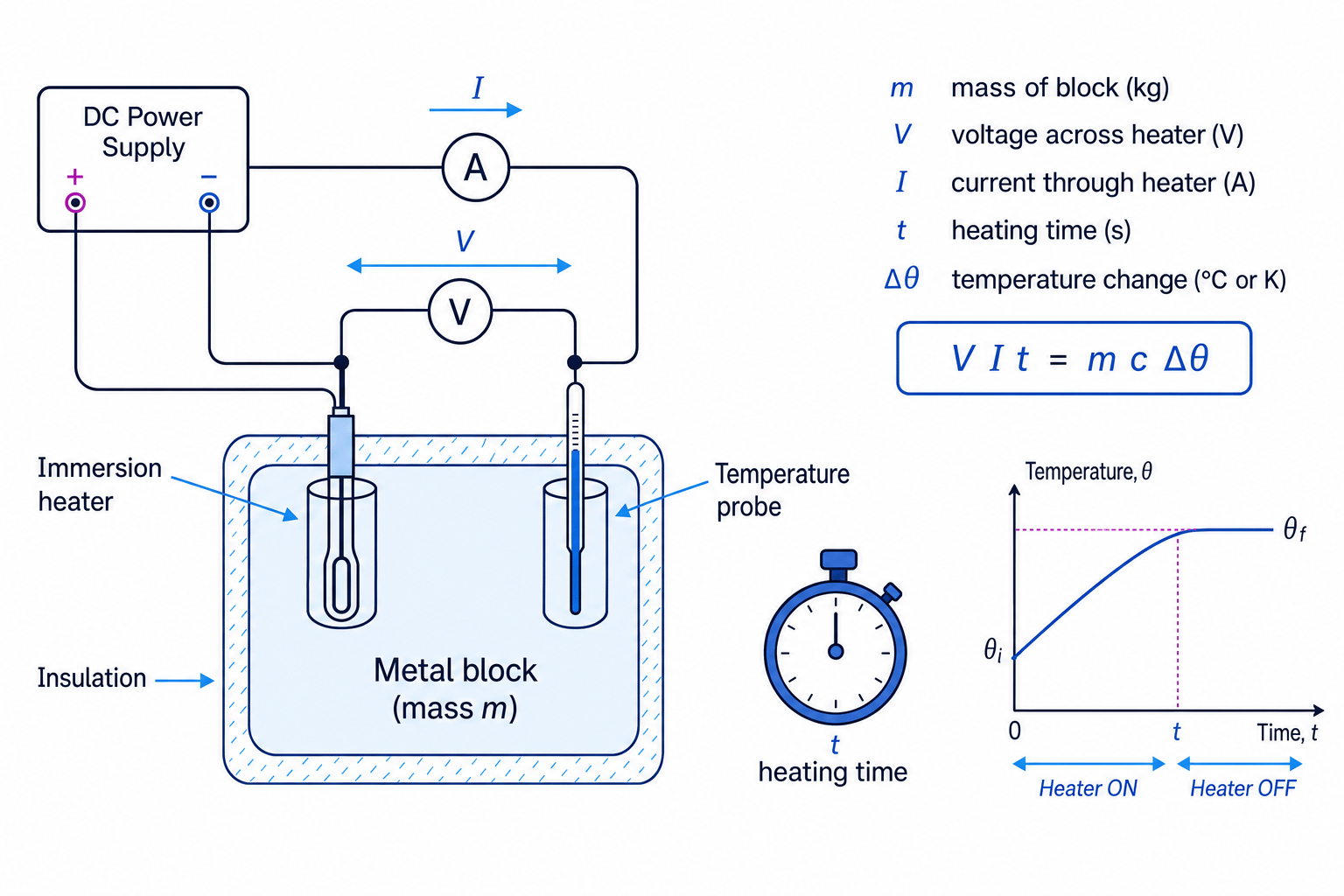
A common method uses an electrical heater in a metal block. Electrical energy supplied is:
E=VItE = VItE=VItAssuming the energy goes into the block:
VIt=mcΔθVIt = mc\Delta\thetaVIt=mcΔθSo:
c=VItmΔθc = \frac{VIt}{m\Delta\theta}c=mΔθVItThe apparatus should include an insulated block, immersion heater, thermometer or temperature probe, ammeter in series, voltmeter across the heater, and stopwatch.
A good method:
- Measure the mass of the block using a balance.
- Record the initial temperature.
- Switch on the heater and record voltage, current and heating time.
- Record the final temperature, or use a temperature-time graph.
- Calculate ccc using c=VItmΔθc = \frac{VIt}{m\Delta\theta}c=mΔθVIt.
Calculating specific heat capacity from electrical heating
A 1.20 kg1.20\ \text{kg}1.20 kg metal block is heated for 300 s300\ \text{s}300 s. The heater has voltage 12.0 V12.0\ \text{V}12.0 V and current 3.50 A3.50\ \text{A}3.50 A. The temperature rises from 19.5 degrees Celsius to 28.0 degrees Celsius. Find ccc.
-
Calculate the temperature change:
Δθ=28.0∘C−19.5∘C=8.5 K\Delta\theta = 28.0^\circ\text{C} - 19.5^\circ\text{C} = 8.5\ \text{K}Δθ=28.0∘C−19.5∘C=8.5 K -
Calculate the electrical energy supplied:
E=VIt=12.0 V×3.50 A×300 s=12600 JE = VIt = 12.0\ \text{V} \times 3.50\ \text{A} \times 300\ \text{s} = 12600\ \text{J}E=VIt=12.0 V×3.50 A×300 s=12600 J -
Rearrange and substitute:
c=EmΔθ=12600 J1.20 kg×8.5 K=1240 J kg−1K−1c = \frac{E}{m\Delta\theta} = \frac{12600\ \text{J}}{1.20\ \text{kg} \times 8.5\ \text{K}} = 1240\ \text{J kg}^{-1}\text{K}^{-1}c=mΔθE=1.20 kg×8.5 K12600 J=1240 J kg−1K−1
The measured specific heat capacity is about 1.2×10³ J kg−1K−11.2 \times 10^3\ \text{J kg}^{-1}\text{K}^{-1}1.2×10³ J kg−1K−1.
Ignoring heat losses
If energy is lost to the surroundings, VItVItVIt is larger than the energy gained by the block. This usually makes the calculated value of ccc too large.
Improving the practical
Use insulation, ensure good thermal contact with the heater and probe, take repeated readings, and use a temperature-time graph to reduce the effect of random fluctuations.
Linking to insulation and buildings
Materials with high specific heat capacity can store a lot of energy for a small temperature rise. This is sometimes called high thermal mass.
Insulating materials usually have low thermal conductivity, so they reduce the rate of heat transfer through walls, roofs or floors. In building design, good heat retention often combines low thermal conductivity insulation with suitable thermal mass.
In the exam
- Always define the system first: decide whether heat and work are entering or leaving that system.
- Use kelvin for gas equations, and remember that temperature changes may be in K or degrees Celsius.
- For the first law, write the signs explicitly before substituting into ΔU=Q−W\Delta U = Q - WΔU=Q−W.
- On a p−Vp - Vp−V graph, work done by the gas is the area under the curve, not the gradient.
- In practical questions, comment on insulation, equilibrium, repeated readings, best-fit lines and whether the pressure used is absolute.
Check yourself
- Why is it wrong to say that a hot object “contains heat”?
- A gas is compressed and no heat enters or leaves it. What happens to its internal energy?
- In the specific heat capacity practical, why does poor insulation affect the calculated value of ccc?
