

What you'll learn
- Use the ideal gas equations pV=nRTpV = nRTpV=nRT and pV=NkTpV = NkTpV=NkT.
- Convert between mass, molar mass, moles, and number of molecules.
- Explain gas pressure using molecular collisions and Newton’s laws.
- Show why absolute temperature is proportional to mean molecular kinetic energy.
The big idea: macroscopic and microscopic views
A gas can be described in two ways.
The macroscopic view uses measurable quantities such as pressure, volume, temperature, and amount of substance. The microscopic view describes the motion of individual molecules.
Pressure and absolute temperature
Pressure ppp is force per unit area, measured in pascal, Pa. Absolute temperature TTT is temperature measured in kelvin, K, and is the temperature scale used in gas equations.
Temperature must be in kelvin. To convert from degrees Celsius, add 273.15.
Using degrees Celsius in gas equations
Never substitute a Celsius temperature into pV=nRTpV = nRTpV=nRT or pV=NkTpV = NkTpV=NkT. A gas at 20 °C has T=293 KT = 293\ \mathrm{K}T=293 K, not 20 K.
Moles, molecules, and molar mass
The amount of substance is measured in moles, mol. One mole contains a fixed number of specified particles: atoms, molecules, ions, or whatever particle type is being counted.
Avogadro constant and the mole
The Avogadro constant NAN_ANA is the number of particles in one mole: NA≈6.02×10²³ mol−1N_A \approx 6.02 \times 10^{23}\ \mathrm{mol^{-1}}NA≈6.02×10²³ mol−1. A mole is an amount of substance containing this number of specified particles.
If a sample contains nnn moles and NNN molecules,
N=nNAN = nN_AN=nNAThe relative molecular mass MrM_rMr has no unit. The molar mass MMM is the mass of one mole of the substance.
Eduqas writes the conversion as
M/kg=Mr1000M / \text{kg} = \frac{M_r}{1000}M/kg=1000Mrmeaning that MMM is in kilogram per mole, kg mol^-1.
The number of moles is
n=total massmolar mass=mtotalMn = \frac{\text{total mass}}{\text{molar mass}} = \frac{m_{\text{total}}}{M}n=molar masstotal mass=MmtotalFinding moles and molecules from mass
A sample of nitrogen molecules has total mass 1.40×10⁻² kg1.40 \times 10^{-2}\ \mathrm{kg}1.40×10⁻² kg. Nitrogen has Mr=28.0M_r = 28.0Mr=28.0. Find the amount in moles and the number of molecules.
-
Convert relative molecular mass to molar mass:
M=28.01000 kg mol−1=2.80×10⁻² kg mol−1M = \frac{28.0}{1000}\ \mathrm{kg\,mol^{-1}} = 2.80 \times 10^{-2}\ \mathrm{kg\,mol^{-1}}M=100028.0 kgmol−1=2.80×10⁻² kgmol−1 -
Use mass divided by molar mass:
n=1.40×10⁻² kg2.80×10−2 kg mol−1=0.500 moln = \frac{1.40 \times 10^{-2}\ \mathrm{kg}}{2.80 \times 10^{-2}\ \mathrm{kg\,mol^{-1}}} = 0.500\ \mathrm{mol}n=2.80×10⁻² kgmol−11.40×10⁻² kg=0.500 mol -
Convert moles to molecules:
N=nNA=(0.500 mol)(6.02×10²³ mol−1)=3.01×10²³N = nN_A = (0.500\ \mathrm{mol})(6.02 \times 10^{23}\ \mathrm{mol^{-1}}) = 3.01 \times 10^{23}N=nNA=(0.500 mol)(6.02×10²³ mol−1)=3.01×10²³
The ideal gas equation of state
An ideal gas is a model gas that obeys the ideal gas equation exactly. Real gases are closest to ideal behaviour at low pressure and high temperature.
Equation of state
An equation of state links the pressure, volume, temperature, and amount of gas in a sample. For an ideal gas, the equation of state can be written using moles or using molecules.
Using moles:
pV=nRTpV = nRTpV=nRTwhere RRR is the molar gas constant:
R=8.31 J mol−1 K−1R = 8.31\ \mathrm{J\,mol^{-1}\,K^{-1}}R=8.31 Jmol−1K−1Using number of molecules:
pV=NkTpV = NkTpV=NkTwhere kkk is the Boltzmann constant:
k=RNA≈1.38×10⁻²³ J K−1k = \frac{R}{N_A} \approx 1.38 \times 10^{-23}\ \mathrm{J\,K^{-1}}k=NAR≈1.38×10⁻²³ JK−1At constant amount of gas and constant temperature,
p=nRTVp = \frac{nRT}{V}p=VnRTso pressure is inversely proportional to volume. This has the same shape as y=kxy = \frac{k}{x}y=xk.
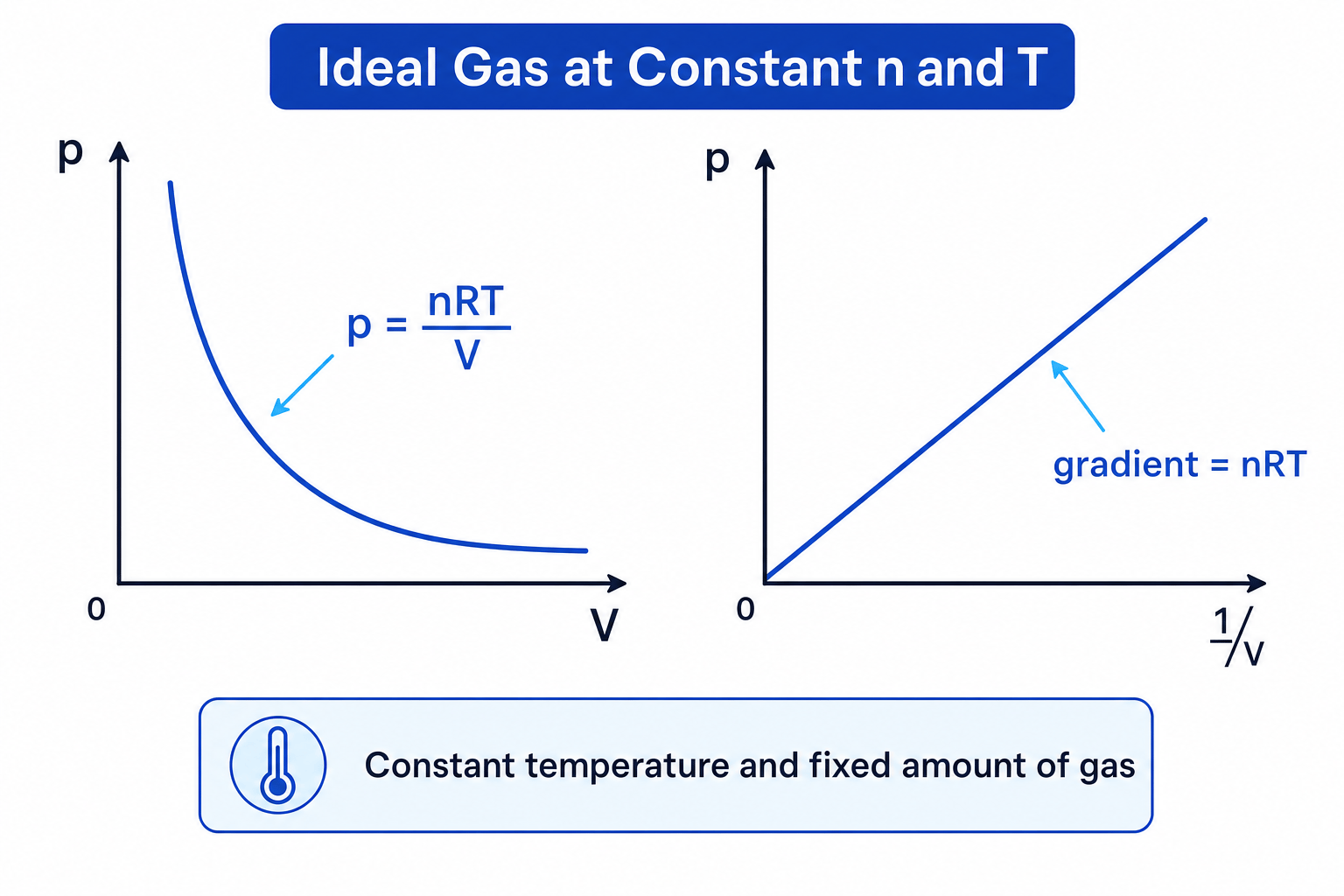
In practical or data-analysis questions, a graph of ppp against 1V\frac{1}{V}V1 should be a straight line through the origin if temperature and amount of gas are constant. The gradient is nRTnRTnRT.
Isothermal means constant temperature
If a gas is compressed quickly, its temperature may rise. Then pVpVpV is not constant, because the process is not isothermal.
Finding the number of molecules in a flask
A sealed flask contains gas at pressure 1.20×10⁵ Pa1.20 \times 10^5\ \mathrm{Pa}1.20×10⁵ Pa, volume 2.00×10⁻³ m32.00 \times 10^{-3}\ \mathrm{m^3}2.00×10⁻³ m3, and temperature 290 K290\ \mathrm{K}290 K. Find the number of molecules.
-
Use the molecular form because the question asks for molecules:
N=pVkTN = \frac{pV}{kT}N=kTpV -
Substitute the values, noting that Pa m3\mathrm{Pa\,m^3}Pam3 is equivalent to joule:
N=(1.20×10⁵ Pa)(2.00×10⁻³ m3)(1.38×10⁻²³ J K−1)(290 K)N = \frac{(1.20 \times 10^5\ \mathrm{Pa})(2.00 \times 10^{-3}\ \mathrm{m^3})} {(1.38 \times 10^{-23}\ \mathrm{J\,K^{-1}})(290\ \mathrm{K})}N=(1.38×10⁻²³ JK−1)(290 K)(1.20×10⁵ Pa)(2.00×10⁻³ m3) -
Calculate and quote a sensible number of significant figures:
N=240 J4.00×10−21 J=5.99×10²²≈6.0×10²²N = \frac{240\ \mathrm{J}}{4.00 \times 10^{-21}\ \mathrm{J}} = 5.99 \times 10^{22} \approx 6.0 \times 10^{22}N=4.00×10⁻²¹ J240 J=5.99×10²²≈6.0×10²²
Assumptions of the kinetic theory of gases
The kinetic theory of gases explains gas behaviour using moving molecules and Newton’s laws.
For the ideal gas model, assume:
- The gas contains a very large number of molecules.
- The molecules are in continuous random motion.
- The volume of the molecules is negligible compared with the volume of the container.
- There are no intermolecular forces except during collisions.
- Collisions between molecules and with the container walls are perfectly elastic.
- The time taken for a collision is negligible compared with the time between collisions.
- Energy is randomly distributed among the molecules, so molecules do not all have the same speed or kinetic energy.
Averages are essential
Because molecular speeds are randomly distributed, kinetic theory uses average quantities such as the mean square speed c2‾\overline{c^2}c2 rather than trying to track one molecule.
How molecular motion causes pressure
A gas molecule colliding with a wall changes momentum. The wall exerts a force on the molecule, and by Newton’s third law the molecule exerts an equal and opposite force on the wall. Many collisions per second create a steady pressure.
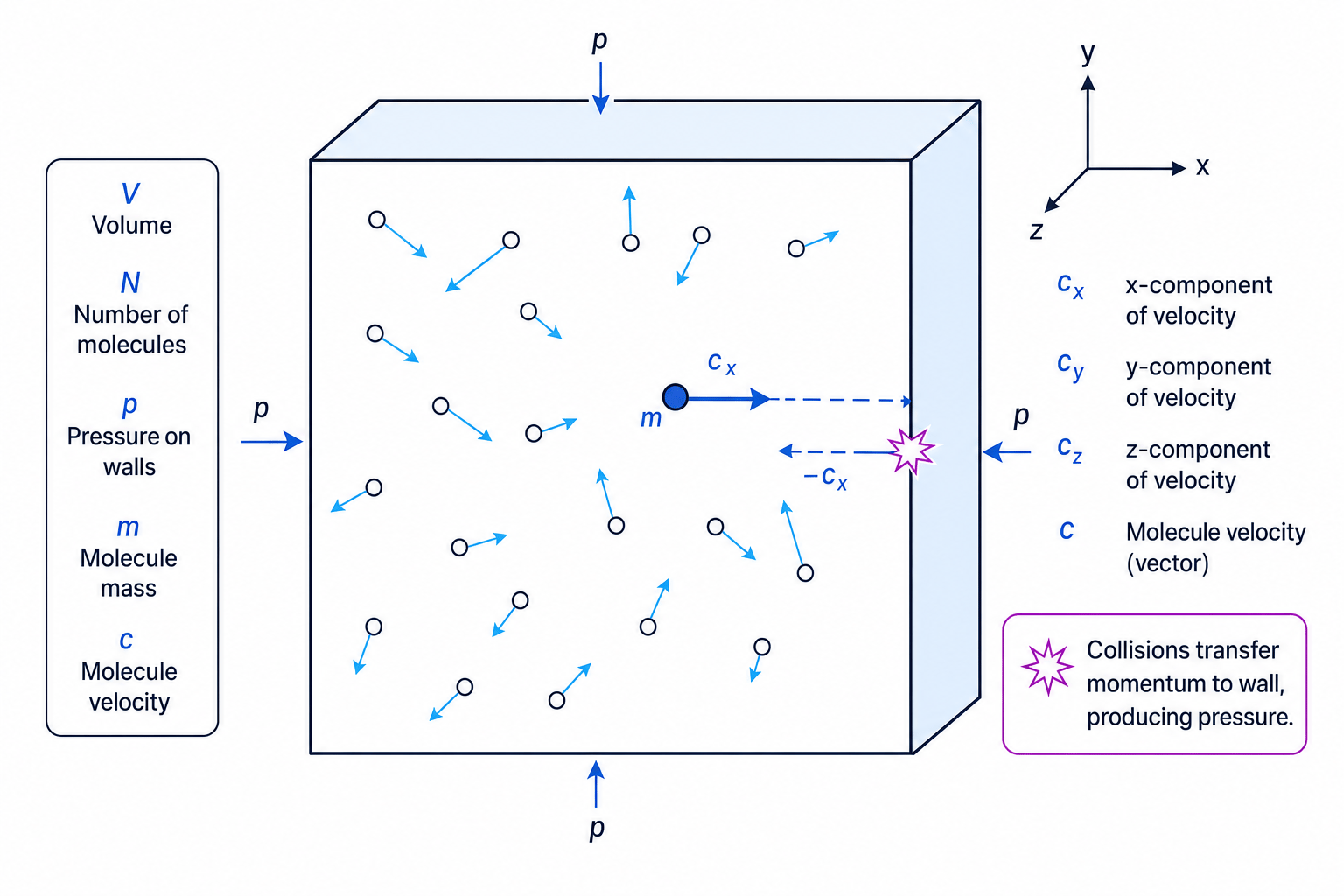
For a gas of density ρ\rhoρ, molecule mass mmm, volume VVV, and number of molecules NNN,
p=13ρc2‾=13NVmc2‾p = \frac{1}{3}\rho \overline{c^2} = \frac{1}{3}\frac{N}{V}m\overline{c^2}p=31ρc2=31VNmc2Here, ccc is molecular speed and c2‾\overline{c^2}c2 is the mean square speed.
The factor 13\frac{1}{3}31 appears because molecular motion is random in three dimensions. On average, one third of the squared speed contributes to motion in each direction.
The root mean square speed is
crms=c2‾c_{\mathrm{rms}} = \sqrt{\overline{c^2}}crms=c2Mean square is not mean speed squared
Do not replace c2‾\overline{c^2}c2 with (c‾)2\left(\overline{c}\right)^2(c)2. You square each molecule’s speed first, then average those squared speeds.
Calculating root mean square speed
A gas has pressure 1.00×10⁵ Pa1.00 \times 10^5\ \mathrm{Pa}1.00×10⁵ Pa and density 0.160 kg m−30.160\ \mathrm{kg\,m^{-3}}0.160 kgm−3. Find crmsc_{\mathrm{rms}}crms.
-
Start from the pressure equation and use crms2=c2‾c_{\mathrm{rms}}^2 = \overline{c^2}crms2=c2:
p=13ρcrms2p = \frac{1}{3}\rho c_{\mathrm{rms}}^2p=31ρcrms2 -
Rearrange for crmsc_{\mathrm{rms}}crms:
crms=3pρc_{\mathrm{rms}} = \sqrt{\frac{3p}{\rho}}crms=ρ3p -
Substitute values and check the units become speed squared inside the square root:
crms=3(1.00×10⁵ Pa)0.160 kg m−3=1.875×10⁶ m2 s−2=1.37×10³ m s−1c_{\mathrm{rms}} = \sqrt{\frac{3(1.00 \times 10^5\ \mathrm{Pa})}{0.160\ \mathrm{kg\,m^{-3}}}} = \sqrt{1.875 \times 10^6\ \mathrm{m^2\,s^{-2}}} = 1.37 \times 10^3\ \mathrm{m\,s^{-1}}crms=0.160 kgm−33(1.00×10⁵ Pa)=1.875×10⁶ m2s−2=1.37×10³ ms−1
Temperature and molecular kinetic energy
Multiplying the pressure equation by volume gives
pV=13Nmc2‾pV = \frac{1}{3}Nm\overline{c^2}pV=31Nmc2For an ideal gas,
pV=NkTpV = NkTpV=NkTCombining them:
13Nmc2‾=NkT13mc2‾=kT12mc2‾=32kT\begin{aligned} \frac{1}{3}Nm\overline{c^2} &= NkT \\ \frac{1}{3}m\overline{c^2} &= kT \\ \frac{1}{2}m\overline{c^2} &= \frac{3}{2}kT \end{aligned}31Nmc231mc221mc2=NkT=kT=23kTSo the mean translational kinetic energy of one molecule is
Ek,mean=32kTE_{\mathrm{k,mean}} = \frac{3}{2}kTEk,mean=23kTFor one mole of a monatomic gas, there are NAN_ANA molecules, so the total translational kinetic energy is
Ek,mole=NA(32kT)=32RTE_{\mathrm{k,mole}} = N_A\left(\frac{3}{2}kT\right) = \frac{3}{2}RTEk,mole=NA(23kT)=23RTTemperature measures mean molecular kinetic energy
On the kelvin scale, TTT is proportional to the mean translational kinetic energy of the molecules. A hotter gas has a larger mean molecular kinetic energy, but not every molecule has the same energy.
Calculating mean kinetic energy at room temperature
Find the mean translational kinetic energy of one molecule, and of one mole, for a monatomic ideal gas at 300 K300\ \mathrm{K}300 K.
-
For one molecule, use the Boltzmann constant form:
Ek,mean=32kTE_{\mathrm{k,mean}} = \frac{3}{2}kTEk,mean=23kT -
Substitute the temperature:
Ek,mean=32(1.38×10⁻²³ J K−1)(300 K)=6.21×10⁻²¹ JE_{\mathrm{k,mean}} = \frac{3}{2}(1.38 \times 10^{-23}\ \mathrm{J\,K^{-1}})(300\ \mathrm{K}) = 6.21 \times 10^{-21}\ \mathrm{J}Ek,mean=23(1.38×10⁻²³ JK−1)(300 K)=6.21×10⁻²¹ J -
For one mole, use the molar gas constant form:
Ek,mole=32RT=32(8.31 J mol−1 K−1)(300 K)=3.74×10³ J mol−1E_{\mathrm{k,mole}} = \frac{3}{2}RT = \frac{3}{2}(8.31\ \mathrm{J\,mol^{-1}\,K^{-1}})(300\ \mathrm{K}) = 3.74 \times 10^3\ \mathrm{J\,mol^{-1}}Ek,mole=23RT=23(8.31 Jmol−1K−1)(300 K)=3.74×10³ Jmol−1
In the exam
- Convert first: use kelvin, cubic metre, kilogram, pascal, and mole before substituting.
- Choose the gas equation by what is given: use pV=nRTpV = nRTpV=nRT for moles and pV=NkTpV = NkTpV=NkT for molecules.
- For kinetic theory, use averages carefully: c2‾\overline{c^2}c2 and crms=c2‾c_{\mathrm{rms}} = \sqrt{\overline{c^2}}crms=c2.
- In graph questions, constant temperature and fixed amount give p∝1Vp \propto \frac{1}{V}p∝V1, so plot ppp against 1V\frac{1}{V}V1 for a straight line.
Check yourself
- Why must temperature be measured in kelvin in the ideal gas equations?
- How would you find the number of molecules from the mass of a gas sample?
- Starting from pV=13Nmc2‾pV = \frac{1}{3}Nm\overline{c^2}pV=31Nmc2 and pV=NkTpV = NkTpV=NkT, can you show that Ek,mean=32kTE_{\mathrm{k,mean}} = \frac{3}{2}kTEk,mean=23kT?
