

What you'll learn
- What electric charge is, and why the coulomb is a large unit compared with the charge on one electron.
- How electric current is defined as a rate of flow of charge.
- Why metals conduct electricity using free electrons.
- How to derive and use the drift-current equation I=nAveI = nAveI=nAve.
1. Electric charge and the coulomb
Electric charge is a property of particles that allows them to experience electric forces. There are two types of charge: positive and negative. Protons are positively charged; electrons are negatively charged.
Charge and the coulomb
Electric charge, symbol QQQ, is measured in coulombs, symbol C. One electron has charge −e-e−e, where the elementary charge has magnitude e=1.60×10⁻¹⁹ Ce = 1.60 \times 10^{-19}\,\text{C}e=1.60×10⁻¹⁹C.
A coulomb is a large amount of charge compared with the charge on one electron. Because one electron only has a tiny fraction of a coulomb, ordinary currents involve enormous numbers of electrons moving through a conductor.
For a collection of NNN electrons, the magnitude of the total charge is:
Q=NeQ = NeQ=Newhere NNN is the number of electrons and eee is the elementary charge.
Forgetting the sign of the electron
The electron’s actual charge is negative, −e-e−e. In many current calculations you use the magnitude e=1.60×10⁻¹⁹ Ce = 1.60 \times 10^{-19}\,\text{C}e=1.60×10⁻¹⁹C, because you are finding the size of the charge flow rather than its direction.
2. Conductors and charge flow
A conductor is a material through which charge can flow. Metals are good conductors because they contain free electrons, also called delocalised electrons, which are not fixed to individual atoms.
Conductor
A conductor is a material containing mobile charge carriers, so electric charge can flow through it when there is a potential difference.
In a metal, the positive metal ions form a fixed lattice. The free electrons move randomly at high speeds. When a potential difference is applied, an electric field is set up in the metal and the electrons gain a small average velocity in one direction. This small average motion is called drift.
Why metals conduct
Metals conduct because they contain free electrons that can drift through the fixed lattice of positive ions.
3. Electric current as a rate of flow of charge
Electric current is not “used up” charge. It is the rate at which charge passes a point in a circuit.
Electric current
Electric current, symbol III, is the rate of flow of charge past a point.
The equation is:
I=ΔQΔtI = \frac{\Delta Q}{\Delta t}I=ΔtΔQwhere:
- III is current in ampères, A
- ΔQ\Delta QΔQ is the charge that passes in coulombs, C
- Δt\Delta tΔt is the time interval in seconds, s
The unit ampère means coulomb per second:
A=C s−1\text{A} = \text{C}\,\text{s}^{-1}A=Cs−1So a current of 1 A means charge is flowing at a rate of 1 C every second.
Finding charge and number of electrons
A current of 0.25 A flows for 4.0 minutes. Find the charge that passes a point, and estimate how many electrons this corresponds to.
-
Convert the time into seconds:
4.0 min=4.0×60 s=240 s4.0\,\text{min} = 4.0 \times 60\,\text{s} = 240\,\text{s}4.0min=4.0×60s=240s. -
Use I=ΔQΔtI = \frac{\Delta Q}{\Delta t}I=ΔtΔQ, rearranged to ΔQ=IΔt\Delta Q = I\Delta tΔQ=IΔt:
ΔQ=0.25 C s−1×240 s=60 C\Delta Q = 0.25\,\text{C s}^{-1} \times 240\,\text{s} = 60\,\text{C}ΔQ=0.25C s−1×240s=60C. -
Use Q=NeQ = NeQ=Ne, rearranged to N=QeN = \frac{Q}{e}N=eQ:
N=60 C1.60×10−19 C=3.75×10²⁰N = \frac{60\,\text{C}}{1.60 \times 10^{-19}\,\text{C}} = 3.75 \times 10^{20}N=1.60×10⁻¹⁹C60C=3.75×10²⁰. -
Quote the result sensibly: about 3.8×10203.8 \times 10^{20}3.8×10²⁰ electrons.
Unit sanity check
Because current is charge per second, multiplying current by time must give charge: C s−1×s=C\text{C s}^{-1} \times \text{s} = \text{C}C s−1×s=C.
4. Conventional current and electron flow
Conventional current is defined as the direction in which positive charge would flow. In a metal, the actual moving charges are electrons, so the electrons drift in the opposite direction to the conventional current.
This can feel backwards at first, but it is just a convention. Circuit current arrows usually show conventional current, not electron motion.
Mixing up electron flow and conventional current
In metals, electrons drift from negative to positive, while conventional current is shown from positive to negative around the external circuit.
5. The mechanism of conduction in metals
Without a potential difference, free electrons in a metal move randomly. Their random velocities point in all directions, so there is no overall current.
When a potential difference is applied:
- An electric field is set up inside the metal.
- Free electrons experience a force due to the field.
- They still collide with ions in the lattice, but they gain a small average drift velocity.
- This drift of charge produces an electric current.
Drift velocity
Drift velocity, symbol vvv, is the average velocity of the charge carriers along the conductor due to an applied potential difference.
Drift velocity is usually very small, often fractions of a millimetre per second in metal wires. This does not mean circuits “respond slowly”: the electric field is established through the circuit very quickly, even though individual electrons drift slowly.
6. Deriving the equation I=nAveI = nAveI=nAve
To connect microscopic electron motion with the measurable current, imagine a metal wire of cross-sectional area AAA. The number density nnn is the number of free electrons per cubic metre.
Number density
Number density, symbol nnn, is the number of charge carriers per unit volume. Its unit is m−3\text{m}^{-3}m−3.
In time Δt\Delta tΔt, electrons with drift speed vvv travel a distance vΔtv\Delta tvΔt. The volume of wire whose electrons pass a cross-section is therefore:
volume=AvΔt\text{volume} = Av\Delta tvolume=AvΔt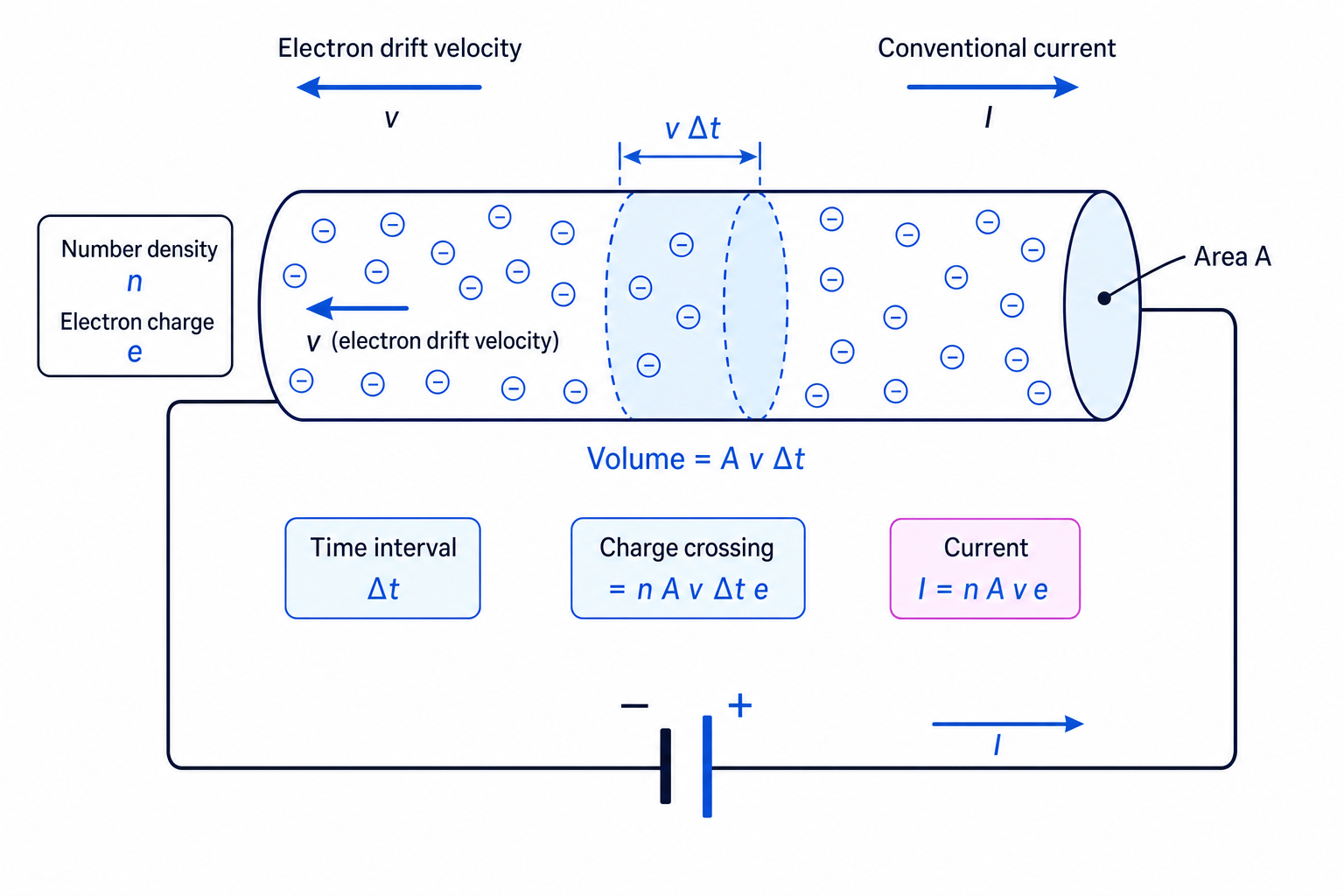
The number of electrons in this volume is:
N=nAvΔtN = nAv\Delta tN=nAvΔtThe charge carried by these electrons has magnitude:
ΔQ=nAvΔte\Delta Q = nAv\Delta t eΔQ=nAvΔteNow use current as rate of flow of charge:
I=ΔQΔtI=nAvΔteΔtI=nAve\begin{aligned} I &= \frac{\Delta Q}{\Delta t} \\ I &= \frac{nAv\Delta t e}{\Delta t} \\ I &= nAve \end{aligned}III=ΔtΔQ=ΔtnAvΔte=nAveDrift-current equation
For conduction by free electrons in a metal, the current is given by I=nAveI = nAveI=nAve, where nnn is number density, AAA is cross-sectional area, vvv is drift velocity, and eee is the elementary charge.
This equation uses magnitudes. The electrons are negative, but I=nAveI = nAveI=nAve gives the size of the conventional current.
7. Using I=nAveI = nAveI=nAve
The drift-current equation is useful because it connects a large-scale measurement, current, to microscopic quantities inside the material.
The symbols and units are:
- III: current in ampères, A
- nnn: number density in per cubic metre, m−3\text{m}^{-3}m−3
- AAA: cross-sectional area in square metres, m2\text{m}^{2}m2
- vvv: drift velocity in metres per second, m s−1\text{m s}^{-1}m s−1
- eee: elementary charge in coulombs, C
For a circular wire, the cross-sectional area is:
A=πr2A = \pi r^2A=πr2where rrr is the radius of the wire in metres.
Calculating drift velocity in a wire
A copper wire has diameter 1.0 mm and carries a current of 2.0 A. The number density of free electrons is 8.5×1028 m−38.5 \times 10^{28}\,\text{m}^{-3}8.5×1028m−3. Calculate the drift velocity of the electrons.
-
Convert the diameter to a radius in metres:
r=0.50 mm=0.50×10⁻³ mr = 0.50\,\text{mm} = 0.50 \times 10^{-3}\,\text{m}r=0.50mm=0.50×10⁻³m. -
Calculate the cross-sectional area:
A=πr2=π(0.50×10⁻³ m)2=7.85×10⁻⁷ m2A = \pi r^2 = \pi(0.50 \times 10^{-3}\,\text{m})^2 = 7.85 \times 10^{-7}\,\text{m}^2A=πr2=π(0.50×10⁻³m)2=7.85×10⁻⁷m2. -
Rearrange I=nAveI = nAveI=nAve to make vvv the subject:
v=InAev = \frac{I}{nAe}v=nAeI. -
Substitute the values, including units:
v=2.0 C s−1(8.5×1028 m−3)(7.85×10⁻⁷ m2)(1.60×10⁻¹⁹ C)v = \frac{2.0\,\text{C s}^{-1}}{(8.5 \times 10^{28}\,\text{m}^{-3})(7.85 \times 10^{-7}\,\text{m}^2)(1.60 \times 10^{-19}\,\text{C})}v=(8.5×1028m−3)(7.85×10⁻⁷m2)(1.60×10⁻¹⁹C)2.0C s−1. -
Calculate the result:
v=1.9×10⁻⁴ m s−1v = 1.9 \times 10^{-4}\,\text{m s}^{-1}v=1.9×10⁻⁴m s−1.
Using diameter instead of area
In I=nAveI = nAveI=nAve, AAA is the cross-sectional area, not the diameter or radius. If the wire is circular, first convert the diameter to a radius, then use A=πr2A = \pi r^2A=πr2.
8. Measuring current in practice
Current is measured using an ammeter. The ammeter must be connected in series with the component, so the same charge flow passes through both the component and the meter.
For accurate practical work:
- choose a suitable range so the reading is not off-scale;
- record current in ampères, not milliamperes, before substituting into equations;
- consider the resolution of the meter as part of the uncertainty.
For example, a current of 35 mA should be written as:
35 mA=35×10−3 A=0.035 A35\,\text{mA} = 35 \times 10^{-3}\,\text{A} = 0.035\,\text{A}35mA=35×10−3A=0.035APrefixes matter
Before using I=ΔQΔtI = \frac{\Delta Q}{\Delta t}I=ΔtΔQ or I=nAveI = nAveI=nAve, convert mA to A, mm to m, and mm² to m². Prefix errors often change an answer by factors of 1000 or more.
In the exam
- Start by identifying whether the question is about total charge flow, using I=ΔQΔtI = \frac{\Delta Q}{\Delta t}I=ΔtΔQ, or microscopic drift, using I=nAveI = nAveI=nAve.
- Convert all quantities to SI units before substituting, especially time, current, radius, diameter and area.
- For metal conduction, remember that electrons drift opposite to conventional current, but I=nAveI = nAveI=nAve gives the magnitude of the current.
Check yourself
- Why does a current of 1 A mean the same as 1 C of charge passing per second?
- In a metal wire, which way do electrons drift compared with conventional current?
- How is the volume AvΔtAv\Delta tAvΔt used to derive I=nAveI = nAveI=nAve?
