

What you'll learn
- How mass and energy are connected by E=mc2E = mc^2E=mc2.
- How to calculate binding energy and binding energy per nucleon using nuclear masses and the unified atomic mass unit.
- Why fission and fusion can both release energy.
- How the binding energy per nucleon curve explains nuclear stability and energy release.
The nuclear notation you need first
A nucleus is written as:
ZAX{}^{A}_{Z}XZAXwhere:
- XXX is the chemical symbol.
- ZZZ is the proton number: the number of protons.
- AAA is the nucleon number: the total number of protons and neutrons.
- The number of neutrons is N=A−ZN = A - ZN=A−Z.
- A nucleon is either a proton or a neutron.
Isotopes
Isotopes are nuclei of the same element with the same proton number ZZZ but different numbers of neutrons, so they have different nucleon numbers AAA.
For example, uranium-235 has Z=92Z = 92Z=92 and A=235A = 235A=235, so it contains 92 protons and 143 neutrons.
Mass and energy are linked
Einstein’s mass-energy equation is:
E=mc2E = mc^2E=mc2Here, EEE is energy in joules (J), mmm is mass in kilograms (kg), and ccc is the speed of light in a vacuum:
c=3.00×10⁸ m s−1c = 3.00 \times 10^8 \ \text{m s}^{-1}c=3.00×10⁸ m s−1This equation means mass is a form of stored energy. In nuclear reactions, a very small decrease in rest mass can release a large amount of energy because c2c^2c2 is enormous.
Mass-energy conservation
In nuclear physics, rest mass alone does not have to be conserved, but total mass-energy is conserved. A decrease in rest mass appears as other forms of energy, such as kinetic energy or gamma radiation.
Energy from a small mass decrease
A nuclear process has a decrease in rest mass of 2.00×10⁻⁶ kg2.00 \times 10^{-6} \ \text{kg}2.00×10⁻⁶ kg. Calculate the energy released.
-
Use the mass-energy equation with the mass decrease as Δm\Delta mΔm:
E=Δmc2E = \Delta mc^2E=Δmc2 -
Substitute the values, keeping units:
E=(2.00×10⁻⁶ kg)(3.00×10⁸ m s−1)2E = \left(2.00 \times 10^{-6} \ \text{kg}\right)\left(3.00 \times 10^8 \ \text{m s}^{-1}\right)^2E=(2.00×10⁻⁶ kg)(3.00×10⁸ m s−1)2 -
Calculate the energy:
E=1.80×10¹¹ JE = 1.80 \times 10^{11} \ \text{J}E=1.80×10¹¹ J
So a mass decrease of only 2.00 milligrams releases 1.80×10¹¹ J1.80 \times 10^{11} \ \text{J}1.80×10¹¹ J.
Binding energy
A bound nucleus has a slightly lower mass than the separate protons and neutrons that make it. The “missing” mass has been transferred as energy when the nucleus formed.
Binding energy
The binding energy of a nucleus is the energy required to completely separate the nucleus into its individual protons and neutrons. It is also equal to the energy released when the nucleus is assembled from separate nucleons.
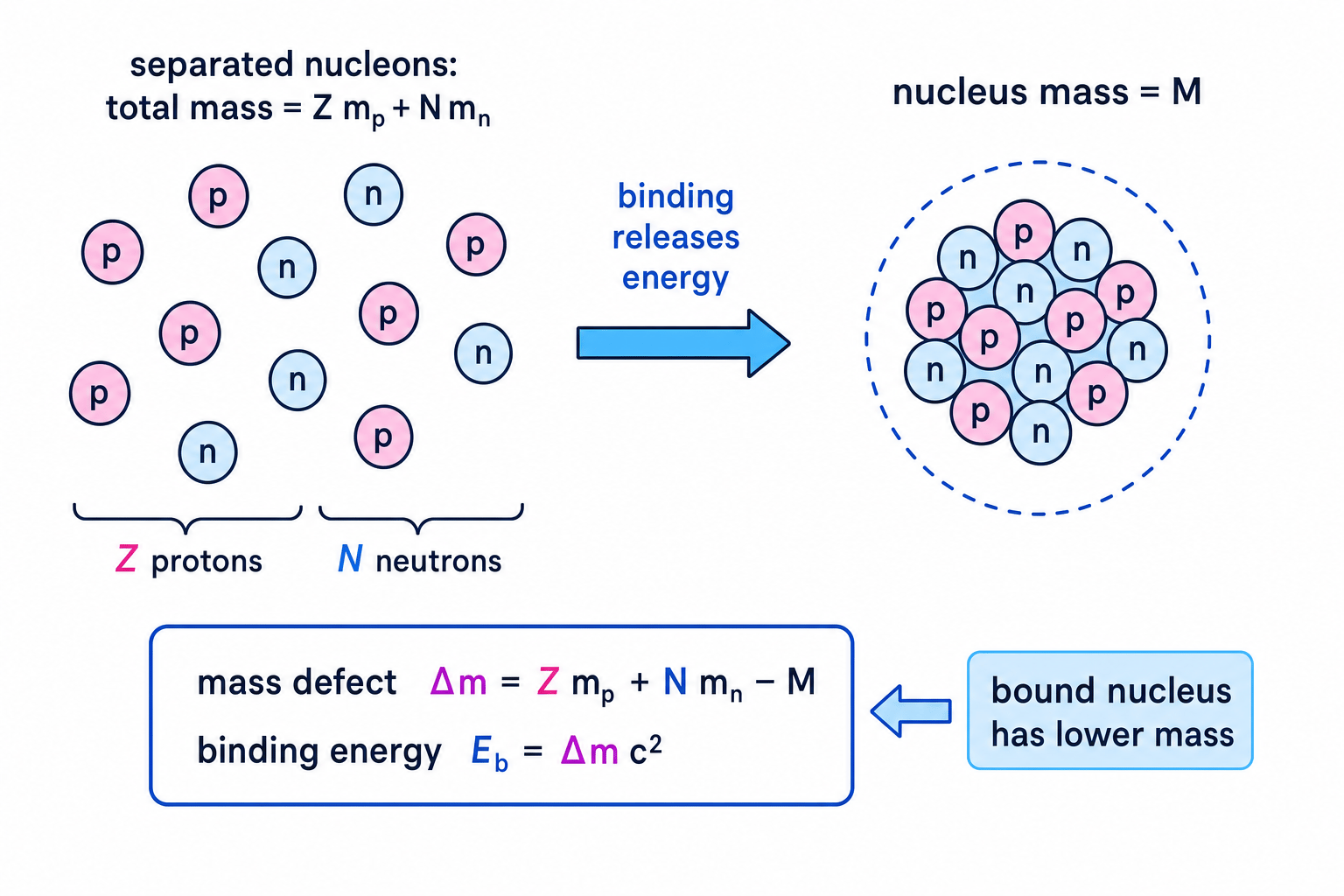
For a nucleus ZAX{}^{A}_{Z}XZAX:
N=A−ZN = A - ZN=A−ZIf MMM is the mass of the nucleus, then the mass defect is:
Δm=Zmp+Nmn−M\Delta m = Zm_p + Nm_n - MΔm=Zmp+Nmn−Mwhere mpm_pmp is the mass of a proton and mnm_nmn is the mass of a neutron.
The binding energy is then:
Eb=Δmc2E_b = \Delta mc^2Eb=Δmc2Binding energy per nucleon
The binding energy per nucleon is:
EbA\frac{E_b}{A}AEbIt tells you, on average, how much energy is needed to remove each nucleon from the nucleus.
Stability and binding energy
A nucleus with a larger binding energy per nucleon is generally more stable, because more energy is needed per nucleon to break it apart.
Using the unified atomic mass unit
Nuclear masses are very small, so they are often given in unified atomic mass units, u.
Unified atomic mass unit
The unified atomic mass unit is a small unit of mass used for atoms and nuclei:
1 u=1.661×10⁻²⁷ kg1 \ \text{u} = 1.661 \times 10^{-27} \ \text{kg}1 u=1.661×10⁻²⁷ kgA useful energy conversion is:
1 uc2=931.5 MeV1 \ \text{u}c^2 = 931.5 \ \text{MeV}1 uc2=931.5 MeVAn electronvolt (eV) is a unit of energy used in atomic and nuclear physics. One megaelectronvolt is:
1 MeV=1.602×10⁻¹³ J1 \ \text{MeV} = 1.602 \times 10^{-13} \ \text{J}1 MeV=1.602×10⁻¹³ JMixing atomic and nuclear masses
If the question gives nuclear masses, use proton and neutron masses. If it gives atomic masses, electrons may cancel in a reaction, but be careful not to mix atomic masses with bare nuclear masses without thinking.
Binding energy per nucleon of helium-4
A helium-4 nucleus has mass 4.001506 u4.001506 \ \text{u}4.001506 u. Use mp=1.007276 um_p = 1.007276 \ \text{u}mp=1.007276 u and mn=1.008665 um_n = 1.008665 \ \text{u}mn=1.008665 u to calculate its binding energy per nucleon.
-
Identify the numbers of protons and neutrons. For 24He{}^{4}_{2}\text{He}24He, Z=2Z = 2Z=2, A=4A = 4A=4, so N=2N = 2N=2.
-
Calculate the total mass of the separate nucleons:
2mp+2mn=2(1.007276 u)+2(1.008665 u)2m_p + 2m_n = 2\left(1.007276 \ \text{u}\right) + 2\left(1.008665 \ \text{u}\right)2mp+2mn=2(1.007276 u)+2(1.008665 u) 2mp+2mn=4.031882 u2m_p + 2m_n = 4.031882 \ \text{u}2mp+2mn=4.031882 u -
Find the mass defect:
Δm=4.031882 u−4.001506 u\Delta m = 4.031882 \ \text{u} - 4.001506 \ \text{u}Δm=4.031882 u−4.001506 u Δm=0.030376 u\Delta m = 0.030376 \ \text{u}Δm=0.030376 u -
Convert the mass defect into binding energy:
Eb=0.030376×931.5 MeVE_b = 0.030376 \times 931.5 \ \text{MeV}Eb=0.030376×931.5 MeV Eb=28.3 MeVE_b = 28.3 \ \text{MeV}Eb=28.3 MeV -
Divide by the nucleon number:
EbA=28.3 MeV4\frac{E_b}{A} = \frac{28.3 \ \text{MeV}}{4}AEb=428.3 MeV EbA=7.07 MeV per nucleon\frac{E_b}{A} = 7.07 \ \text{MeV per nucleon}AEb=7.07 MeV per nucleon
Conservation of mass-energy in particle interactions
A particle interaction is a process where particles collide, transform, or produce new particles. In nuclear physics, fission and fusion are important examples.
In nuclear equations, you should check:
- Total proton number ZZZ is conserved.
- Total nucleon number AAA is conserved.
- Total mass-energy is conserved.
If the total rest mass decreases, the released energy is:
Q=(mreactants−mproducts)c2Q = \left(m_{\text{reactants}} - m_{\text{products}}\right)c^2Q=(mreactants−mproducts)c2Here, QQQ is the energy released by the reaction.
Energy released in deuterium-tritium fusion
In the fusion reaction
12H+13H→24He+01n{}^{2}_{1}\text{H} + {}^{3}_{1}\text{H} \to {}^{4}_{2}\text{He} + {}^{1}_{0}\text{n}12H+13H→24He+01nuse the masses 2.014102 u2.014102 \ \text{u}2.014102 u, 3.016049 u3.016049 \ \text{u}3.016049 u, 4.002603 u4.002603 \ \text{u}4.002603 u and 1.008665 u1.008665 \ \text{u}1.008665 u to calculate the energy released.
-
Check the reaction balances. On the left, A=2+3=5A = 2 + 3 = 5A=2+3=5 and Z=1+1=2Z = 1 + 1 = 2Z=1+1=2. On the right, A=4+1=5A = 4 + 1 = 5A=4+1=5 and Z=2+0=2Z = 2 + 0 = 2Z=2+0=2.
-
Add the reactant masses:
mreactants=2.014102 u+3.016049 um_{\text{reactants}} = 2.014102 \ \text{u} + 3.016049 \ \text{u}mreactants=2.014102 u+3.016049 u mreactants=5.030151 um_{\text{reactants}} = 5.030151 \ \text{u}mreactants=5.030151 u -
Add the product masses:
mproducts=4.002603 u+1.008665 um_{\text{products}} = 4.002603 \ \text{u} + 1.008665 \ \text{u}mproducts=4.002603 u+1.008665 u mproducts=5.011268 um_{\text{products}} = 5.011268 \ \text{u}mproducts=5.011268 u -
Find the mass decrease:
Δm=5.030151 u−5.011268 u\Delta m = 5.030151 \ \text{u} - 5.011268 \ \text{u}Δm=5.030151 u−5.011268 u Δm=0.018883 u\Delta m = 0.018883 \ \text{u}Δm=0.018883 u -
Convert to energy:
Q=0.018883×931.5 MeVQ = 0.018883 \times 931.5 \ \text{MeV}Q=0.018883×931.5 MeV Q=17.6 MeVQ = 17.6 \ \text{MeV}Q=17.6 MeVIn joules:
Q=17.6×1.602×10−13 J=2.82×10⁻¹² JQ = 17.6 \times 1.602 \times 10^{-13} \ \text{J} = 2.82 \times 10^{-12} \ \text{J}Q=17.6×1.602×10−13 J=2.82×10⁻¹² J
Fission, fusion and the binding energy curve
Fission is the splitting of a heavy nucleus into smaller nuclei, usually after absorbing a neutron.
Fusion is the joining of light nuclei to form a heavier nucleus.
The key to both is the binding energy per nucleon curve.
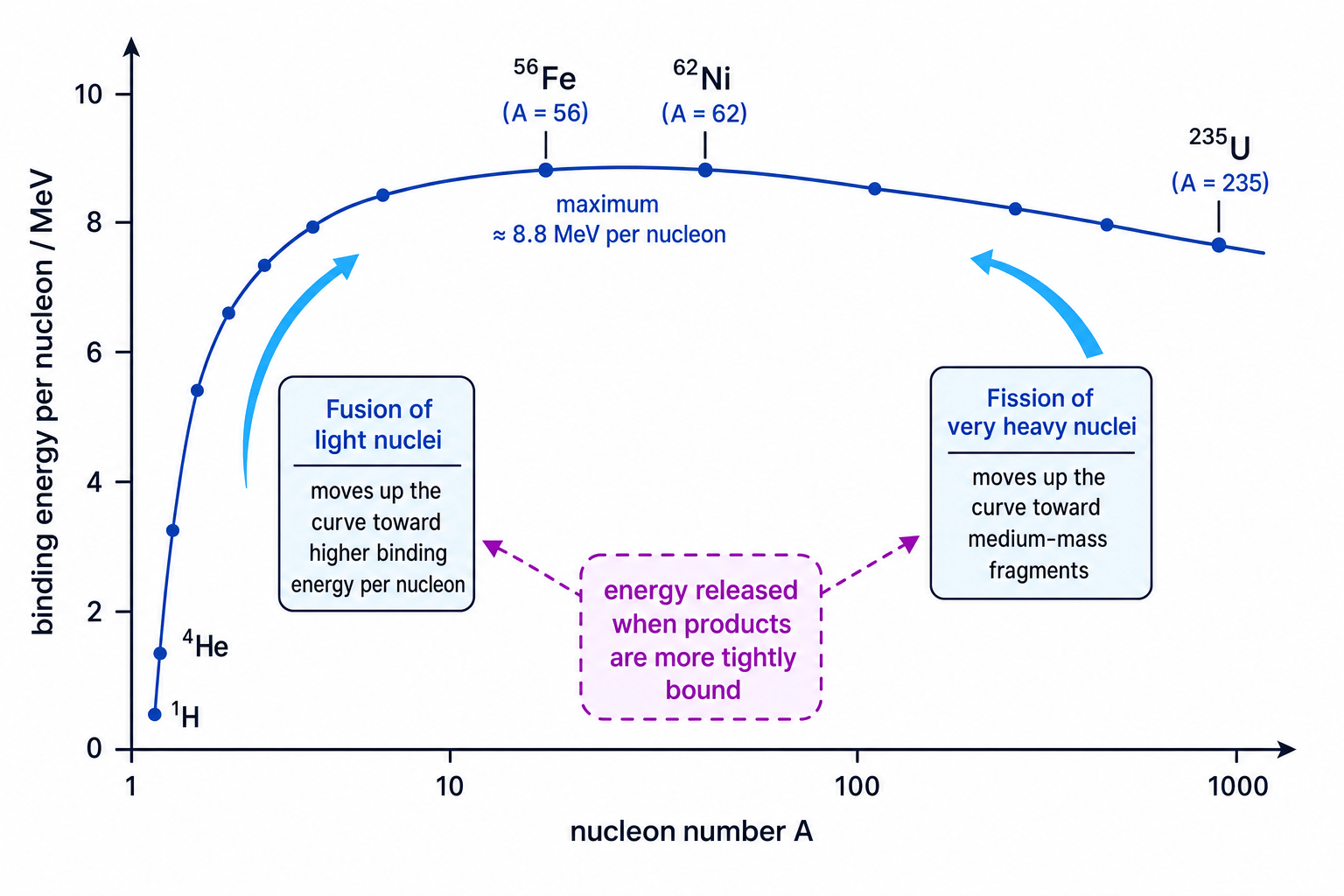
The curve rises steeply for light nuclei, reaches a maximum near iron-56 and nickel-62, then slowly falls for very heavy nuclei.
Why both fission and fusion release energy
Energy is released when the products have a greater binding energy per nucleon than the reactants. The products are more tightly bound, so their total rest mass is lower.
For light nuclei, fusion moves nuclei up the curve towards greater binding energy per nucleon. For very heavy nuclei, fission also moves products up the curve towards medium-mass nuclei.
Estimating fission energy from the curve
A uranium-235 nucleus absorbs a neutron, so the total nucleon number involved is about 236. Estimate the energy released if the binding energy per nucleon increases from about 7.6 MeV to 8.5 MeV.
-
Find the increase in binding energy per nucleon:
Δ(EbA)=8.5 MeV−7.6 MeV\Delta \left(\frac{E_b}{A}\right) = 8.5 \ \text{MeV} - 7.6 \ \text{MeV}Δ(AEb)=8.5 MeV−7.6 MeV Δ(EbA)=0.9 MeV per nucleon\Delta \left(\frac{E_b}{A}\right) = 0.9 \ \text{MeV per nucleon}Δ(AEb)=0.9 MeV per nucleon -
Multiply by the total number of nucleons:
ΔEb≈236×0.9 MeV\Delta E_b \approx 236 \times 0.9 \ \text{MeV}ΔEb≈236×0.9 MeV ΔEb≈212 MeV\Delta E_b \approx 212 \ \text{MeV}ΔEb≈212 MeV -
Convert to joules:
E≈212×1.602×10−13 JE \approx 212 \times 1.602 \times 10^{-13} \ \text{J}E≈212×1.602×10−13 J E≈3.40×10⁻¹¹ JE \approx 3.40 \times 10^{-11} \ \text{J}E≈3.40×10⁻¹¹ J
This is close to the typical energy released per uranium fission, about 200 MeV.
Chain reactions and probability
In a fission reactor, each fission may release 2 or 3 neutrons. Some escape, some are absorbed without causing fission, and some trigger further fission.
A critical chain reaction is steady: on average, one neutron from each fission causes another fission.
Using probability in a chain reaction
Each fission releases 3 neutrons. The probability that any one neutron causes another fission is 0.30. Decide whether the chain reaction grows, stays steady, or dies away.
-
Calculate the expected number of new fissions caused by one fission:
3×0.30=0.903 \times 0.30 = 0.903×0.30=0.90 -
Compare this with one new fission per fission. Since 0.90 is less than 1, the chain reaction dies away.
-
Find the probability needed for a critical chain reaction:
3p=13p = 13p=1 p=0.333p = 0.333p=0.333
So each neutron would need about a 0.333 probability of causing another fission for the reactor to be critical.
In a nuclear power station, fission energy becomes thermal energy, which produces steam to turn a turbine and generator. The reactor uses:
- a moderator to slow neutrons down,
- control rods to absorb neutrons and control the chain reaction,
- a coolant to transfer thermal energy,
- shielding and containment to reduce radiation risk.
Data, uncertainty and society
Binding energy data come from accurate mass measurements, often using mass spectrometry. Since binding energy depends on a small mass difference between larger masses, small measurement uncertainties can matter.
Working with mass data
Use isotope masses, not rounded relative atomic masses for naturally occurring elements. Keep enough significant figures during subtraction, because the mass defect is much smaller than the masses being subtracted.
Nuclear power has major benefits and risks. It has a high energy density and low carbon dioxide emissions during operation, but it also involves radioactive waste, decommissioning, accident risk, security concerns, and ethical questions about siting power stations and long-term environmental responsibility.
Good evaluation weighs scientific evidence alongside engineering, economic, environmental and social factors.
In the exam
- For binding energy, start by finding ZZZ, AAA and N=A−ZN = A - ZN=A−Z, then calculate the mass defect before converting to energy.
- Check whether the question gives nuclear masses or atomic masses; do not mix the two carelessly.
- For fission and fusion explanations, refer directly to the binding energy per nucleon curve and say that energy is released when products are more tightly bound.
Check yourself
- Why does a bound nucleus have less mass than its separate nucleons?
- How would you calculate binding energy per nucleon from a mass defect given in u?
- Why can both fusion of light nuclei and fission of heavy nuclei release energy?
