What you'll learn
- Why Rutherford’s alpha scattering experiment overturned the plum pudding model.
- How to estimate and compare Coulomb repulsion forces in the two atomic models.
- How quarks, leptons, antiparticles and hadrons fit together.
- How to test particle reactions using conservation of charge, lepton number and baryon number.
The nuclear atom: what Rutherford showed
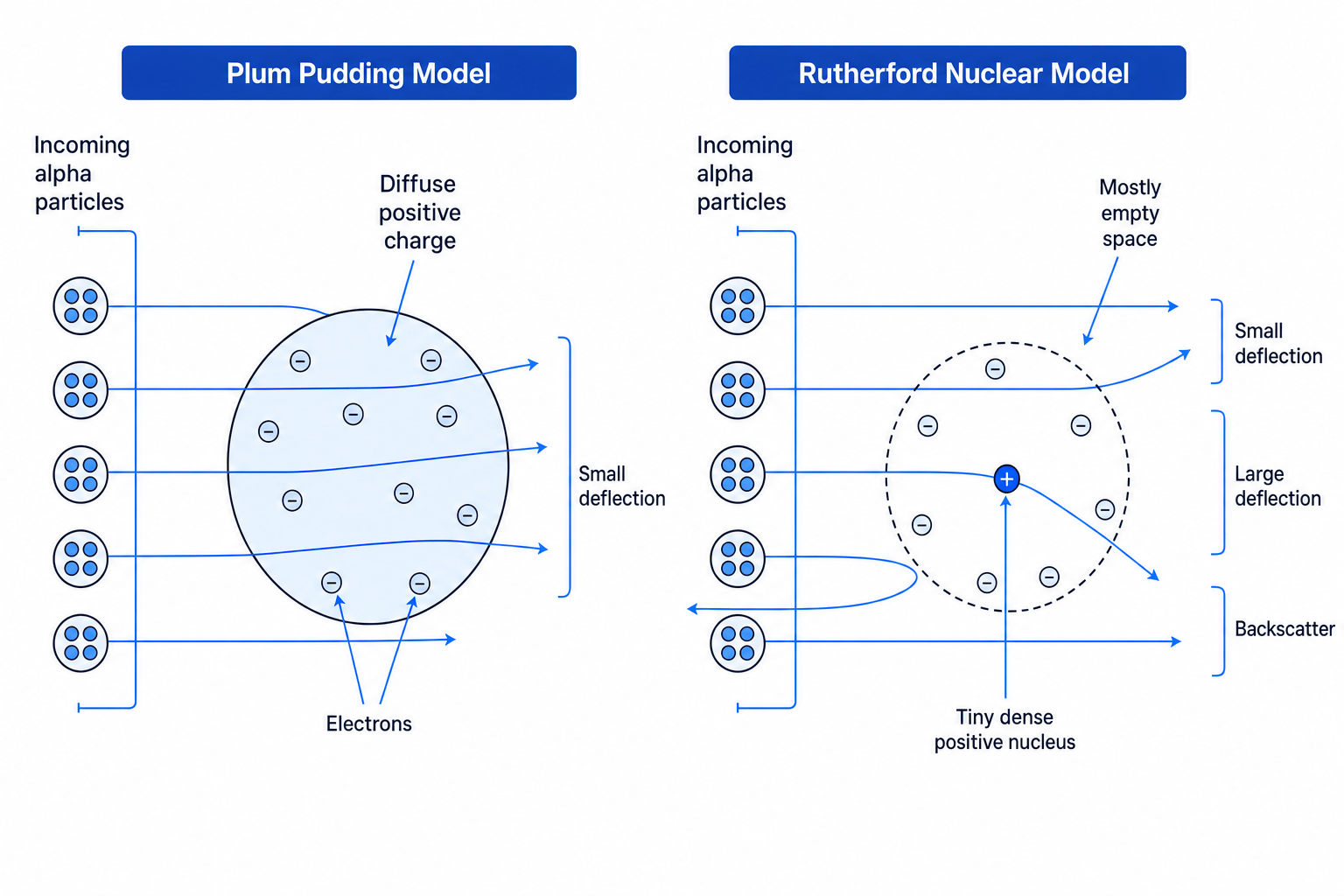
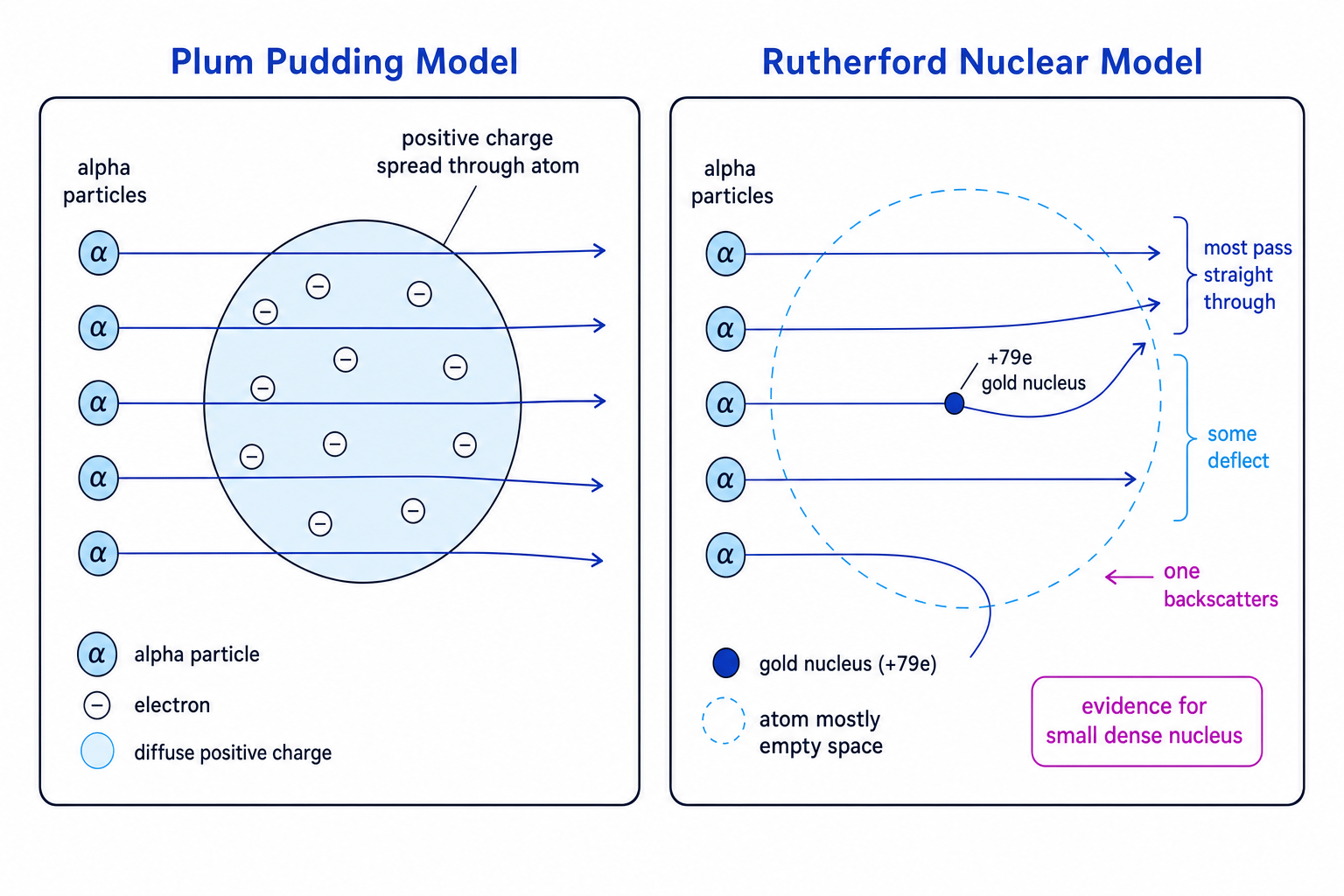
Before Rutherford, many physicists used the plum pudding model: the atom was imagined as a diffuse sphere of positive charge with electrons embedded in it.
Rutherford’s team fired alpha particles at very thin gold foil. An alpha particle is a helium nucleus, so it has charge +2e+2e+2e. Most alpha particles passed straight through, some were deflected, and a very tiny fraction were scattered backwards.
Rutherford’s evidence
The results showed that an atom is mostly empty space, with nearly all its positive charge and mass concentrated in a tiny, dense, positively charged nucleus.
The reasoning is important:
- Most passed straight through: atoms cannot be solid positive spheres; most of the atom must be empty space.
- Some were deflected: alpha particles met strong repulsion from positive charge.
- A few came back: the positive charge and mass must be concentrated in a very small region, not spread through the atom.
This is a good example of a scientific model being replaced because new evidence could not be explained by the old model.
Scattering data
In Rutherford scattering, the rare large-angle deflections are the most important evidence. Do not dismiss them just because they are uncommon.
Estimating the Coulomb repulsion force
The repulsive force between two positive charges is an electrostatic or Coulomb force.
Coulomb force
For two point charges QQQ and qqq separated by distance rrr,
F=Qq4πϵ0r2F = \frac{Qq}{4\pi\epsilon_0 r^2}F=4πϵ0r2Qqwhere ϵ0\epsilon_0ϵ0 is the permittivity of free space. Equivalently, use 14πϵ0=8.99×10⁹ N m2C−2\frac{1}{4\pi\epsilon_0} = 8.99 \times 10^9\ \text{N m}^2\text{C}^{-2}4πϵ01=8.99×10⁹ N m2C−2.
For gold, the nuclear charge is +79e+79e+79e. An alpha particle has charge +2e+2e+2e, where e=1.60×10⁻¹⁹ Ce = 1.60 \times 10^{-19}\ \text{C}e=1.60×10⁻¹⁹ C.
In the plum pudding model, the positive charge is spread across the whole atom, so the closest meaningful distance is about the atomic radius, roughly 1.0×10⁻¹⁰ m1.0 \times 10^{-10}\ \text{m}1.0×10⁻¹⁰ m.
In the Rutherford model, the same positive charge is concentrated in the nucleus, so the closest meaningful distance is about the nuclear radius, roughly 1.0×10⁻¹⁴ m1.0 \times 10^{-14}\ \text{m}1.0×10⁻¹⁴ m.
Comparing Coulomb forces in the two models
Estimate the maximum Coulomb force on an alpha particle near a gold atom in the plum pudding model and near a gold nucleus in the Rutherford model.
-
Use the charges:
qα=+2e,QAu=+79eq_\alpha = +2e,\qquad Q_{\text{Au}} = +79eqα=+2e,QAu=+79eso
qαQAu=158e2q_\alpha Q_{\text{Au}} = 158e^2qαQAu=158e2 -
For the plum pudding model, use r≈1.0×10⁻¹⁰ mr \approx 1.0 \times 10^{-10}\ \text{m}r≈1.0×10⁻¹⁰ m:
Fplum=(8.99×10⁹)(158)(1.60×10⁻¹⁹)2(1.0×10⁻¹⁰)2=3.6×10⁻⁶ NF_{\text{plum}} = \frac{(8.99 \times 10^9)(158)(1.60 \times 10^{-19})^2}{(1.0 \times 10^{-10})^2} = 3.6 \times 10^{-6}\ \text{N}Fplum=(1.0×10⁻¹⁰)2(8.99×10⁹)(158)(1.60×10⁻¹⁹)2=3.6×10⁻⁶ N -
For the Rutherford model, use r≈1.0×10⁻¹⁴ mr \approx 1.0 \times 10^{-14}\ \text{m}r≈1.0×10⁻¹⁴ m:
Fnuclear=(8.99×10⁹)(158)(1.60×10⁻¹⁹)2(1.0×10⁻¹⁴)2=3.6×10² NF_{\text{nuclear}} = \frac{(8.99 \times 10^9)(158)(1.60 \times 10^{-19})^2}{(1.0 \times 10^{-14})^2} = 3.6 \times 10^{2}\ \text{N}Fnuclear=(1.0×10⁻¹⁴)2(8.99×10⁹)(158)(1.60×10⁻¹⁹)2=3.6×10² N -
Compare the sizes:
FnuclearFplum=(1.0×10−101.0×10⁻¹⁴)2=1.0×10⁸\frac{F_{\text{nuclear}}}{F_{\text{plum}}} = \left(\frac{1.0 \times 10^{-10}}{1.0 \times 10^{-14}}\right)^2 = 1.0 \times 10^8FplumFnuclear=(1.0×10−141.0×10⁻¹⁰)2=1.0×10⁸The nuclear model gives a force about one hundred million times larger, explaining why large-angle scattering is possible.
Forgetting the inverse square
If the distance is 10000 times smaller, the Coulomb force is not 10000 times bigger. Because F∝1r2F \propto \frac{1}{r^2}F∝r21, it is 100002=10810000^2 = 10^8100002=108 times bigger.
Quarks and leptons
Matter is described using two main families of fundamental particles: quarks and leptons.
Leptons and quarks
A lepton is a fundamental particle that is not made of quarks. A quark is a fundamental particle that can combine with other quarks or antiquarks to form hadrons.
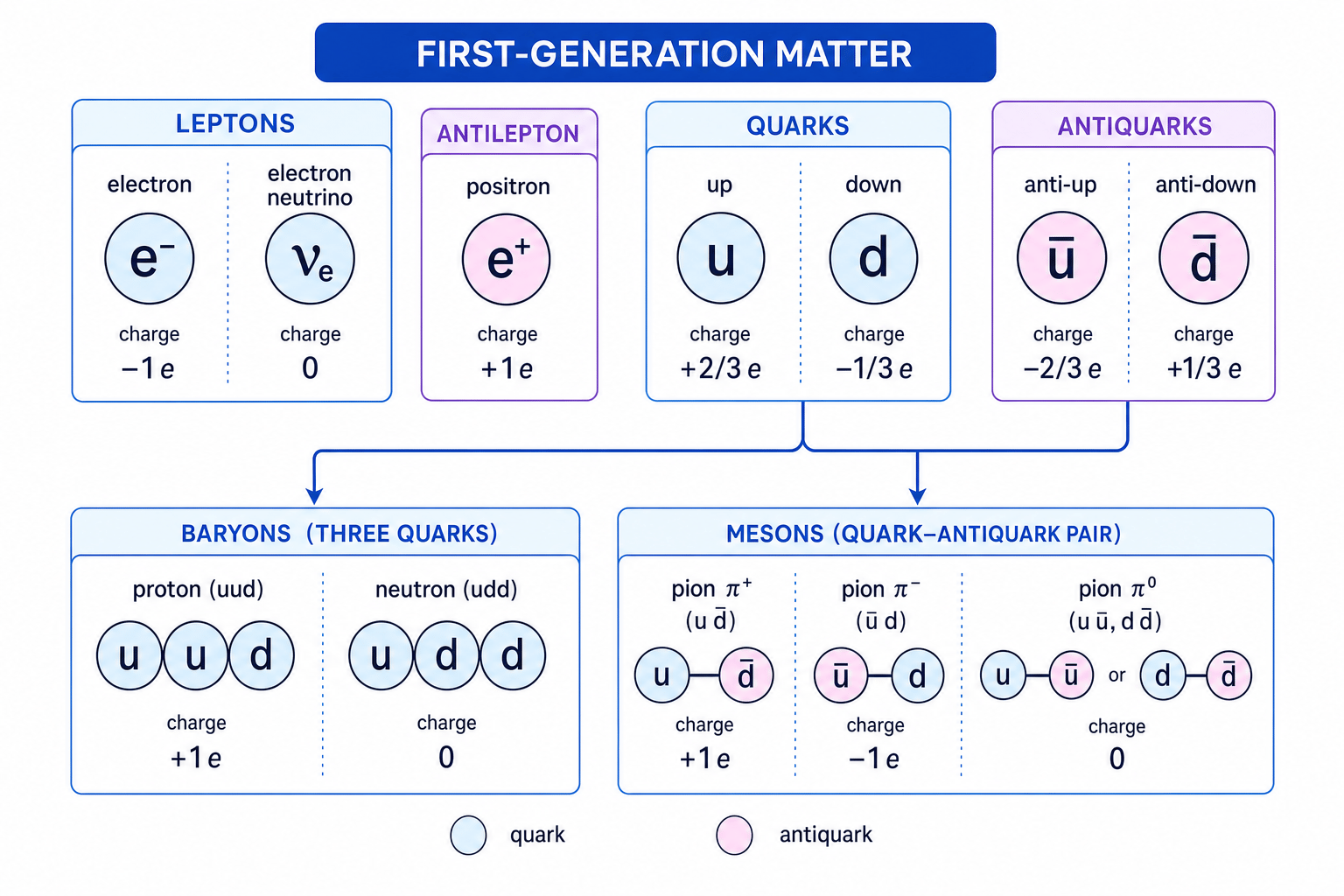
There are three generations of quarks and leptons. A generation is a set with the same pattern of interactions but larger masses in later generations. For this Eduqas section, you only need to use the first generation:
- Electron: symbol e−e^-e−, charge −e-e−e.
- Electron neutrino: symbol νe\nu_eνe, charge zero.
- Up quark: symbol uuu, charge +23e+\frac{2}{3}e+32e.
- Down quark: symbol ddd, charge −13e-\frac{1}{3}e−31e.
Use charges in units of e
For quark questions, add charges as fractions of eee. For example, +23e−13e−13e=0+\frac{2}{3}e - \frac{1}{3}e - \frac{1}{3}e = 0+32e−31e−31e=0.
Antiparticles and annihilation
Every particle in this section has an antiparticle. An antiparticle has the same rest mass as the corresponding particle, but opposite charge. In conservation rules, it also has the opposite lepton number or baryon number.
The antiparticle of the electron is the positron, symbol e+e^+e+. The antiparticle of the electron neutrino is the electron antineutrino, symbol νˉe\bar{\nu}_eνˉe.
For quarks, a bar over the symbol means “anti”:
- Anti-up quark: uˉ\bar{u}uˉ, charge −23e-\frac{2}{3}e−32e.
- Anti-down quark: dˉ\bar{d}dˉ, charge +13e+\frac{1}{3}e+31e.
For hadrons, the same bar notation is used: for example, an antiproton is pˉ\bar{p}pˉ and an antineutron is nˉ\bar{n}nˉ.
Annihilation
Annihilation occurs when a particle and its corresponding antiparticle meet and are converted into other particles or photons, with energy and conservation laws still obeyed.
Hadrons: baryons, antibaryons and mesons
Quarks and antiquarks are never observed in isolation. This is called quark confinement.
Particles made from quarks are called hadrons. There are three important types here:
- Baryons are made from three quarks.
- Antibaryons are made from three antiquarks.
- Mesons are made from one quark and one antiquark.
The proton and neutron are baryons:
- Proton: uuduuduud, giving charge +23e+23e−13e=+e+\frac{2}{3}e + \frac{2}{3}e - \frac{1}{3}e = +e+32e+32e−31e=+e.
- Neutron: udduddudd, giving charge +23e−13e−13e=0+\frac{2}{3}e - \frac{1}{3}e - \frac{1}{3}e = 0+32e−31e−31e=0.
Charged pions are mesons:
- Positive pion: π+=udˉ\pi^+ = u\bar{d}π+=udˉ.
- Negative pion: π−=uˉd\pi^- = \bar{u}dπ−=uˉd.
Suggesting a quark composition
A first-generation baryon has charge +2e+2e+2e. Suggest its quark composition.
-
A baryon must contain three quarks, not antiquarks.
-
To get the largest possible positive charge, choose up quarks because each up quark has charge +23e+\frac{2}{3}e+32e.
-
Add the charges:
+23e+23e+23e=+2e+\frac{2}{3}e + \frac{2}{3}e + \frac{2}{3}e = +2e+32e+32e+32e=+2e -
The baryon composition is therefore uuuuuuuuu.
Building mesons incorrectly
A meson is not made from two quarks. It is always a quark-antiquark pair.
The four interactions
Particles experience four fundamental interactions.
Gravitational interaction
Gravity is experienced by all matter and has infinite range. It is extremely weak at particle scale, so it is usually negligible unless very large masses are involved, such as planets or stars.
Weak interaction
The weak interaction is experienced by all leptons and all quarks, so it is also experienced by hadrons. It has a very short range.
Weak interaction clue
Neutrino involvement and quark flavour changes are exclusive to weak interactions.
A quark flavour means the type of quark, such as up or down. For example, in beta-minus decay, a down quark changes into an up quark.
Electromagnetic interaction
The electromagnetic interaction is experienced by charged particles and has infinite range. Neutral hadrons can also experience electromagnetic effects because they are made from charged quarks.
Rutherford scattering is mainly an electromagnetic interaction: a positive alpha particle is repelled by a positive gold nucleus.
Strong interaction
The strong interaction is experienced by all quarks, so it is experienced by all hadrons. It has short range and is responsible for binding quarks inside hadrons.
Conservation laws in particle reactions
To test whether a simple particle reaction is possible, compare totals before and after.
Conservation rules
In a valid particle reaction, total charge, total lepton number and total baryon number are conserved.
Use these values:
- Leptons such as e−e^-e− and νe\nu_eνe have lepton number +1+1+1.
- Antileptons such as e+e^+e+ and νˉe\bar{\nu}_eνˉe have lepton number −1-1−1.
- Baryons have baryon number +1+1+1.
- Antibaryons have baryon number −1-1−1.
- Mesons, leptons and photons have baryon number zero.
- A quark has baryon number +13+\frac{1}{3}+31 and an antiquark has baryon number −13-\frac{1}{3}−31.
Finding the missing particle in beta-minus decay
A neutron decays as follows:
n→p+e−+?n \to p + e^- + ?n→p+e−+?Find the missing particle.
-
Check charge. The neutron has charge zero. On the right, the proton is +e+e+e and the electron is −e-e−e, so the missing particle must have charge zero.
-
Check baryon number. The neutron has baryon number +1+1+1, and the proton has baryon number +1+1+1. The missing particle must have baryon number zero.
-
Check lepton number. The initial lepton number is zero. The electron has lepton number +1+1+1, so the missing particle must have lepton number −1-1−1.
-
A neutral particle with lepton number −1-1−1 is the electron antineutrino:
n→p+e−+νˉen \to p + e^- + \bar{\nu}_en→p+e−+νˉe -
The reaction involves a neutrino and a quark flavour change from udduddudd to uuduuduud, so it is a weak interaction.
In the exam
- For scattering questions, link each observation to an inference: straight through means empty space; large deflection means concentrated positive charge; backscatter means a massive dense nucleus.
- For quark composition, first decide whether the particle is a baryon, antibaryon or meson, then add the quark charges as fractions of eee.
- For reactions, make three separate checks: charge, lepton number and baryon number. If a neutrino appears or a quark changes flavour, identify the interaction as weak.
Check yourself
- Why could the plum pudding model not explain alpha particles being scattered backwards?
- What quark combination gives a neutron, and how do the charges add to zero?
- In the reaction p→n+e++νep \to n + e^+ + \nu_ep→n+e++νe, which conservation laws are satisfied?