Question 14
a.[2]
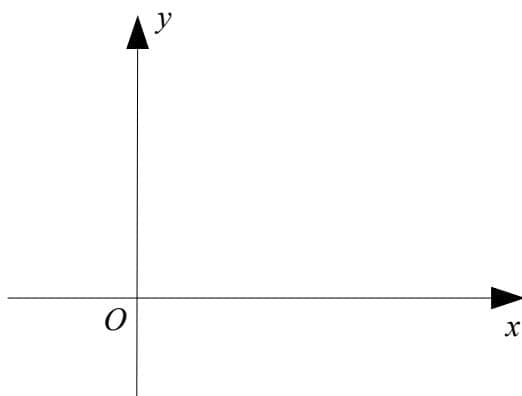
Sketch the graphs of y=lnxy = \ln xy=lnx and y=1x\displaystyle y = \frac{1}{x}y=x1 for x>0 x > 0\,x>0 on the same axes.
b.[1]
Explain why the equation lnx=1x\displaystyle \ln x = \frac{1}{x}lnx=x1 has exactly one solution.
c.[2]
By considering a suitable change of sign, show that the solution to the equation lies between 1.7 and 1.8
d.[2]
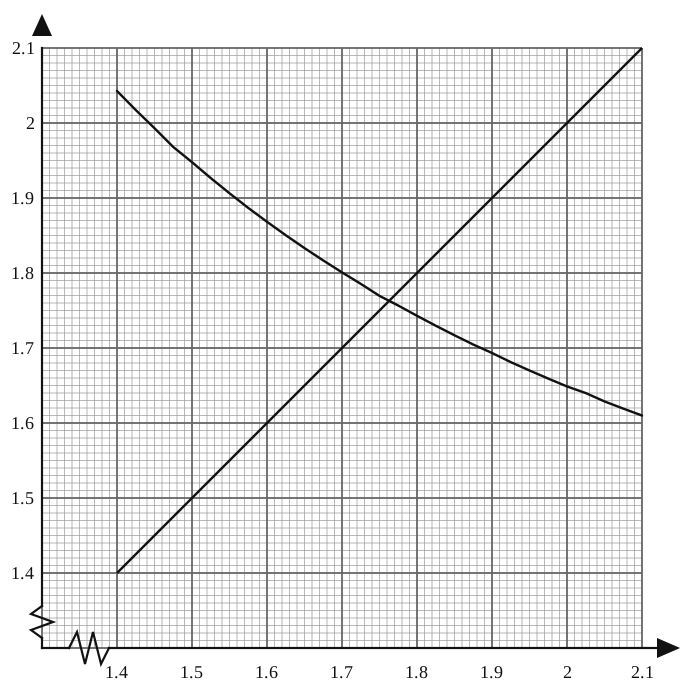
Use the iterative formula xn+1=e1xn\displaystyle x_{n+1} = e^{\frac{1}{x_n}}xn+1=exn1 with x1=2.1x_1 = 2.1x1=2.1, to find x2,x3 x_2, x_3\,x2,x3 and x4x_4x4, giving your answers to four decimal places.
e.[2]
On the graph below, draw a cobweb or staircase diagram to show how the convergence takes place.
Numerical Methods Questions
329 exam-style questions on Edexcel A Level Maths Numerical Methods, covering 10.1 Locating Roots, 10.2 Iteration, 10.3 The Newton-Raphson Method, and 10.4 Applications to Modelling. Each one has a worked solution and a mark scheme showing where the marks go.