1.5 B: Algebra and functions
123456789101112131415161718192021222324252627282930313233343536373839404142434445464748495051525354555657585960616263646566676869707172737475767778798081828384858687888990919293949596979899100101102103104105106107108109110111112113114115116117118119120121122123124125126127128129130131132133134135136137138139140141142143144145146147148149150151152153154155156157158159160161162163164165166167168169170171172173174175176177178179180181182183184185186187188189190191192193194195196197198199200201202203204205206207208209210211212213214215216217218219220221222223224225226227228229230231232233
Question 120
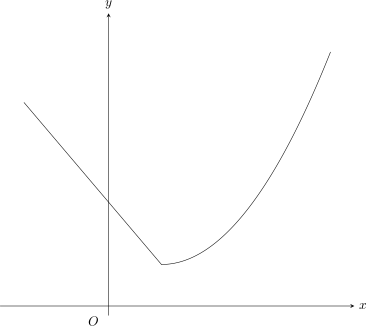
Figure 1 below shows a sketch of y=g(x)y = g(x)y=g(x), where
g(x)={5−3xx<1(x−1)2+2x≥1g(x) = \begin{cases} 5 - 3x & x < 1 \\ (x - 1)^2 + 2 & x \geq 1 \end{cases}g(x)={5−3x(x−1)2+2x<1x≥1
a.[2]
Find the value of gg(0)gg(0)gg(0).
b.[4]
Using set notation, find all the values of x x\,x for which g(x)>18g(x) > 18g(x)>18.
1.5 B: Algebra and functions Questions
532 exam-style questions on AQA A Level Maths 1.5 B: Algebra and functions, covering 1.5.1 Laws of indices, 1.5.2 Surds, 1.5.3 Quadratic functions, 1.5.4 Simultaneous equations, 1.5.5 Linear and quadratic inequalities, 1.5.6 Polynomials and rational expressions, 1.5.7 Graphs of functions and proportion, 1.5.8 Composite and inverse functions (A-level only), 1.5.9 Transformations of graphs, 1.5.10 Partial fractions (A-level only), and 1.5.11 Functions in modelling (A-level only). Each one has a worked solution and a mark scheme showing where the marks go.