

Practical work is the backbone of chemistry. In your written examinations, OCR will assess your understanding of how experiments are actually executed in the laboratory. This area of the specification is called Implementing. It covers selecting the correct apparatus, measuring physical quantities using appropriate units, and recording observations and data with absolute precision.
What you'll learn
- How to select and use high-precision laboratory apparatus (such as burettes, pipettes, and volumetric flasks).
- The correct units, conversions, and significant figure rules required for quantitative calculations.
- How to construct professional data tables and record precise qualitative and quantitative observations.
1. Selecting and Using Practical Apparatus
To carry out a successful chemical experiment, you must choose apparatus that provides the correct level of precision. Using a measuring cylinder when you require the high precision of a volumetric pipette is a classic experimental error that introduces unnecessary uncertainty.
Resolution
The resolution of a measuring instrument is the smallest change in the quantity being measured that gives a perceptible change in the reading on the instrument's scale.
The table below summarises the typical apparatus you will use and their associated precision in A-Level Chemistry:
| Apparatus | Typical Capacity | Typical Resolution / Uncertainty | When to Use |
|---|---|---|---|
| Volumetric Pipette | 25.0 cm³ (fixed) | ±0.06 cm3\pm 0.06\text{ cm}^3±0.06 cm3 | To deliver highly accurate, fixed volumes of a solution. |
| Burette | 50.0 cm³ (variable) | ±0.05 cm3\pm 0.05\text{ cm}^3±0.05 cm3 (per reading) | To deliver variable, precise volumes of a solution (e.g., in titrations). |
| Volumetric Flask | 250.0 cm³ (fixed) | ±0.15 cm3\pm 0.15\text{ cm}^3±0.15 cm3 | To prepare standard solutions of exact concentration. |
| Measuring Cylinder | 10 cm³ to 100 cm³ | ±0.5 cm3\pm 0.5\text{ cm}^3±0.5 cm3 to ±1.0 cm3\pm 1.0\text{ cm}^3±1.0 cm3 | For measuring approximate volumes of reagents in excess. |
Reading a Burette Scale
When using a burette, you must read the scale at the bottom of the curved liquid surface, known as the meniscus. Your eye must be completely level with the meniscus to avoid parallax error.
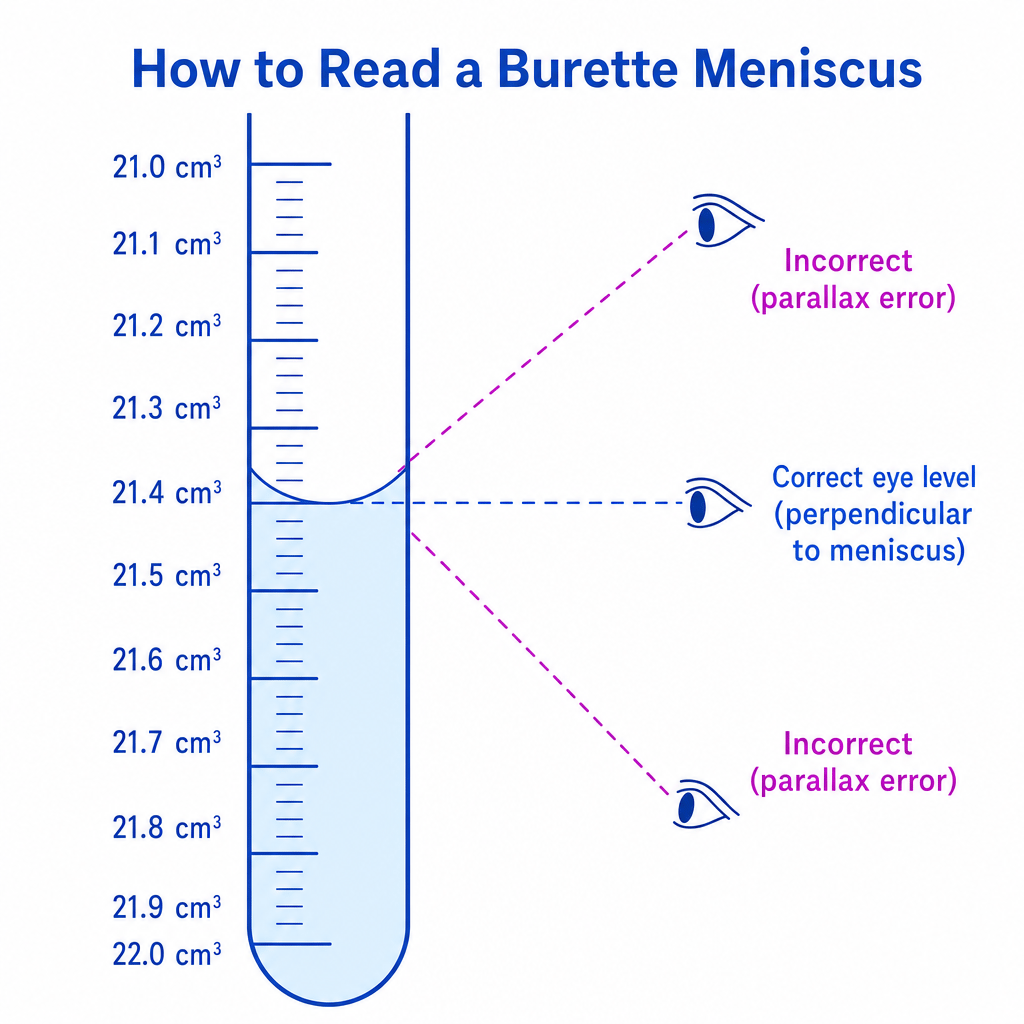
Because a burette has markings every 0.1 cm³, you are expected to interpolate (estimate) between the lines to the nearest 0.05 cm³. This means every single burette reading you write down must end in either .00 or .05.
Burette Reading Precision
Even if the meniscus sits perfectly on a line, you must record it to two decimal places. For example, a reading exactly on the 22 cm³ mark must be written as 22.00 cm³, not 22 cm³ or 22.0 cm³.
2. Appropriate Units for Measurements
In chemistry calculations, mismatching your units is one of the fastest ways to lose marks. You must be comfortable converting between units seamlessly.
Volume
While the standard SI unit of volume is the cubic metre (m³), chemists typically work with much smaller volumes:
- Cubic decimetres (dm³): Equivalent to litres.
- Cubic centimetres (cm³): Equivalent to millilitres.
The conversion factors are:
1 dm3=1000 cm3 1\text{ dm}^3 = 1000\text{ cm}^3 1 dm3=1000 cm3 1 m3=1000 dm3=1,000,000 cm3 1\text{ m}^3 = 1000\text{ dm}^3 = 1,000,000\text{ cm}^3 1 m3=1000 dm3=1,000,000 cm3To convert from cm³ to dm³, you divide by 1000:
Volume in dm3=Volume in cm31000 \text{Volume in dm}^3 = \frac{\text{Volume in cm}^3}{1000} Volume in dm3=1000Volume in cm3Temperature
Most laboratory thermometers measure temperature in degrees Celsius (°C), but thermodynamic calculations (such as those involving gas laws or Gibbs free energy) require temperature in Kelvin (K).
The scale conversion is:
T/K=θ/∘C+273 T/\text{K} = \theta/^\circ\text{C} + 273 T/K=θ/∘C+273Temperature Changes
A change in temperature (ΔT\Delta TΔT) has the same numerical value in both Celsius and Kelvin. If a reaction mixture warms up by 15 °C, it has also warmed up by 15 K. Do not add 273 to a temperature difference!
Pressure
Pressure is measured in Pascals (Pa) or kilopascals (kPa).
- 1 kPa=1000 Pa1\text{ kPa} = 1000\text{ Pa}1 kPa=1000 Pa
- In gas calculations using the ideal gas equation (pV=nRTpV = nRTpV=nRT), pressure (ppp) must always be converted into Pascals (Pa).
Unit Consistency in Calculations
Always check that your units match the units of the constant you are using. In pV=nRTpV = nRTpV=nRT, the gas constant RRR is 8.314 J K−1 mol−18.314\text{ J K}^{-1}\text{ mol}^{-1}8.314 J K−1 mol−1. Because RRR contains Joules (which is based on SI base units like metres and kilograms), you must use volume in m3\text{m}^3m3, pressure in Pa\text{Pa}Pa, and temperature in K\text{K}K.
3. Presenting Observations and Data
When you record raw data during a practical activity, it must be laid out systematically so that any other scientist can understand and repeat your work.
Quantitative Data Tables
When constructing tables for numerical data:
- Headers: Every column header must contain both the physical quantity and its unit, separated by a forward slash. For example:
Volume / cm³orTemperature / °CorTime / s. - Raw Data Precision: All raw data in a given column must be recorded to the same number of decimal places or significant figures, matching the resolution of the apparatus used.
- Processed Data: Calculations derived from raw data (like averages or rate calculations) should be presented in separate columns, rounded to an appropriate number of significant figures (typically matching the least precise piece of raw data).
Units inside the data rows
Do not write units next to individual numbers inside the cells of a table (e.g. writing 12.5 cm³ in a cell). The unit belongs only in the column header. The cells should contain pure numbers.
Qualitative Observations
Qualitative data describes physical properties that do not involve numbers, such as colour changes, gas evolution, or precipitate formation. Your descriptions must be precise and unambiguous:
- Colourless vs Clear: A solution can be "clear" (not cloudy) but still have a colour (like copper sulfate solution, which is blue and clear). If it has no colour, describe it as colourless, never "clear".
- Precipitates: If a solid forms when two solutions are mixed, do not just state "it turned cloudy". State the colour of the solid and use the term precipitate (e.g., "a white precipitate formed").
- Gases: If a reaction produces gas bubbles, record effervescence or "fizzing". If you test the gas, record both the test and the result (e.g., "the gas turned damp red litmus paper blue").
Worked Example
Recording and processing titration data
A student performs a titration to find the concentration of a sample of hydrochloric acid using 0.100 mol dm−30.100\text{ mol dm}^{-3}0.100 mol dm−3 sodium hydroxide solution.
Their raw burette readings are shown in the table below:
| Titration Run | Rough | Run 1 | Run 2 | Run 3 |
|---|---|---|---|---|
| Final Reading / cm³ | 24.50 | 23.40 | 46.95 | 24.15 |
| Initial Reading / cm³ | 0.00 | 0.00 | 23.40 | 0.80 |
| Titre / cm³ | 24.50 | 23.40 | 23.55 | 23.35 |
Calculate the mean titre that the student should use for their subsequent concentration calculations.
Step-by-step Solution:
-
Understand the rule for concordant titres: In volumetric analysis, concordant titres are those that agree within 0.10 cm30.10\text{ cm}^30.10 cm3 of each other. Only concordant titres can be used to calculate the mean.
-
Evaluate and select the concordant values:
- Rough run: 24.50 cm324.50\text{ cm}^324.50 cm3 (always exclude the rough titre, as it is only a guide).
- Run 1: 23.40 cm323.40\text{ cm}^323.40 cm3
- Run 2: 23.55 cm323.55\text{ cm}^323.55 cm3
- Run 3: 23.35 cm323.35\text{ cm}^323.35 cm3
Let's check the differences between the real runs:
- Difference between Run 1 and Run 3: ∣23.40−23.35∣=0.05 cm3|23.40 - 23.35| = 0.05\text{ cm}^3∣23.40−23.35∣=0.05 cm3 (concordant).
- Difference between Run 1 and Run 2: ∣23.40−23.55∣=0.15 cm3|23.40 - 23.55| = 0.15\text{ cm}^3∣23.40−23.55∣=0.15 cm3 (not concordant).
- Difference between Run 2 and Run 3: ∣23.55−23.35∣=0.20 cm3|23.55 - 23.35| = 0.20\text{ cm}^3∣23.55−23.35∣=0.20 cm3 (not concordant).
Therefore, the concordant titres are Run 1 (23.40 cm323.40\text{ cm}^323.40 cm3) and Run 3 (23.35 cm323.35\text{ cm}^323.35 cm3). Run 2 must be excluded.
-
Calculate the mean of the selected concordant titres: Sum the concordant values and divide by the number of values (2):
- Round to the appropriate precision: Burette readings are measured to two decimal places (ending in .00 or .05). When calculating a mean of values ending in .00 or .05, the result must be rounded to two decimal places.
In the exam
- Always use 2 decimal places for burette volumes: Ensure every single burette reading and calculated titre ends in
.00or.05. - State colour changes clearly: Avoid writing "the solution changed colour". Instead, write "the solution changed from yellow to orange".
- Double-check unit conversions: In physical chemistry questions (especially ideal gas, enthalpy, and rate calculations), pause and check if you need to convert cm3→dm3\text{cm}^3 \to \text{dm}^3cm3→dm3, kPa→Pa\text{kPa} \to \text{Pa}kPa→Pa, or ∘C→K^\circ\text{C} \to \text{K}∘C→K.
Check yourself
- Why is it incorrect to include a rough titration value when calculating a mean titre?
- A gas syringe has markings every 1 cm31\text{ cm}^31 cm3. To what precision should you record gas volumes measured with this syringe?
- Convert 24.5 cm324.5\text{ cm}^324.5 cm3 into m3\text{m}^3m3 for use in the ideal gas equation.
