Planning is the foundation of practical chemistry. In your written OCR A-Level Chemistry examinations, you will be assessed on your ability to design a logically sound, safe, and precise experiment to solve a practical problem.
Whether you are asked to design an experiment to find the enthalpy change of a reaction, determine the rate equation of a kinetics process, or prepare a standard solution, the same fundamental principles of experimental design apply.
What you'll learn
- How to select the most appropriate apparatus, glassware, and techniques for a given chemical reaction.
- How to identify independent, dependent, and control variables to ensure valid, reproducible results.
- How to evaluate and refine an experimental method to minimise errors and meet expected outcomes.
1. Selection of Apparatus and Techniques
An elegant experimental design starts with choosing the right tools. Your choice of apparatus directly dictates the precision and validity of your data. When planning, you must justify why a particular piece of equipment is suitable for the chemical species involved.
Measuring Gas Volumes
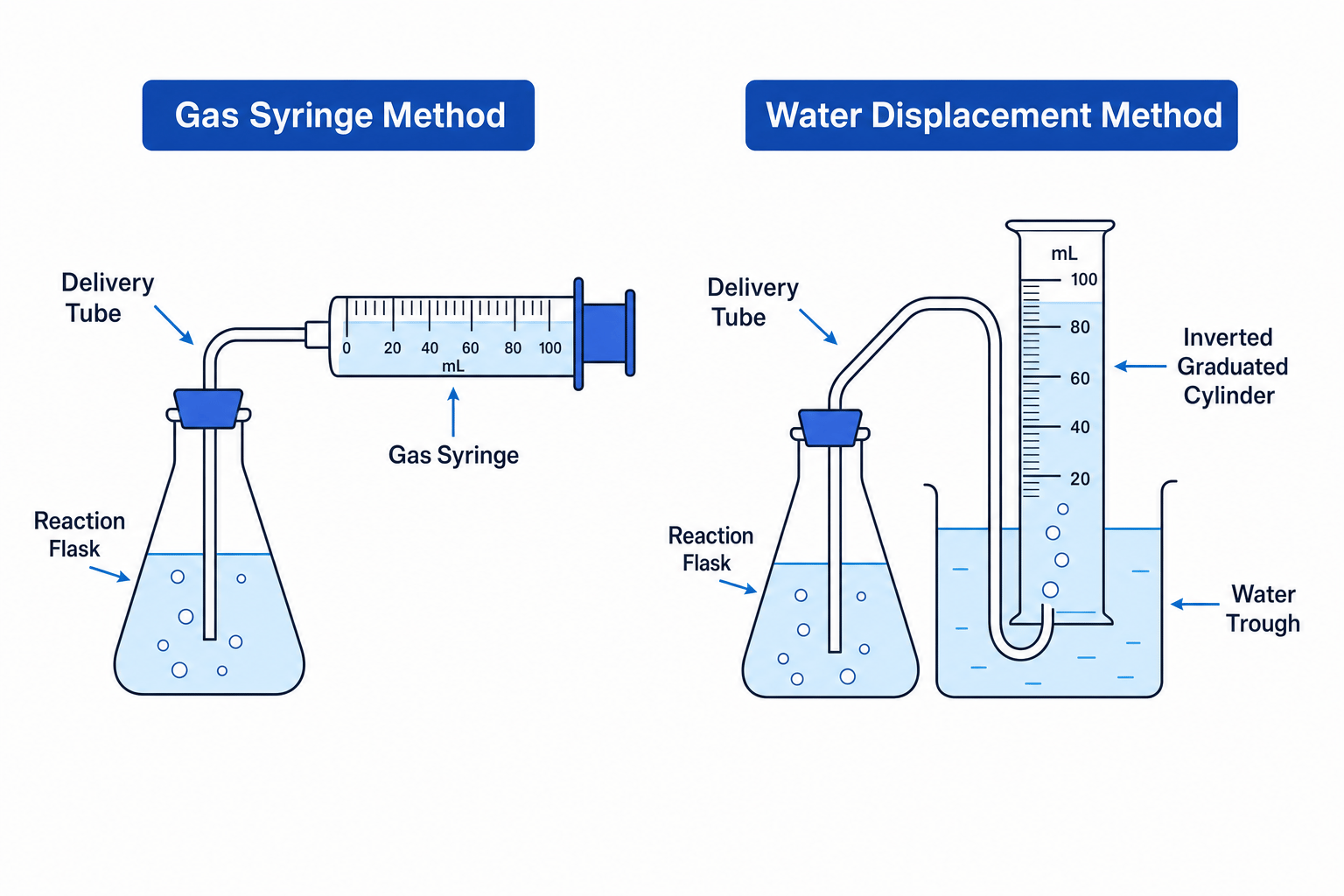
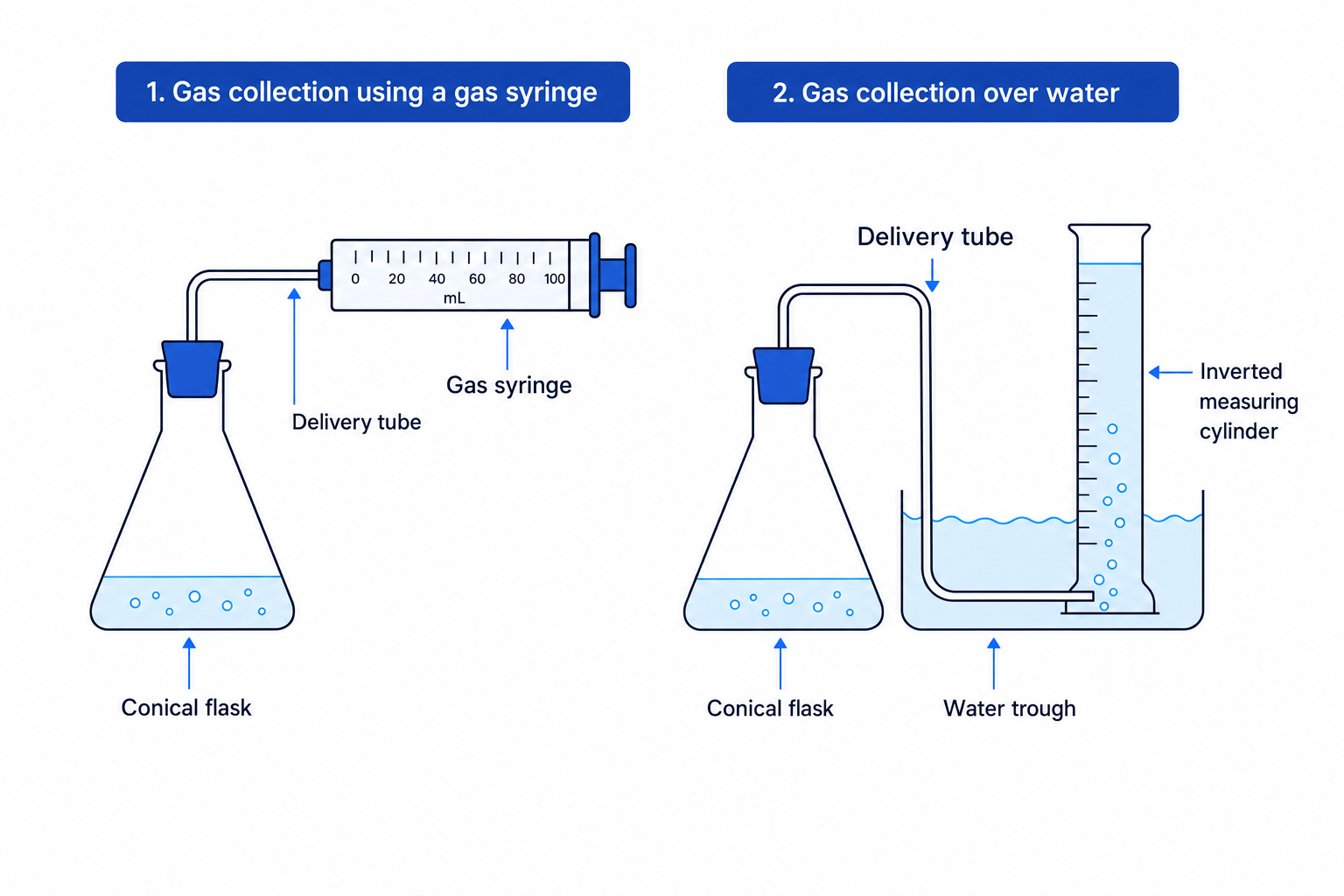
When a reaction produces a gas (such as CO2\text{CO}_2CO2, H2\text{H}_2H2, or O2\text{O}_2O2), you must choose an appropriate collection method:
- Gas Syringe: This is the most versatile method. It is highly precise and is essential if the gas being produced is soluble in water (for example, carbon dioxide, CO2\text{CO}_2CO2, or sulfur dioxide, SO2\text{SO}_2SO2).
- Inverted Cylinder over Water: This method is simpler but is only appropriate for gases with low water solubility, such as hydrogen (H2\text{H}_2H2) or oxygen (O2\text{O}_2O2). If you try to collect a highly soluble gas this way, some of it will dissolve in the water, leading to an underestimate of the gas volume produced.
Measuring Liquids
In titrations and quantitative preparations, the precision of your liquid volume measurements is paramount:
- Volumetric Pipette: Used to measure and transfer a highly precise, fixed volume (typically 10.0 cm310.0\text{ cm}^310.0 cm3 or 25.0 cm325.0\text{ cm}^325.0 cm3).
- Burette: Used to deliver variable volumes of liquid dropwise with high precision (measured to the nearest 0.05 cm30.05\text{ cm}^30.05 cm3).
- Measuring Cylinder: Used for rapid, less precise measurements where the reagent is in excess (e.g., adding 50 cm350\text{ cm}^350 cm3 of acid to a reaction where the exact acid volume does not affect the stoichiometric calculation).
Standard Solution
A standard solution is a solution of known concentration. It is prepared by dissolving a highly pure, known mass of a solid solute (a primary standard) in deionised water and making it up to an exact volume in a volumetric flask.
2. Quantifying Reagents: Calculations in Planning
To plan an experiment, you must calculate the exact quantities of reagents required. If you use too much, the reaction may be dangerously violent or wasteful; if you use too little, the changes you measure (such as temperature change or mass loss) will be too small to detect accurately.
The two main equations you will use are:
n=mM n = \frac{m}{M} n=Mm n=c×V n = c \times V n=c×VWhere:
- nnn = amount of substance in mol\text{mol}mol
- mmm = mass of substance in g\text{g}g
- MMM = molar mass of substance in g mol−1\text{g mol}^{-1}g mol−1
- ccc = concentration in mol dm−3\text{mol dm}^{-3}mol dm−3
- VVV = volume in dm3\text{dm}^3dm3 (note: to convert cm3\text{cm}^3cm3 to dm3\text{dm}^3dm3, divide by 1000)
Calculating the mass of solid required for a standard solution
You need to write a plan to prepare 250.0 cm3250.0\text{ cm}^3250.0 cm3 of a 0.150 mol dm−30.150\text{ mol dm}^{-3}0.150 mol dm−3 standard solution of anhydrous sodium carbonate, Na2CO3\text{Na}_2\text{CO}_3Na2CO3. Calculate the mass of solid you must weigh out.
- Convert the target volume to dm3\text{dm}^3dm3:
- Calculate the amount of Na2CO3\text{Na}_2\text{CO}_3Na2CO3 needed in moles:
- Determine the molar mass (MMM) of anhydrous Na2CO3\text{Na}_2\text{CO}_3Na2CO3 using the Periodic Table:
- Calculate the required mass (mmm):
Note: For your final answer, round to a sensible number of significant figures (usually 3 s.f., matching the concentration given), which gives 3.98 g3.98\text{ g}3.98 g.
Weighing by Difference
When transferring a solid from a weighing boat to a beaker, some solid always remains stuck to the boat. To prevent this systematic error, use weighing by difference:
- Weigh the boat containing the solid.
- Tip the solid into the beaker.
- Reweigh the empty boat (with any residue).
- Subtract the second mass from the first to find the exact mass transferred.
3. Controlling Variables
To make sure your experiment is a valid and fair test, you must control variables. This is particularly crucial in kinetics (rates of reaction) and energetics (enthalpy changes).
Variables
- Independent Variable: The factor you deliberately change (e.g., the concentration of a reactant).
- Dependent Variable: The factor you measure to see how it responds to changes in the independent variable (e.g., the rate of reaction).
- Control Variables: All other factors that must be kept constant throughout the experiment to ensure they do not affect the dependent variable.
When planning a kinetics experiment to determine the effect of concentration on rate, you must control the following:
- Temperature: Rate is highly sensitive to temperature because a small rise in temperature significantly increases the fraction of molecules with energy E≥EaE \ge E_aE≥Ea. You must use a temperature-controlled water bath.
- Total Volume of the Reaction Mixture: If you change the volume of one reactant, you must add deionised water to keep the total volume of the mixture constant. This ensures that changing the volume of one reagent directly correlates to its concentration without changing the overall concentration of other components.
Controlling variables in a kinetics experiment
A student is planning an experiment to find the order of reaction with respect to iodide ions (I−\text{I}^-I−) in the reaction between hydrogen peroxide and acidified iodide ions.
H2O2(aq)+2I−(aq)+2H+(aq)→I2(aq)+2H2O(l) \text{H}_2\text{O}_2\text{(aq)} + 2\text{I}^-\text{(aq)} + 2\text{H}^+\text{(aq)} \to \text{I}_2\text{(aq)} + 2\text{H}_2\text{O(l)} H2O2(aq)+2I−(aq)+2H+(aq)→I2(aq)+2H2O(l)Explain how the student can vary the concentration of I−\text{I}^-I− while keeping the concentrations of H2O2\text{H}_2\text{O}_2H2O2 and H+\text{H}^+H+ constant.
- Set up a series of reaction mixtures: Keep the volume of H2O2(aq)\text{H}_2\text{O}_2\text{(aq)}H2O2(aq) and the acid (H+\text{H}^+H+ source) constant in every run.
- Vary the volume of iodide solution: Use different volumes of the stock KI(aq)\text{KI(aq)}KI(aq) solution (the source of I−\text{I}^-I−) for each run.
- Keep the total volume constant: Add varying volumes of deionised water to each mixture so that the final total volume of the reaction mixture is identical in every experiment. This keeps the initial concentrations of H2O2\text{H}_2\text{O}_2H2O2 and H+\text{H}^+H+ completely constant while the concentration of I−\text{I}^-I− is varied systematically.
4. Evaluating and Refining Experimental Methods
Once an experimental plan is written, you must evaluate its potential limitations and suggest refinements. This is a common high-tariff written question style in OCR chemistry exams.
Reducing Experimental Uncertainty
To reduce percentage uncertainty, you should aim to obtain larger experimental readings.
% Uncertainty=Uncertainty of Equipment×Number of ReadingsQuantity Measured×100 \text{\% Uncertainty} = \frac{\text{Uncertainty of Equipment} \times \text{Number of Readings}}{\text{Quantity Measured}} \times 100 % Uncertainty=Quantity MeasuredUncertainty of Equipment×Number of Readings×100If you cannot change the equipment, you can reduce percentage uncertainty by using a larger mass, volume, or temperature change.
Typical Limitations and Refinements
Let's look at three classic scenarios you will need to evaluate:
A. Calorimetry (Enthalpy Determinations)
- Problem: Heat loss to the surroundings, or incomplete combustion of fuel.
- Refinement: Use a polystyrene cup inside a beaker to provide draft insulation. For combustion, use a copper calorimeter with draft shields, or a bomb calorimeter.
B. Gas Escaping During Initiation
- Problem: In a rate experiment, some gas escapes after adding the solid reactant but before the rubber bung can be pushed into the conical flask.
- Refinement: Suspend the solid reactant in a small tube inside the flask, seal the flask with the bung, and then shake/tilt the flask to start the reaction without opening the system. Alternatively, use a two-necked flask.
C. Titration Endpoint Identification
- Problem: The endpoint of a titration is difficult to judge by eye, leading to random error.
- Refinement: Use a pH probe or a colorimeter to quantitatively determine the equivalence point rather than relying on visual observation of an indicator.
Stating 'Human Error'
Never write "human error" as a source of error in your plan evaluation. Examiners treat "human error" as poor practice. Instead, identify specific limitations of the method or equipment, such as "heat loss to surroundings", "evaporation of solvent", or "the parallax error associated with reading a meniscus".
In the exam
When writing or evaluating an experimental plan in your exam:
- State the quantities clearly: Give exact volumes, concentrations, and masses. Don't just say "add some acid"—say "add 25.0 cm325.0\text{ cm}^325.0 cm3 of 1.0 mol dm−31.0\text{ mol dm}^{-3}1.0 mol dm−3 hydrochloric acid".
- Specify the exact apparatus: Name volumetric flasks, pipettes, burettes, or gas syringes by their scientific names, rather than generic terms like "container" or "tube".
- Include safety precautions: Identify specific hazards of the chemicals involved (e.g., "concentrated nitric acid is corrosive; wear nitrile gloves and work in a fume cupboard") rather than a generic "wear safety goggles".
- Use weighing by difference: Always state that you will record the mass of the weighing boat before and after emptying it to ensure accuracy.
Check yourself
- Why is a gas syringe preferred over gas collection over water when collecting carbon dioxide gas?
- If a balance has an uncertainty of ±0.01 g\pm 0.01\text{ g}±0.01 g per reading, what is the overall uncertainty when weighing a solid by difference, and how can you minimise the percentage uncertainty of this measurement?
- What substance is added to keep the overall volume of a kinetics reaction mixture constant when varying the volume of a reactant?