

What you'll learn
- How ionic and covalent bonds form, and how to draw dot-and-cross diagrams.
- How giant ionic lattices and simple molecular lattices explain physical properties.
- How electron-pair repulsion predicts molecular shapes and bond angles.
- How electronegativity, polarity and intermolecular forces affect substances such as water, iodine and ice.
Ionic bonding
Ionic bonding
Ionic bonding is the strong electrostatic attraction between oppositely charged ions.
An ion is a charged particle formed when an atom or group of atoms gains or loses electrons. Metals tend to lose electrons to form positive ions, called cations. Non-metals tend to gain electrons to form negative ions, called anions.
In a dot-and-cross diagram, electrons from different atoms are shown using different symbols. This helps you show electron transfer clearly, but the symbols do not mean the electrons are actually different.
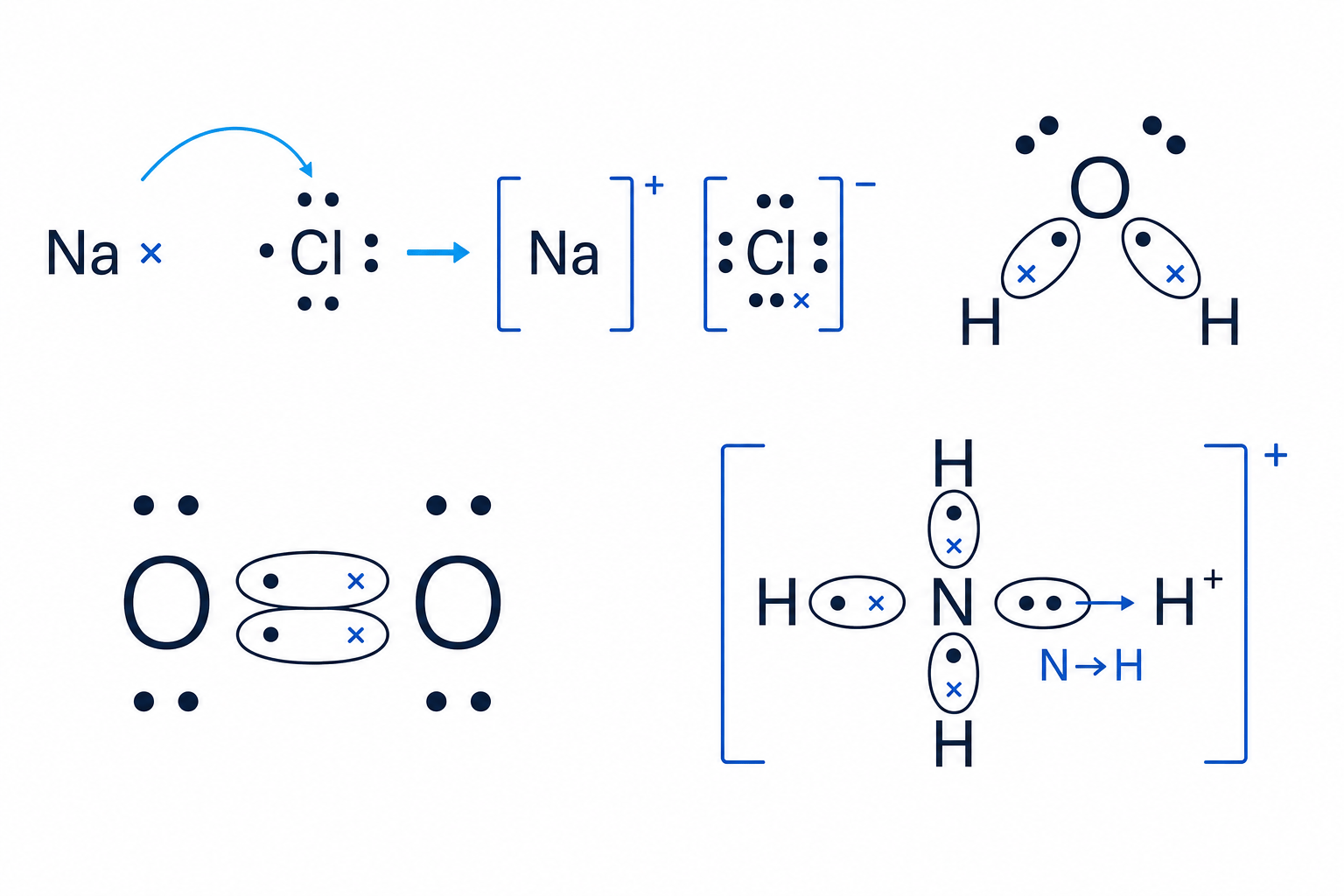
Constructing an ionic dot-and-cross diagram
Draw a dot-and-cross diagram for magnesium chloride, MgCl₂.
-
Magnesium is in Group 2, so it loses two outer-shell electrons to form Mg²⁺. Chlorine is in Group 17, so each chlorine atom gains one electron to form Cl⁻.
-
Because magnesium loses two electrons, you need two chlorine atoms: one electron is transferred to each chlorine atom.
-
Draw Mg²⁺ in square brackets with a 2+ charge, and draw two separate Cl⁻ ions in square brackets, each with a full outer shell and a 1− charge.
Giant ionic lattices
Giant ionic lattice
A giant ionic lattice is a repeating 3D arrangement of positive and negative ions, held together by strong electrostatic attractions in all directions.
Sodium chloride, NaCl, is a classic example. Each Na⁺ ion is surrounded by Cl⁻ ions, and each Cl⁻ ion is surrounded by Na⁺ ions. The bonding is not just between one pair of ions; the attraction acts throughout the whole lattice.
Ionic bonding is non-directional
In ionic compounds, each ion attracts oppositely charged ions around it in all directions. This produces a giant structure, not separate NaCl molecules.
Physical properties of ionic compounds
Ionic compounds usually have high melting points and high boiling points because many strong electrostatic attractions must be overcome to separate the ions.
They often dissolve in polar solvents such as water. Water molecules can attract and separate the ions from the lattice.
Their electrical conductivity depends on whether the ions can move:
- Solid ionic compound: does not conduct, because ions are fixed in position.
- Molten ionic compound: conducts, because ions are free to move.
- Aqueous ionic solution: conducts, because dissolved ions are free to move.
Explaining conductivity of sodium chloride
Explain why solid sodium chloride does not conduct electricity, but molten sodium chloride does.
-
Electrical conduction requires mobile charged particles, such as electrons or ions.
-
In solid NaCl, Na⁺ and Cl⁻ ions are held in fixed positions in the giant ionic lattice, so they cannot move through the structure.
-
When NaCl is molten, the lattice has broken down and the ions can move. The mobile Na⁺ and Cl⁻ ions carry charge, so the molten compound conducts.
Saying electrons move in molten ionic compounds
Molten ionic compounds conduct by movement of ions, not by movement of delocalised electrons.
Covalent bonding
Covalent bond
A covalent bond is the strong electrostatic attraction between a shared pair of electrons and the nuclei of the bonded atoms.
Covalent bonding usually occurs between non-metal atoms. The shared pair of electrons is attracted to both nuclei, holding the atoms together.
A single covalent bond contains one shared pair of electrons, such as an O–H bond in H₂O. A multiple covalent bond contains more than one shared pair, such as the double bond in O₂.
Dative covalent bond
A dative covalent bond, also called a coordinate bond, is a covalent bond in which both electrons in the shared pair are donated by the same atom.
For example, NH₃ can donate a lone pair from nitrogen to H⁺ to form NH₄⁺. Once formed, the dative bond behaves like an ordinary covalent bond.
Average bond enthalpy
Average bond enthalpy is a measure of covalent bond strength. The larger the average bond enthalpy, the stronger the covalent bond.
You do not need calculations with average bond enthalpies in this section, but you should understand the idea: stronger covalent bonds require more energy to break.
Shapes of simple molecules and ions
Electron-pair repulsion
Electron-pair repulsion theory says that pairs of electrons around a central atom repel each other and arrange themselves as far apart as possible.
An electron pair can be a bonded pair or a lone pair. A bonded pair is shared between two atoms. A lone pair is a pair of outer-shell electrons not involved in bonding.
Lone pairs repel more strongly than bonded pairs:
lone pair–lone pair > lone pair–bonded pair > bonded pair–bonded pair
This is why lone pairs slightly reduce bond angles.
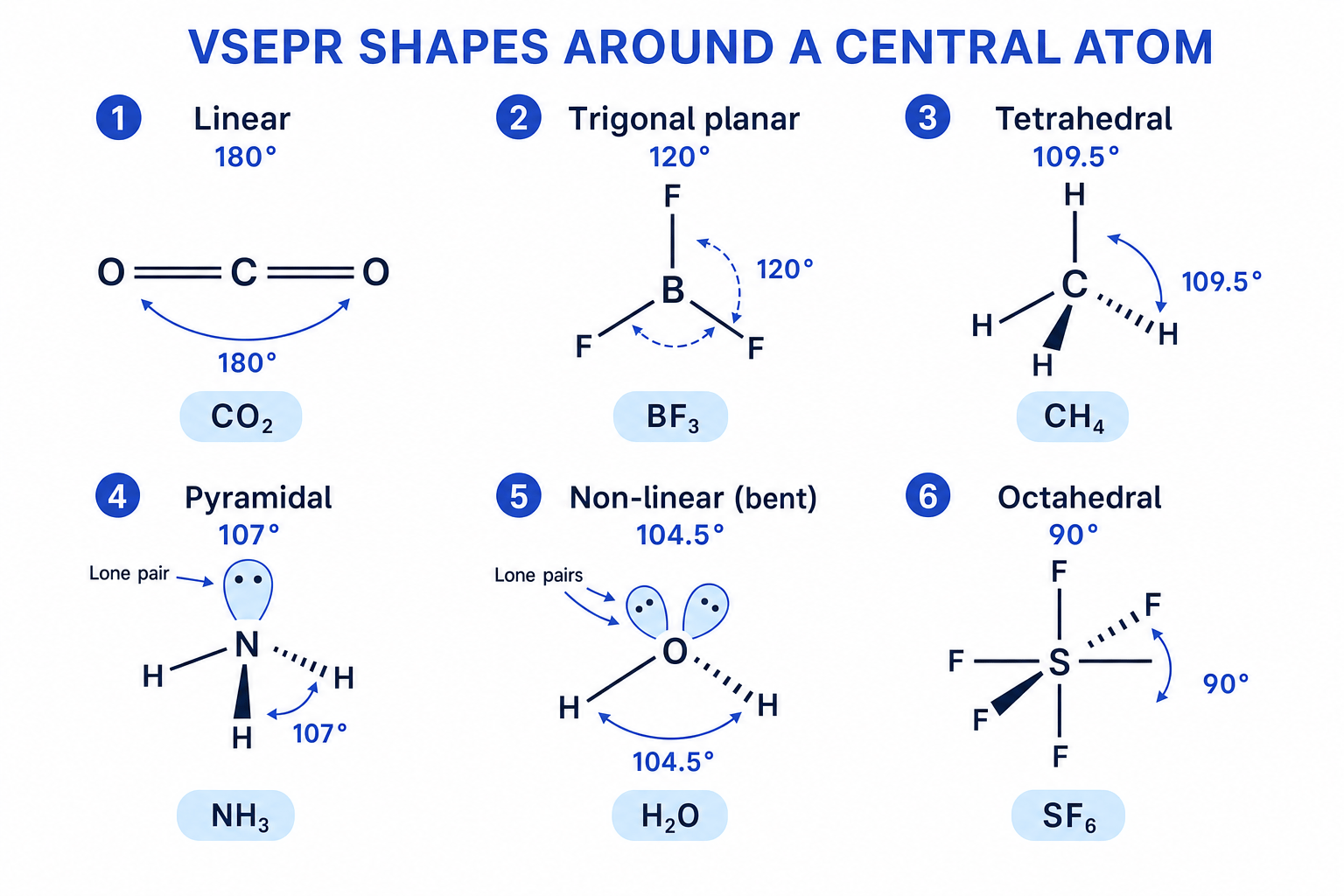
Shapes you need to know
- Linear: 2 electron pairs around the central atom, bond angle 180°. Example: CO₂.
- Trigonal planar: 3 bonded pairs, bond angle 120°. Example: BF₃.
- Tetrahedral: 4 bonded pairs, bond angle 109.5°. Example: CH₄.
- Pyramidal: 3 bonded pairs and 1 lone pair, bond angle about 107°. Example: NH₃.
- Non-linear: 2 bonded pairs and 2 lone pairs, bond angle about 104.5°. Example: H₂O.
- Octahedral: 6 bonded pairs, bond angle 90°. Example: SF₆.
Predicting the shape of ammonia
Predict the shape and bond angle of NH₃.
-
Nitrogen is the central atom. It has five outer-shell electrons and forms three N–H covalent bonds, so there are three bonded pairs.
-
The remaining two outer-shell electrons on nitrogen form one lone pair. Therefore, there are four electron pairs around nitrogen in total.
-
Four electron pairs arrange tetrahedrally, but one is a lone pair. The molecular shape is pyramidal, and the lone pair compresses the H–N–H bond angle to about 107°.
Counting regions of electron density
For shape prediction, a double bond counts as one region of electron density around the central atom, not two separate directions of repulsion.
Electronegativity and bond polarity
Electronegativity
Electronegativity is the ability of an atom to attract the bonding electrons in a covalent bond.
Electronegativity is often measured using Pauling values. Electronegativity increases across a period and decreases down a group, so it increases towards fluorine, the most electronegative element.
If two bonded atoms have different electronegativities, the bonding electrons are pulled more strongly towards one atom.
Polar bond
A polar bond is a covalent bond in which the bonding electrons are unevenly distributed, giving one atom a partial negative charge, δ⁻, and the other a partial positive charge, δ⁺.
A separation of charge like this is called a permanent dipole. The dipole points towards the more electronegative atom.
Polar molecule
A polar molecule is a molecule with an overall permanent dipole because its bond dipoles do not cancel.
A molecule can contain polar bonds but still be non-polar overall if the dipoles cancel due to symmetry. CO₂ has polar C=O bonds, but the molecule is linear, so the dipoles cancel. H₂O has polar O–H bonds and a bent shape, so the dipoles do not cancel.
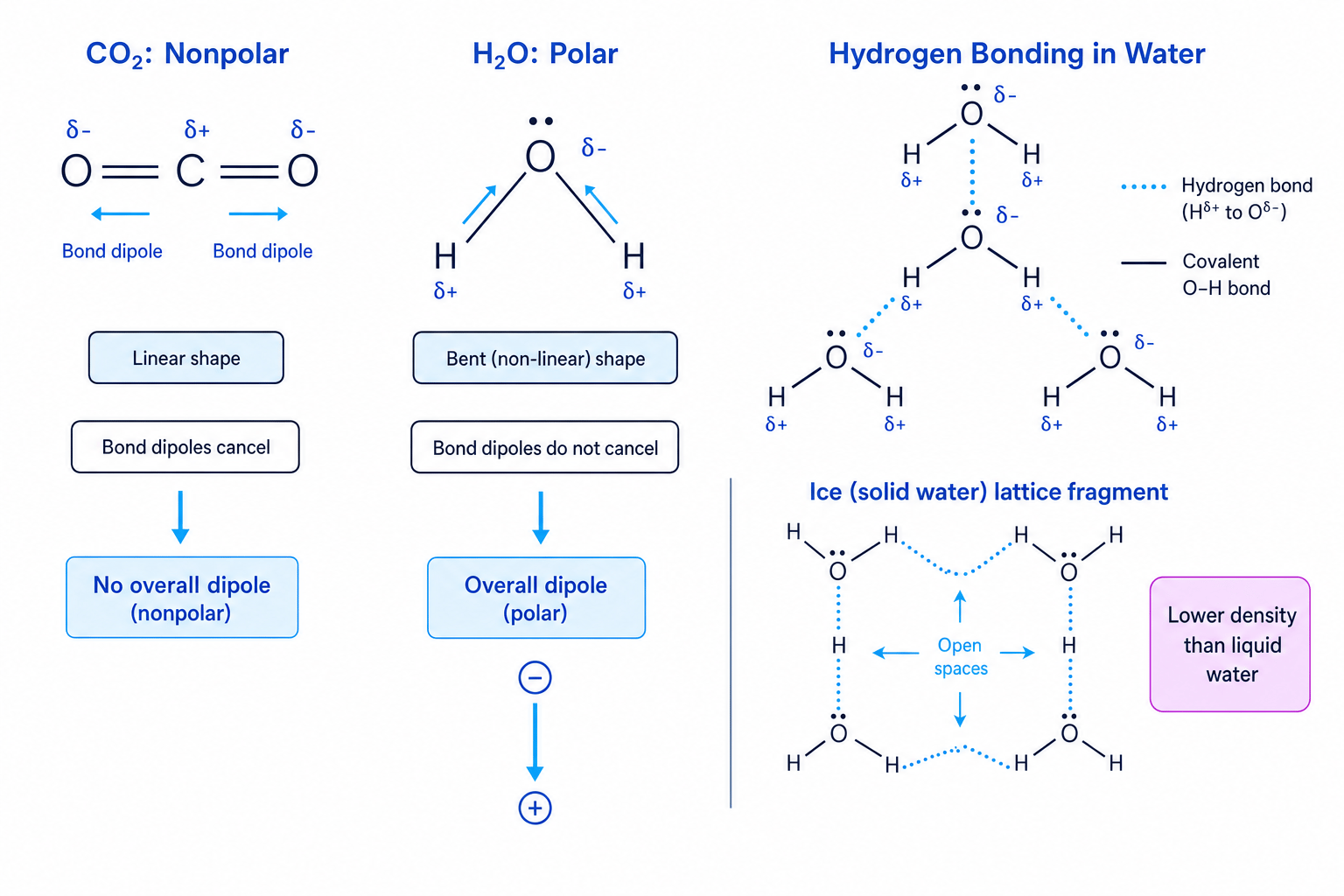
Deciding whether a molecule is polar
Decide whether BF₃ is polar.
-
Each B–F bond is polar because fluorine is more electronegative than boron, so each bond has a dipole pointing towards F.
-
BF₃ is trigonal planar, with three identical B–F bonds arranged symmetrically at 120°.
-
The three bond dipoles cancel, so BF₃ has no overall dipole and is non-polar.
Only checking whether bonds are polar
To decide whether a molecule is polar, you must consider both bond polarity and molecular shape.
Intermolecular forces
Intermolecular forces
Intermolecular forces are attractions between molecules. They are weaker than covalent bonds, which are attractions within molecules.
Two important types are:
- Permanent dipole–dipole interactions: attractions between polar molecules with permanent dipoles.
- Induced dipole–dipole interactions: attractions caused by temporary dipoles that induce dipoles in neighbouring molecules. These are also called London forces or London dispersion forces.
Permanent dipole–dipole interactions and induced dipole–dipole interactions can both be called van der Waals’ forces.
London forces are present between all atoms and molecules. They become stronger when molecules have more electrons and larger surface area, because temporary dipoles are easier to form.
Hydrogen bonding
Hydrogen bonding is an intermolecular attraction between a lone pair on N, O or F and a hydrogen atom bonded to N, O or F.
Hydrogen bonding occurs in substances with N–H, O–H or H–F bonds. The H atom is strongly δ⁺, and the N, O or F atom has a lone pair and is strongly δ⁻.
Why water is unusual
Water has strong hydrogen bonding between molecules. This explains two important anomalous properties:
- Water has relatively high melting and boiling points for such a small molecule, because extra energy is needed to overcome hydrogen bonds.
- Ice is less dense than liquid water. In ice, hydrogen bonds hold water molecules in an open lattice with gaps. When ice melts, some of this structure collapses, so liquid water is denser.
Simple molecular lattices
Simple molecular lattice
A simple molecular lattice is a solid structure made from covalently bonded molecules held together by intermolecular forces.
Examples include iodine, I₂, and ice, H₂O(s). In iodine, each I₂ molecule has a strong covalent bond within the molecule, but the molecules are held together by London forces. In ice, water molecules are held together in a lattice by hydrogen bonds.
Physical properties of simple molecular substances
Simple molecular substances usually have low melting and boiling points because only intermolecular forces are overcome during melting or boiling. The covalent bonds inside the molecules are not broken.
They usually do not conduct electricity because they have no mobile ions or delocalised electrons.
Their solubility depends on polarity:
- Non-polar molecular substances often dissolve in non-polar solvents.
- Polar molecular substances may dissolve in polar solvents.
- Substances that can form hydrogen bonds with water are often more soluble in water.
Comparing iodine and sodium chloride
Explain why iodine has a much lower melting point than sodium chloride.
-
Iodine, I₂, is a simple molecular substance. Its molecules are held together by intermolecular forces, mainly London forces.
-
Sodium chloride is a giant ionic lattice with strong electrostatic attractions between Na⁺ and Cl⁻ ions in all directions.
-
Melting iodine only overcomes intermolecular forces between I₂ molecules, but melting sodium chloride requires overcoming strong ionic attractions throughout the lattice. Therefore, iodine has a much lower melting point.
Structure explains properties
Always link the property to the particles present, the forces between them, and whether any charged particles are mobile.
In the exam
-
For structure-and-property questions, name the structure first: giant ionic lattice, simple molecular lattice, or covalent molecule.
-
For melting and boiling points, state which forces are overcome: ionic bonds in a lattice, or intermolecular forces between molecules.
-
For conductivity, look for mobile charged particles: ions in molten/aqueous ionic compounds, but usually none in simple molecular substances.
Check yourself
- Why does molten MgCl₂ conduct electricity but solid MgCl₂ does not?
- What shape and bond angle would you predict for a molecule with 3 bonded pairs and 1 lone pair?
- Why is CO₂ non-polar overall but H₂O polar overall?
