

What you'll learn
- How electrons are arranged in shells, sub-shells and atomic orbitals.
- How many electrons can fit in the first four shells and in s-, p- and d-sub-shells.
- How to fill orbitals using energy order and “electrons-in-box” diagrams.
- How to write electron configurations for atoms and simple ions up to Z=36Z=36Z=36.
From shells to orbitals
At GCSE, you probably met electron arrangements like 2,8,1 for sodium. That is a useful shell model, but A-Level Chemistry needs a more detailed model: electrons occupy atomic orbitals within sub-shells within shells.
Shell
A shell is a main energy level around the nucleus. Shells are labelled by the principal quantum number nnn: first shell n=1n=1n=1, second shell n=2n=2n=2, and so on.
The maximum number of electrons in a shell is given by:
2n22n^22n2So the first four shells can hold:
| Shell | Maximum number of electrons |
|---|---|
| 1st shell | 2 |
| 2nd shell | 8 |
| 3rd shell | 18 |
| 4th shell | 32 |
Capacity is not the same as filling order
The third shell can hold 18 electrons in total, but atoms do not fill the whole third shell before any electrons enter the fourth shell. For example, 4s fills before 3d.
Working out a shell capacity
Use the shell formula to find the maximum number of electrons in the fourth shell.
- Identify the shell number: for the fourth shell, n=4n=4n=4.
- Substitute into the maximum-electrons formula: 2n2=2×422n^2 = 2 \times 4^22n2=2×42.
- Calculate: 2×16=322 \times 16 = 322×16=32, so the fourth shell can hold 32 electrons.
Sub-shells and atomic orbitals
Each shell is split into sub-shells, labelled s, p, d and f. For this topic, you need s, p and d.
Atomic orbital
An atomic orbital is a region around the nucleus that can hold up to two electrons. If two electrons occupy the same orbital, they must have opposite spins, shown as ↑↓ in an electrons-in-box diagram.
An s-orbital is spherical. A p-orbital has a dumbbell shape. A p-sub-shell contains three p-orbitals, arranged at right angles to each other: px, py and pz.
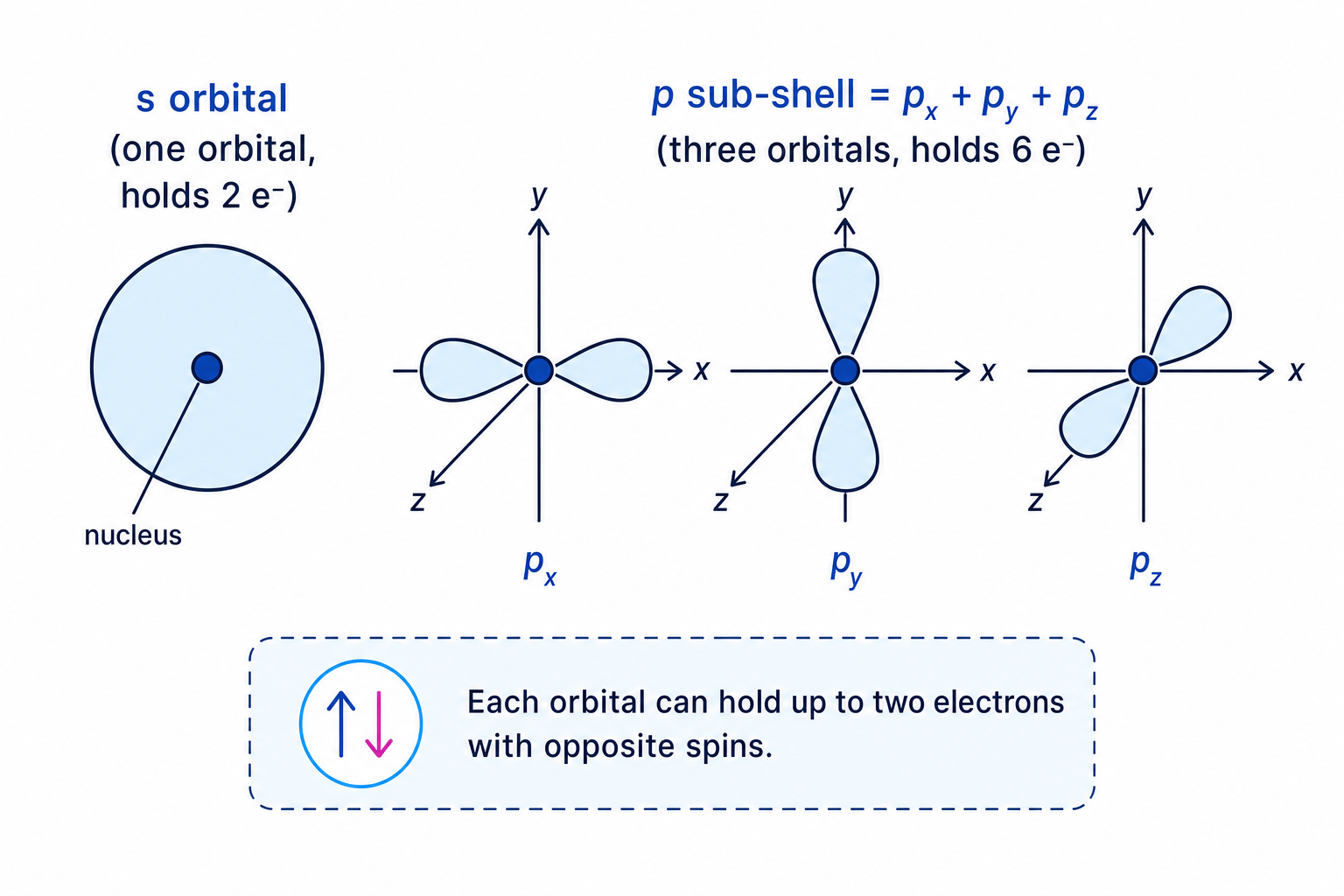
How many orbitals are in each sub-shell?
| Sub-shell | Number of orbitals | Maximum electrons |
|---|---|---|
| s | 1 | 2 |
| p | 3 | 6 |
| d | 5 | 10 |
The reason is simple: each orbital holds a maximum of two electrons.
Sub-shell capacity
s holds 2 electrons, p holds 6 electrons, and d holds 10 electrons. These numbers come from the number of orbitals in each sub-shell.
Building the capacity of the third shell
Work out the maximum number of electrons in the third shell using its sub-shells.
- The third shell contains 3s, 3p and 3d sub-shells.
- Add their capacities: s holds 2, p holds 6, and d holds 10.
- Total capacity: 2+6+10=182 + 6 + 10 = 182+6+10=18 electrons.
Electron configurations
Electron configuration
An electron configuration shows how electrons are arranged in sub-shells. For example, oxygen is written as 1s² 2s² 2p⁴.
The small superscript number tells you how many electrons are in that sub-shell. For oxygen, 2p⁴ means there are four electrons in the 2p sub-shell.
Filling orbitals in order of energy
Electrons occupy the lowest available energy orbitals first. Up to Z=36Z=36Z=36, the filling order you need is:
1s → 2s → 2p → 3s → 3p → 4s → 3d → 4p
This is why potassium is 1s² 2s² 2p⁶ 3s² 3p⁶ 4s¹, not 1s² 2s² 2p⁶ 3s² 3p⁷.
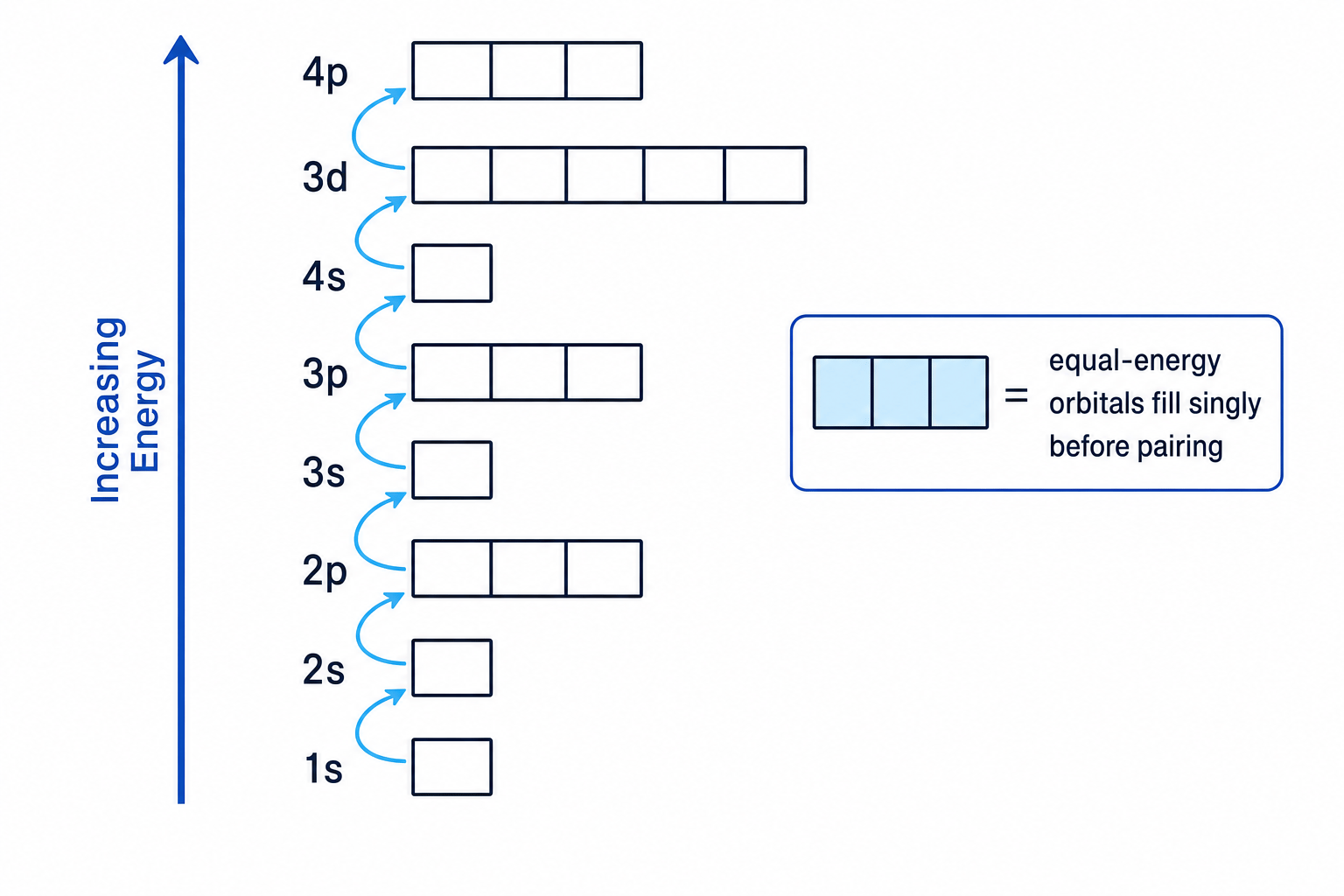
The three filling rules
Rules for filling orbitals
Fill orbitals from lowest to highest energy. Each orbital holds a maximum of two electrons with opposite spins. Orbitals of the same energy, such as the three p-orbitals, are occupied singly before electrons start to pair.
The “singly before pairing” rule matters for electrons-in-box diagrams. For example, 2p³ is shown as:
2p: [↑] [↑] [↑]
not:
2p: [↑↓] [↑] [ ]
Filling orbitals for oxygen
Deduce the electron configuration and 2p box diagram for oxygen, which has atomic number 8.
- A neutral oxygen atom has 8 electrons because its atomic number is 8.
- Fill from the lowest energy upwards: 1s takes 2 electrons, then 2s takes 2 electrons. That uses 4 electrons, leaving 4 for 2p.
- Put one electron into each of the three 2p orbitals before pairing the fourth electron: 2p is [↑↓] [↑] [↑].
- The electron configuration is 1s² 2s² 2p⁴.
Quick filling-order memory
For this topic, practise writing this sequence until it feels automatic: 1s, 2s, 2p, 3s, 3p, 4s, 3d, 4p.
Deducing configurations for atoms up to Z = 36
The atomic number, ZZZ, is the number of protons in the nucleus. In a neutral atom, it is also the number of electrons.
To write an atom’s electron configuration:
- Find the number of electrons.
- Fill sub-shells in the order 1s → 2s → 2p → 3s → 3p → 4s → 3d → 4p.
- Stop when you have placed all the electrons.
- Check that the superscripts add up to the atomic number.
Deducing bromine's electron configuration
Bromine has atomic number 35. Deduce its electron configuration.
- A neutral bromine atom has 35 electrons.
- Fill up to argon: 1s² 2s² 2p⁶ 3s² 3p⁶. This accounts for 18 electrons.
- Continue in energy order: 4s² brings the total to 20, then 3d¹⁰ brings the total to 30.
- Put the remaining 5 electrons into 4p, giving 4p⁵.
- Bromine is 1s² 2s² 2p⁶ 3s² 3p⁶ 4s² 3d¹⁰ 4p⁵.
Chromium and copper
Chromium and copper are common exceptions: chromium is [Ar] 3d⁵ 4s¹, and copper is [Ar] 3d¹⁰ 4s¹. These arrangements give a half-filled or filled d-sub-shell, which is especially stable.
Electron configurations of ions
An ion is an atom or group of atoms with an overall charge because it has lost or gained electrons.
For this section, OCR limits ion configurations to s- and p-block ions up to Z=36Z=36Z=36. That means you avoid the more awkward transition-metal ion cases.
Positive ions
A positive ion has lost electrons.
For s- and p-block cations, remove electrons from the outermost shell first. For example, aluminium loses its 3p electron and its two 3s electrons to form Al³⁺.
Negative ions
A negative ion has gained electrons.
For non-metal anions, add electrons into the next available spaces, often forming the same configuration as the nearest noble gas.
Writing ion configurations
Deduce the electron configurations of Al³⁺ and Br⁻.
- Aluminium has Z=13Z=13Z=13, so a neutral Al atom has 13 electrons: 1s² 2s² 2p⁶ 3s² 3p¹.
- Al³⁺ has lost 3 electrons, so it has 10 electrons. Remove the outer-shell 3p¹ and 3s² electrons to give 1s² 2s² 2p⁶.
- Bromine has Z=35Z=35Z=35, so neutral Br has 35 electrons. Br⁻ has gained 1 electron, so it has 36 electrons.
- Fill to 36 electrons: 1s² 2s² 2p⁶ 3s² 3p⁶ 4s² 3d¹⁰ 4p⁶.
Forgetting the charge changes the electron count
For ions, do not start and stop at the atomic number. Add one electron for each negative charge, and subtract one electron for each positive charge.
Why this model matters
The electron-structure model is a refined model of the atom. Simple shells explain broad patterns, but sub-shells and orbitals explain more detailed behaviour, such as why elements are grouped into s-, p- and d-blocks and why transition elements involve d-orbitals.
You will use electron configurations throughout A-Level Chemistry: ion formation, periodicity, bonding, shapes of molecules, ionisation energies and transition-metal chemistry all build from this foundation.
In the exam
- Count electrons carefully first: for neutral atoms use ZZZ, for ions adjust for the charge.
- Use the filling order 1s → 2s → 2p → 3s → 3p → 4s → 3d → 4p, and check the superscripts add to the total electron count.
- For box diagrams, put electrons into equal-energy orbitals singly before pairing, and show paired electrons with opposite spins.
Check yourself
- What is the maximum number of electrons in an s-sub-shell, a p-sub-shell and a d-sub-shell?
- Why is sulfur written as 1s² 2s² 2p⁶ 3s² 3p⁴ rather than using only shell numbers?
- What is the full electron configuration of Se²⁻?
