What you'll learn
- How the periodic table is arranged, and why properties repeat.
- How electron configurations across Periods 2 and 3 link to s-, p- and d-blocks.
- How to explain first and successive ionisation energies.
- How structure and bonding explain melting points, conductivity and solubility.
1. The periodic table: patterns, not just a list
The atomic number or proton number is the number of protons in the nucleus of an atom. The modern periodic table arranges elements in order of increasing atomic number.
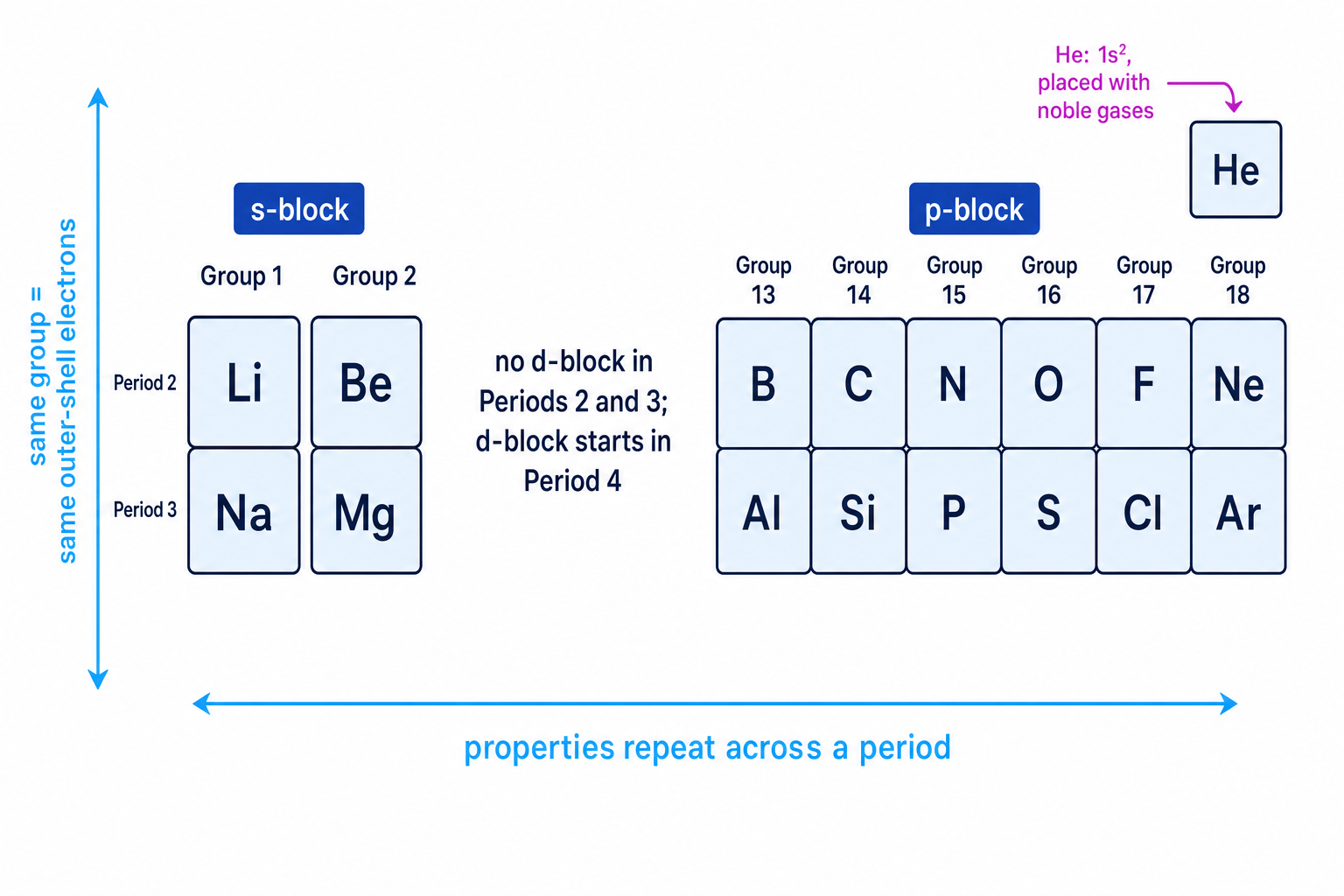
A period is a horizontal row. Across a period, physical and chemical properties change in a repeating pattern. This repeating pattern is called periodicity.
A group is a vertical column. Elements in the same group have similar chemical properties because they have the same number of outer-shell electrons.
Periodic Law
The properties of elements are periodic functions of atomic number: when elements are arranged by increasing proton number, patterns in their properties repeat.
Historically, Mendeleev arranged elements mainly by atomic mass and chemical properties, leaving gaps for undiscovered elements. His predictions were later confirmed, which helped the scientific community accept the Periodic Law. Later, arranging by atomic number explained awkward cases such as iodine and tellurium. The table still extends when new elements are discovered, confirmed experimentally, and accepted after reliable evidence.
Why groups behave similarly
For main-group elements, chemical behaviour is mainly controlled by the number of electrons in the outer shell.
2. Electron configurations and blocks
An electron configuration shows how electrons are arranged in shells and sub-shells. A shell is a principal energy level. A sub-shell is a region within a shell, labelled s, p, d and so on.
For this topic:
- an s sub-shell holds up to 2 electrons;
- a p sub-shell holds up to 6 electrons;
- a d sub-shell holds up to 10 electrons.
An orbital is a region that can hold up to two electrons. A p sub-shell contains three p orbitals.
Across Periods 2 and 3, the outer shell fills in the same pattern:
| Position | Period 2 configuration | Period 3 configuration | Block |
|---|---|---|---|
| Group 1 | Li: [He] 2s¹ | Na: [Ne] 3s¹ | s-block |
| Group 2 | Be: [He] 2s² | Mg: [Ne] 3s² | s-block |
| 3 outer electrons | B: [He] 2s² 2p¹ | Al: [Ne] 3s² 3p¹ | p-block |
| 4 outer electrons | C: [He] 2s² 2p² | Si: [Ne] 3s² 3p² | p-block |
| 5 outer electrons | N: [He] 2s² 2p³ | P: [Ne] 3s² 3p³ | p-block |
| 6 outer electrons | O: [He] 2s² 2p⁴ | S: [Ne] 3s² 3p⁴ | p-block |
| 7 outer electrons | F: [He] 2s² 2p⁵ | Cl: [Ne] 3s² 3p⁵ | p-block |
| Full outer shell | Ne: [He] 2s² 2p⁶ | Ar: [Ne] 3s² 3p⁶ | p-block |
The block of an element is named after the type of sub-shell being filled. The s-block contains Groups 1 and 2, the p-block contains the right-hand side of the table, and the d-block contains the transition metals.
Helium is the awkward exception
Helium has the configuration 1s², so by electron configuration it is s-block, but it is placed with the noble gases because its chemical properties match Group 18, also called Group 0 in some school conventions.
3. First ionisation energy
First ionisation energy
The first ionisation energy is the energy required to remove 1 mol of electrons from 1 mol of gaseous atoms to form 1 mol of gaseous 1+ ions: X(g) → X⁺(g) + e⁻.
Ionisation energies are usually given in kJ mol⁻¹. The word gaseous matters: ionisation energy is about isolated atoms, not atoms in a solid metal or in molecules.
Three main factors control first ionisation energy:
- Nuclear charge: more protons means stronger attraction to electrons.
- Atomic radius: a larger atom has its outer electrons further from the nucleus, so attraction is weaker.
- Shielding: inner-shell electrons repel outer electrons and reduce the attraction from the nucleus.
Across Periods 2 and 3
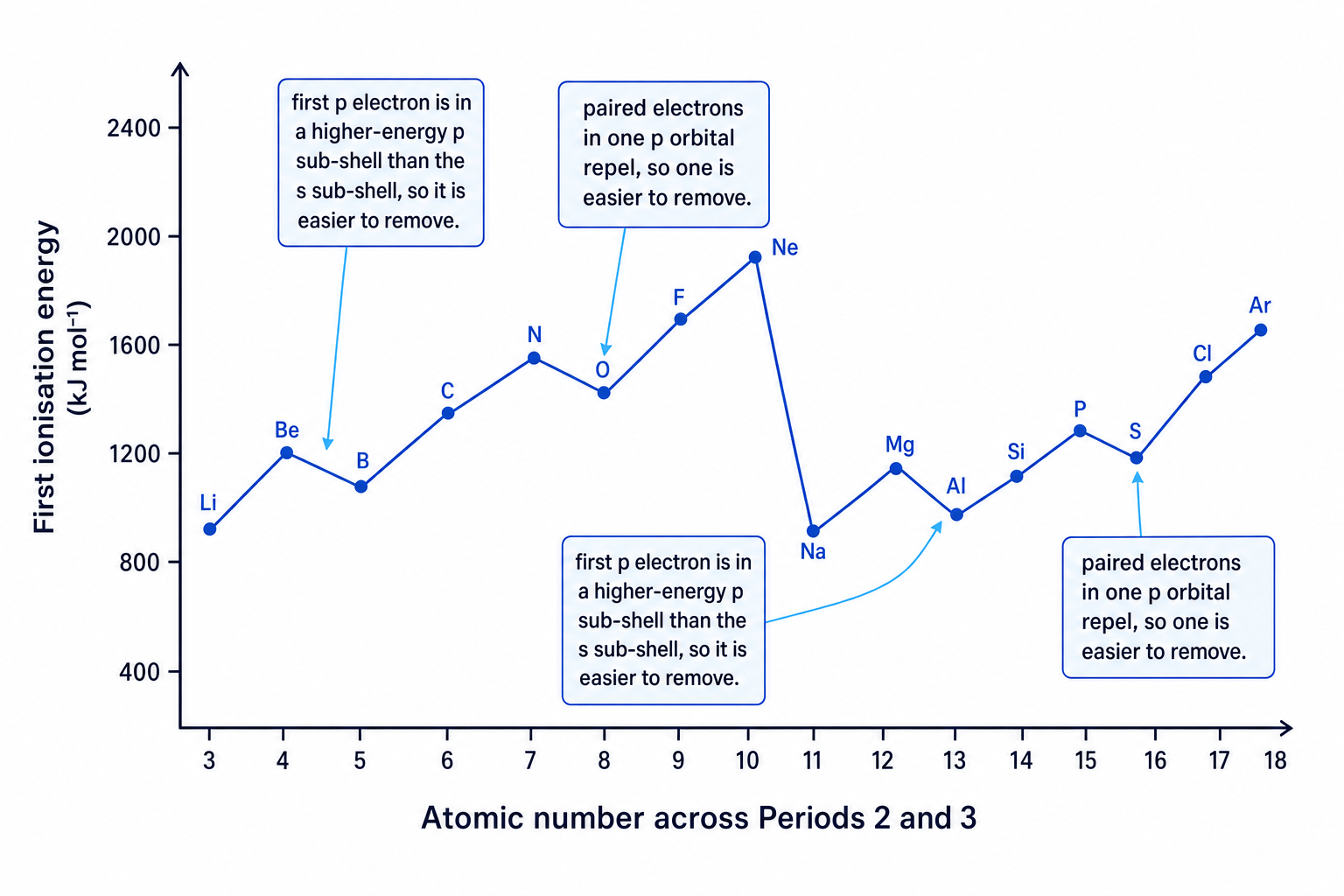
First ionisation energy generally increases across a period. Nuclear charge increases, but electrons are added to the same shell, so shielding does not increase much. The outer electrons are pulled closer to the nucleus, so more energy is needed to remove one.
There are two important small dips:
- Be to B, and Mg to Al: the electron removed from B or Al is in a higher-energy p sub-shell, so it is easier to remove than an s electron.
- N to O, and P to S: O and S have one paired set of p electrons. Repulsion between paired electrons makes one easier to remove.
The graph below shows the key pattern and the dips you must be able to explain.
Explaining the oxygen dip
- Compare the p sub-shells: nitrogen has 2p³, with one electron in each p orbital, while oxygen has 2p⁴, so one p orbital contains a pair of electrons.
- In oxygen, the two paired electrons repel each other, reducing the energy needed to remove one of them.
- This repulsion outweighs the extra nuclear charge in oxygen, so oxygen has a lower first ionisation energy than nitrogen.
Down a group
First ionisation energy decreases down a group. Nuclear charge increases, but the outer electron is in a shell further from the nucleus and there is more shielding. Increased radius and shielding outweigh the increased nuclear charge.
Only saying “more protons”
Across a period, “more protons” is not enough by itself. A full explanation compares nuclear charge, shielding and atomic radius.
4. Successive ionisation energies
Successive ionisation energies are the energies needed to remove electrons one after another from the same element. For example:
- first: X(g) → X⁺(g) + e⁻
- second: X⁺(g) → X²⁺(g) + e⁻
- third: X²⁺(g) → X³⁺(g) + e⁻
Successive ionisation energies always increase because the remaining electrons are attracted more strongly by the same nucleus. A large jump shows that the next electron is being removed from an inner shell, closer to the nucleus with less shielding.
This evidence for shells helped support shell models of atomic structure.
Using successive ionisation energies
An element has successive ionisation energies, in kJ mol⁻¹: 580, 1820, 2750, 11600, 14800, 18400, 23300, 27500, 31900, 38400, 42600, 201000, 222000.
- Find the first very large jump: it occurs between the third and fourth ionisation energies, from 2750 to 11600 kJ mol⁻¹.
- This means three electrons were removed before an inner shell was reached, so the atom has three outer-shell electrons.
- Find the next very large jump: it occurs between the eleventh and twelfth ionisation energies, so the shell beneath the outer shell contains eight electrons.
- The remaining inner shell contains two electrons, giving the shell arrangement 2,8,3. The element is in the group with three outer electrons: Group 13 on a 1–18 table.
5. Metallic and giant covalent structures
A lattice is a regular repeating arrangement of particles.
Giant metallic lattices
Metallic bonding
Metallic bonding is the strong electrostatic attraction between positive metal ions and delocalised electrons.
A delocalised electron is not attached to one particular atom; it can move through the whole structure. A metal is a giant metallic lattice of positive ions surrounded by delocalised electrons.
This explains metallic properties:
- high melting and boiling points, because strong metallic bonds need lots of energy to overcome;
- electrical conductivity when solid or molten, because delocalised electrons can move and carry charge;
- usually insoluble in water and organic solvents, because solvent interactions cannot usually overcome the metallic lattice.
Giant covalent lattices
A giant covalent lattice is a huge network of atoms joined by strong covalent bonds.
Important examples are:
- diamond: each carbon atom forms four covalent bonds in a 3D network; very hard, very high melting point, does not conduct electricity;
- graphite: each carbon atom forms three covalent bonds in layers; one electron per carbon is delocalised, so graphite conducts along the layers;
- graphene: a single layer of graphite; strong, light, flexible and electrically conductive, so it has potential uses in electronics, composites and sensors;
- silicon: a giant covalent network with many strong Si–Si covalent bonds, giving a high melting point.
Giant covalent substances are generally insoluble because dissolving would require breaking many strong covalent bonds. Graphite and graphene conduct because they contain mobile delocalised electrons; diamond does not.
6. Melting point trends across Periods 2 and 3
To explain melting point, always identify the particles and what must be overcome during melting.
Period 3 is especially clear: Na, Mg and Al are giant metallic; Si is giant covalent; P₄, S₈, Cl₂ and Ar form simple molecular or monatomic lattices with weak London forces between particles.
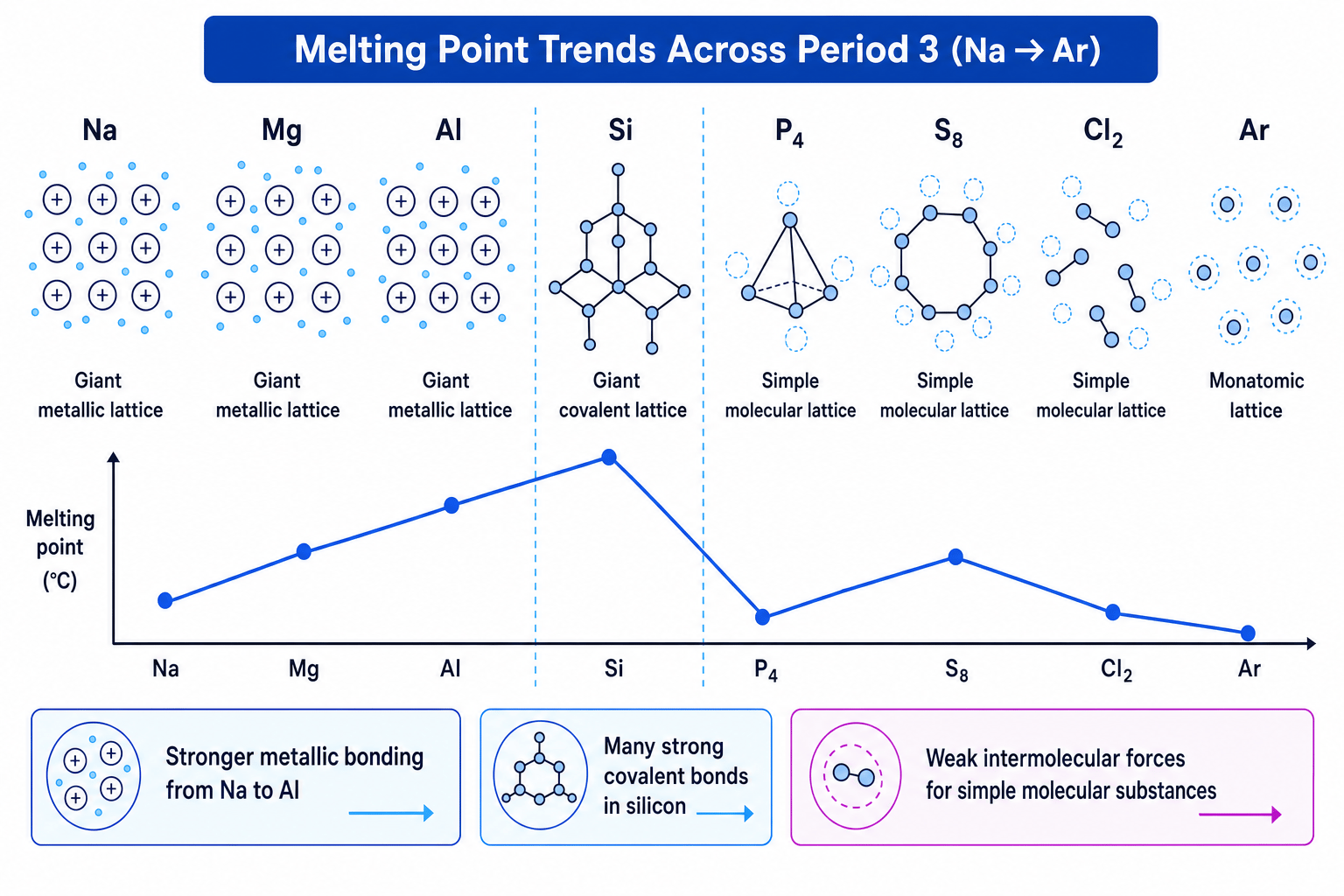
From Na to Al, melting point increases because metallic bonding becomes stronger: the ions have higher charge and more delocalised electrons are available.
Silicon has a much higher melting point because many strong covalent bonds must be broken in its giant lattice.
Phosphorus, sulfur, chlorine and argon have much lower melting points because melting only overcomes weak London forces, which are temporary attractions between particles. S₈ has a higher melting point than P₄ because S₈ molecules are larger and have more electrons, so London forces are stronger.
Period 2 follows the same structure-based logic: Li and Be are metallic, B and C are giant covalent, then N₂, O₂, F₂ and Ne are simple molecular or monatomic with low melting points.
Comparing silicon, phosphorus and sulfur melting points
- Identify the structures: silicon is giant covalent, while phosphorus exists as P₄ molecules and sulfur as S₈ molecules.
- Melting silicon requires breaking many strong covalent bonds in a giant lattice, so its melting point is very high.
- Melting phosphorus and sulfur only overcomes intermolecular London forces, so both are much lower than silicon.
- Sulfur has a higher melting point than phosphorus because S₈ is larger than P₄ and has more electrons, giving stronger London forces.
Breaking the wrong bonds
When simple molecular substances melt, covalent bonds inside the molecules are not broken. Only intermolecular forces between molecules are overcome.
In the exam
- For ionisation-energy trends, use nuclear charge, atomic radius and shielding; add sub-shell energy or paired-electron repulsion for the small dips.
- For melting point questions, identify the structure first, then state whether metallic bonds, covalent bonds or intermolecular forces are being overcome.
- For successive ionisation energies, locate the big jumps: a big jump means the next electron is in an inner shell.
Check yourself
- Why is the first ionisation energy of aluminium lower than that of magnesium?
- An element has a very large jump after its second ionisation energy. What does this tell you about its group?
- Why does graphite conduct electricity but diamond does not?