Welcome to your study notes on Aromatic compounds (Section 6.1.1 of the OCR A specification). In this topic, we transition from the chemistry of aliphatic compounds (chains and non-aromatic rings) to the unique, highly stable world of arenes and phenols.
What you'll learn
By the end of these notes, you will be able to:
- Compare the historic Kekulé model of benzene with the modern delocalised π\piπ-system using structural and thermodynamic evidence.
- Name substituted aromatic molecules systematically using IUPAC rules.
- Draw curly-arrow mechanisms for the electrophilic substitution of benzene, including nitration, halogenation, and Friedel–Crafts reactions.
- Explain why phenol is significantly more reactive than benzene, and predict the products of multi-step aromatic syntheses using directing effects.
1. The Structure of Benzene: Kekulé vs. The Delocalised Model
To understand how benzene reacts, we must first look at its structure. Historically, chemists struggled to determine how six carbon atoms and six hydrogen atoms (C6H6\text{C}_6\text{H}_6C6H6) could be arranged.
The Kekulé Model
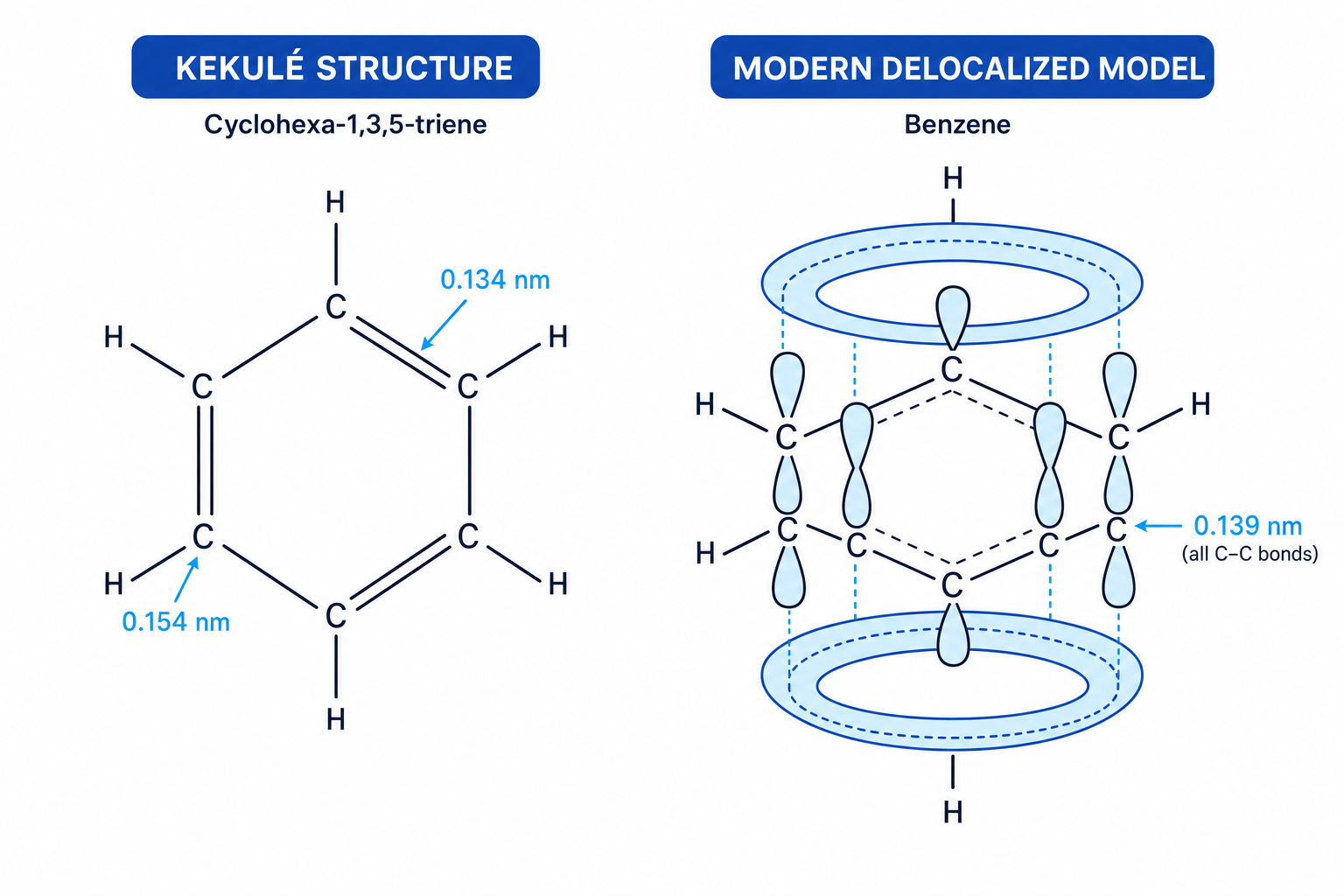
In 1865, Friedrich August Kekulé proposed that benzene was a flat ring of six carbon atoms with alternating single and double bonds: cyclohexa-1,3,5-triene.
The Delocalised Model
Modern orbital theory revealed a different picture. Benzene is a planar, cyclic, hexagonal hydrocarbon.
- Each carbon atom uses three of its four outer-shell electrons to form three σ\sigmaσ-bonds (two to adjacent carbons and one to a hydrogen atom).
- This leaves one remaining electron in a p-orbital perpendicular to the plane of the carbon ring.
- Instead of forming localized π\piπ-bonds (as in an alkene), these six p-orbitals overlap sideways in both directions, above and below the plane of the carbon ring.
- This sideways overlap creates a continuous, ring-shaped system of delocalised π\piπ-electrons.
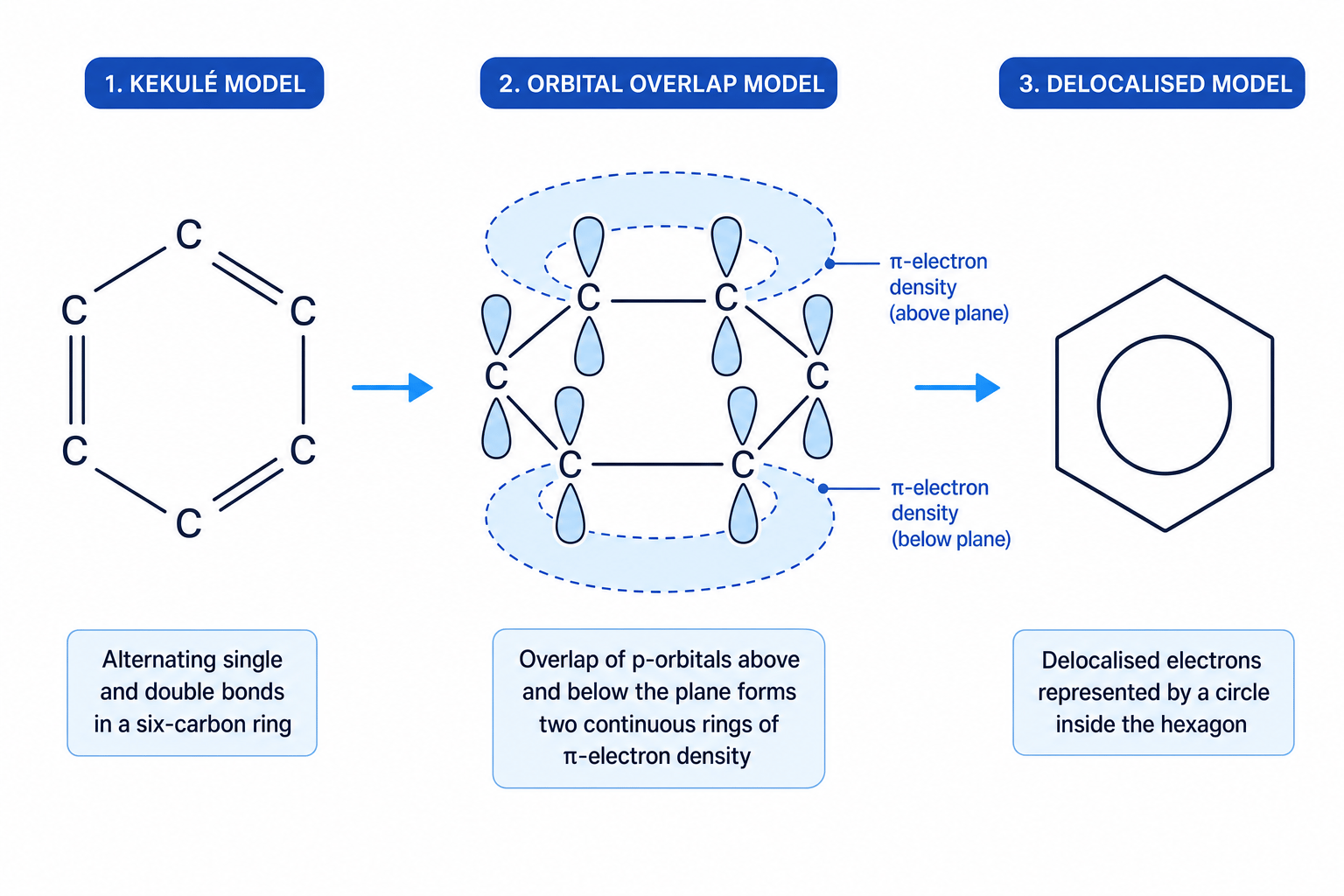
Delocalised electrons
Delocalised electrons are electrons that are shared between more than two atoms in a molecule, rather than being confined to a single covalent bond.
2. Evidence Against the Kekulé Structure
The scientific community eventually rejected the Kekulé structure because of three key pieces of experimental evidence:
A. Carbon–Carbon Bond Lengths
In Kekulé's model, we would expect three short C=C\text{C=C}C=C double bonds (0.134 nm0.134\text{ nm}0.134 nm) and three longer C–C\text{C–C}C–C single bonds (0.154 nm0.154\text{ nm}0.154 nm). However, X-ray diffraction studies showed that all carbon–carbon bonds in benzene are identical, with a length of 0.139 nm0.139\text{ nm}0.139 nm. This is intermediate between a single and double bond.
B. Enthalpy Change of Hydrogenation
If benzene contained three localized double bonds (cyclohexa-1,3,5-triene), its enthalpy change of hydrogenation should be approximately three times that of cyclohexene.
- Hydrogenation of cyclohexene:
- Predicted hydrogenation of Kekulé's cyclohexa-1,3,5-triene:
- Experimental hydrogenation of benzene:
Benzene is actualy 152 kJ mol−1152\text{ kJ mol}^{-1}152 kJ mol−1 more stable than expected! This difference is known as the delocalisation energy (or resonance stabilisation energy).
C. Resistance to Reaction
Alkenes readily undergo electrophilic addition reactions (for example, decolourising bromine water at room temperature). If benzene contained three localized double bonds, we would expect it to do the same. Instead, benzene is highly resistant to addition reactions because doing so would destroy the stable, delocalised π\piπ-system. Instead, benzene undergoes electrophilic substitution reactions, preserving the aromatic ring.
3. Nomenclature of Aromatic Compounds
Naming aromatic compounds requires identifying the principal functional group and numbering the ring to give substituents the lowest possible locants (numbers).
- Benzene as the parent name: Used when alkyl chains (with fewer than seven carbons), halogens, or nitro groups are attached. Examples include chlorobenzene, nitrobenzene, and methylbenzene.
- Phenyl as a prefix: Used when the benzene ring is attached to an alkyl chain with seven or more carbons, or to a functional group with higher priority (like an alkene or an amine). The prefix C6H5−\text{C}_6\text{H}_5-C6H5− is called a phenyl group. Examples include phenylethane and phenylamine.
- Special systematic exceptions: Some historical names are retained by IUPAC, such as phenol (C6H5OH\text{C}_6\text{H}_5\text{OH}C6H5OH) and benzoic acid (C6H5COOH\text{C}_6\text{H}_5\text{COOH}C6H5COOH).
Systematic naming of a multi-substituted aromatic ring
Name the following molecule systematically using IUPAC rules: a benzene ring with a methyl group (−CH3-\text{CH}_3−CH3) at position 1, and nitro groups (−NO2-\text{NO}_2−NO2) at positions 2 and 4.
- Identify the parent structure: The principal substituent is the methyl group, which makes the parent name "methylbenzene" (toluene is acceptable but methylbenzene is the systematic IUPAC term). The carbon with the methyl group is designated as carbon-1.
- Number the ring: Number around the ring in the direction that gives the other substituents the lowest possible numbers. Going clockwise or anticlockwise, we assign numbers to the carbons containing the nitro groups. The nitro groups are at carbon-2 and carbon-4.
- Assemble the name: Combine the prefixes alphabetically (though here both are nitro groups) and use multiplier prefixes (di-, tri-, etc.) where necessary. With two nitro groups at positions 2 and 4, the prefix becomes "2,4-dinitro".
- Combine prefix and parent: The final systematic name is 2,4-dinitromethylbenzene.
Benzene vs Phenyl
Do not confuse the terms benzyl and phenyl. A phenyl group is a benzene ring directly attached to a main chain (−C6H5-\text{C}_6\text{H}_5−C6H5). A benzyl group contains an extra −CH2−-\text{CH}_2-−CH2− spacer group (−CH2C6H5-\text{CH}_2\text{C}_6\text{H}_5−CH2C6H5). Stick strictly to IUPAC guidance to avoid confusion.
4. Electrophilic Substitution of Benzene
Because of the high electron density of the delocalised π\piπ-ring, benzene is naturally attractive to electrophiles (electron-pair acceptors). The general reaction type is electrophilic substitution.
A. Nitration of Benzene
Benzene reacts with concentrated nitric acid (HNO3\text{HNO}_3HNO3) in the presence of a concentrated sulfuric acid catalyst (H2SO4\text{H}_2\text{SO}_4H2SO4) at 50 ∘C50\text{ }^\circ\text{C}50 ∘C to form nitrobenzene.
C6H6+HNO3→H2SO4C6H5NO2+H2O \text{C}_6\text{H}_6 + \text{HNO}_3 \xrightarrow{\text{H}_2\text{SO}_4} \text{C}_6\text{H}_5\text{NO}_2 + \text{H}_2\text{O} C6H6+HNO3H2SO4C6H5NO2+H2OTemperature control in nitration
If the temperature rises above 50 ∘C50\text{ }^\circ\text{C}50 ∘C, further substitution reactions can occur, producing dinitrobenzene and trinitrobenzene. Keeping the temperature at or below 50 ∘C50\text{ }^\circ\text{C}50 ∘C is a vital practical step to ensure mono-substitution.
B. Halogenation of Benzene
Benzene will not react with halogens on its own because the π\piπ-system electron density is too low to polarise non-polar halogen molecules. It requires a catalyst called a halogen carrier (such as AlCl3\text{AlCl}_3AlCl3, FeCl3\text{FeCl}_3FeCl3, or FeBr3\text{FeBr}_3FeBr3).
C6H6+Cl2→AlCl3C6H5Cl+HCl \text{C}_6\text{H}_6 + \text{Cl}_2 \xrightarrow{\text{AlCl}_3} \text{C}_6\text{H}_5\text{Cl} + \text{HCl} C6H6+Cl2AlCl3C6H5Cl+HClC. Friedel–Crafts Reactions (C–C Bond Formation)
Friedel–Crafts reactions are highly valued in synthetic chemistry because they allow the introduction of carbon-containing chains directly onto the benzene ring, forming crucial carbon–carbon bonds.
- Alkylation: Reaction with a haloalkane in the presence of a halogen carrier (such as AlCl3\text{AlCl}_3AlCl3).
- Acylation: Reaction with an acyl chloride in the presence of an AlCl3\text{AlCl}_3AlCl3 catalyst to yield an aromatic ketone.
5. The Reaction Mechanism
No matter which electrophile (E+\text{E}^+E+) is used, the mechanism for electrophilic substitution follows the same basic two-step pathway.
Step 1: Generation of the Electrophile
Because benzene is extremely stable, we must first generate a highly reactive, positive electrophile in situ using our catalysts.
- For Nitration:
(The nitronium ion, NO2+\text{NO}_2^+NO2+, is our active electrophile)
- For Chlorination:
(The chloronium ion, Cl+\text{Cl}^+Cl+, is our active electrophile)
Step 2: Electrophilic Attack & Ring Regeneration
The electrophile accepts a pair of electrons from the delocalised π\piπ-system of benzene. This disrupts the aromatic ring, forming a high-energy, unstable intermediate.
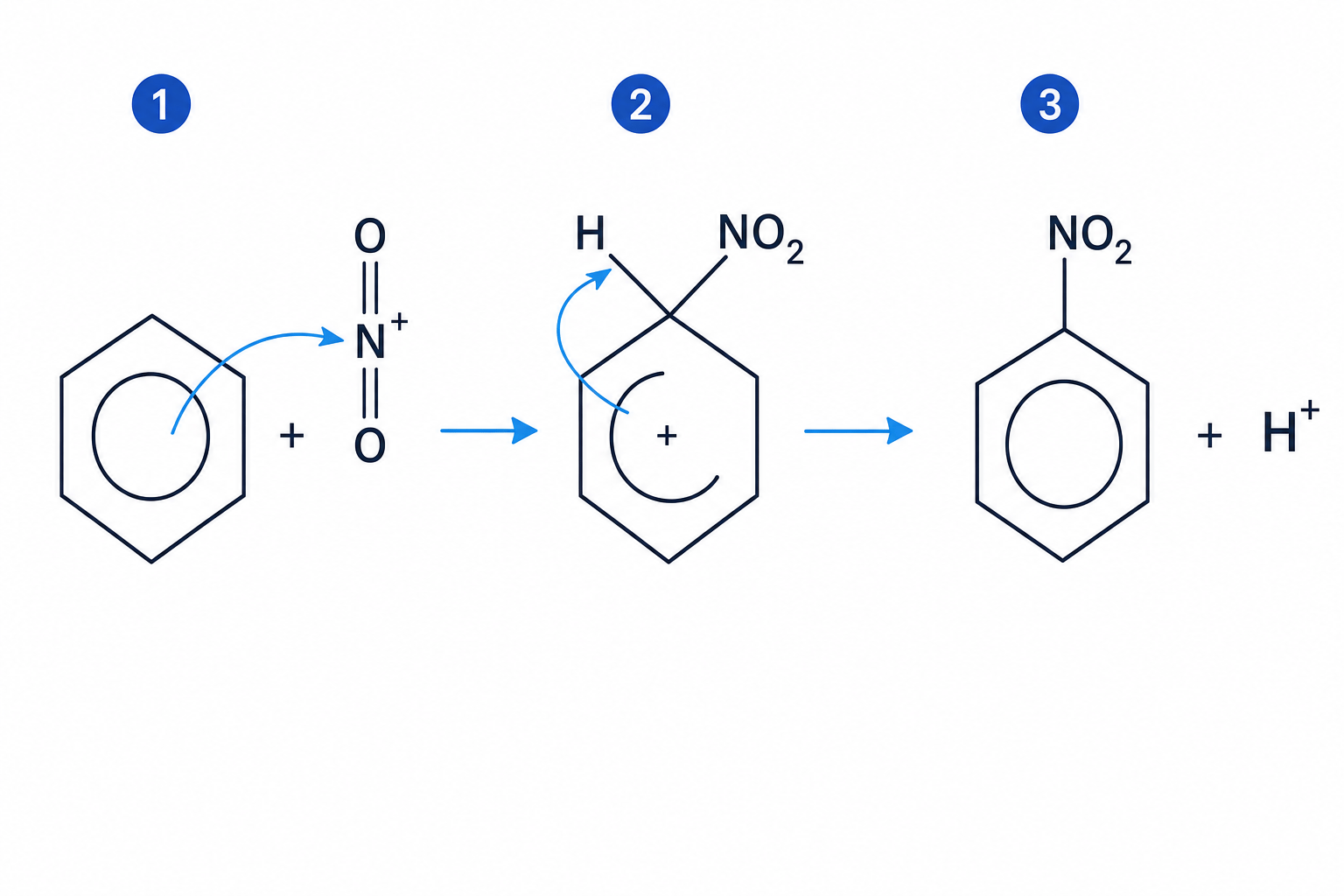
Drawing the curly-arrow mechanism
When drawing this mechanism in your exam, pay close attention to:
- The first curly arrow must start from the circle of the benzene ring and point directly to the electrophile (NO2+\text{NO}_2^+NO2+ or Cl+\text{Cl}^+Cl+).
- The intermediate must feature a broken ring (horseshoe) representing the disrupted π\piπ-system. The open side of the horseshoe must face the carbon containing the substituents.
- The positive charge must be drawn inside the horseshoe, not on any specific carbon atom.
- The second curly arrow must start on the C–H bond and point back into the ring to regenerate the stable delocalised π\piπ-system.
Finally, the catalyst is regenerated:
H++HSO4−→H2SO4 \text{H}^+ + \text{HSO}_4^- \to \text{H}_2\text{SO}_4 H++HSO4−→H2SO4 H++AlCl4−→AlCl3+HCl \text{H}^+ + \text{AlCl}_4^- \to \text{AlCl}_3 + \text{HCl} H++AlCl4−→AlCl3+HCl6. Reactivity: Benzene vs. Alkenes
Alkenes react readily with bromine, while benzene does not. Why?
- Alkenes contain a localized π\piπ-bond between two carbon atoms. This localized region of high electron density is capable of polarizing non-polar bromine molecules (Br–Br\text{Br–Br}Br–Br), inducing a dipole (Brδ+−Brδ−\text{Br}^{\delta+}-\text{Br}^{\delta-}Brδ+−Brδ−). This strong polarization allows the electrophilic addition to occur spontaneously at room temperature.
- Benzene has its six π\piπ-electrons delocalised across the entire ring system, meaning the electron density is much lower than in a localized alkene double bond. Consequently, benzene is unable to polarise the bromine molecule. It requires a halogen carrier catalyst to generate a powerful, fully-charged Br+\text{Br}^+Br+ electrophile.
7. Phenols
Phenol
A phenol is an organic compound containing a hydroxyl (−OH-\text{OH}−OH) group directly bonded to an aromatic ring.
If the −OH-\text{OH}−OH group is attached to a carbon side-chain instead (for example, in phenylmethanol, C6H5CH2OH\text{C}_6\text{H}_5\text{CH}_2\text{OH}C6H5CH2OH), the compound is classified as an alcohol, not a phenol.
Weak Acidity of Phenols
Phenols are weakly acidic. When dissolved in water, they partially dissociate:
C6H5OH(aq)⇌C6H5O−(aq)+H+(aq) \text{C}_6\text{H}_5\text{OH(aq)} \rightleftharpoons \text{C}_6\text{H}_5\text{O}^-\text{(aq)} + \text{H}^+\text{(aq)} C6H5OH(aq)⇌C6H5O−(aq)+H+(aq)The phenoxide ion is stabilized because the lone pair on the oxygen atom overlaps with the delocalised π\piπ-system, spreading the negative charge across the ring.
We can compare acid strength by observing reactions with bases of varying strengths:
- Alcohols: Too weakly acidic to react with either sodium hydroxide (a strong base) or sodium carbonate (a weak base).
- Phenols: Weakly acidic. They react with sodium hydroxide to form a soluble salt (sodium phenoxide) and water, but they are not strong enough to react with carbonates (so no carbon dioxide gas is produced).
- Carboxylic Acids: Strong enough to react with both sodium hydroxide and carbonates (yielding effervescence of CO2\text{CO}_2CO2 gas).
8. Reactivity & Reactions of Phenols
Phenols undergo electrophilic substitution much more easily than benzene.
Relative Ease of Substitution
In phenol, one of the lone pairs of electrons on the oxygen atom is donated into the delocalised π\piπ-system of the benzene ring.
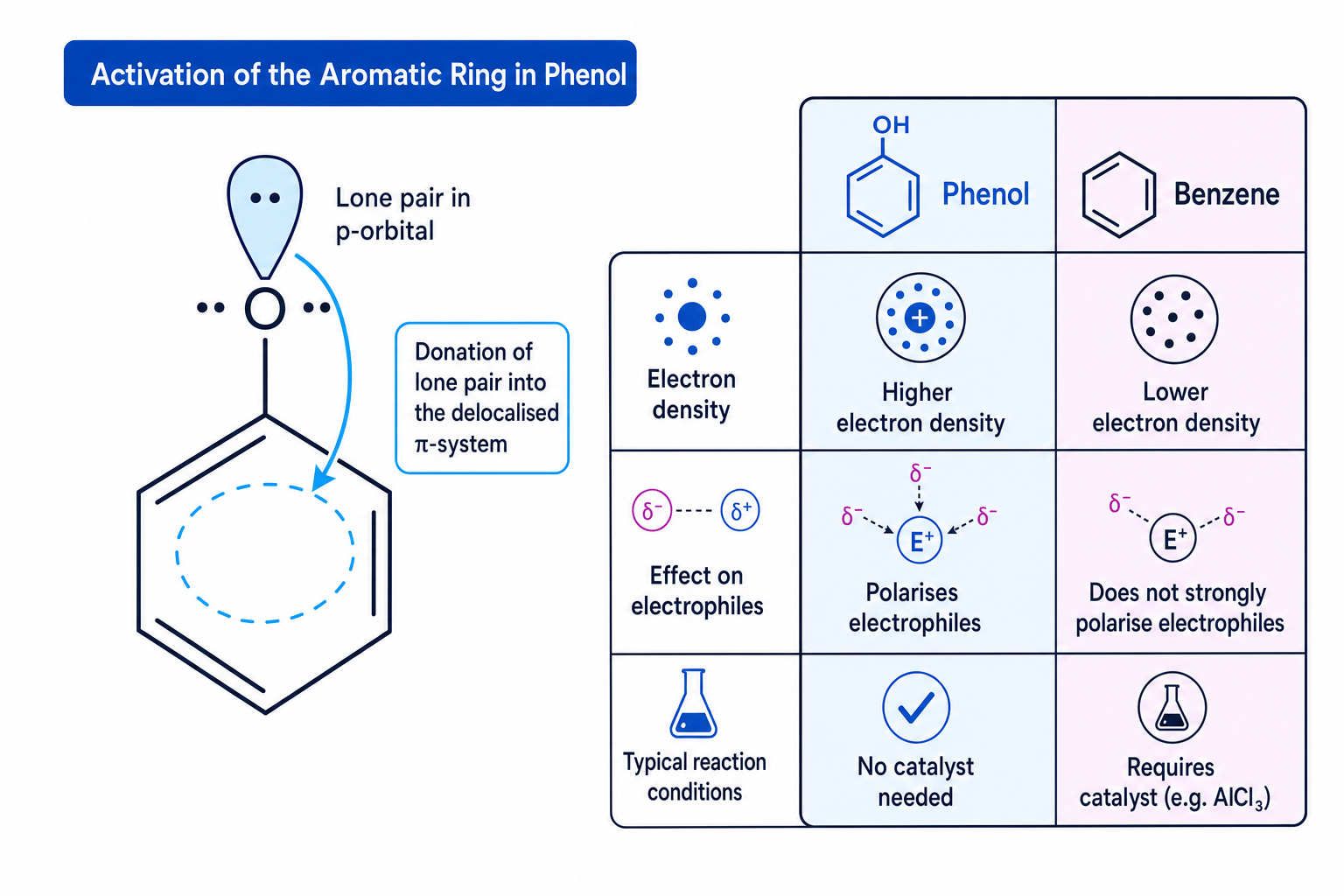
This increases the electron density of the aromatic ring, making it much more susceptible to attack by electrophiles. The increased electron density is strong enough to polarise molecules like bromine without requiring a halogen carrier catalyst.
Reactions of Phenols
Because of this activation, reaction conditions for phenol are much gentler than those for benzene:
A. Bromination
Phenol reacts rapidly with bromine water at room temperature without a catalyst. The bromine is decoloured, and a white precipitate of 2,4,6-tribromophenol is formed, along with an antiseptic smell.
C6H5OH+3Br2→C6H2Br3OH+3HBr \text{C}_6\text{H}_5\text{OH} + 3\text{Br}_2 \to \text{C}_6\text{H}_2\text{Br}_3\text{OH} + 3\text{HBr} C6H5OH+3Br2→C6H2Br3OH+3HBrB. Nitration
Because phenol is highly activated, it reacts with dilute nitric acid at room temperature. It does not require concentrated nitric acid or a sulfuric acid catalyst. The reaction yields a mixture of 2-nitrophenol and 4-nitrophenol.
9. Directing Effects in Synthesis
When carrying out electrophilic substitution on a benzene ring that already has a substituent, the existing group directs where the incoming electrophile will attach.
- 2- and 4-directing groups (activating): These groups donate electron density into the ring, activating it. The incoming group is directed to positions 2 and 4.
- Examples: −OH-\text{OH}−OH and −NH2-\text{NH}_2−NH2.
- 3-directing groups (deactivating): These groups withdraw electron density from the ring, deactivating it. The incoming group is directed to position 3.
- Example: −NO2-\text{NO}_2−NO2.
Directing Effect Shortcut
Groups that have a lone pair directly on the atom connected to the ring (like −O¨H-\ddot{\text{O}}\text{H}−O¨H and −N¨H2-\ddot{\text{N}}\text{H}_2−N¨H2) are activating and are 2- and 4-directing. Groups that have a highly electronegative atom double-bonded to the connecting atom (like −N+(=O)O−-\text{N}^+(=\text{O})\text{O}^-−N+(=O)O−) withdraw electron density and are 3-directing.
Synthesising Multi-substituted Arenes
In synthesis, the order in which you carry out reactions is crucial because the first substituent placed on the ring determines where the second one goes.
Designing an aromatic synthesis using directing effects
Design a two-step synthesis to prepare 3-nitrochlorobenzene from benzene.
- Analyze the target molecule: The target molecule has both a chlorine atom (−Cl-\text{Cl}−Cl) and a nitro group (−NO2-\text{NO}_2−NO2) attached to a benzene ring in a 1,3-relationship (meta to each other).
- Determine the directing effects of each substituent:
- A chlorine atom (−Cl-\text{Cl}−Cl) is a 2- and 4-director. If we chlorinate first, any subsequent nitration will yield 2-nitrochlorobenzene and 4-nitrochlorobenzene.
- A nitro group (−NO2-\text{NO}_2−NO2) is a 3-director. If we nitrate first, any subsequent chlorination will yield 3-nitrochlorobenzene.
- Plan the reaction sequence: To achieve a 3-substituted product, we must install the 3-directing group first. Therefore, the sequence must be:
- State the reagents and conditions for each step:
- Step 1 (Nitration): React benzene with concentrated HNO3\text{HNO}_3HNO3 and concentrated H2SO4\text{H}_2\text{SO}_4H2SO4 at 50 ∘C50\text{ }^\circ\text{C}50 ∘C to form nitrobenzene.
- Step 2 (Chlorination): React nitrobenzene with Cl2\text{Cl}_2Cl2 in the presence of an AlCl3\text{AlCl}_3AlCl3 halogen carrier catalyst to form 3-nitrochlorobenzene.
In the exam
- Draw curly arrows accurately: Make sure your arrow starts directly on the C–H bond in Step 2 of the mechanism and points inside the ring. Starting the arrow in empty space is a common reason to lose marks.
- State conditions explicitly: When writing synthetic routes, always include the catalysts (H2SO4\text{H}_2\text{SO}_4H2SO4, AlCl3\text{AlCl}_3AlCl3) and correct concentrations (e.g. dilute nitric acid for phenol vs concentrated nitric acid for benzene).
- Remember the formula of phenol: If asked for molecular formulas, remember that phenol is C6H6O\text{C}_6\text{H}_6\text{O}C6H6O (or C6H5OH\text{C}_6\text{H}_5\text{OH}C6H5OH). Phenoxide is C6H5O−\text{C}_6\text{H}_5\text{O}^-C6H5O−.
- Watch out for directing effects: Before proposing a synthetic route, always write down whether each group is a 2,4-director or a 3-director to verify your proposed sequence.
Check yourself
- Why is the enthalpy change of hydrogenation of benzene (−208 kJ mol−1-\text{208 kJ mol}^{-1}−208 kJ mol−1) different from the value predicted by the Kekulé model (−360 kJ mol−1-\text{360 kJ mol}^{-1}−360 kJ mol−1)?
- Write the equation for the formation of the electrophile used during the bromination of benzene.
- Explain why phenol reacts with bromine water without a catalyst, whereas benzene requires a halogen carrier.
- Predict the major product of the nitration of methylbenzene.