

What you'll learn
- How the polar C=O bond makes aldehydes and ketones reactive.
- How aldehydes are oxidised, and why ketones usually are not.
- How NaBH4 and HCN add to carbonyl compounds by nucleophilic addition.
- How 2,4-DNPH and Tollens’ reagent are used to test and identify carbonyl compounds.
The carbonyl group
Carbonyl group
A carbonyl group is a carbon atom double-bonded to an oxygen atom: C=O. In this topic, “carbonyl compounds” mainly means aldehydes and ketones.
An aldehyde has the carbonyl group at the end of a carbon chain and contains the group –CHO. Its general formula is RCHO.
A ketone has the carbonyl group within the carbon chain, bonded to two carbon groups. Its general formula is RCOR′.
The C=O bond is strongly polar because oxygen is more electronegative than carbon. Oxygen becomes δ− and the carbonyl carbon becomes δ+, so the carbonyl carbon is attacked by electron-pair donors.
Nucleophile
A nucleophile is an electron-pair donor. It is attracted to electron-deficient, δ+ atoms such as the carbon atom in a carbonyl group.
Why carbonyls react
The carbonyl carbon is δ+, so aldehydes and ketones commonly undergo nucleophilic addition, where a nucleophile attacks the C=O carbon and the C=O π bond opens up.
Oxidation of aldehydes
Aldehydes are oxidised to carboxylic acids using acidified dichromate(VI), written as Cr2O72−/H+. In practice this is usually K2Cr2O7 with dilute H2SO4, warmed under reflux.
The observation is a colour change from orange to green as dichromate(VI) ions are reduced to chromium(III) ions.
For OCR organic redox equations, use [O] for oxidation:
CH3CHO + [O] → CH3COOH
More generally:
RCHO + [O] → RCOOH
Ketones are not oxidised by acidified dichromate(VI) under these normal A-Level conditions, because oxidation would require breaking C–C bonds.
Writing an aldehyde oxidation equation
Propanal is heated with acidified K2Cr2O7. Predict the product and write the organic equation.
- Identify propanal as an aldehyde because it ends in –CHO: CH3CH2CHO.
- Oxidise the aldehyde group –CHO to the carboxylic acid group –COOH, keeping the carbon chain the same.
- Write the equation using [O]:
CH3CH2CHO + [O] → CH3CH2COOH. - Name the product: propanoic acid.
Oxidising ketones
Do not write ketones oxidising to carboxylic acids with acidified dichromate(VI). For this specification, ketones give no reaction under these conditions.
Reduction with NaBH₄
Sodium tetrahydridoborate, NaBH4, is a reducing agent. In the mechanism, OCR allows you to treat it as a source of hydride ions, H−.
Aldehydes are reduced to primary alcohols:
RCHO + 2[H] → RCH2OH
Ketones are reduced to secondary alcohols:
RCOR′ + 2[H] → RCH(OH)R′
Typical conditions are NaBH4 in water or aqueous ethanol at room temperature, followed by protonation of the intermediate by water.
Hydride ion
A hydride ion, H−, is a hydrogen species with a lone pair and a negative charge. In carbonyl reduction, it acts as the nucleophile.
The mechanism below shows the general pattern for both NaBH4 reduction and HCN addition.
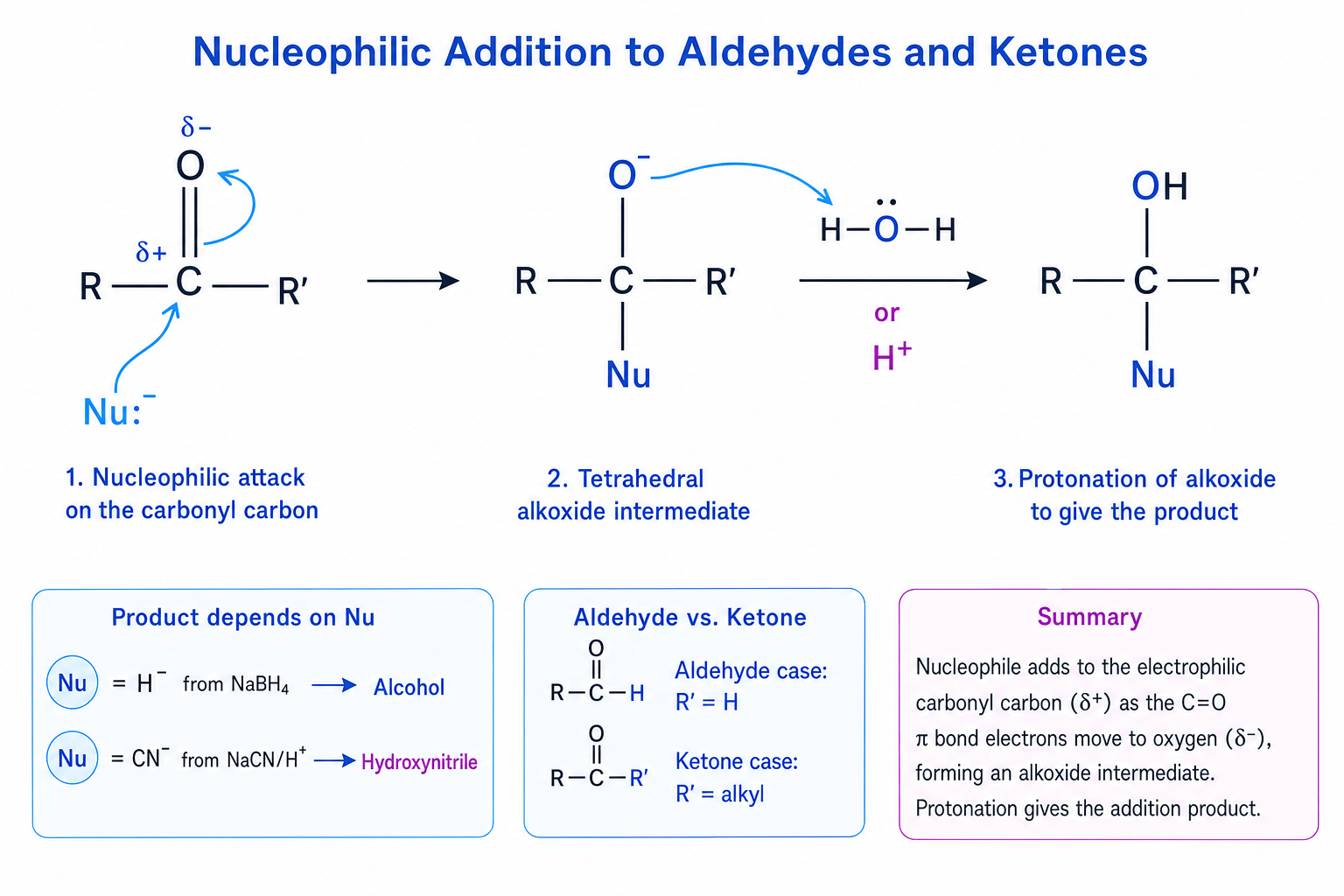
Mechanism for reducing ethanal
Show how ethanal forms ethanol with NaBH4.
- The carbonyl carbon in CH3CHO is δ+, so H− from NaBH4 attacks this carbon.
- Draw a curly arrow from the lone pair on H− to the carbonyl carbon, and a second curly arrow from the C=O π bond to the oxygen atom. This forms the alkoxide intermediate CH3CH2O−.
- The alkoxide ion is protonated by water. Draw a curly arrow from O− to H in H2O, giving CH3CH2OH.
- Overall, the aldehyde has been reduced: CH3CHO + 2[H] → CH3CH2OH.
Counting [H] in reductions
Use 2[H] for reduction of a C=O to an alcohol: one hydrogen effectively adds to carbon, and one to oxygen.
Addition of HCN to form hydroxynitriles
Aldehydes and ketones also react with HCN to form hydroxynitriles.
Hydroxynitrile
A hydroxynitrile is an organic compound containing both a hydroxy group, –OH, and a nitrile group, –C≡N, on the same carbon atom.
In the lab and in exam equations, the reagent is usually written as NaCN(aq)/H+(aq). This produces CN− ions, which are the nucleophile.
General reaction:
R2C=O + HCN → R2C(OH)CN
For ethanal:
CH3CHO + HCN → CH3CH(OH)CN
The product is 2-hydroxypropanenitrile. Notice that the carbon chain has increased by one carbon because the –CN group contains carbon.
Mechanism for forming a hydroxynitrile
Show the mechanism for the reaction of propanone with HCN, using NaCN(aq)/H+(aq).
- CN− attacks through its carbon atom. Draw a curly arrow from the lone pair on CN− to the δ+ carbonyl carbon in CH3COCH3.
- Draw a second curly arrow from the C=O π bond to oxygen. This forms the alkoxide intermediate (CH3)2C(O−)CN.
- Protonate the alkoxide using H+ or H2O to form (CH3)2C(OH)CN.
- Name the product: 2-hydroxy-2-methylpropanenitrile.
Cyanide reagents
HCN and cyanide salts are highly toxic. In exams, focus on the specified reagent notation: NaCN(aq)/H+(aq), with CN− as the attacking nucleophile.
Curly arrows
A curly arrow shows movement of an electron pair, so it must start from a lone pair or a bond — not from a charge symbol floating near an atom.
Optical isomer link
The C=O group is planar around the carbonyl carbon. If CN− attacks a planar aldehyde or unsymmetrical ketone from either side and a chiral centre is formed, a mixture of optical isomers can result.
You do not need to overcomplicate this for 6.1.2, but it is a useful bridge to the optical isomerism work in Module 6.
Testing for carbonyl compounds with 2,4-DNPH
2,4-dinitrophenylhydrazine, often shortened to 2,4-DNPH, is used to test for aldehydes and ketones.
A positive result is an orange or yellow precipitate.
This shows that an aldehyde or ketone carbonyl group is present. OCR does not require the equation or the structure of the derivative for this reaction.
The solid product is a derivative. To identify the original carbonyl compound, you can:
- filter and purify the derivative,
- measure its melting point,
- compare the melting point with data-book values.
A pure derivative should have a sharp melting point. Impurities usually lower and broaden the melting range.
What 2,4-DNPH tells you
2,4-DNPH tells you that an aldehyde or ketone is present, but it does not distinguish between aldehydes and ketones.
Tollens’ reagent: distinguishing aldehydes and ketones
Tollens’ reagent is ammoniacal silver nitrate. It contains silver(I) ions that can be reduced to silver metal.
Aldehydes give a positive result: a silver mirror or grey silver precipitate forms.
Ketones give no reaction.
The chemistry is redox:
- the aldehyde is oxidised to a carboxylic acid,
- Ag+ ions are reduced to Ag.
For the organic oxidation, OCR accepts:
RCHO + [O] → RCOOH
For example:
CH3CHO + [O] → CH3COOH
The silver reduction can be summarised as:
Ag+ + e− → Ag
The flowchart shows how these tests fit together for an unknown sample.
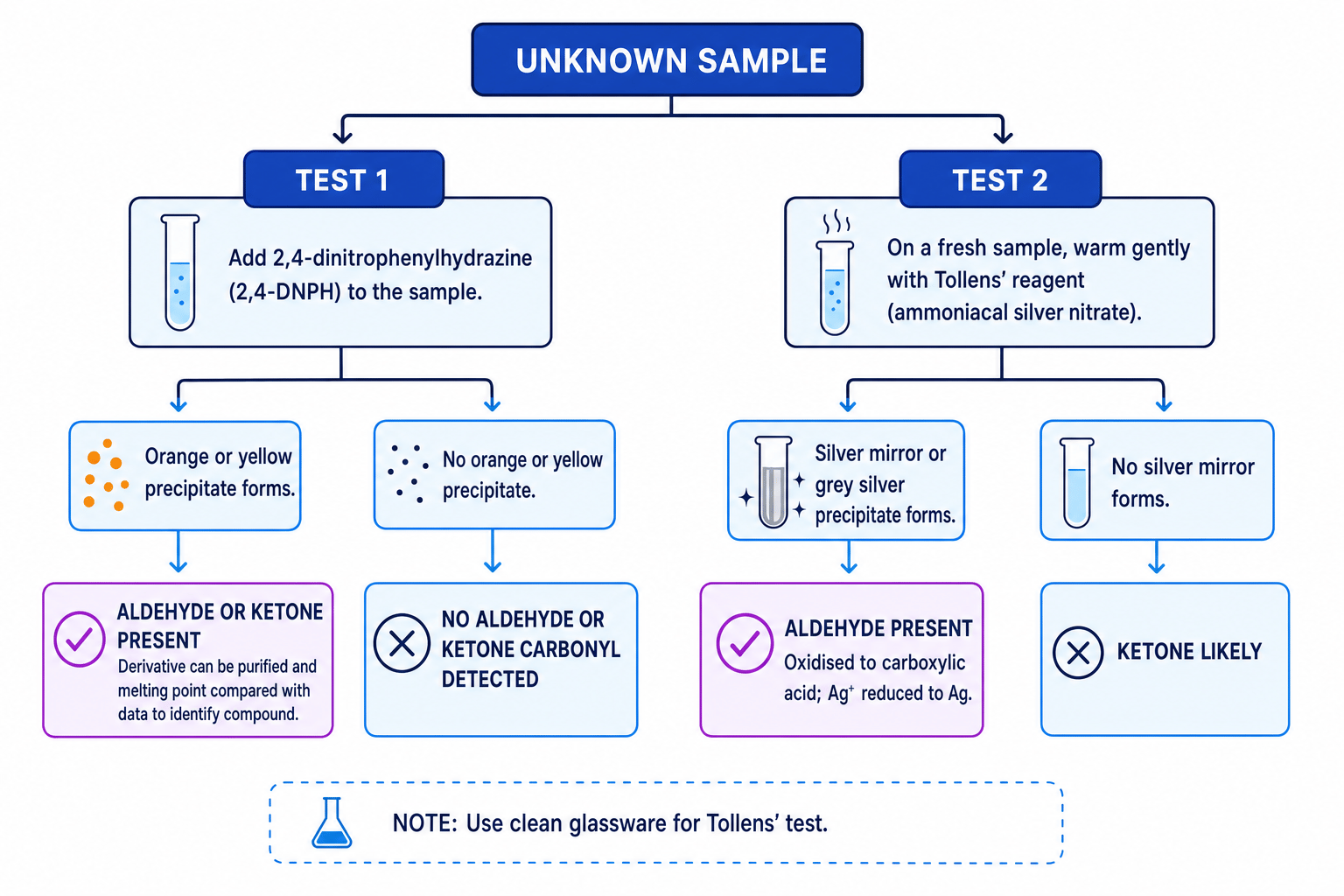
Interpreting carbonyl test results
An unknown compound gives an orange precipitate with 2,4-DNPH. Its purified derivative has a melting point matching propanone in a data table. A fresh sample gives no silver mirror with Tollens’ reagent. Identify the compound type and likely compound.
- The orange 2,4-DNPH precipitate shows that the compound is an aldehyde or ketone.
- The derivative melting point matching propanone identifies the carbonyl compound as propanone, assuming the derivative is pure.
- The negative Tollens’ test supports this because propanone is a ketone, and ketones are not oxidised by Tollens’ reagent.
- Conclusion: the unknown is propanone, a ketone.
Use fresh samples
Use a fresh portion of the unknown for Tollens’ reagent. Do not try to test the 2,4-DNPH precipitate itself with Tollens’ reagent.
In the exam
- For aldehyde oxidation, state acidified K2Cr2O7/H2SO4, orange to green, and write RCHO + [O] → RCOOH.
- For nucleophilic addition mechanisms, always show two arrows in the first step: nucleophile to carbonyl carbon, and C=O π bond to oxygen.
- For tests, remember the sequence: 2,4-DNPH detects aldehyde or ketone; Tollens’ reagent distinguishes aldehyde from ketone.
Check yourself
- What product forms when butanal is warmed with acidified dichromate(VI)?
- In NaBH4 reduction, why does the hydride ion attack the carbonyl carbon rather than oxygen?
- An unknown gives 2,4-DNPH positive and Tollens’ positive. What functional group must it contain?
