

Qualitative analysis is a fundamental practical skill in chemistry. While quantitative analysis tells you how much of a substance is present, qualitative analysis tells you exactly what is present.
In your OCR A-Level chemistry course, you will carry out these tests on a test-tube scale (PAG4). Understanding the chemistry behind these tests, writing balanced ionic equations (with state symbols), and knowing the strict logical sequence of tests are all highly examined.
What you'll learn
- How to test for key anions (CO32−\text{CO}_3^{2-}CO32−, SO42−\text{SO}_4^{2-}SO42−, and halide ions) in the correct logical sequence.
- How to identify cations (NH4+\text{NH}_4^+NH4+ and transition metal ions) using precipitation and gas-evolution reactions.
- How to write ionic equations with state symbols for every qualitative test.
Identifying Anions (Negative Ions)
Anions are negatively charged ions. The tests for carbonates, sulfates, and halides must be conducted in a specific order to prevent false positives.
Qualitative analysis
The experimental determination of the identity of chemical species present in a sample, rather than their concentration or quantity.
1. The Carbonate Test (CO32−\text{CO}_3^{2-}CO32−)
Carbonates react with acids to form a salt, water, and carbon dioxide gas.
- Method: Add dilute nitric acid, HNO3(aq)\text{HNO}_3(\text{aq})HNO3(aq), to the solid or aqueous sample.
- Observation: Bubbles of gas (effervescence) are produced.
- Confirmation: Bubble the gas through limewater (aqueous calcium hydroxide, Ca(OH)2\text{Ca(OH)}_2Ca(OH)2). The limewater turns cloudy/milky as a white precipitate of calcium carbonate forms.
Ionic equation for the acid reaction:
CO32−(aq)+2H+(aq)→CO2(g)+H2O(l) \text{CO}_3^{2-}(\text{aq}) + 2\text{H}^+(\text{aq}) \to \text{CO}_2(\text{g}) + \text{H}_2\text{O}(\text{l}) CO32−(aq)+2H+(aq)→CO2(g)+H2O(l)Ionic equation for the limewater confirmation:
CO2(g)+Ca2+(aq)+2OH−(aq)→CaCO3(s)+H2O(l) \text{CO}_2(\text{g}) + \text{Ca}^{2+}(\text{aq}) + 2\text{OH}^-(\text{aq}) \to \text{CaCO}_3(\text{s}) + \text{H}_2\text{O}(\text{l}) CO2(g)+Ca2+(aq)+2OH−(aq)→CaCO3(s)+H2O(l)2. The Sulfate Test (SO42−\text{SO}_4^{2-}SO42−)
Most sulfates are soluble, but barium sulfate is highly insoluble.
- Method: Add aqueous barium nitrate, Ba(NO3)2(aq)\text{Ba(NO}_3)_2(\text{aq})Ba(NO3)2(aq), or barium chloride, BaCl2(aq)\text{BaCl}_2(\text{aq})BaCl2(aq), to the sample.
- Observation: A dense white precipitate forms.
Ionic equation:
Ba2+(aq)+SO42−(aq)→BaSO4(s) \text{Ba}^{2+}(\text{aq}) + \text{SO}_4^{2-}(\text{aq}) \to \text{BaSO}_4(\text{s}) Ba2+(aq)+SO42−(aq)→BaSO4(s)Using sulfuric acid for acidification
When carrying out qualitative tests, you often need to acidify your sample first. Never use sulfuric acid (H2SO4\text{H}_2\text{SO}_4H2SO4) to acidify a sample before a sulfate test! This introduces sulfate ions into your test tube, giving an immediate false-positive white precipitate of barium sulfate. Always use dilute nitric acid (HNO3\text{HNO}_3HNO3) instead.
3. The Halide Tests (Cl−\text{Cl}^-Cl−, Br−\text{Br}^-Br−, I−\text{I}^-I−)
Halide ions react with aqueous silver ions to form insoluble silver halide precipitates.
- Method: Add dilute nitric acid, HNO3(aq)\text{HNO}_3(\text{aq})HNO3(aq) (to remove any interfering carbonate ions), followed by aqueous silver nitrate, AgNO3(aq)\text{AgNO}_3(\text{aq})AgNO3(aq).
- Observations:
- Chloride (Cl−\text{Cl}^-Cl−): White precipitate
- Bromide (Br−\text{Br}^-Br−): Cream precipitate
- Iodide (I−\text{I}^-I−): Yellow precipitate
General Ionic Equation:
Ag+(aq)+X−(aq)→AgX(s) \text{Ag}^+(\text{aq}) + \text{X}^-(\text{aq}) \to \text{AgX}(\text{s}) Ag+(aq)+X−(aq)→AgX(s)Because these three colours can look incredibly similar (especially white and cream), you must confirm the halide identity using aqueous ammonia, NH3(aq)\text{NH}_3(\text{aq})NH3(aq):
- Silver chloride (AgCl\text{AgCl}AgCl): Precipitate dissolves in dilute NH3(aq)\text{NH}_3(\text{aq})NH3(aq) to form a colourless solution.
- Silver bromide (AgBr\text{AgBr}AgBr): Precipitate does not dissolve in dilute ammonia, but dissolves in concentrated NH3(aq)\text{NH}_3(\text{aq})NH3(aq).
- Silver iodide (AgI\text{AgI}AgI): Precipitate is insoluble in both dilute and concentrated NH3(aq)\text{NH}_3(\text{aq})NH3(aq).
Remembering the ammonia confirmation sequence
The solubility of the silver halides in ammonia decreases down the group.
- Chloride is the easiest to dissolve (requires only dilute NH3\text{NH}_3NH3).
- Bromide is intermediate (requires concentrated NH3\text{NH}_3NH3).
- Iodide is the most insoluble (won't dissolve even in concentrated NH3\text{NH}_3NH3).
The Correct Anion Testing Sequence
If you are handed an unknown solution that could contain a mixture of ions, you cannot perform these tests in any random order. Doing so will lead to false-positive results.
The strict sequence: Carbonate ➔ Sulfate ➔ Halide
To prevent cross-contamination and false positives, you must test for anions in the exact order:
- Carbonate (CO32−\text{CO}_3^{2-}CO32−)
- Sulfate (SO42−\text{SO}_4^{2-}SO42−)
- Halide (Cl−\text{Cl}^-Cl−, Br−\text{Br}^-Br−, I−\text{I}^-I−)
Why is this sequence necessary?
- Why Carbonate must be first: If you perform the sulfate test first on a sample containing carbonate ions, barium carbonate (BaCO3\text{BaCO}_3BaCO3) will precipitate as a white solid. This looks identical to barium sulfate, leading to a false positive for sulfate. Carbonate ions do not interfere if they are removed first by adding excess acid until effervescence stops.
- Why Sulfate must be second: If you perform the halide test on a sample containing sulfate ions, silver sulfate (Ag2SO4\text{Ag}_2\text{SO}_4Ag2SO4) can precipitate as a white solid. This looks identical to silver chloride, causing a false positive for chloride.
- Why Halide is last: Once you have ruled out or removed all carbonate and sulfate ions, you can safely add silver nitrate, knowing that any precipitate formed must be a silver halide.
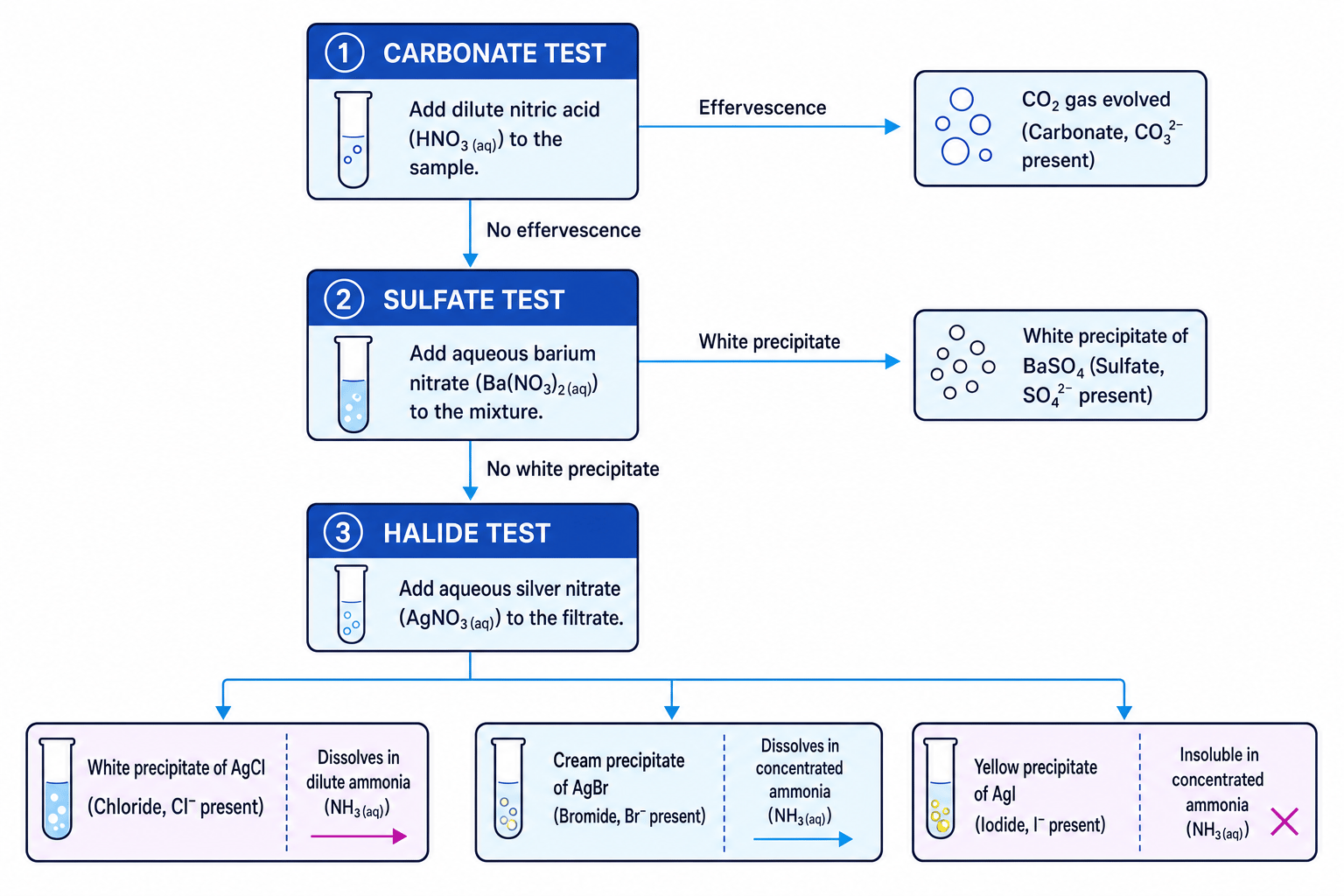
Acid Choice in the Sequential Test
If you are testing for halides downstream in the same mixture, you must never use hydrochloric acid (HCl\text{HCl}HCl) to acidify your sample in the carbonate step, and you must never use barium chloride (BaCl2\text{BaCl}_2BaCl2) in the sulfate step. Both of these reagents introduce chloride (Cl−\text{Cl}^-Cl−) ions into the mixture, which will guarantee a false-positive white precipitate when you add silver nitrate! Use nitric acid (HNO3\text{HNO}_3HNO3) and barium nitrate (Ba(NO3)2\text{Ba(NO}_3)_2Ba(NO3)2) instead.
Identifying Cations (Positive Ions)
Cations are positively charged ions. Your specification requires you to identify the ammonium ion (NH4+\text{NH}_4^+NH4+) and five specific transition metal cations: Cu2+\text{Cu}^{2+}Cu2+, Fe2+\text{Fe}^{2+}Fe2+, Fe3+\text{Fe}^{3+}Fe3+, Mn2+\text{Mn}^{2+}Mn2+, and Cr3+\text{Cr}^{3+}Cr3+.
1. The Ammonium Test (NH4+\text{NH}_4^+NH4+)
Ammonium ions react with warm hydroxide ions to produce ammonia gas and water.
- Method: Add aqueous sodium hydroxide, NaOH(aq)\text{NaOH}(\text{aq})NaOH(aq), to the sample and warm gently in a water bath.
- Observation: Ammonia gas is evolved. Since ammonia is highly soluble, you will not see vigorous bubbling, but you can detect it.
- Detection: Ammonia is the only common alkaline gas. It will turn damp red litmus paper blue. It also has a distinct, pungent smell.
Ionic equation:
NH4+(aq)+OH−(aq)→NH3(g)+H2O(l) \text{NH}_4^+(\text{aq}) + \text{OH}^-(\text{aq}) \to \text{NH}_3(\text{g}) + \text{H}_2\text{O}(\text{l}) NH4+(aq)+OH−(aq)→NH3(g)+H2O(l)2. Transition Metal Cation Tests
Transition metal aqueous ions exist as hydrated complex ions in solution. When you add aqueous sodium hydroxide, NaOH(aq)\text{NaOH}(\text{aq})NaOH(aq), or aqueous ammonia, NH3(aq)\text{NH}_3(\text{aq})NH3(aq), dropwise, they undergo precipitation reactions to form insoluble neutral metal hydroxides.
Precipitate
An insoluble solid compound that forms and settles out of a liquid solution during a chemical reaction.
The table below outlines the precipitates formed when adding NaOH(aq)\text{NaOH}(\text{aq})NaOH(aq) or NH3(aq)\text{NH}_3(\text{aq})NH3(aq) dropwise:
| Cation | Formula of Precipitate | Colour of Precipitate | Effect of adding Excess NaOH(aq)\text{NaOH}(\text{aq})NaOH(aq) | Effect of adding Excess NH3(aq)\text{NH}_3(\text{aq})NH3(aq) |
|---|---|---|---|---|
| Copper(II) (Cu2+\text{Cu}^{2+}Cu2+) | Cu(OH)2(s)\text{Cu(OH)}_2(\text{s})Cu(OH)2(s) | Pale blue | Insoluble | Dissolves to form a deep blue solution: [Cu(NH3)4(H2O)2]2+(aq)[\text{Cu(NH}_3)_4(\text{H}_2\text{O})_2]^{2+}(\text{aq})[Cu(NH3)4(H2O)2]2+(aq) |
| Iron(II) (Fe2+\text{Fe}^{2+}Fe2+) | Fe(OH)2(s)\text{Fe(OH)}_2(\text{s})Fe(OH)2(s) | Pale green (darkens on standing) | Insoluble | Insoluble |
| Iron(III) (Fe3+\text{Fe}^{3+}Fe3+) | Fe(OH)3(s)\text{Fe(OH)}_3(\text{s})Fe(OH)3(s) | Orange-brown | Insoluble | Insoluble |
| Manganese(II) (Mn2+\text{Mn}^{2+}Mn2+) | Mn(OH)2(s)\text{Mn(OH)}_2(\text{s})Mn(OH)2(s) | Pale brown/buff (darkens on standing) | Insoluble | Insoluble |
| Chromium(III) (Cr3+\text{Cr}^{3+}Cr3+) | Cr(OH)3(s)\text{Cr(OH)}_3(\text{s})Cr(OH)3(s) | Grey-green | Dissolves to form a dark green solution: [Cr(OH)6]3−(aq)[\text{Cr(OH)}_6]^{3-}(\text{aq})[Cr(OH)6]3−(aq) | Dissolves to form a purple solution: [Cr(NH3)6]3+(aq)[\text{Cr(NH}_3)_6]^{3+}(\text{aq})[Cr(NH3)6]3+(aq) |
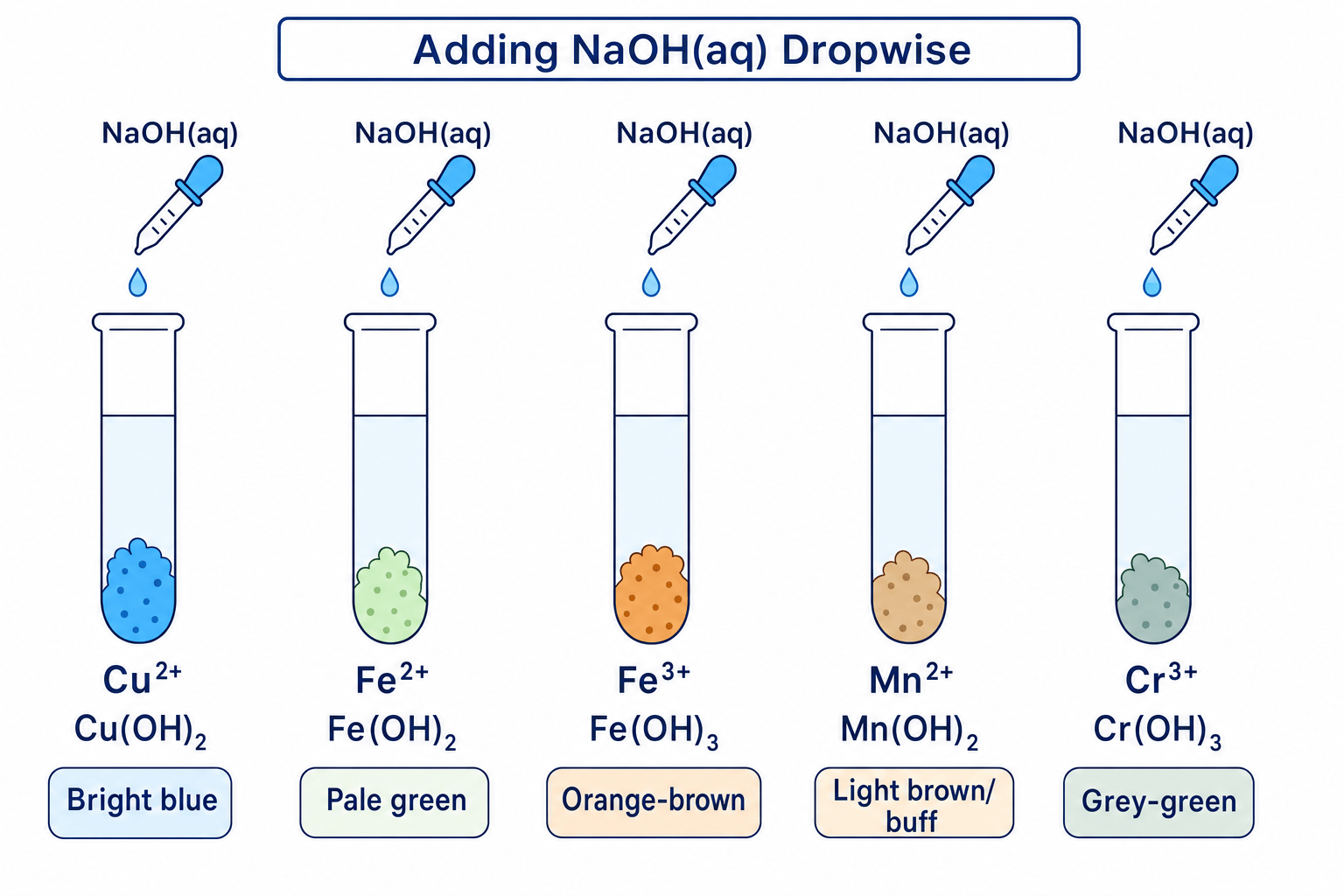
Key Equations for Precipitation and Re-dissolving:
- Copper(II) Precipitation:
- Chromium(III) Precipitation and Re-dissolving in excess NaOH\text{NaOH}NaOH:
- Iron(II) and Iron(III) Precipitation:
Amphoteric Chromium
Think of Chromium(III) hydroxide as a "chemical chameleon". It behaves amphoterically, meaning it can react with excess hydroxide ions to break down its precipitate structure and re-dissolve back into aqueous form. The other transition metal hydroxides do not have this chemical flexibility with sodium hydroxide, leaving them locked as solid precipitates.
Deducing the identity of an unknown salt
A student is given a green crystalline solid, Compound X. They dissolve X in distilled water to make a green solution, then perform a series of qualitative tests.
Experimental observations:
- Addition of dilute nitric acid to the solution produces no bubbles.
- Subsequent addition of aqueous barium nitrate produces no precipitate.
- Addition of aqueous silver nitrate to the mixture produces a cream precipitate. This precipitate does not dissolve in dilute ammonia but dissolves fully when concentrated ammonia is added.
- Dropwise addition of aqueous sodium hydroxide to a fresh sample of the green solution produces a pale green precipitate. On standing in the air, the top layer of this precipitate turns orange-brown. The precipitate is insoluble in excess sodium hydroxide.
Deduce the identity of Compound X. Write ionic equations for the reactions occurring in steps 3 and 4.
Step-by-step solution:
- Analyze the anion tests (Steps 1, 2, and 3):
- The absence of effervescence in Step 1 rules out carbonate ions (CO32−\text{CO}_3^{2-}CO32−).
- The absence of a precipitate in Step 2 rules out sulfate ions (SO42−\text{SO}_4^{2-}SO42−).
- The formation of a cream precipitate in Step 3 that dissolves only in concentrated ammonia confirms that the anion is bromide (Br−\text{Br}^-Br−).
- The ionic equation for this precipitation is:
- Analyze the cation test (Step 4):
- The formation of a pale green precipitate with sodium hydroxide points to either Fe2+\text{Fe}^{2+}Fe2+ or Cr3+\text{Cr}^{3+}Cr3+.
- Since the precipitate is insoluble in excess sodium hydroxide, it cannot be Cr3+\text{Cr}^{3+}Cr3+ (which would dissolve to form a dark green solution).
- The oxidation observation (turning orange-brown at the surface as it oxidises from Fe2+\text{Fe}^{2+}Fe2+ to Fe3+\text{Fe}^{3+}Fe3+ in air) confirms the presence of iron(II) ions, Fe2+\text{Fe}^{2+}Fe2+.
- The ionic equation for this precipitation is:
- Formulate the final compound name and formula:
- Combine the cation (Fe2+\text{Fe}^{2+}Fe2+) and the anion (Br−\text{Br}^-Br−).
- To achieve electrical neutrality, two bromide ions are needed for every iron(II) ion.
- Therefore, the chemical formula of Compound X is FeBr2\text{FeBr}_2FeBr2, and its IUPAC name is iron(II) bromide.
In the exam
- Always include state symbols: Qualitative analysis questions are highly specific about state symbols. Precipitates are always solid (s)(\text{s})(s), starting ions in solution are aqueous (aq)(\text{aq})(aq), and gases evolved are (g)(\text{g})(g).
- Specify excess reagents: If a question asks you how to distinguish between Fe2+(aq)\text{Fe}^{2+}(\text{aq})Fe2+(aq) and Cr3+(aq)\text{Cr}^{3+}(\text{aq})Cr3+(aq) using NaOH(aq)\text{NaOH}(\text{aq})NaOH(aq), you must state that you add it dropwise and then in excess. Simply adding it dropwise gives two green precipitates; you must add it in excess to show that Cr(OH)3\text{Cr(OH)}_3Cr(OH)3 re-dissolves while Fe(OH)2\text{Fe(OH)}_2Fe(OH)2 does not.
- Detail gas tests fully: If a gas is produced (like NH3\text{NH}_3NH3 or CO2\text{CO}_2CO2), don't just name the gas. State the reagent used to test it (damp red litmus paper or limewater) and the visible observation (turns blue or turns cloudy).
Check yourself
- Why will performing a sulfate test before a carbonate test on an unknown sample lead to an incorrect deduction?
- Write a balanced ionic equation, including state symbols, for the reaction of chromium(III) hydroxide precipitate with excess hydroxide ions.
- What visible observation distinguishes the reaction of copper(II) ions with excess aqueous sodium hydroxide from their reaction with excess aqueous ammonia?
