

What you'll learn
- Why d-block elements often form ions with several oxidation states.
- How ligands form tetrahedral and octahedral complex ions.
- Why transition-metal complexes are coloured, and why ligand exchange changes colour.
- How transition metals and their compounds act as catalysts and react with excess hydroxide ions.
1. What counts as a transition element?
The d-block is the central block of the Periodic Table, where electrons are being added to a d sub-shell. A transition element is a stricter idea.
Transition element
A transition element is an element that forms at least one ion with a partially filled d sub-shell.
So zinc is in the d-block, but is not usually classed as a transition element because zinc only commonly forms Zn2+\text{Zn}^{2+}Zn2+, which has a full 3d103d^{10}3d10 sub-shell.
Transition-metal ions are important because they often have:
- variable oxidation states
- coloured ions and complexes
- complex ion formation
- catalytic activity
2. Variable oxidation states
An oxidation state is the apparent charge an atom would have if bonding electrons were assigned to the more electronegative atom.
Transition metals can often lose both 4s and 3d electrons. The 4s and 3d sub-shells are close in energy, so several different numbers of electrons can be removed or involved in bonding.
Why oxidation states vary
In transition-metal ions, the 4s electrons are lost before the 3d electrons, and the 3d electrons can then be removed or used in bonding to give several stable oxidation states.
For example, iron has the electron configuration [Ar] 3d64s2\text{[Ar] }3d^6 4s^2[Ar] 3d64s2. It commonly forms:
- Fe2+\text{Fe}^{2+}Fe2+ by losing the two 4s electrons
- Fe3+\text{Fe}^{3+}Fe3+ by losing the two 4s electrons and one 3d electron
Important oxidation states and colours
You should know these common colours for Eduqas PI2.2:
- Cr3+\text{Cr}^{3+}Cr3+: green aqueous solution
- CrO42−\text{CrO}_4^{2-}CrO42−: yellow, chromium(VI)
- Cr2O72−\text{Cr}_2\text{O}_7^{2-}Cr2O72−: orange, chromium(VI)
- MnO4−\text{MnO}_4^-MnO4−: purple, manganese(VII)
- Co2+\text{Co}^{2+}Co2+ in water: pink
- Fe2+\text{Fe}^{2+}Fe2+: pale green
- Fe3+\text{Fe}^{3+}Fe3+: yellow-brown
- Cu2+\text{Cu}^{2+}Cu2+: pale blue
Chromium and manganese are especially good examples of high oxidation states being stabilised by oxygen in oxoanions such as chromate(VI), dichromate(VI) and manganate(VII).
Finding oxidation states in oxoanions
- In CrO42−\text{CrO}_4^{2-}CrO42−, let the oxidation state of chromium be xxx. Oxygen is usually −2-2−2, so x+4(−2)=−2x + 4(-2) = -2x+4(−2)=−2.
- Solving gives x−8=−2x - 8 = -2x−8=−2, so x=+6x = +6x=+6. Chromium is in oxidation state +6.
- In MnO4−\text{MnO}_4^-MnO4−, let manganese be xxx: x+4(−2)=−1x + 4(-2) = -1x+4(−2)=−1, so x−8=−1x - 8 = -1x−8=−1 and x=+7x = +7x=+7. Manganese is in oxidation state +7.
3. Complex ions, ligands and coordinate bonds
A complex ion contains a central metal ion surrounded by molecules or ions called ligands.
Ligand
A ligand is a molecule or ion that donates a lone pair of electrons to a central metal ion to form a coordinate bond.
A coordinate bond is a covalent bond in which both bonding electrons come from the same atom or ion. In these complexes, the ligand donates the electron pair and the metal ion accepts it.
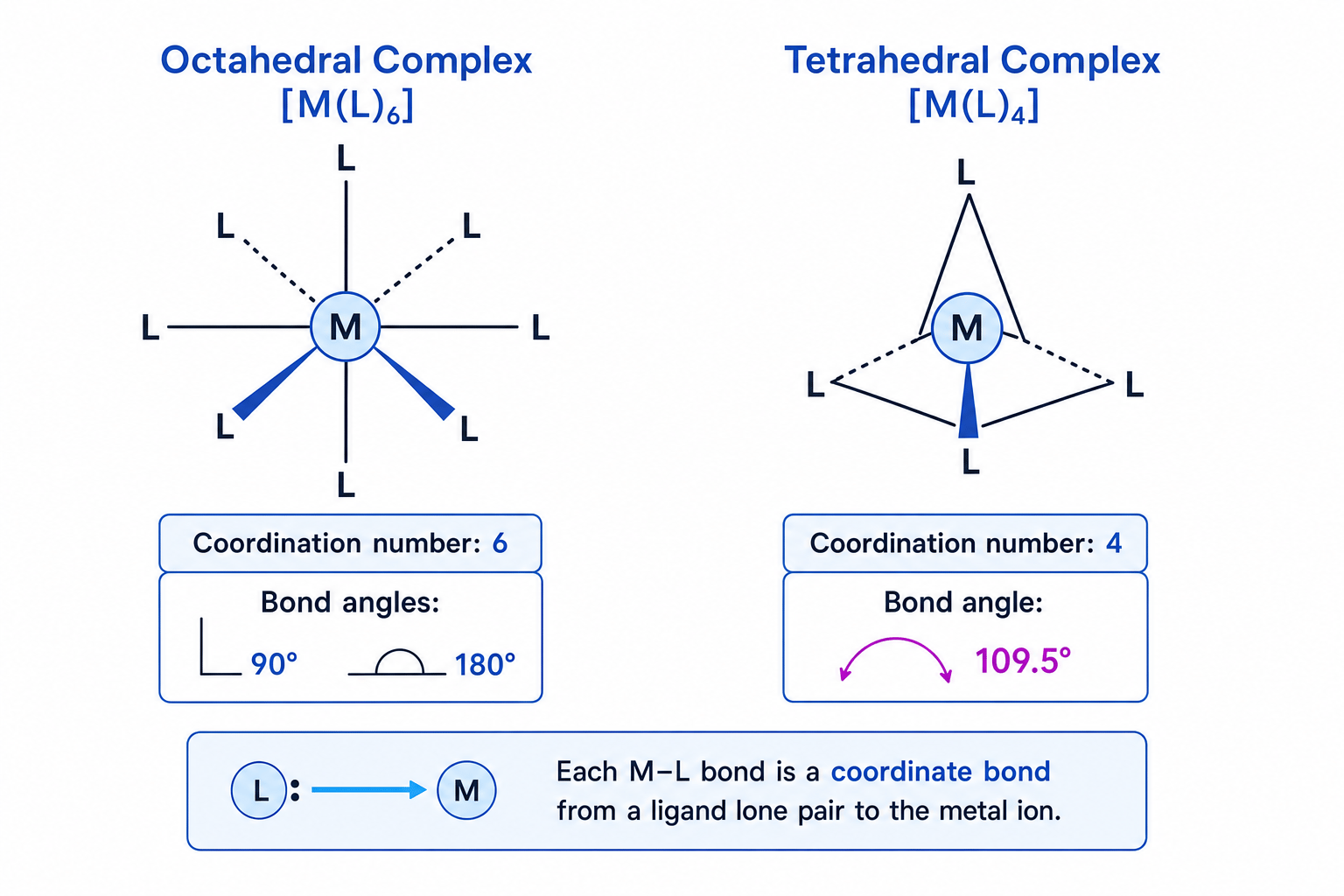
The coordination number is the number of coordinate bonds to the central metal ion.
Two key shapes are:
- Octahedral: coordination number 6, bond angles 90° and 180°
- Tetrahedral: coordination number 4, bond angle 109.5°
Deducing shape and oxidation state
For [Cu(NH3)4(H2O)2]2+[\text{Cu}(\text{NH}_3)_4(\text{H}_2\text{O})_2]^{2+}[Cu(NH3)4(H2O)2]2+:
- NH3\text{NH}_3NH3 and H2O\text{H}_2\text{O}H2O are neutral ligands, so the +2 charge must come from the copper ion. Copper is Cu2+\text{Cu}^{2+}Cu2+.
- There are four ammonia ligands and two water ligands, giving six coordinate bonds in total.
- A coordination number of 6 gives an approximately octahedral complex, with bond angles close to 90° and 180°.
4. Why transition-metal complexes are coloured
In an isolated metal ion, the five 3d orbitals have the same energy. In a complex ion, the ligands repel electrons in the d orbitals. This splits the d orbitals into two energy levels.
d-orbital splitting
d-orbital splitting is the separation of the five d orbitals into groups with different energies when ligands surround a transition-metal ion.
If the energy gap, ΔE\Delta EΔE, matches the energy of visible light, an electron can absorb a photon and move to a higher d orbital. This is a d-d transition.
The colour you see is the complementary colour to the colour absorbed.
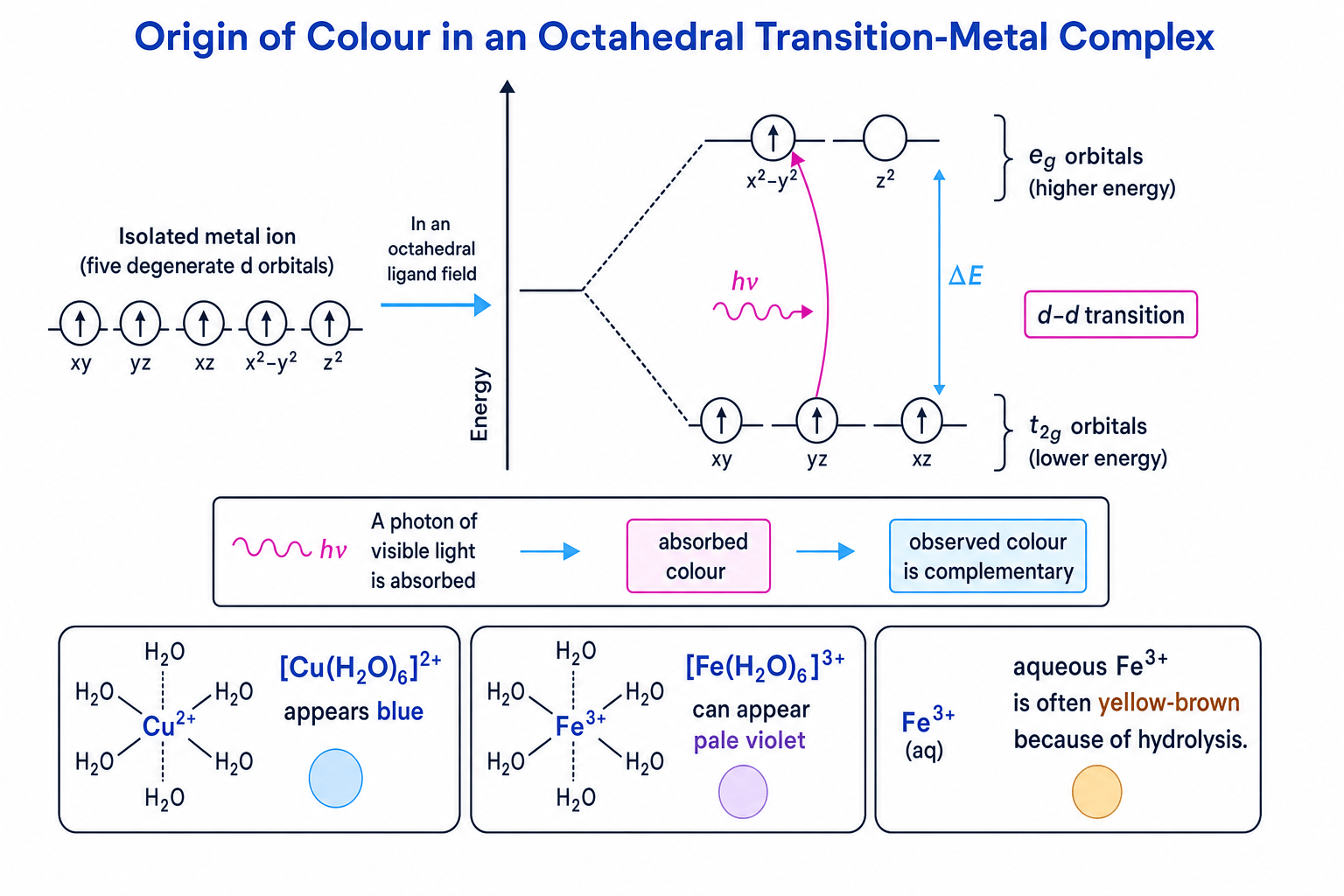
The exact value of ΔE\Delta EΔE depends on the metal ion, its oxidation state, the ligand and the shape of the complex. That is why changing ligands can change colour.
Absorbed, not emitted
A coloured complex usually appears coloured because it absorbs some wavelengths of visible light. The observed colour is what is left, not usually the colour being emitted.
5. Ligand exchange and colour changes
Ligand exchange happens when one ligand in a complex ion is replaced by another ligand.
For copper(II), pale blue [Cu(H2O)6]2+[\text{Cu}(\text{H}_2\text{O})_6]^{2+}[Cu(H2O)6]2+ reacts with excess ammonia to form a deep blue complex:
[Cu(H2O)6]2+(aq)+4NH3(aq)⇌[Cu(NH3)4(H2O)2]2+(aq)+4H2O(l)[\text{Cu}(\text{H}_2\text{O})_6]^{2+}(\text{aq}) + 4\text{NH}_3(\text{aq}) \rightleftharpoons [\text{Cu}(\text{NH}_3)_4(\text{H}_2\text{O})_2]^{2+}(\text{aq}) + 4\text{H}_2\text{O}(\text{l})[Cu(H2O)6]2+(aq)+4NH3(aq)⇌[Cu(NH3)4(H2O)2]2+(aq)+4H2O(l)With concentrated hydrochloric acid, chloride ligands replace water ligands and the coordination number can fall from 6 to 4.
For copper(II):
[Cu(H2O)6]2+(aq)+4Cl−(aq)⇌[CuCl4]2−(aq)+6H2O(l)[\text{Cu}(\text{H}_2\text{O})_6]^{2+}(\text{aq}) + 4\text{Cl}^-(\text{aq}) \rightleftharpoons [\text{CuCl}_4]^{2-}(\text{aq}) + 6\text{H}_2\text{O}(\text{l})[Cu(H2O)6]2+(aq)+4Cl−(aq)⇌[CuCl4]2−(aq)+6H2O(l)Pale blue [Cu(H2O)6]2+[\text{Cu}(\text{H}_2\text{O})_6]^{2+}[Cu(H2O)6]2+ forms yellow-green, approximately tetrahedral [CuCl4]2−[\text{CuCl}_4]^{2-}[CuCl4]2−.
For cobalt(II):
[Co(H2O)6]2+(aq)+4Cl−(aq)⇌[CoCl4]2−(aq)+6H2O(l)[\text{Co}(\text{H}_2\text{O})_6]^{2+}(\text{aq}) + 4\text{Cl}^-(\text{aq}) \rightleftharpoons [\text{CoCl}_4]^{2-}(\text{aq}) + 6\text{H}_2\text{O}(\text{l})[Co(H2O)6]2+(aq)+4Cl−(aq)⇌[CoCl4]2−(aq)+6H2O(l)Pink, approximately octahedral [Co(H2O)6]2+[\text{Co}(\text{H}_2\text{O})_6]^{2+}[Co(H2O)6]2+ forms blue, approximately tetrahedral [CoCl4]2−[\text{CoCl}_4]^{2-}[CoCl4]2−.
Predicting a ligand exchange colour change
- Adding concentrated HCl greatly increases the concentration of Cl−\text{Cl}^-Cl− ligands.
- The equilibrium shifts towards the chloro complex, so [Co(H2O)6]2+[\text{Co}(\text{H}_2\text{O})_6]^{2+}[Co(H2O)6]2+ is converted into [CoCl4]2−[\text{CoCl}_4]^{2-}[CoCl4]2−.
- The complex changes from pink octahedral cobalt(II) to blue tetrahedral cobalt(II). Adding water shifts the equilibrium back left, so the solution becomes pink again.
Formula-colour-shape links
Learn these as linked sets: [Cu(H2O)6]2+[\text{Cu}(\text{H}_2\text{O})_6]^{2+}[Cu(H2O)6]2+ pale blue octahedral; [Cu(NH3)4(H2O)2]2+[\text{Cu}(\text{NH}_3)_4(\text{H}_2\text{O})_2]^{2+}[Cu(NH3)4(H2O)2]2+ deep blue octahedral; [Co(H2O)6]2+[\text{Co}(\text{H}_2\text{O})_6]^{2+}[Co(H2O)6]2+ pink octahedral; [CuCl4]2−[\text{CuCl}_4]^{2-}[CuCl4]2− yellow-green tetrahedral; [CoCl4]2−[\text{CoCl}_4]^{2-}[CoCl4]2− blue tetrahedral.
6. Reactions with excess hydroxide ions
Aqueous hydroxide ions can form insoluble metal hydroxide precipitates. The colour and behaviour in excess hydroxide help identify the metal ion.
For chromium(III):
Cr3+(aq)+3OH−(aq)→Cr(OH)3(s)\text{Cr}^{3+}(\text{aq}) + 3\text{OH}^-(\text{aq}) \to \text{Cr}(\text{OH})_3(\text{s})Cr3+(aq)+3OH−(aq)→Cr(OH)3(s)Grey-green Cr(OH)3\text{Cr}(\text{OH})_3Cr(OH)3 dissolves in excess hydroxide:
Cr(OH)3(s)+3OH−(aq)→[Cr(OH)6]3−(aq)\text{Cr}(\text{OH})_3(\text{s}) + 3\text{OH}^-(\text{aq}) \to [\text{Cr}(\text{OH})_6]^{3-}(\text{aq})Cr(OH)3(s)+3OH−(aq)→[Cr(OH)6]3−(aq)For iron(II), iron(III) and copper(II):
Fe2+(aq)+2OH−(aq)→Fe(OH)2(s)\text{Fe}^{2+}(\text{aq}) + 2\text{OH}^-(\text{aq}) \to \text{Fe}(\text{OH})_2(\text{s})Fe2+(aq)+2OH−(aq)→Fe(OH)2(s)Green Fe(OH)2\text{Fe}(\text{OH})_2Fe(OH)2 does not dissolve in excess hydroxide and may turn brown on standing due to oxidation.
Fe3+(aq)+3OH−(aq)→Fe(OH)3(s)\text{Fe}^{3+}(\text{aq}) + 3\text{OH}^-(\text{aq}) \to \text{Fe}(\text{OH})_3(\text{s})Fe3+(aq)+3OH−(aq)→Fe(OH)3(s)Brown Fe(OH)3\text{Fe}(\text{OH})_3Fe(OH)3 does not dissolve in excess hydroxide.
Cu2+(aq)+2OH−(aq)→Cu(OH)2(s)\text{Cu}^{2+}(\text{aq}) + 2\text{OH}^-(\text{aq}) \to \text{Cu}(\text{OH})_2(\text{s})Cu2+(aq)+2OH−(aq)→Cu(OH)2(s)Pale blue Cu(OH)2\text{Cu}(\text{OH})_2Cu(OH)2 does not dissolve in excess hydroxide.
Identifying a metal ion using hydroxide
- A green precipitate forms when aqueous hydroxide is added, so the ion could be Cr3+\text{Cr}^{3+}Cr3+ or Fe2+\text{Fe}^{2+}Fe2+.
- The precipitate dissolves in excess hydroxide to give a green solution, showing amphoteric behaviour.
- Therefore the ion is Cr3+\text{Cr}^{3+}Cr3+, because Fe(OH)2\text{Fe}(\text{OH})_2Fe(OH)2 does not dissolve in excess hydroxide.
7. Catalysis by transition metals and compounds
A catalyst increases the rate of reaction by providing an alternative route with lower activation energy. It is regenerated by the end of the reaction.
In heterogeneous catalysis, the catalyst is in a different physical phase from the reactants. This often works by surface adsorption: reactant particles stick to the catalyst surface, bonds are weakened, reaction occurs, then products desorb.
Examples:
- Nickel catalyses hydrogenation of alkenes, such as ethene to ethane.
- Iron catalyses the Haber process: N2(g)+3H2(g)⇌2NH3(g)\text{N}_2(\text{g}) + 3\text{H}_2(\text{g}) \rightleftharpoons 2\text{NH}_3(\text{g})N2(g)+3H2(g)⇌2NH3(g).
- Manganese(IV) oxide catalyses decomposition of hydrogen peroxide: 2H2O2(aq)→2H2O(l)+O2(g)2\text{H}_2\text{O}_2(\text{aq}) \to 2\text{H}_2\text{O}(\text{l}) + \text{O}_2(\text{g})2H2O2(aq)→2H2O(l)+O2(g).
In homogeneous catalysis, the catalyst is in the same phase as the reactants. Transition-metal ions are useful here because they can change oxidation state and then be regenerated.
Vanadium(V) oxide is the catalyst in the Contact process, which converts sulfur dioxide into sulfur trioxide:
2SO2(g)+O2(g)⇌2SO3(g)2\text{SO}_2(\text{g}) + \text{O}_2(\text{g}) \rightleftharpoons 2\text{SO}_3(\text{g})2SO2(g)+O2(g)⇌2SO3(g)Showing vanadium(V) oxide is regenerated
- The catalyst is reduced when sulfur dioxide is oxidised: SO2(g)+V2O5(s)→SO3(g)+V2O4(s)\text{SO}_2(\text{g}) + \text{V}_2\text{O}_5(\text{s}) \to \text{SO}_3(\text{g}) + \text{V}_2\text{O}_4(\text{s})SO2(g)+V2O5(s)→SO3(g)+V2O4(s).
- The reduced vanadium compound is oxidised again: V2O4(s)+12O2(g)→V2O5(s)\text{V}_2\text{O}_4(\text{s}) + \frac{1}{2}\text{O}_2(\text{g}) \to \text{V}_2\text{O}_5(\text{s})V2O4(s)+21O2(g)→V2O5(s).
- Adding the two equations cancels V2O5\text{V}_2\text{O}_5V2O5 and V2O4\text{V}_2\text{O}_4V2O4, giving SO2(g)+12O2(g)→SO3(g)\text{SO}_2(\text{g}) + \frac{1}{2}\text{O}_2(\text{g}) \to \text{SO}_3(\text{g})SO2(g)+21O2(g)→SO3(g). The vanadium(V) oxide is regenerated, so it is a catalyst.
In the exam
- For complex ions, always identify ligand charge first, then use the overall charge to find the metal oxidation state.
- Link colour changes to ligand exchange and a changed d-orbital splitting, not to the metal “becoming coloured”.
- For hydroxide tests, give both the precipitate colour and whether it dissolves in excess hydroxide.
Check yourself
- Why does [Co(H2O)6]2+[\text{Co}(\text{H}_2\text{O})_6]^{2+}[Co(H2O)6]2+ change colour when concentrated HCl is added?
- What are the formulae, colours and shapes of [Cu(H2O)6]2+[\text{Cu}(\text{H}_2\text{O})_6]^{2+}[Cu(H2O)6]2+ and [CuCl4]2−[\text{CuCl}_4]^{2-}[CuCl4]2−?
- How would you distinguish Cr3+\text{Cr}^{3+}Cr3+ from Fe2+\text{Fe}^{2+}Fe2+ using aqueous hydroxide?
