

What you'll learn
- How reaction rates are measured, especially by sampling and quenching.
- How experimental data is used to find orders of reaction and build a rate equation.
- How kinetics gives evidence for a reaction mechanism and the rate-determining step.
- How the Arrhenius equation links temperature, catalysts, activation energy and the rate constant.
1. Reaction rate: the basic idea
Chemical kinetics is the study of how fast reactions happen and what this tells us about the pathway from reactants to products.
Reaction rate
The rate of reaction is the change in concentration of a reactant or product per unit time. It is usually measured in mol dm⁻³ s⁻¹.
For a product, concentration increases, so the gradient of a concentration-time graph is positive. For a reactant, concentration decreases, so the gradient is negative; the rate is usually quoted as a positive value.
For a reaction such as:
aA+bB→cC+dDaA+bB \to cC+dDaA+bB→cC+dDthe rate can be written as:
rate=−1aΔ[A]Δt=−1bΔ[B]Δt=1cΔ[C]Δt=1dΔ[D]Δt\text{rate}=-\frac{1}{a}\frac{\Delta[A]}{\Delta t}=-\frac{1}{b}\frac{\Delta[B]}{\Delta t}=\frac{1}{c}\frac{\Delta[C]}{\Delta t}=\frac{1}{d}\frac{\Delta[D]}{\Delta t}rate=−a1ΔtΔ[A]=−b1ΔtΔ[B]=c1ΔtΔ[C]=d1ΔtΔ[D]The gradient of a tangent to a concentration-time curve gives the instantaneous rate at that time.
Calculating an average rate
In a reaction, the concentration of iodine increases from 0.0000 mol dm⁻³ to 1.20×10−31.20 \times 10^{-3}1.20×10⁻³ mol dm⁻³ in the first 60.0 s.
- Use the product concentration because iodine is increasing, so the rate is positive.
- Calculate the concentration change: Δ[I2]=1.20×10⁻³ mol dm−3\Delta[\text{I}_2]=1.20 \times 10^{-3}\ \text{mol dm}^{-3}Δ[I2]=1.20×10⁻³ mol dm−3.
- Divide by the time interval: rate=1.20×10−360.0=2.00×10⁻⁵ mol dm−3 s−1\text{rate}=\frac{1.20 \times 10^{-3}}{60.0}=2.00 \times 10^{-5}\ \text{mol dm}^{-3}\text{ s}^{-1}rate=60.01.20×10−3=2.00×10⁻⁵ mol dm−3 s−1.
2. Measuring rate by sampling and quenching
Sometimes a reaction mixture must be analysed at different times. You remove small samples at known times, then stop the reaction in each sample before analysis.
Quenching
Quenching means stopping or greatly slowing a reaction at a known time so that the composition of the sample no longer changes before it is analysed.
A typical sampling and quenching method is:
- Start the reaction and keep the temperature constant.
- Remove equal-volume samples at recorded times.
- Quench each sample immediately.
- Analyse the sample, often by titration or colorimetry.
- Use the concentrations found to plot a concentration-time graph.
Common quenching methods include rapid cooling, large dilution, neutralising an acid catalyst, or adding a reagent that removes one reactant.
Analysing an unquenched sample
If the reaction continues while you are titrating or measuring the sample, the result no longer represents the concentration at the sampling time. The quench must be fast compared with the reaction.
3. Orders of reaction and the rate equation
The order with respect to a reactant tells you how the rate depends on the concentration of that reactant.
Order of reaction
The order with respect to a reactant is the power to which its concentration is raised in the experimentally determined rate equation. The overall order is the sum of these powers.
For a reaction involving reactants A and B, the general rate equation is:
rate=k[A]m[B]n\text{rate}=k[A]^m[B]^nrate=k[A]m[B]nwhere kkk is the rate constant, mmm is the order with respect to A, and nnn is the order with respect to B.
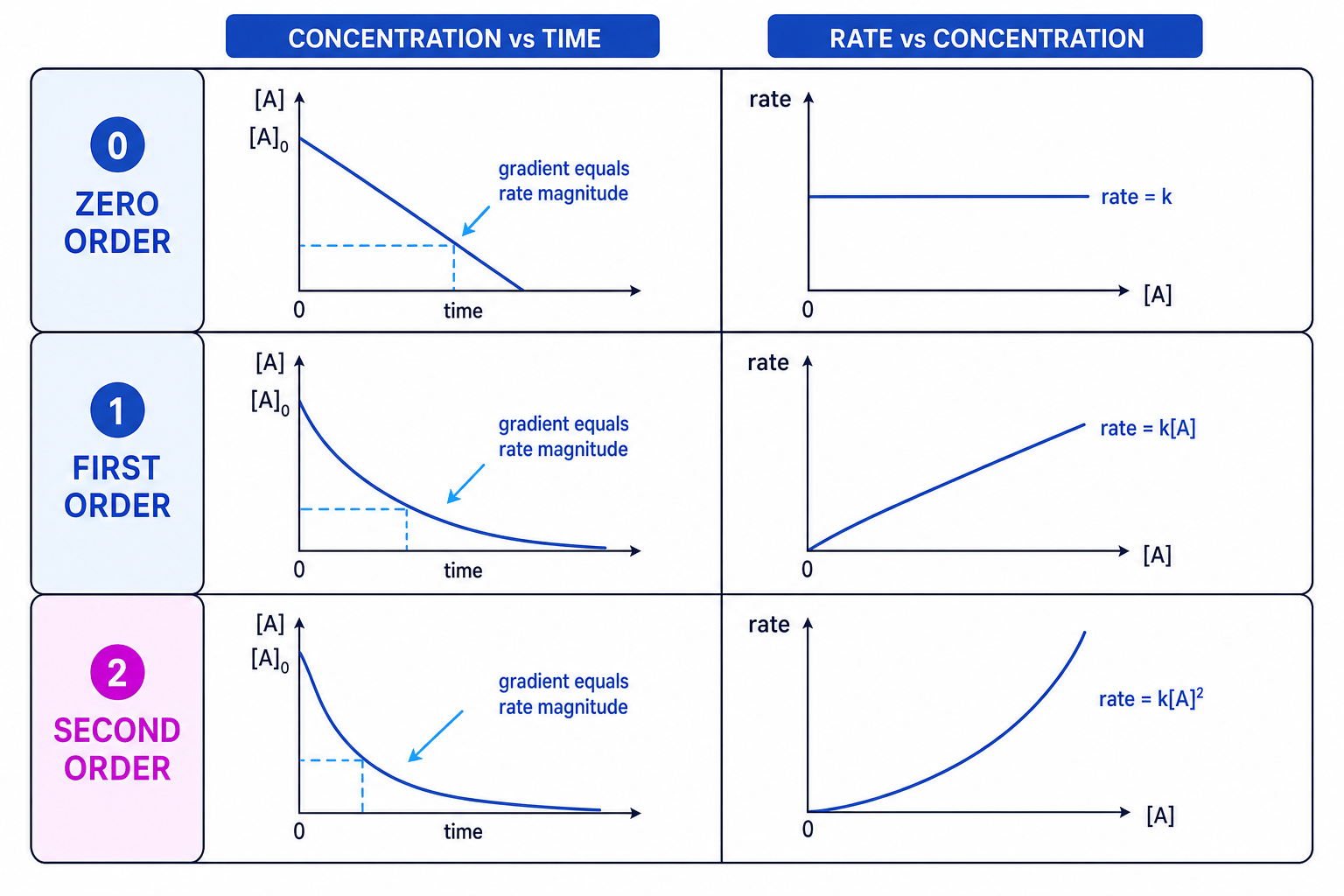
- Zero order in A: changing [A][A][A] has no effect on rate.
- First order in A: doubling [A][A][A] doubles the rate.
- Second order in A: doubling [A][A][A] makes the rate four times larger.
The shapes of rate graphs are a very useful way to recognise order.
Orders come from experiments
Reaction orders are not normally found from the balanced equation. They are determined from experimental rate data.
The units of kkk depend on the overall order:
- Overall order 0: mol dm⁻³ s⁻¹
- Overall order 1: s⁻¹
- Overall order 2: dm³ mol⁻¹ s⁻¹
- Overall order 3: dm⁶ mol⁻² s⁻¹
Finding a rate equation from initial rates
The oxidation of iodide ions by hydrogen peroxide in acid can be studied using initial-rate data.
| Experiment | Hydrogen peroxide concentration / mol dm⁻³ | Iodide ion concentration / mol dm⁻³ | Hydrogen ion concentration / mol dm⁻³ | Initial rate / mol dm⁻³ s⁻¹ |
|---|---|---|---|---|
| 1 | 0.0100 | 0.100 | 0.100 | 2.50e-5 |
| 2 | 0.0200 | 0.100 | 0.100 | 5.00e-5 |
| 3 | 0.0100 | 0.200 | 0.100 | 5.00e-5 |
| 4 | 0.0100 | 0.100 | 0.200 | 5.00e-5 |
- Compare experiments 1 and 2: [H2O2][\text{H}_2\text{O}_2][H2O2] doubles while the other concentrations stay constant; the rate doubles, so the reaction is first order in hydrogen peroxide.
- Compare experiments 1 and 3: [I−][\text{I}^-][I−] doubles and the rate doubles, so the reaction is first order in iodide ions.
- Compare experiments 1 and 4: [H+][\text{H}^+][H+] doubles and the rate doubles, so the reaction is first order in hydrogen ions.
- Write the rate equation: rate=k[H2O2][I−][H+]\text{rate}=k[\text{H}_2\text{O}_2][\text{I}^-][\text{H}^+]rate=k[H2O2][I−][H+].
- Use experiment 1 to find kkk: k=2.50×10−50.0100×0.100×0.100=0.250 dm6 mol−2 s−1k=\frac{2.50 \times 10^{-5}}{0.0100 \times 0.100 \times 0.100}=0.250\ \text{dm}^6\text{ mol}^{-2}\text{ s}^{-1}k=0.0100×0.100×0.1002.50×10−5=0.250 dm6 mol−2 s−1.
4. Specified practical: iodide and hydrogen peroxide clock reaction
The overall reaction is:
H2O2(aq)+2I−(aq)+2H+(aq)→I2(aq)+2H2O(l)\text{H}_2\text{O}_2(aq)+2\text{I}^-(aq)+2\text{H}^+(aq)\to \text{I}_2(aq)+2\text{H}_2\text{O}(l)H2O2(aq)+2I−(aq)+2H+(aq)→I2(aq)+2H2O(l)A common practical method uses sodium thiosulfate and starch. Iodine is produced slowly, but thiosulfate removes it:
I2(aq)+2S2O32−(aq)→2I−(aq)+S4O62−(aq)\text{I}_2(aq)+2\text{S}_2\text{O}_3^{2-}(aq)\to 2\text{I}^-(aq)+\text{S}_4\text{O}_6^{2-}(aq)I2(aq)+2S2O32−(aq)→2I−(aq)+S4O62−(aq)When the thiosulfate has been used up, iodine remains and forms a blue-black complex with starch. If the same small amount of thiosulfate is used each time, the same amount of iodine is needed to reach the endpoint, so the initial rate is proportional to 1/t1/t1/t.
To determine order:
- Keep temperature constant using a water bath.
- Keep total volume constant by replacing solution with water when changing a reactant concentration.
- Change only one reactant concentration at a time.
- Measure the time for the blue-black colour to appear.
- Use 1/t1/t1/t as a value proportional to the initial rate.
Why use initial rates?
At the start of a reaction, concentrations are known accurately. Later on, several concentrations have changed, making the rate harder to interpret.
Important evaluation points:
- Very short times have high percentage timing uncertainty.
- Very long times may mean conditions drift, especially temperature.
- The colour change is subjective; a colorimeter can reduce this uncertainty.
- Hydrogen peroxide is an oxidising agent, acids are irritants, and iodine stains, so eye protection is needed.
5. Rate-determining step and mechanism
A mechanism is a sequence of elementary steps showing how reactants become products. An intermediate is made in one step and used up in a later step.
Rate-determining step
The rate-determining step is the slowest step in a reaction mechanism. It controls the overall rate, like the narrowest point in a funnel controls the flow.
For an elementary step, the rate depends on the particles involved in that step. Therefore, the experimental rate equation gives evidence about which species are involved before or during the rate-determining step.
Using kinetics to test a mechanism
For the reaction NO2(g)+CO(g)→NO(g)+CO2(g)\text{NO}_2(g)+\text{CO}(g)\to \text{NO}(g)+\text{CO}_2(g)NO2(g)+CO(g)→NO(g)+CO2(g), a proposed mechanism is:
Slow: NO2(g)+NO2(g)→NO3(g)+NO(g)\text{NO}_2(g)+\text{NO}_2(g)\to \text{NO}_3(g)+\text{NO}(g)NO2(g)+NO2(g)→NO3(g)+NO(g)
Fast: NO3(g)+CO(g)→NO2(g)+CO2(g)\text{NO}_3(g)+\text{CO}(g)\to \text{NO}_2(g)+\text{CO}_2(g)NO3(g)+CO(g)→NO2(g)+CO2(g)
- Add the two steps and cancel the intermediate NO3\text{NO}_3NO3 and the regenerated NO2\text{NO}_2NO2; the overall equation is NO2+CO→NO+CO2\text{NO}_2+\text{CO}\to \text{NO}+\text{CO}_2NO2+CO→NO+CO2.
- Use the slow step to predict the rate equation: two NO2\text{NO}_2NO2 particles are involved, so rate=k[NO2]2\text{rate}=k[\text{NO}_2]^2rate=k[NO2]2.
- Compare with experiment: if the measured rate equation is rate=k[NO2]2\text{rate}=k[\text{NO}_2]^2rate=k[NO2]2, the mechanism is consistent with the kinetic evidence.
Kinetics supports, but does not prove
A rate equation can rule out an impossible mechanism, but it usually cannot prove that one mechanism is the only possible pathway.
6. The Arrhenius equation
Particles must collide with enough energy to react. The minimum energy needed is the activation energy, EaE_aEa.
Arrhenius equation
The Arrhenius equation links the rate constant to temperature:
k=Ae−Ea/(RT)k=Ae^{-E_a/(RT)}k=Ae−Ea/(RT)where AAA is the frequency factor, EaE_aEa is activation energy in J mol⁻¹, RRR is 8.31 J K⁻¹ mol⁻¹, and TTT is temperature in K.
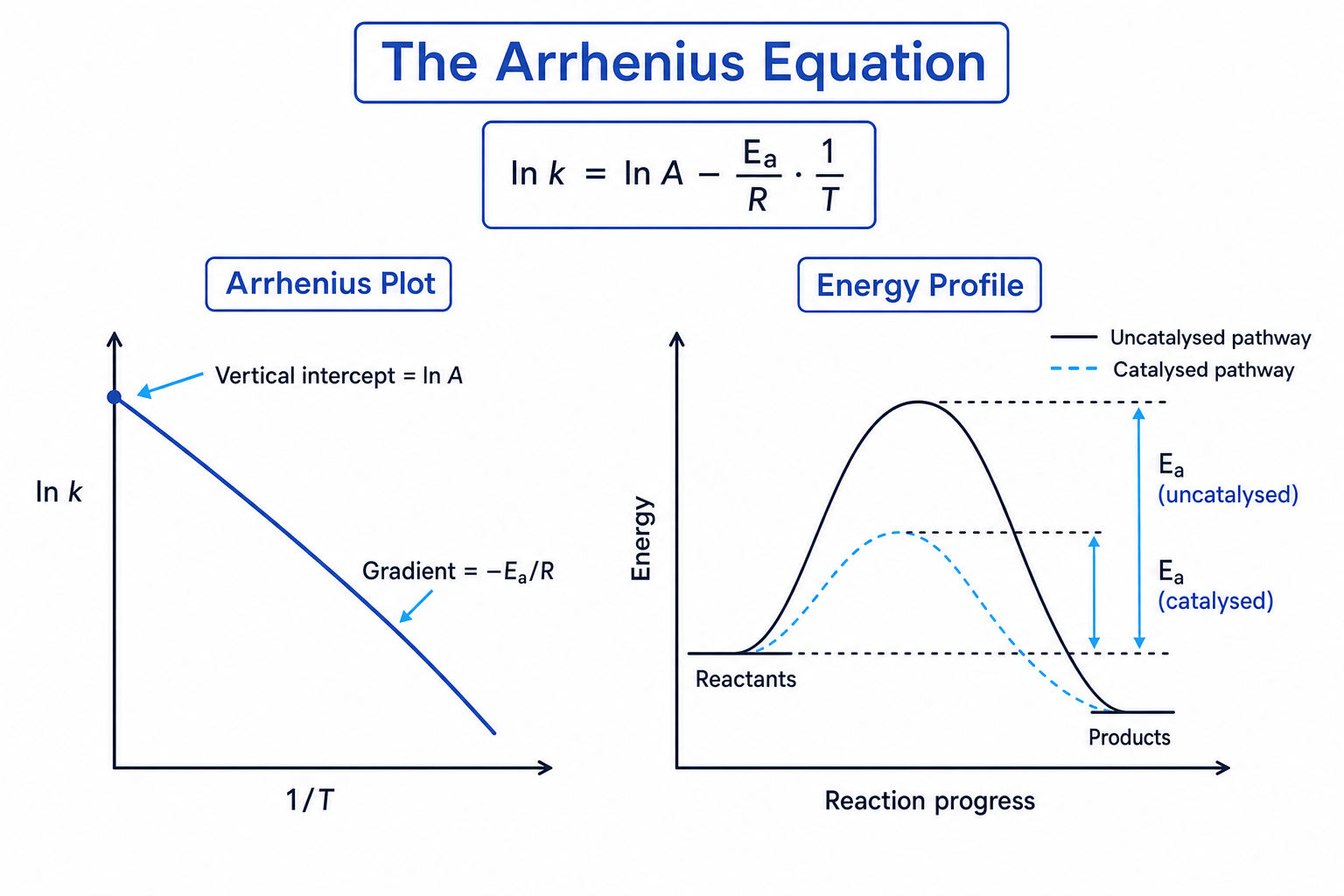
Taking natural logarithms gives the straight-line form:
lnk=lnA−EaR⋅1T\ln k=\ln A-\frac{E_a}{R}\cdot\frac{1}{T}lnk=lnA−REa⋅T1So a graph of lnk\ln klnk against 1/T1/T1/T has gradient −EaR-\frac{E_a}{R}−REa and intercept lnA\ln AlnA.
A catalyst provides an alternative pathway with lower activation energy. This increases kkk, but it does not change the enthalpy change or the equilibrium constant.
Finding activation energy and frequency factor
For a first-order reaction, k=1.20×10⁻³ s−1k=1.20 \times 10^{-3}\ \text{s}^{-1}k=1.20×10⁻³ s−1 at 298 K and k=8.90×10⁻³ s−1k=8.90 \times 10^{-3}\ \text{s}^{-1}k=8.90×10⁻³ s−1 at 318 K.
- Use the two-temperature Arrhenius form: ln(k2k1)=EaR(1T1−1T2)\ln\left(\frac{k_2}{k_1}\right)=\frac{E_a}{R}\left(\frac{1}{T_1}-\frac{1}{T_2}\right)ln(k1k2)=REa(T11−T21).
- Substitute the values: ln(8.90×10−31.20×10−3)=2.00\ln\left(\frac{8.90 \times 10^{-3}}{1.20 \times 10^{-3}}\right)=2.00ln(1.20×10−38.90×10−3)=2.00 and 1298−1318=2.11×10⁻⁴ K−1\frac{1}{298}-\frac{1}{318}=2.11 \times 10^{-4}\ \text{K}^{-1}2981−3181=2.11×10⁻⁴ K−1.
- Rearrange for activation energy: Ea=2.00×8.312.11×10−4=7.89×10⁴ J mol−1=78.9 kJ mol−1E_a=\frac{2.00 \times 8.31}{2.11 \times 10^{-4}}=7.89 \times 10^4\ \text{J mol}^{-1}=78.9\ \text{kJ mol}^{-1}Ea=2.11×10−42.00×8.31=7.89×10⁴ J mol−1=78.9 kJ mol−1.
- Find AAA using lnA=lnk1+EaRT1\ln A=\ln k_1+\frac{E_a}{RT_1}lnA=lnk1+RT1Ea: lnA=ln(1.20×10⁻³)+7.89×1048.31×298=25.1\ln A=\ln(1.20 \times 10^{-3})+\frac{7.89 \times 10^4}{8.31 \times 298}=25.1lnA=ln(1.20×10⁻³)+8.31×2987.89×104=25.1.
- Convert from lnA\ln AlnA to AAA: A=e25.1=8.0×10¹⁰ s−1A=e^{25.1}=8.0 \times 10^{10}\ \text{s}^{-1}A=e25.1=8.0×10¹⁰ s−1.
Mixing J and kJ in Arrhenius calculations
Use EaE_aEa in J mol⁻¹ when using R=8.31 J K−1 mol−1R=8.31\ \text{J K}^{-1}\text{ mol}^{-1}R=8.31 J K−1 mol−1. Convert to kJ mol⁻¹ only at the end if needed.
In the exam
- For orders, compare experiments where only one concentration changes; use the rate ratio and concentration ratio, not the balanced equation.
- For graphs, remember that rate from a concentration-time curve is the gradient of a tangent, while an Arrhenius plot has gradient −EaR-\frac{E_a}{R}−REa.
- For mechanisms, check that the steps add to the overall equation and that the slow step matches the experimental rate equation.
Check yourself
- Why must a sampled reaction mixture be quenched before analysis?
- If doubling [A][A][A] quadruples the rate, what is the order with respect to A?
- How does a catalyst affect EaE_aEa, kkk, and the position of equilibrium?
