

What you'll learn
- How p-block chemistry changes from non-metallic behaviour at the top of groups to more metallic behaviour lower down.
- Why some p-block compounds break the “octet rule”, including Al2Cl6\text{Al}_2\text{Cl}_6Al2Cl6 and NH3⋅BF3\text{NH}_3 \cdot \text{BF}_3NH3⋅BF3.
- How Group 4 oxides and chlorides show trends in bonding, acid-base behaviour and oxidation-state stability.
- How to predict observations for lead(II), chlorine/alkali, and halide reactions with concentrated sulfuric acid.
1. The p-block: the big idea
The p-block contains elements whose highest-energy electrons are in a p sub-shell. In Eduqas “Group 3, 4, 5…” p-block language, this means the boron group, carbon group, nitrogen group, and so on.
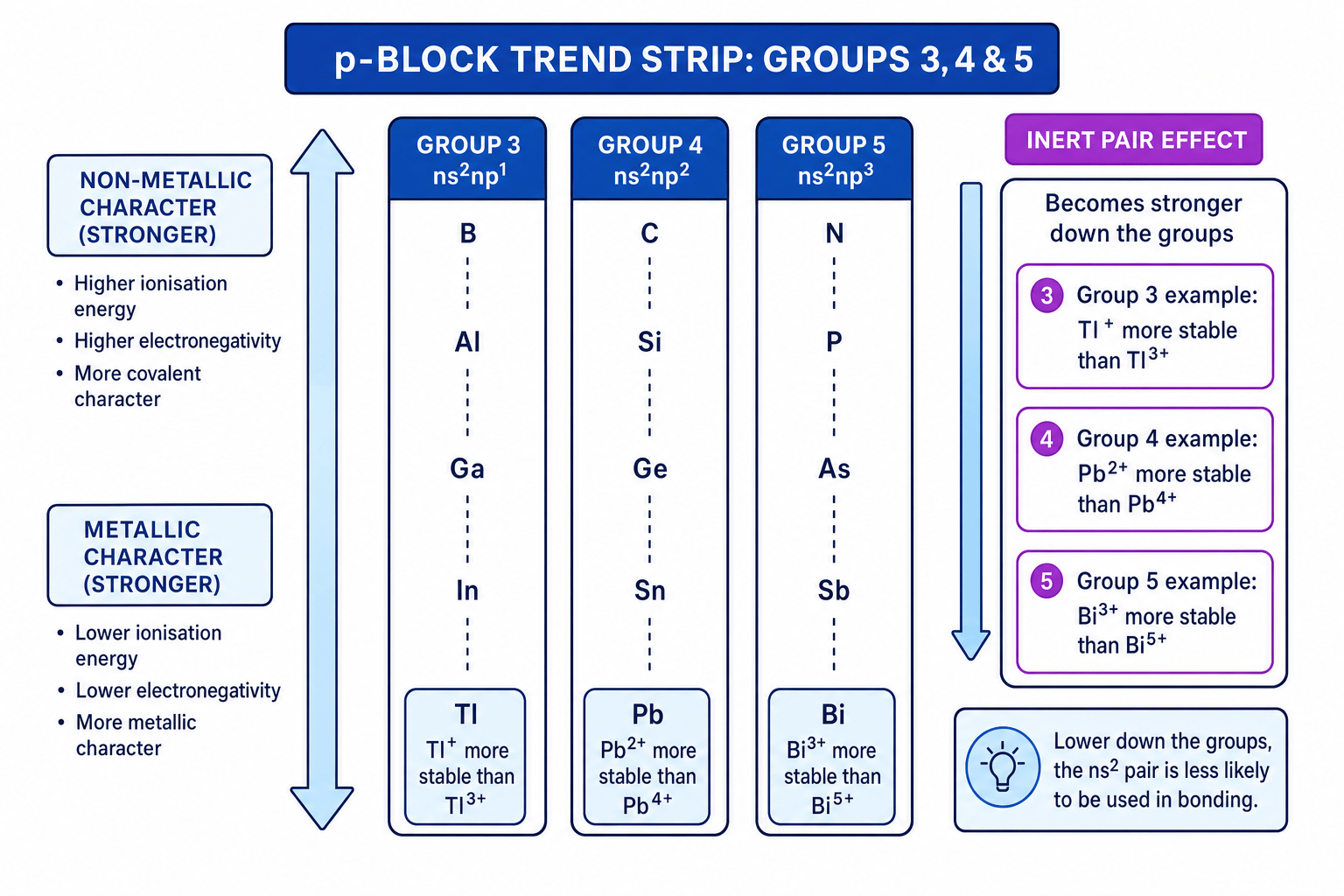
Going down a p-block group:
- atoms get larger
- ionisation energies generally decrease
- metallic character increases
- lower oxidation states often become more stable
Valence shell and octet
The valence shell is the outer electron shell involved in bonding. The octet rule is the useful idea that many atoms form bonds so they have eight electrons in their valence shell — but several p-block compounds are important exceptions.
2. The inert pair effect
In Groups 3, 4 and 5, the outer configuration is based on ns2npx\text{ns}^2\text{np}^xns2npx. Lower down these groups, the ns2\text{ns}^2ns2 pair is less likely to be used in bonding. This is called the inert pair effect.
Inert pair effect
The inert pair effect is the increasing stability, down a p-block group, of oxidation states that are two lower than the group’s maximum oxidation state because the outer ns2\text{ns}^2ns2 electron pair is less readily used in bonding.
So the more stable lower oxidation states are:
- Group 3: Tl+\text{Tl}^+Tl+ is more stable than Tl3+\text{Tl}^{3+}Tl3+
- Group 4: Pb2+\text{Pb}^{2+}Pb2+ is more stable than Pb4+\text{Pb}^{4+}Pb4+
- Group 5: Bi3+\text{Bi}^{3+}Bi3+ is more stable than Bi5+\text{Bi}^{5+}Bi5+
Stability down the p-block
Down Groups 3, 4 and 5, the lower oxidation state becomes more stable: +1 in Group 3, +2 in Group 4, and +3 in Group 5.
3. Amphoteric behaviour: reacting with acids and bases
An amphoteric substance reacts with both acids and bases. In this topic, aluminium and lead chemistry are the key examples.
Amphoteric
An amphoteric oxide, hydroxide or metal can react with acids and also with bases/alkalis.
Aluminium and aluminium(III)
Aluminium metal reacts with acids, producing hydrogen:
2Al(s)+6H+(aq)→2Al3+(aq)+3H2(g)2\text{Al}(s)+6\text{H}^+(aq)\to2\text{Al}^{3+}(aq)+3\text{H}_2(g)2Al(s)+6H+(aq)→2Al3+(aq)+3H2(g)It also reacts with hot concentrated alkali, forming aluminate ions:
2Al(s)+2OH−(aq)+6H2O(l)→2[Al(OH)4]−(aq)+3H2(g)2\text{Al}(s)+2\text{OH}^-(aq)+6\text{H}_2\text{O}(l)\to2[\text{Al(OH)}_4]^-(aq)+3\text{H}_2(g)2Al(s)+2OH−(aq)+6H2O(l)→2[Al(OH)4]−(aq)+3H2(g)For Al3+(aq)\text{Al}^{3+}(aq)Al3+(aq), adding aqueous sodium hydroxide gives a white precipitate of aluminium hydroxide:
Al3+(aq)+3OH−(aq)→Al(OH)3(s)\text{Al}^{3+}(aq)+3\text{OH}^-(aq)\to\text{Al(OH)}_3(s)Al3+(aq)+3OH−(aq)→Al(OH)3(s)In excess hydroxide, the precipitate dissolves:
Al(OH)3(s)+OH−(aq)→[Al(OH)4]−(aq)\text{Al(OH)}_3(s)+\text{OH}^-(aq)\to[\text{Al(OH)}_4]^-(aq)Al(OH)3(s)+OH−(aq)→[Al(OH)4]−(aq)Lead and lead(II)
Lead(II) hydroxide behaves similarly. Adding hydroxide to Pb2+(aq)\text{Pb}^{2+}(aq)Pb2+(aq) gives a white precipitate:
Pb2+(aq)+2OH−(aq)→Pb(OH)2(s)\text{Pb}^{2+}(aq)+2\text{OH}^-(aq)\to\text{Pb(OH)}_2(s)Pb2+(aq)+2OH−(aq)→Pb(OH)2(s)In excess hydroxide, it dissolves to form a plumbate(II) complex:
Pb(OH)2(s)+2OH−(aq)→[Pb(OH)4]2−(aq)\text{Pb(OH)}_2(s)+2\text{OH}^-(aq)\to[\text{Pb(OH)}_4]^{2-}(aq)Pb(OH)2(s)+2OH−(aq)→[Pb(OH)4]2−(aq)White precipitate is not enough
Both Al3+\text{Al}^{3+}Al3+ and Pb2+\text{Pb}^{2+}Pb2+ can give a white precipitate that dissolves in excess sodium hydroxide. You need another test, such as iodide for Pb2+\text{Pb}^{2+}Pb2+, to distinguish them.
Distinguishing aluminium(III) and lead(II) ions
-
Add aqueous sodium hydroxide dropwise. A white precipitate suggests an ion such as Al3+\text{Al}^{3+}Al3+ or Pb2+\text{Pb}^{2+}Pb2+ because insoluble hydroxides are forming.
-
Add excess sodium hydroxide. If the precipitate dissolves, the hydroxide is amphoteric, so Al3+\text{Al}^{3+}Al3+ and Pb2+\text{Pb}^{2+}Pb2+ are still both possible.
-
Test a fresh portion with iodide ions. A bright yellow precipitate of PbI2\text{PbI}_2PbI2 confirms Pb2+\text{Pb}^{2+}Pb2+; aluminium(III) does not give this yellow iodide precipitate.
4. Fewer than eight and more than eight electrons
Some Group 3 compounds are electron-deficient, meaning the central atom has fewer than eight electrons around it. Examples include BF3\text{BF}_3BF3 and AlCl3\text{AlCl}_3AlCl3.
Some elements in Groups 5, 6 and 7, especially from Period 3 downwards, can form compounds with more than eight electrons around the central atom. Examples include PCl5\text{PCl}_5PCl5, SF6\text{SF}_6SF6 and IF7\text{IF}_7IF7.
Counting electrons around a central atom
-
In BF3\text{BF}_3BF3, boron forms three single covalent bonds. Three bond pairs around boron give six electrons, so boron is electron-deficient.
-
In PCl5\text{PCl}_5PCl5, phosphorus forms five single covalent bonds. Five bond pairs around phosphorus give ten electrons, so this is an expanded valence shell.
-
Compare this with second-period elements such as carbon, nitrogen, oxygen and fluorine: they do not exceed an octet in normal A-Level examples.
5. Dative bonding: Al2Cl6\text{Al}_2\text{Cl}_6Al2Cl6 and NH3⋅BF3\text{NH}_3 \cdot \text{BF}_3NH3⋅BF3
A dative covalent bond, also called a coordinate bond, is a covalent bond where both shared electrons come from the same atom.
In AlCl3\text{AlCl}_3AlCl3, aluminium has only six electrons around it. Two AlCl3\text{AlCl}_3AlCl3 units can join to form Al2Cl6\text{Al}_2\text{Cl}_6Al2Cl6, using bridging chlorine atoms that donate lone pairs towards electron-deficient aluminium atoms.
In NH3⋅BF3\text{NH}_3 \cdot \text{BF}_3NH3⋅BF3, ammonia donates the lone pair on nitrogen to electron-deficient boron in BF3\text{BF}_3BF3:
NH3+BF3→H3N→BF3\text{NH}_3+\text{BF}_3\to\text{H}_3\text{N}\to\text{BF}_3NH3+BF3→H3N→BF3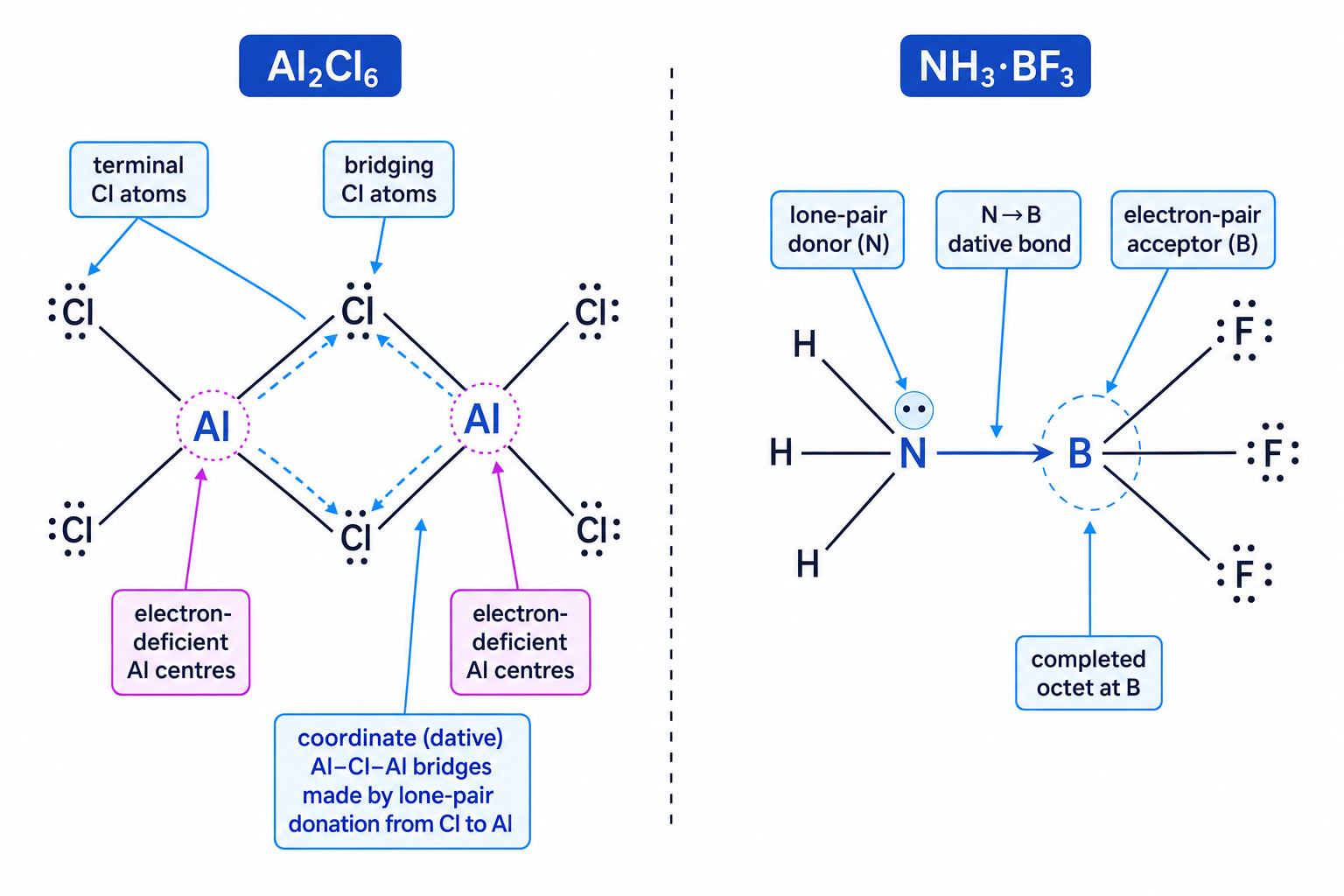
Dative bonds after formation
Once a dative bond has formed, it is a covalent bond. The special feature is only how it formed: both electrons were donated by one atom.
6. Boron nitride: same formula type, different structures
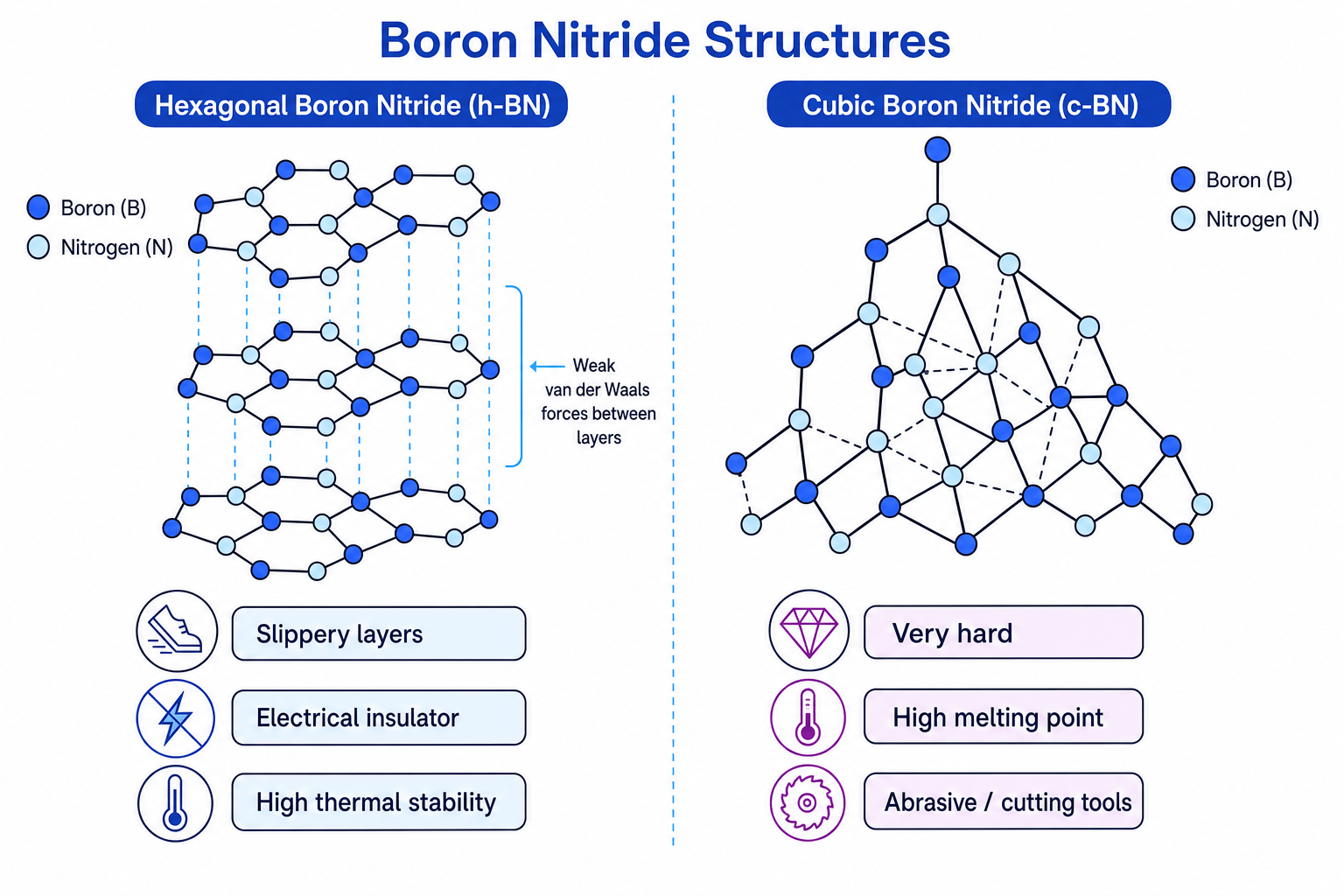
Boron nitride contains alternating boron and nitrogen atoms, but it can exist in different giant covalent structures.
Hexagonal boron nitride, h-BN, is like graphite:
- layers of hexagonal rings
- strong covalent bonds within each layer
- weak forces between layers
- slippery, so useful as a lubricant
- electrical insulator because electrons are not delocalised as in graphite
Cubic boron nitride, c-BN, is like diamond:
- three-dimensional tetrahedral giant covalent lattice
- very hard
- high melting point
- used in abrasives and cutting tools
7. Group 4: oxidation states, oxides and chlorides
Oxidation states II and IV
Group 4 elements can show +2 and +4 oxidation states. Down the group, +2 becomes more stable and +4 becomes less stable. This is especially important for lead.
Carbon and silicon strongly favour +4. Lead favours +2, so lead(IV) compounds are often oxidising agents because they are reduced to lead(II).
Carbon monoxide can act as a reducing agent because carbon in CO is oxidised from +2 to +4 in CO2\text{CO}_2CO2. For example:
PbO2(s)+CO(g)→PbO(s)+CO2(g)\text{PbO}_2(s)+\text{CO}(g)\to\text{PbO}(s)+\text{CO}_2(g)PbO2(s)+CO(g)→PbO(s)+CO2(g)Lead(IV) oxide is reduced to lead(II) oxide.
Oxidation states in the lead(IV) oxide and hydrochloric acid reaction
-
Assign oxidation states. Lead is +4 in PbO2\text{PbO}_2PbO2 and +2 in PbCl2\text{PbCl}_2PbCl2, while chlorine is -1 in HCl\text{HCl}HCl and 0 in Cl2\text{Cl}_2Cl2.
-
Compare the changes. Lead decreases from +4 to +2, so lead is reduced. Chloride increases from -1 to 0, so chloride is oxidised.
-
Link this to the trend. Because Pb2+\text{Pb}^{2+}Pb2+ is more stable than Pb4+\text{Pb}^{4+}Pb4+, PbO2\text{PbO}_2PbO2 acts as an oxidising agent:
Carbon dioxide and lead(II) oxide
CO2\text{CO}_2CO2 is a simple molecular covalent substance. It is a gas at room temperature, has a low boiling point, and does not conduct electricity. It is an acidic oxide:
CO2(g)+H2O(l)⇌H2CO3(aq)\text{CO}_2(g)+\text{H}_2\text{O}(l)\rightleftharpoons\text{H}_2\text{CO}_3(aq)CO2(g)+H2O(l)⇌H2CO3(aq)It reacts with alkali, for example:
CO2(g)+2NaOH(aq)→Na2CO3(aq)+H2O(l)\text{CO}_2(g)+2\text{NaOH}(aq)\to\text{Na}_2\text{CO}_3(aq)+\text{H}_2\text{O}(l)CO2(g)+2NaOH(aq)→Na2CO3(aq)+H2O(l)PbO\text{PbO}PbO is a solid with much more ionic character and a high melting point. It is amphoteric:
PbO(s)+2H+(aq)→Pb2+(aq)+H2O(l)\text{PbO}(s)+2\text{H}^+(aq)\to\text{Pb}^{2+}(aq)+\text{H}_2\text{O}(l)PbO(s)+2H+(aq)→Pb2+(aq)+H2O(l) PbO(s)+2OH−(aq)+H2O(l)→[Pb(OH)4]2−(aq)\text{PbO}(s)+2\text{OH}^-(aq)+\text{H}_2\text{O}(l)\to[\text{Pb(OH)}_4]^{2-}(aq)PbO(s)+2OH−(aq)+H2O(l)→[Pb(OH)4]2−(aq)Group 4 chlorides and water
The chlorides show a bonding trend from covalent molecular chlorides to more ionic chlorides.
CCl4\text{CCl}_4CCl4 is a simple covalent molecular liquid. It does not hydrolyse with water.
SiCl4\text{SiCl}_4SiCl4 is also simple molecular, but it hydrolyses rapidly in water, giving steamy fumes of hydrogen chloride:
SiCl4(l)+2H2O(l)→SiO2(s)+4HCl(aq)\text{SiCl}_4(l)+2\text{H}_2\text{O}(l)\to\text{SiO}_2(s)+4\text{HCl}(aq)SiCl4(l)+2H2O(l)→SiO2(s)+4HCl(aq)PbCl2\text{PbCl}_2PbCl2 is much more ionic. It is a white solid, sparingly soluble in cold water but more soluble in hot water, and it does not hydrolyse like SiCl4\text{SiCl}_4SiCl4.
8. Lead(II) ion tests
For Pb2+(aq)\text{Pb}^{2+}(aq)Pb2+(aq):
- with aqueous sodium hydroxide: white Pb(OH)2\text{Pb(OH)}_2Pb(OH)2 precipitate, soluble in excess hydroxide
- with chloride ions: white PbCl2\text{PbCl}_2PbCl2 precipitate, soluble in hot water
- with iodide ions: bright yellow PbI2\text{PbI}_2PbI2 precipitate, forming golden crystals on cooling from hot solution
The key ionic equations are:
Pb2+(aq)+2Cl−(aq)→PbCl2(s)\text{Pb}^{2+}(aq)+2\text{Cl}^-(aq)\to\text{PbCl}_2(s)Pb2+(aq)+2Cl−(aq)→PbCl2(s) Pb2+(aq)+2I−(aq)→PbI2(s)\text{Pb}^{2+}(aq)+2\text{I}^-(aq)\to\text{PbI}_2(s)Pb2+(aq)+2I−(aq)→PbI2(s)Safety in p-block practical work
Lead compounds are toxic, chlorine and hydrogen halides are harmful gases, hydrogen sulfide is toxic, and concentrated sulfuric acid is highly corrosive. These tests should be small-scale, with appropriate PPE, good ventilation or a fume cupboard, and correct waste disposal.
9. Chlorine with sodium hydroxide: disproportionation
A disproportionation reaction is one where the same element is both oxidised and reduced.
Disproportionation
In disproportionation, atoms of the same element in one oxidation state form products where that element has both a higher and a lower oxidation state.
With cold dilute sodium hydroxide:
Cl2(aq)+2OH−(aq)→Cl−(aq)+ClO−(aq)+H2O(l)\text{Cl}_2(aq)+2\text{OH}^-(aq)\to\text{Cl}^-(aq)+\text{ClO}^-(aq)+\text{H}_2\text{O}(l)Cl2(aq)+2OH−(aq)→Cl−(aq)+ClO−(aq)+H2O(l)Chlorine goes from 0 to -1 in Cl−\text{Cl}^-Cl− and from 0 to +1 in ClO−\text{ClO}^-ClO−.
With warm concentrated sodium hydroxide, chlorate(V) forms:
3Cl2(aq)+6OH−(aq)→5Cl−(aq)+ClO3−(aq)+3H2O(l)3\text{Cl}_2(aq)+6\text{OH}^-(aq)\to5\text{Cl}^-(aq)+\text{ClO}_3^-(aq)+3\text{H}_2\text{O}(l)3Cl2(aq)+6OH−(aq)→5Cl−(aq)+ClO3−(aq)+3H2O(l)This can be understood as further disproportionation of chlorate(I):
3ClO−(aq)→2Cl−(aq)+ClO3−(aq)3\text{ClO}^-(aq)\to2\text{Cl}^-(aq)+\text{ClO}_3^-(aq)3ClO−(aq)→2Cl−(aq)+ClO3−(aq)Identifying disproportionation in chlorine and alkali
-
Assign chlorine’s oxidation state in Cl2\text{Cl}_2Cl2: it is 0 because chlorine is in its elemental form.
-
In cold alkali, compare the products. Chlorine is -1 in Cl−\text{Cl}^-Cl− and +1 in ClO−\text{ClO}^-ClO−, so some chlorine atoms have gained electrons and others have lost electrons.
-
In warm alkali, chlorine is still reduced to -1 in Cl−\text{Cl}^-Cl−, but oxidised further to +5 in ClO3−\text{ClO}_3^-ClO3−. This is also disproportionation.
Chlorine and chlorate(I) ions bleach and kill bacteria because they are oxidising agents. In water:
Cl2(aq)+H2O(l)⇌HCl(aq)+HClO(aq)\text{Cl}_2(aq)+\text{H}_2\text{O}(l)\rightleftharpoons\text{HCl}(aq)+\text{HClO}(aq)Cl2(aq)+H2O(l)⇌HCl(aq)+HClO(aq)Chloric(I) acid, HClO\text{HClO}HClO, and chlorate(I), ClO−\text{ClO}^-ClO−, oxidise coloured molecules and essential bacterial cell components.
10. Sodium halides with concentrated sulfuric acid
Concentrated sulfuric acid first acts as an acid:
NaX(s)+H2SO4(l)→NaHSO4(s)+HX(g)\text{NaX}(s)+\text{H}_2\text{SO}_4(l)\to\text{NaHSO}_4(s)+\text{HX}(g)NaX(s)+H2SO4(l)→NaHSO4(s)+HX(g)where X is Cl, Br or I.
Then the behaviour depends on how strongly reducing the halide ion is. Reducing power increases down Group 7.
For NaCl\text{NaCl}NaCl, steamy white fumes of HCl\text{HCl}HCl form. Chloride is not a strong enough reducing agent to reduce concentrated sulfuric acid.
For NaBr\text{NaBr}NaBr, HBr\text{HBr}HBr forms, then reduces sulfuric acid to sulfur dioxide:
2HBr(g)+H2SO4(l)→Br2(g)+SO2(g)+2H2O(l)2\text{HBr}(g)+\text{H}_2\text{SO}_4(l)\to\text{Br}_2(g)+\text{SO}_2(g)+2\text{H}_2\text{O}(l)2HBr(g)+H2SO4(l)→Br2(g)+SO2(g)+2H2O(l)You may see orange-brown bromine and smell choking SO2\text{SO}_2SO2.
For NaI\text{NaI}NaI, HI\text{HI}HI is an even stronger reducing agent. It can reduce sulfuric acid to SO2\text{SO}_2SO2, sulfur, and hydrogen sulfide:
2HI(g)+H2SO4(l)→I2(s)+SO2(g)+2H2O(l)2\text{HI}(g)+\text{H}_2\text{SO}_4(l)\to\text{I}_2(s)+\text{SO}_2(g)+2\text{H}_2\text{O}(l)2HI(g)+H2SO4(l)→I2(s)+SO2(g)+2H2O(l) 6HI(g)+H2SO4(l)→3I2(s)+S(s)+4H2O(l)6\text{HI}(g)+\text{H}_2\text{SO}_4(l)\to3\text{I}_2(s)+\text{S}(s)+4\text{H}_2\text{O}(l)6HI(g)+H2SO4(l)→3I2(s)+S(s)+4H2O(l) 8HI(g)+H2SO4(l)→4I2(s)+H2S(g)+4H2O(l)8\text{HI}(g)+\text{H}_2\text{SO}_4(l)\to4\text{I}_2(s)+\text{H}_2\text{S}(g)+4\text{H}_2\text{O}(l)8HI(g)+H2SO4(l)→4I2(s)+H2S(g)+4H2O(l)Observations include purple iodine vapour or black iodine solid, yellow sulfur, and a rotten-egg smell from H2S\text{H}_2\text{S}H2S.
Halides with concentrated sulfuric acid
Think “acid first, redox second”. All three halides form HX initially, but only bromide and iodide reduce concentrated sulfuric acid.
In the exam
-
For trend questions, link observations to electron configuration or oxidation-state stability — especially the inert pair effect for lead and bismuth.
-
For test-tube chemistry, give both the observation and the species formed, such as “white precipitate of PbCl2\text{PbCl}_2PbCl2” or “yellow precipitate of PbI2\text{PbI}_2PbI2”.
-
For chlorine and halide redox questions, assign oxidation states carefully before naming oxidising and reducing agents.
Check yourself
- Why does PbO2\text{PbO}_2PbO2 oxidise chloride ions in concentrated hydrochloric acid?
- How would you distinguish Al3+(aq)\text{Al}^{3+}(aq)Al3+(aq) from Pb2+(aq)\text{Pb}^{2+}(aq)Pb2+(aq) using simple aqueous tests?
- What observations would you expect when NaI\text{NaI}NaI reacts with concentrated sulfuric acid?

