What you'll learn
- How ionic, covalent and coordinate bonds form from electron changes.
- How electronegativity explains bond polarity and why bonding is a continuum.
- How VSEPR predicts molecular shapes and bond angles.
- How dipoles and hydrogen bonding affect boiling temperature and solubility.
Starting point: outer electrons and stability
Chemical bonding is mainly about outer-shell electrons. Atoms form bonds because the bonded arrangement is usually lower in energy than the separate atoms.
For many main-group elements, a stable arrangement often involves a full outer shell: eight outer electrons for many atoms, or two for hydrogen and helium-like arrangements. This is a useful model, not a law that explains every compound.
Valence electrons
Valence electrons are the electrons in the outer shell of an atom. They are the electrons most involved in forming chemical bonds.
Ionic bonding
An ion is a charged particle formed when an atom or group of atoms loses or gains electrons. Metals tend to lose electrons to form positive ions called cations. Non-metals tend to gain electrons to form negative ions called anions.
Ionic bonding
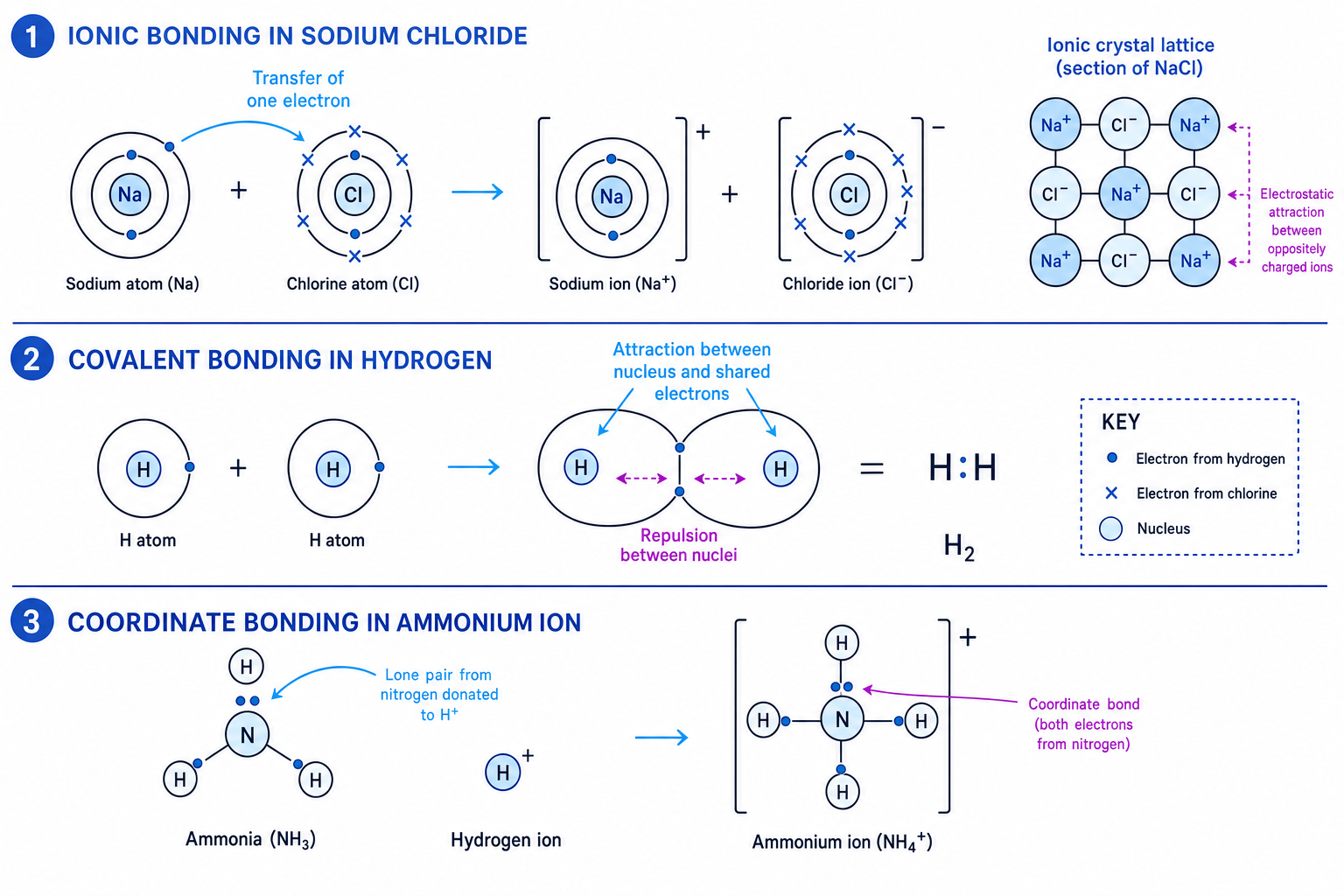
Ionic bonding is the strong electrostatic attraction between oppositely charged ions in a giant ionic crystal lattice.
An ionic crystal is a regular, repeating three-dimensional arrangement of ions. In sodium chloride, Na⁺ and Cl⁻ ions alternate through the lattice. Each ion attracts oppositely charged ions around it in all directions.
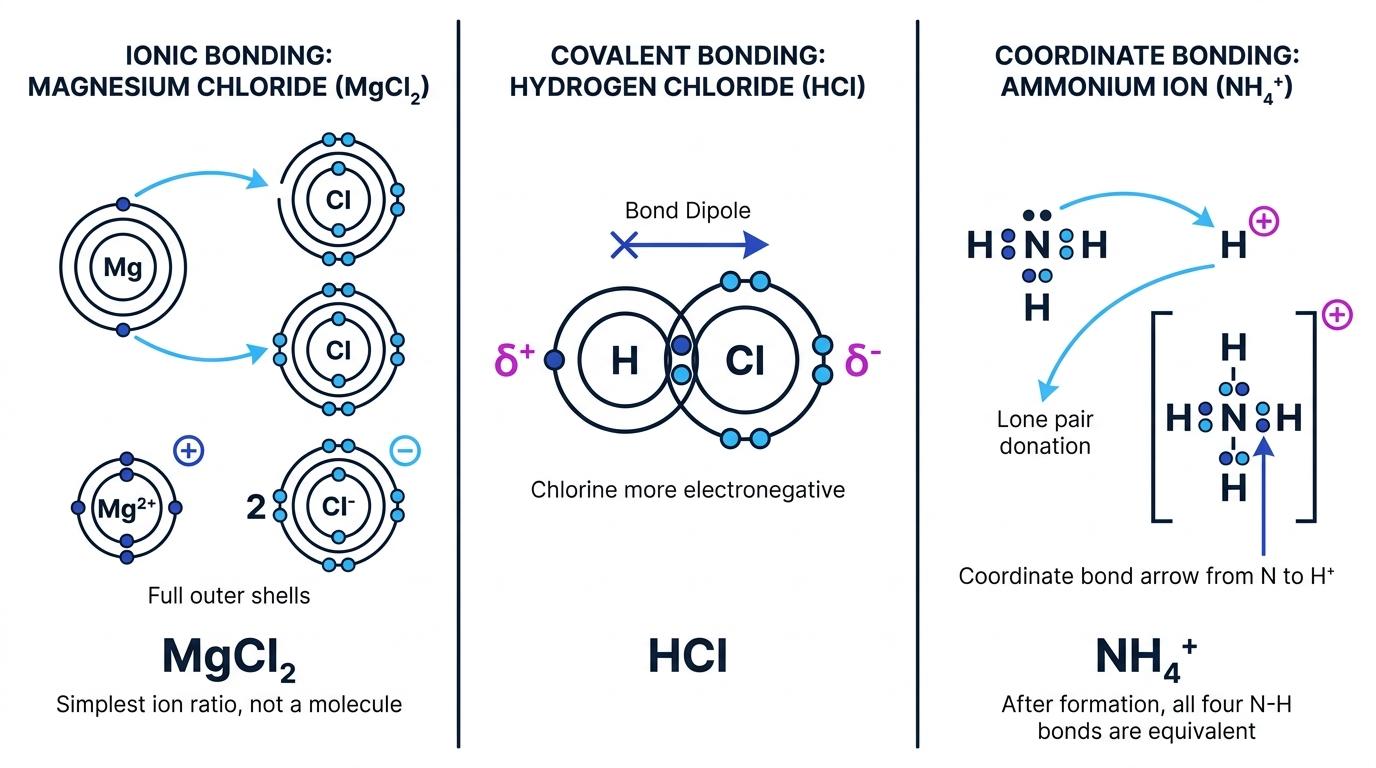
The diagram below compares ionic, covalent and coordinate bonding using dot-and-cross ideas.
Working out an ionic formula from electron transfer
-
Magnesium is in Group 2, so a magnesium atom loses two outer electrons to form Mg²⁺. Chlorine is in Group 17, so each chlorine atom gains one electron to form Cl⁻.
-
The compound must be electrically neutral. One Mg²⁺ ion has a charge of 2+, so it needs two Cl⁻ ions to balance the charge.
-
The formula is MgCl₂. In the solid, the bonding is not between one magnesium and two chlorine atoms as a little molecule; it is attraction between Mg²⁺ and Cl⁻ ions throughout a giant lattice.
Ionic compounds are not molecules
Do not describe sodium chloride as “NaCl molecules”. NaCl is a formula unit in a giant ionic lattice: it shows the simplest whole-number ratio of Na⁺ to Cl⁻ ions.
Covalent bonding
Covalent bond
A covalent bond is a shared pair of electrons between two atoms, with both nuclei attracted to the shared electrons.
A covalent bond exists because there is a balance of forces:
- attraction between each positive nucleus and the shared pair of electrons
- repulsion between the two positive nuclei
- repulsion between electrons
At the bond length, these attractions and repulsions balance to give a stable molecule. Covalent bonds can be single, double or triple depending on how many electron pairs are shared.
Coordinate bonding
A lone pair is a pair of electrons in the outer shell that is not currently involved in bonding.
Coordinate bond
A coordinate bond is a covalent bond in which both electrons in the shared pair are donated by the same atom.
A common example is the formation of the ammonium ion, NH₄⁺, from ammonia and a hydrogen ion.
Identifying a coordinate bond in NH₄⁺
-
In NH₃, nitrogen has three N–H bonds and one lone pair. H⁺ has no electron to contribute.
-
The nitrogen atom donates its lone pair to H⁺, forming a new N–H covalent bond. Both electrons in this new bond originally came from nitrogen.
-
Once NH₄⁺ has formed, all four N–H bonds are equivalent. The term “coordinate” explains how the bond formed, not that it remains a weaker or different type of bond.
A bond is a stable balance
Covalent bonding is not just “sharing electrons”; it is the stable balance between attractions and repulsions inside the molecule.
Electronegativity, polarity and intermediate bonding
Electronegativity
Electronegativity is the ability of an atom in a covalent bond to attract the shared pair of electrons towards itself.
If two bonded atoms have different electronegativities, the shared electrons are pulled closer to the more electronegative atom. That atom becomes slightly negative, shown as δ−, and the other atom becomes slightly positive, shown as δ+.
Bond polarity
Bond polarity is the uneven distribution of electron density in a covalent bond, producing partial charges δ+ and δ−.
Bonding is best thought of as a continuum:
- identical atoms, such as Cl₂, form non-polar covalent bonds
- atoms with different electronegativities, such as HCl, form polar covalent bonds
- very large electronegativity differences often give bonding that is mostly ionic
- many real bonds have intermediate character rather than being perfectly ionic or perfectly covalent
Assigning bond polarity in hydrogen chloride
-
Chlorine is more electronegative than hydrogen, so the shared electron pair in H–Cl is pulled closer to chlorine.
-
Chlorine becomes δ− and hydrogen becomes δ+.
-
HCl has a permanent bond dipole, so neighbouring HCl molecules can attract each other by δ+ to δ− interactions.
VSEPR and molecular shape
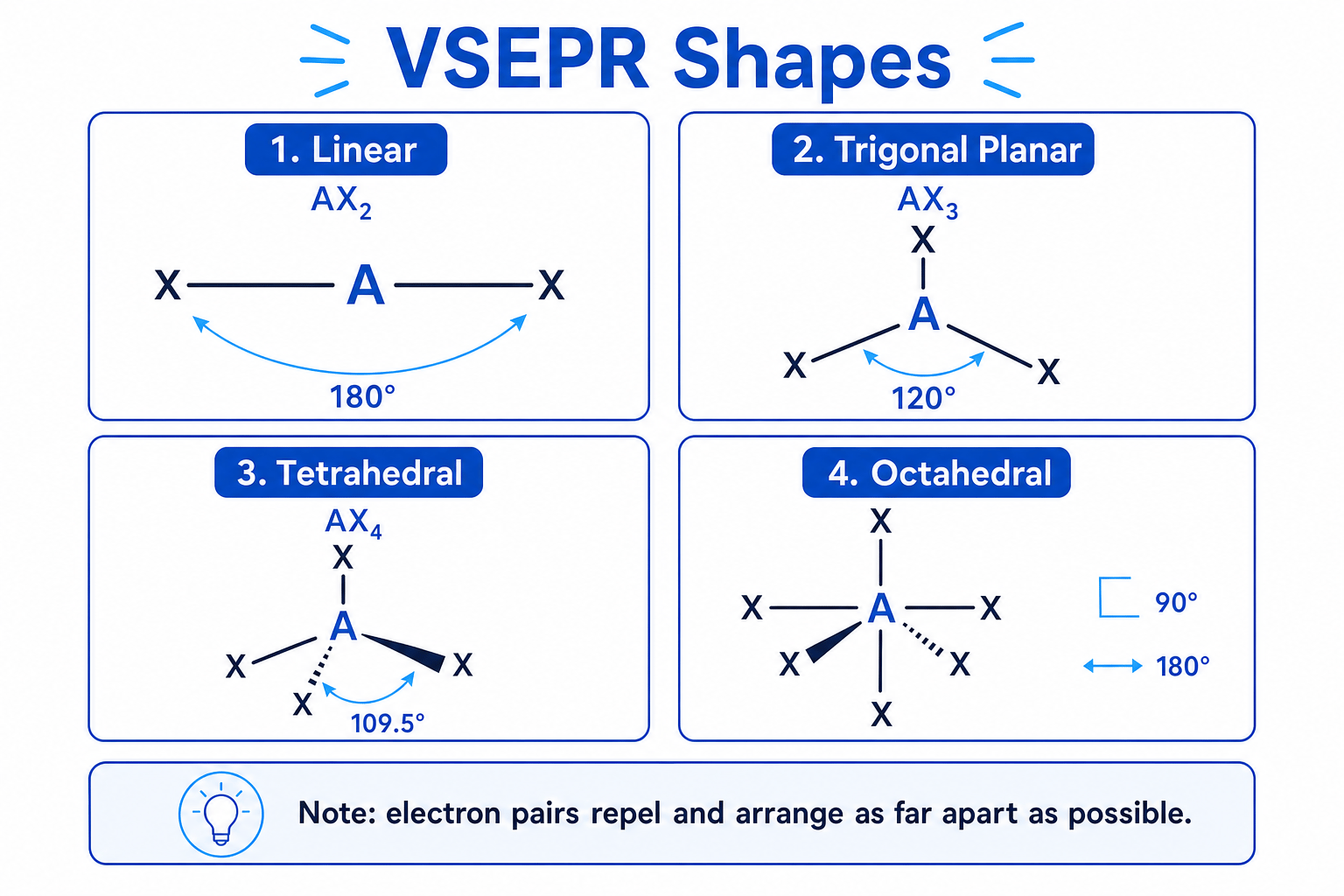
VSEPR stands for valence shell electron pair repulsion. It is a model used to predict the shapes of molecules and ions.
VSEPR principle
Electron pairs around a central atom repel each other and arrange themselves as far apart as possible in three-dimensional space.
A bonding pair is an electron pair used in a bond. A lone pair is not bonded, but it still repels. Multiple bonds count as one region of electron density when deciding the basic arrangement.
For 3D drawings:
- a straight line shows a bond in the plane of the page
- a solid wedge shows a bond coming out towards you
- a dashed wedge shows a bond going back away from you
The key ideal shapes and angles you need here are:
- linear: two bonding regions, 180°, for example CO₂
- trigonal planar: three bonding regions, 120°, for example BF₃
- tetrahedral: four bonding regions, 109.5°, for example CH₄ or NH₄⁺
- octahedral: six bonding regions, 90° and 180°, for example SF₆
Predicting the shape of NH₄⁺
-
Nitrogen is the central atom. In NH₄⁺, it has four N–H bonds and no lone pairs, so there are four regions of electron density around nitrogen.
-
Four electron-pair regions arrange themselves as far apart as possible in a tetrahedral arrangement.
-
Because all four regions are bonding pairs, the molecular shape is tetrahedral and the H–N–H bond angle is 109.5°.
Lone pairs still count
Use electron pairs to find the arrangement, then use atoms to name the molecular shape. Lone pairs repel more strongly than bonding pairs, so they can reduce bond angles slightly, as in NH₃ and H₂O.
Molecular polarity: bond dipoles plus shape
A molecule with polar bonds is not always a polar molecule. You must consider the shape.
If bond dipoles are arranged symmetrically, they can cancel. If they do not cancel, the molecule has an overall dipole.
Comparing CCl₄ and CH₃Cl polarity
-
C–Cl bonds are polar because chlorine is more electronegative than carbon, so each C–Cl bond dipole points towards chlorine.
-
In CCl₄, the four identical C–Cl bond dipoles are arranged symmetrically in a tetrahedral shape. The dipoles cancel, so CCl₄ is non-polar overall.
-
In CH₃Cl, the tetrahedral molecule is not symmetrical because one bond is C–Cl and the others are C–H. The dipoles do not cancel, so CH₃Cl is polar.
Intermolecular forces
Intermolecular forces
Intermolecular forces are attractions between molecules. They are much weaker than covalent bonds within molecules and much weaker than ionic bonding in ionic lattices.
This distinction matters. When a simple molecular substance boils, you usually overcome intermolecular forces between molecules, not covalent bonds within molecules.
Temporary and permanent dipoles
A dipole is a separation of charge. A temporary dipole happens when electrons are unevenly distributed for an instant. This can induce a dipole in a neighbouring molecule. These attractions are often called London forces.
All molecules have London forces. They are stronger when molecules have:
- more electrons
- larger electron clouds
- greater surface contact between molecules
A permanent dipole exists in a polar molecule all the time. Permanent dipole-dipole attractions occur when the δ+ end of one polar molecule attracts the δ− end of another.
Hydrogen bonding
Hydrogen bonding
Hydrogen bonding is a strong type of intermolecular attraction involving a hydrogen atom covalently bonded to N, O or F, attracted to a lone pair on N, O or F in a neighbouring molecule.
Hydrogen bonding is stronger than ordinary permanent dipole-dipole attractions, but still much weaker than a covalent bond.
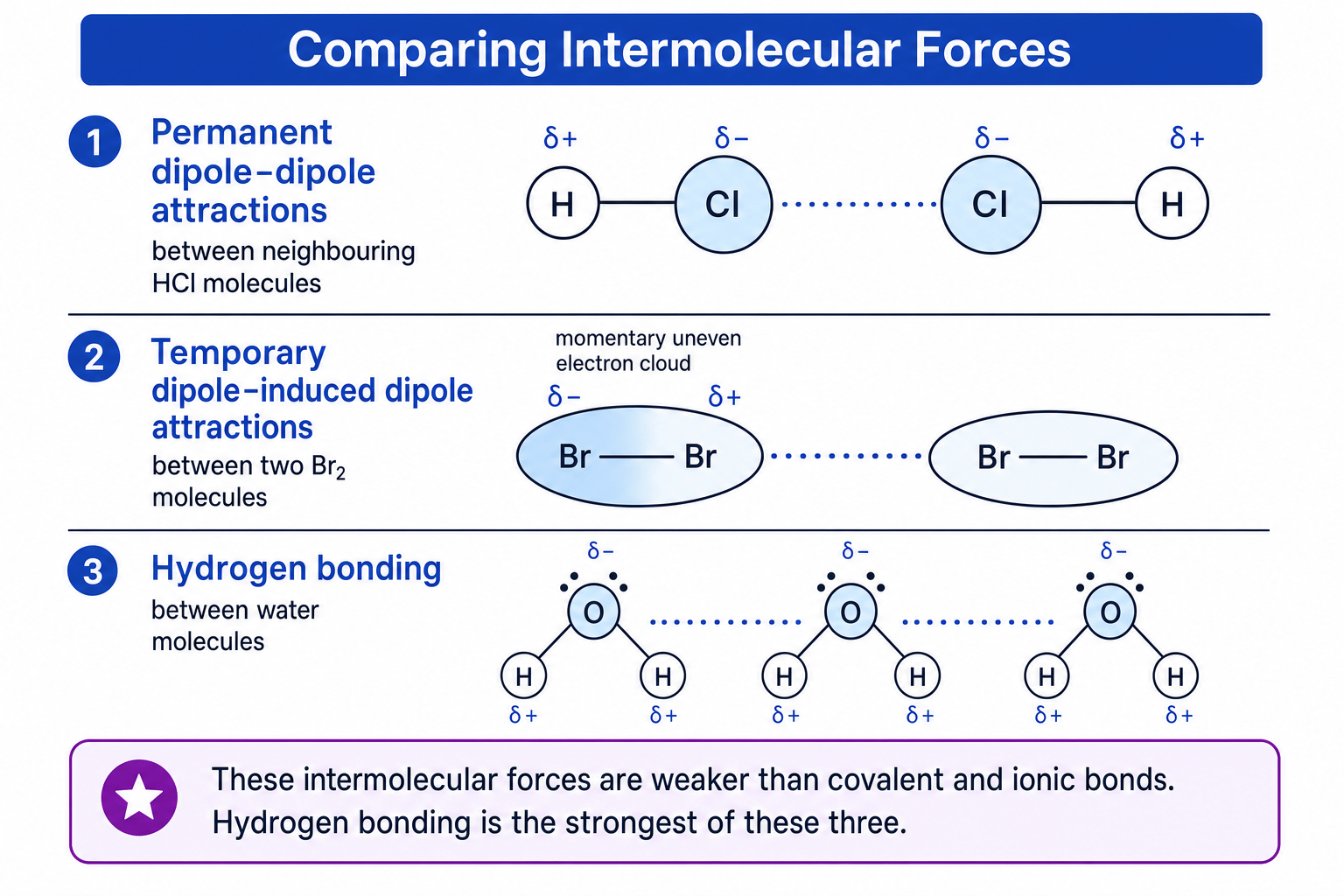
Stronger intermolecular forces usually mean higher boiling temperatures, because more energy is needed to separate molecules. They also affect solubility: polar substances and substances that can hydrogen bond often dissolve well in polar solvents such as water.
Explaining the high boiling temperature of water
-
H₂O and H₂S are both simple molecular substances, so boiling involves overcoming intermolecular forces, not breaking covalent bonds.
-
Water molecules have O–H bonds and lone pairs on oxygen, so they form hydrogen bonds between molecules. H₂S cannot form hydrogen bonds because sulfur is not electronegative enough in this context.
-
Hydrogen bonds require more energy to overcome, so H₂O has a much higher boiling temperature than H₂S.
Hydrogen bonding needs the right bond
A molecule containing hydrogen does not automatically have hydrogen bonding. The hydrogen must be directly bonded to N, O or F for strong hydrogen bonding between molecules of that substance.
Solubility shortcut
Use “like dissolves like”: polar and hydrogen-bonding substances tend to dissolve in polar solvents; non-polar substances tend to dissolve better in non-polar solvents.
In the exam
-
Always name the particles and forces: ions in a lattice, atoms sharing electrons in a molecule, or intermolecular forces between molecules.
-
For shapes, count regions of electron density around the central atom, choose the arrangement that minimises repulsion, then give the shape and bond angle.
-
For boiling point or solubility comparisons, identify the strongest relevant intermolecular force and explain how much energy is needed to overcome it.
Check yourself
- Explain how MgCl₂ forms from magnesium and chlorine atoms, including the ions produced.
- Predict the shape and bond angle of BF₃ and NH₄⁺.
- Why does ethanol dissolve in water much better than hexane?