

What you'll learn
- How sodium chloride and caesium chloride form different ionic crystal structures.
- How diamond, graphite, iodine and ice are built from different particles and forces.
- How the electron sea model explains metallic bonding.
- How to link melting temperature, hardness, solubility and electrical conductance to structure and bonding.
Why solid structure matters
A solid’s properties are not random. They depend on:
- which particles are present: atoms, ions or molecules
- how those particles are arranged
- what forces hold the particles together
In C1.5, your main skill is to connect a structure to a property using the correct type of bonding.
Crystal lattice
A crystal lattice is a regular, repeating three-dimensional arrangement of particles in a solid.
Crystals are usually described using models such as unit cells, which are small repeating sections of the lattice. These models are not just guesses: structures are supported by evidence from techniques such as X-ray diffraction.
Ionic crystal structures
An ionic compound contains positive ions and negative ions held together by strong electrostatic attractions. These attractions act in all directions through a giant lattice.
Coordination number
The coordination number of an ion in a crystal is the number of oppositely charged ions directly surrounding it.
Sodium chloride, NaCl
Sodium chloride has the rock salt structure. Each Na+ ion is surrounded by 6 Cl− ions, and each Cl− ion is surrounded by 6 Na+ ions.
So sodium chloride has a 6:6 coordination.
It is important to say that NaCl does not contain separate “NaCl molecules”. It is a giant ionic lattice with a 1:1 ratio of Na+ to Cl− ions.
Caesium chloride, CsCl
Caesium chloride has a different structure. Each Cs+ ion is surrounded by 8 Cl− ions, and each Cl− ion is surrounded by 8 Cs+ ions.
So caesium chloride has an 8:8 coordination.
The difference happens because Cs+ is much larger than Na+, so a different packing arrangement is possible.
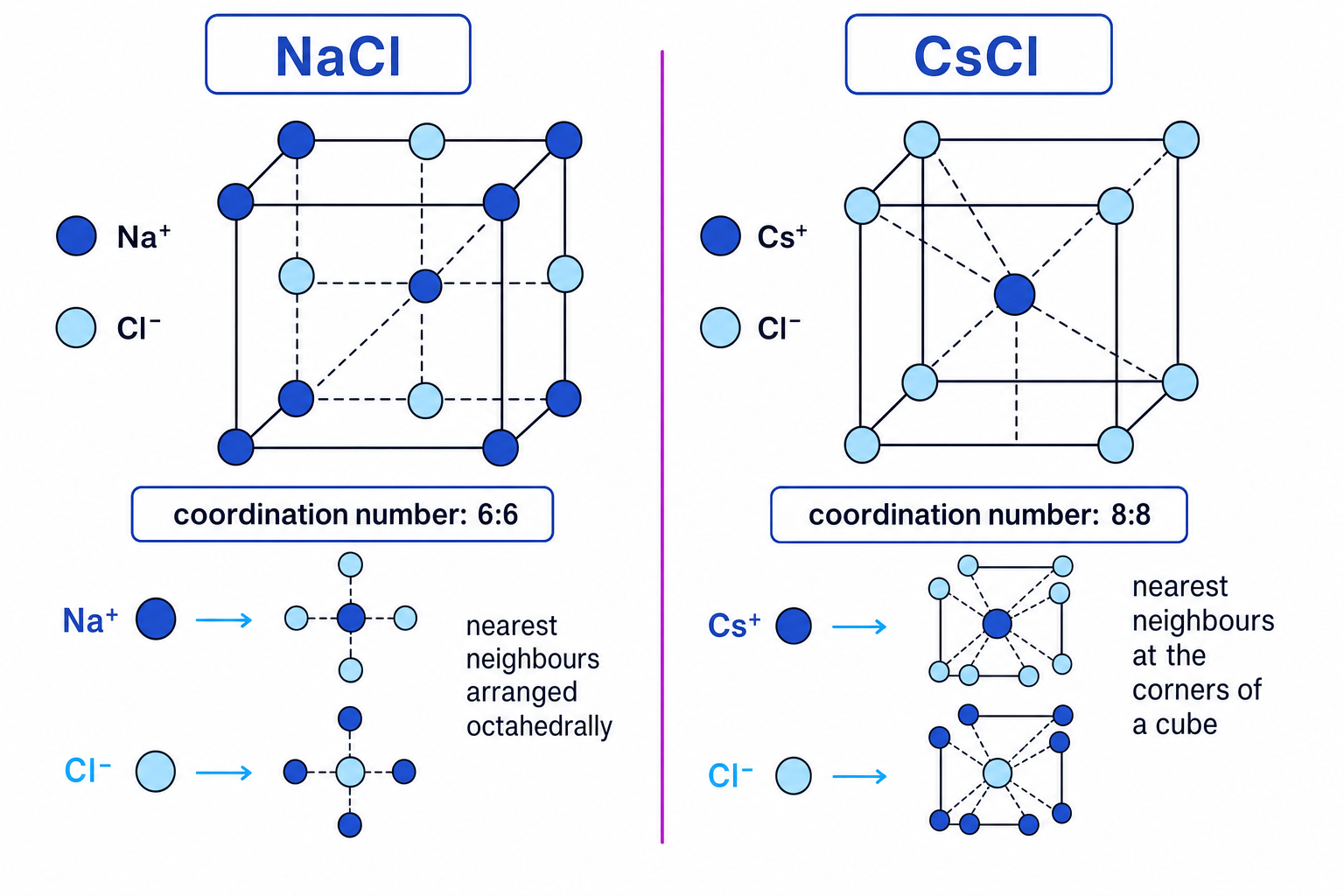
Counting ions in a CsCl unit cell
-
In the usual CsCl unit cell model, one Cs+ ion is shown at the centre of the cube. A particle fully inside the unit cell counts as 1 ion.
-
The Cl− ions are shown at the 8 corners. Each corner ion is shared between 8 neighbouring cubes, so each contributes 18\frac{1}{8}81 to one unit cell.
-
The total number of Cl− ions counted is 8×18=18 \times \frac{1}{8} = 18×81=1, giving 1 Cs+ and 1 Cl− per unit cell.
-
The ratio is therefore 1:1, which matches the formula CsCl.
Calling ionic lattices molecules
Do not describe sodium chloride or caesium chloride as simple molecules. Ionic compounds form giant lattices, not discrete NaCl or CsCl molecules.
Giant covalent structures
A giant covalent structure is a huge network of atoms joined by covalent bonds. The specification may also call these giant molecular substances, but the key point is that covalent bonds extend throughout the structure.
Covalent bond
A covalent bond is a strong attraction between a shared pair of electrons and the nuclei of the bonded atoms.
Diamond
Diamond is made only of carbon atoms. Each carbon atom forms 4 covalent bonds to 4 other carbon atoms in a tetrahedral arrangement.
This creates a rigid three-dimensional network.
Diamond has:
- a very high melting temperature, because many strong covalent bonds must be broken
- great hardness, because the 3D network is very rigid
- no electrical conductance, because it has no mobile ions or delocalised electrons
- insolubility in water and organic solvents, because covalent bonds throughout the network would need to be broken
Graphite
Graphite is also made only of carbon atoms, but its structure is different.
Each carbon atom forms 3 covalent bonds to other carbon atoms in flat hexagonal layers. The fourth outer electron from each carbon becomes delocalised, meaning it is no longer fixed between two particular atoms.
Delocalised electron
A delocalised electron is an electron that is free to move through part of a structure rather than being held in one specific bond.
Graphite has:
- a high melting temperature, because strong covalent bonds exist within the layers
- softness and slipperiness, because weak forces between layers allow the layers to slide
- electrical conductance along the layers, because delocalised electrons can move
- insolubility, because the covalent network within layers is still very strong
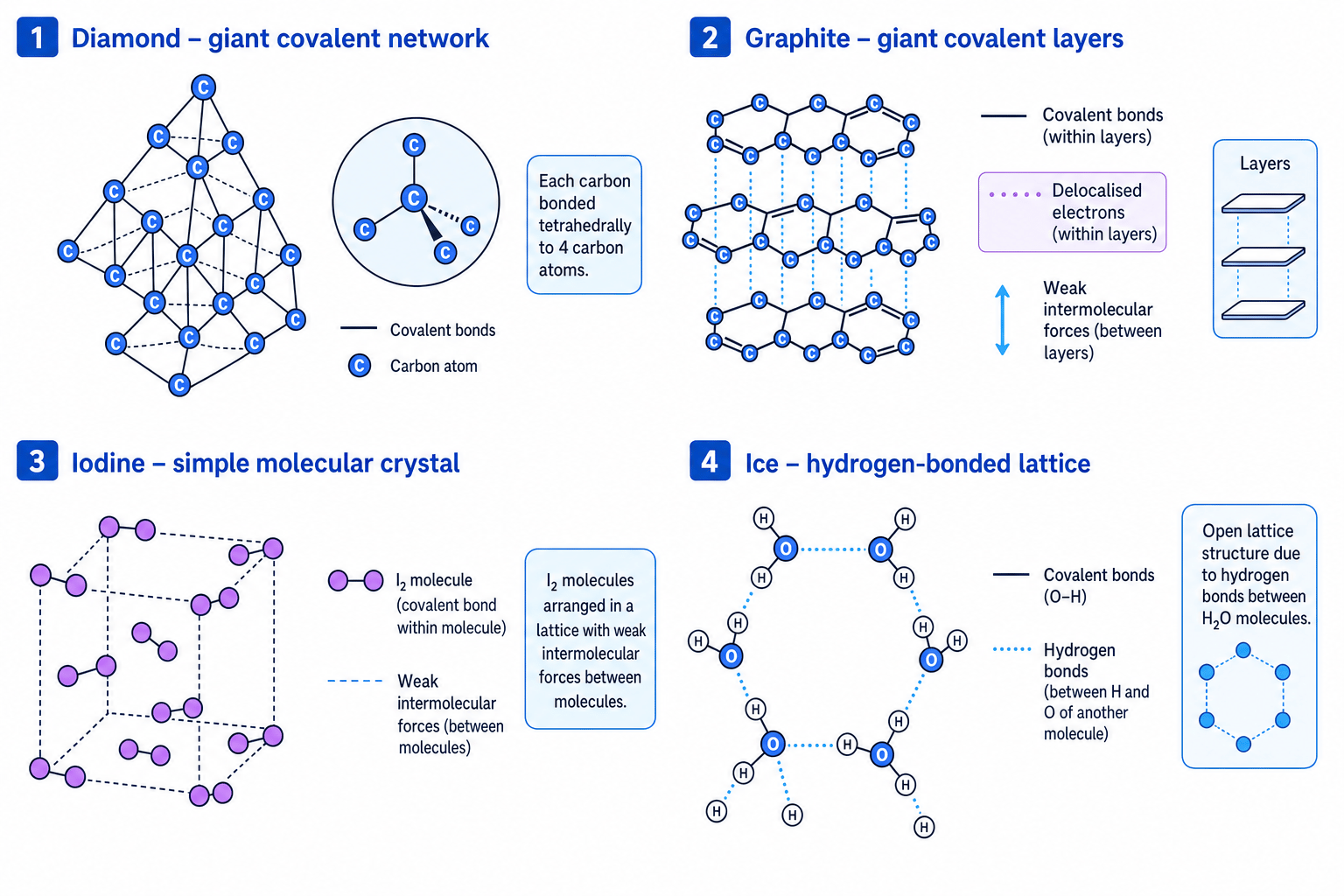
Same atoms, different structure
Diamond and graphite are both forms of carbon, but their different structures give them very different properties. In exams, properties come from structure, not just formula.
Simple molecular solids
A simple molecular substance contains separate molecules. The atoms within each molecule are joined by covalent bonds, but the molecules are held to each other by intermolecular forces.
Intermolecular force
An intermolecular force is an attraction between molecules. It is usually much weaker than a covalent, ionic or metallic bond.
Iodine, I2
Solid iodine contains I2 molecules arranged in a crystal lattice. Within each I2 molecule, the two iodine atoms are joined by a covalent bond.
Between the I2 molecules there are weak intermolecular forces, specifically London forces.
Iodine has:
- a low melting temperature compared with giant structures, because only intermolecular forces are overcome
- a tendency to sublime, changing from solid to gas
- no electrical conductance, because it has no mobile charged particles
- greater solubility in non-polar solvents than in water
Breaking the wrong bond in iodine
When iodine melts or boils, the covalent I–I bonds inside I2 molecules are not broken. The intermolecular forces between I2 molecules are overcome.
Ice, H2O
Ice is a molecular solid made from H2O molecules. Each water molecule has strong covalent O–H bonds within it.
Between water molecules, there are hydrogen bonds.
Hydrogen bond
A hydrogen bond is a strong type of intermolecular force involving a hydrogen atom covalently bonded to a very electronegative atom, usually O, N or F, attracted to a lone pair on O, N or F in another molecule.
Hydrogen bonding gives ice an open lattice structure. This is why ice is less dense than liquid water, so ice floats.
Ice has a higher melting temperature than expected for such a small molecule, because hydrogen bonds are stronger than ordinary London forces. However, it is still far lower melting than giant ionic or giant covalent structures.
Metallic bonding and the electron sea model
Metals consist of positive metal ions in a regular lattice surrounded by delocalised electrons.
Electron sea model
The electron sea model describes metallic bonding as the electrostatic attraction between positive metal ions and a “sea” of delocalised electrons.
This model explains several key metallic properties.
Metals conduct electricity because delocalised electrons can move through the solid and carry charge. They also conduct when molten, because the electrons remain mobile.
Metals are malleable and ductile because layers of positive ions can slide over each other while the delocalised electrons continue to hold the structure together.
Many metals have high melting temperatures because metallic bonding is strong. However, the strength varies: metals with more delocalised electrons and smaller, more highly charged ions often have stronger metallic bonding.
A quick conductance test
Ask: “Are there mobile charged particles?” If yes, the substance can conduct. In metals these are electrons; in molten or aqueous ionic compounds these are ions.
Linking structure to physical properties
The most important exam skill in this section is explaining a property using the particles and forces present.
Melting temperature
A substance has a high melting temperature if strong attractions must be overcome.
- Ionic compounds: high, due to strong electrostatic attractions between oppositely charged ions.
- Giant covalent substances: very high, due to many strong covalent bonds.
- Simple molecular substances: low, because only intermolecular forces are overcome.
- Metals: usually high, due to metallic bonding, but values vary.
Solubility
Solubility depends on whether favourable attractions can form between the solute and solvent.
Ionic compounds often dissolve in polar solvents such as water, because water molecules can attract and stabilise ions. However, not all ionic compounds are soluble.
Simple non-polar molecular substances, such as iodine, tend to dissolve better in non-polar solvents.
Giant covalent substances are generally insoluble because breaking up the network would require breaking many covalent bonds.
Metals are generally insoluble, although some react chemically with water or acids.
Hardness and brittleness
Diamond is very hard because its covalent network is rigid in three dimensions.
Graphite is soft because its layers can slide over each other.
Ionic crystals are often hard but brittle. A force can shift layers so that ions with the same charge become aligned next to each other. Repulsion then splits the crystal.
Metals are often malleable rather than brittle because the electron sea still attracts the shifted positive ions.
Electrical conductance
Electrical conductance requires mobile charged particles.
| Type of solid | Conducts as solid? | Conducts when molten or dissolved? | Reason |
|---|---|---|---|
| Ionic compound | No | Yes, if molten or aqueous | ions are fixed in the solid but mobile when molten or in solution |
| Diamond | No | No | no mobile charged particles |
| Graphite | Yes, along layers | Not usually considered molten in this context | delocalised electrons can move along layers |
| Simple molecular substance | No | No, usually | molecules are neutral and no mobile ions or electrons are present |
| Metal | Yes | Yes when molten | delocalised electrons are mobile |
Identifying a solid from its properties
A solid has a very high melting temperature, does not dissolve in water, does not conduct electricity, and is extremely hard. Identify the most likely structure.
-
The very high melting temperature suggests either a giant ionic lattice, a giant covalent structure, or a metal, because strong attractions must be overcome.
-
The lack of electrical conductance rules out a metal, because metals conduct as solids. It also makes graphite unlikely, because graphite conducts due to delocalised electrons.
-
The insolubility and extreme hardness point to a rigid giant covalent network rather than an ionic compound, since many ionic compounds dissolve in water and are brittle.
-
The most likely structure is diamond: a giant covalent structure with each carbon bonded to 4 other carbon atoms.
Structure-property explanations
A strong answer usually follows this chain: structure → particles or bonding → property. For example: “graphite conducts because it has delocalised electrons that can move along the layers.”
In the exam
-
Identify the type of solid first: ionic lattice, giant covalent, simple molecular or metallic.
-
For melting or hardness questions, name the force being overcome: ionic attraction, covalent bonds, intermolecular forces or metallic bonding.
-
For electrical conductance, always state the mobile charged particle: ions for molten or aqueous ionic compounds, electrons for metals and graphite.
Check yourself
- Why does NaCl have 6:6 coordination but CsCl has 8:8 coordination?
- Why does graphite conduct electricity but diamond does not?
- When iodine melts, which forces are overcome?
