What you'll learn
- How relative masses, isotopes and mass spectra connect to ArA_rAr and MrM_rMr.
- How to use the mole, molar mass, concentration and gas equations confidently.
- How to calculate empirical formulae, titration results, atom economy and percentage yield.
- How to handle percentage uncertainty and sensible significant figures.
Why “amount of substance” matters
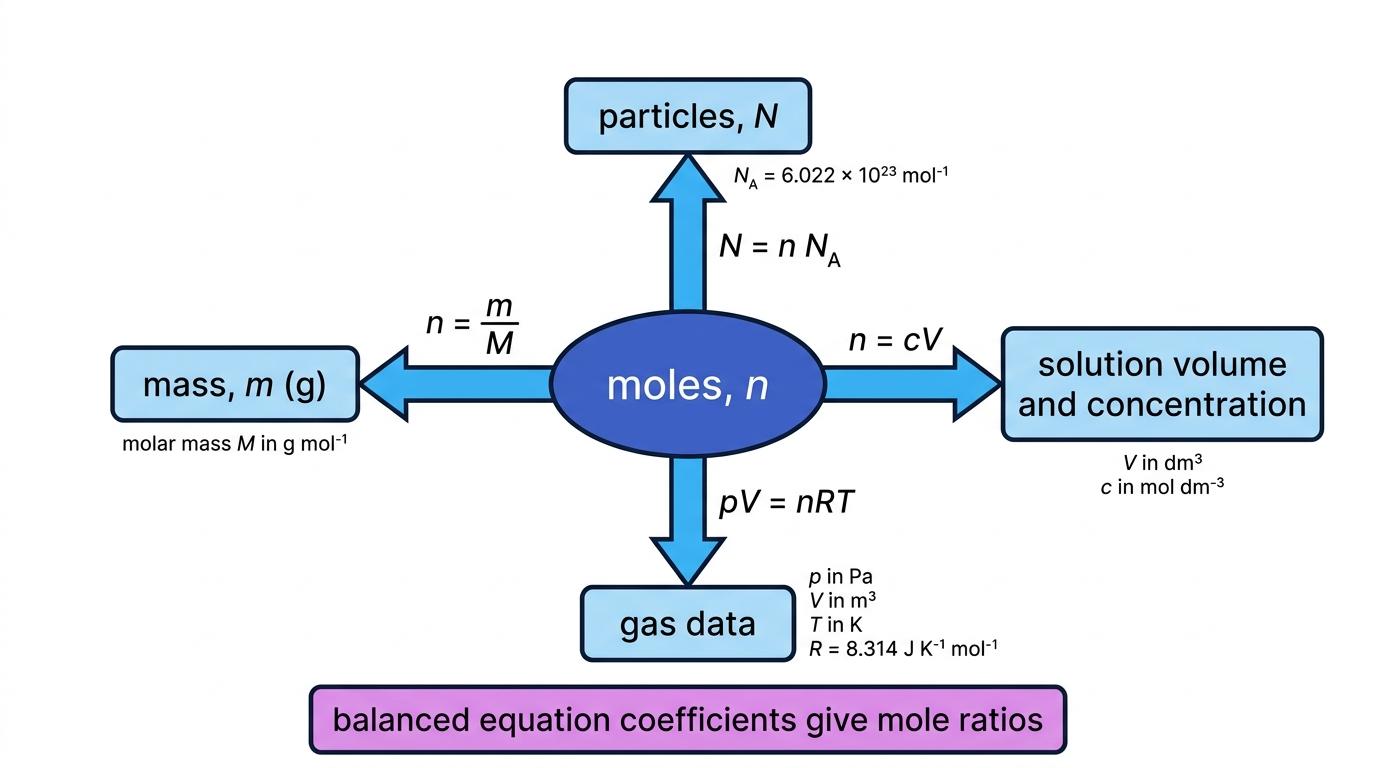
Atoms and molecules are far too small to count one by one in the lab. Instead, chemists weigh substances, measure volumes, or record spectra, then convert those measurements into amount of substance in mol.
The central strategy
Most chemical calculations become easier once you convert the given information into moles, use the balanced equation ratio, then convert into the unit asked for.
Relative mass terms
Chemistry uses a relative mass scale based on carbon-12. One atom of carbon-12 is assigned a mass of exactly 12, so one twelfth of a carbon-12 atom is the reference.
Relative mass terms
- Relative isotopic mass is the mass of an atom of a particular isotope compared with one twelfth of the mass of a carbon-12 atom.
- Relative atomic mass, ArA_rAr, is the weighted mean mass of the atoms of an element compared with one twelfth of the mass of a carbon-12 atom.
- Relative molecular mass, MrM_rMr, is the sum of the ArA_rAr values in a molecule.
- Relative formula mass is the sum of the ArA_rAr values in a formula unit, often used for ionic compounds such as NaCl.
ArA_rAr and MrM_rMr are relative, so they have no units. When the same number is used as a mass per mole, it becomes the molar mass, with units g mol⁻¹.
Mass spectrometry and isotopes
A mass spectrometer separates particles according to their mass-to-charge ratio, written as m/zm/zm/z. For simple isotope questions, the ions usually have a charge of +1, so the m/zm/zm/z value is effectively the mass number.
The basic stages are:
- Ionisation: atoms or molecules form positive ions, for example Cl(g) → Cl+(g) + e−.
- Acceleration: positive ions are accelerated by an electric field.
- Separation: lighter ions, or ions with lower m/zm/zm/z, are separated from heavier ones.
- Detection: the detector records relative abundance, producing a mass spectrum.
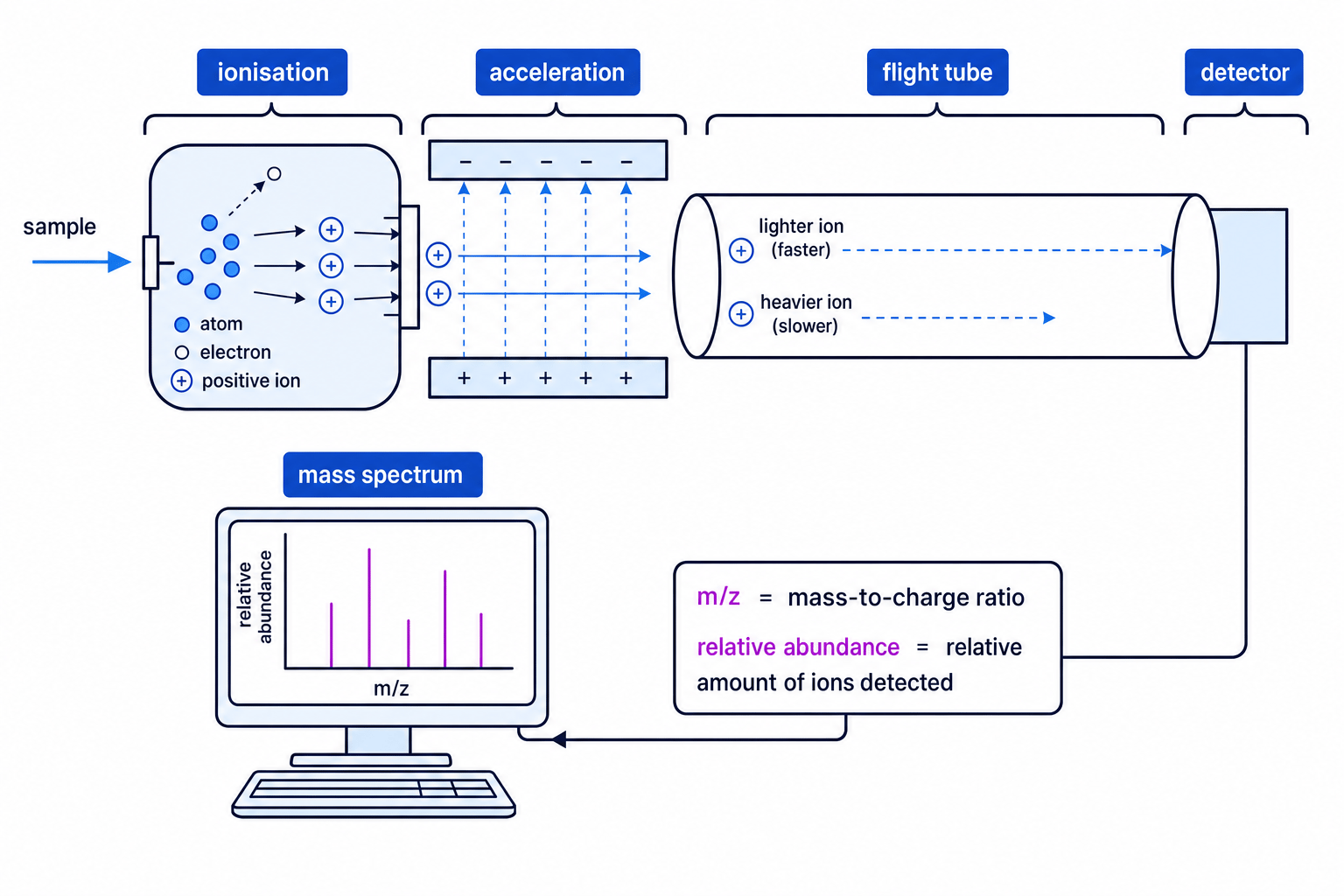
For chlorine atoms, the main isotope peaks are at 35 and 37 in about a 3:1 ratio. For chlorine gas, Cl2, molecular ion peaks appear at 70, 72 and 74:
- 70 from 35Cl–35Cl
- 72 from 35Cl–37Cl or 37Cl–35Cl
- 74 from 37Cl–37Cl
So their relative abundances are approximately 9:6:1.
Peak height is not mass
The x-axis gives m/zm/zm/z, while the peak height or area gives relative abundance. Use abundance as the weighting when calculating ArA_rAr.
Calculating relative atomic mass from isotope data
Chlorine has 75.8% 35Cl and 24.2% 37Cl. Estimate its relative atomic mass.
-
Treat the percentages as weightings, because ArA_rAr is a weighted mean, not a simple average.
-
Substitute into the weighted mean calculation:
Ar=(35×75.8)+(37×24.2)100A_r = \frac{(35 \times 75.8) + (37 \times 24.2)}{100}Ar=100(35×75.8)+(37×24.2) -
Calculate the value:
Ar=2653+895.4100=35.5A_r = \frac{2653 + 895.4}{100} = 35.5Ar=1002653+895.4=35.5
The mole, Avogadro constant and molar mass
Mole and Avogadro constant
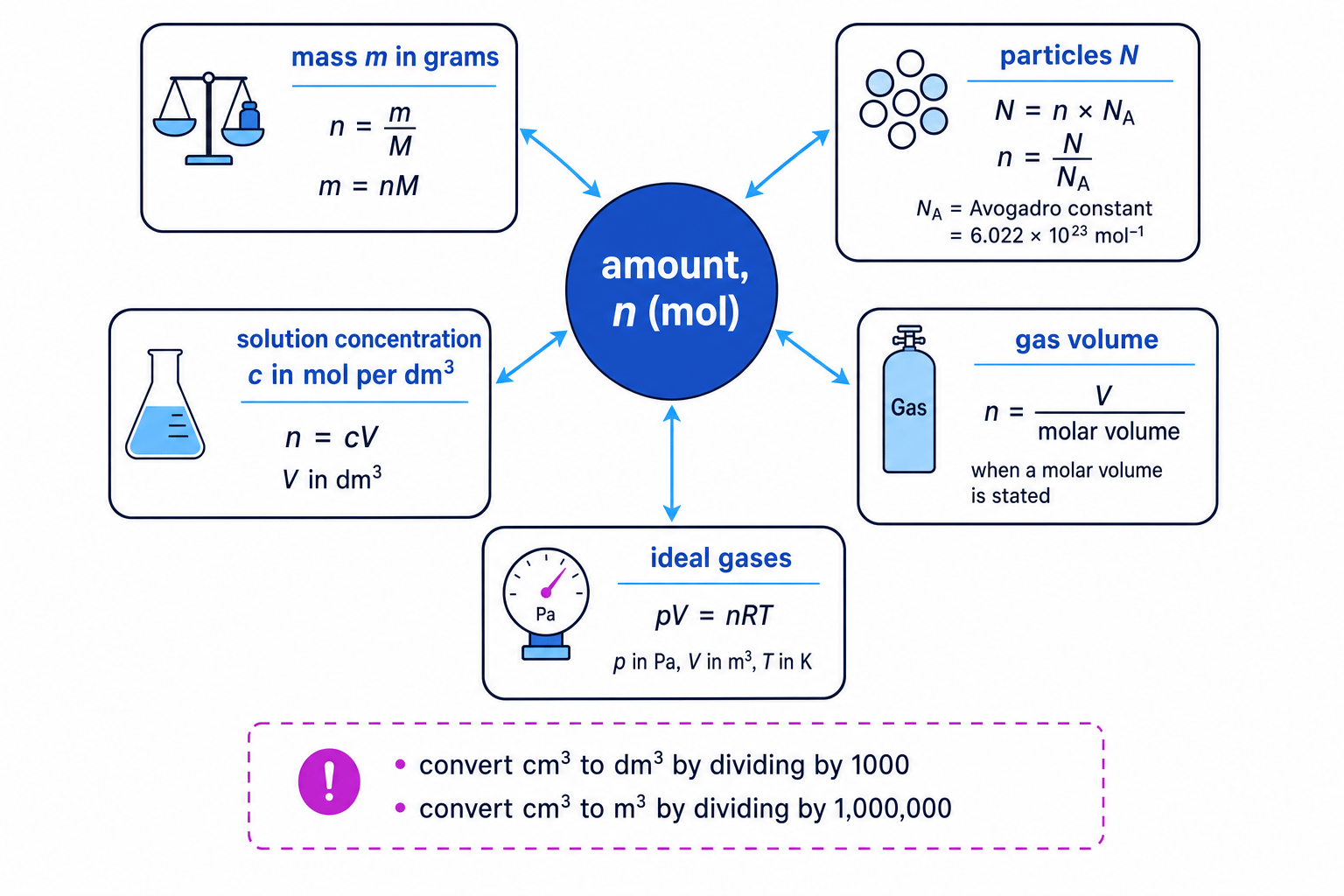
One mole is the amount of substance containing the Avogadro constant of particles. The Avogadro constant is NA=6.022×10²³ mol−1N_A = 6.022 \times 10^{23}\ \text{mol}^{-1}NA=6.022×10²³ mol−1.
The key equations are:
n=mMn = \frac{m}{M}n=Mmwhere nnn is amount in mol, mmm is mass in g, and MMM is molar mass in g mol⁻¹.
N=nNAN = nN_AN=nNAwhere NNN is the number of particles.
Converting mass into particles
How many water molecules are in 9.00 g of H2O?
-
Find the molar mass of water:
M=(2×1.0)+16.0=18.0 g mol−1M = (2 \times 1.0) + 16.0 = 18.0\ \text{g mol}^{-1}M=(2×1.0)+16.0=18.0 g mol−1 -
Convert mass into amount:
n=9.0018.0=0.500 moln = \frac{9.00}{18.0} = 0.500\ \text{mol}n=18.09.00=0.500 mol -
Convert amount into number of molecules:
N=0.500×6.022×1023=3.01×10²³N = 0.500 \times 6.022 \times 10^{23} = 3.01 \times 10^{23}N=0.500×6.022×1023=3.01×10²³
Empirical and molecular formulae
The empirical formula is the simplest whole-number ratio of atoms in a compound. The molecular formula gives the actual number of atoms of each element in one molecule.
To find an empirical formula:
- Convert masses or percentages into moles.
- Divide all mole values by the smallest.
- Multiply if needed to reach whole numbers.
Dealing with awkward ratios
If a ratio ends in about 0.5, multiply all ratios by 2. If it ends in about 0.33 or 0.67, multiply by 3.
Finding empirical and molecular formulae
A compound contains 40.0% carbon, 6.7% hydrogen and 53.3% oxygen by mass. Its MrM_rMr is 180. Find its empirical and molecular formulae.
-
Assume 100 g, so the masses are 40.0 g C, 6.7 g H and 53.3 g O. Convert each to moles:
n(C)=40.012.0=3.33n(H)=6.71.0=6.7n(O)=53.316.0=3.33\begin{aligned} n(\text{C}) &= \frac{40.0}{12.0} = 3.33 \\ n(\text{H}) &= \frac{6.7}{1.0} = 6.7 \\ n(\text{O}) &= \frac{53.3}{16.0} = 3.33 \end{aligned}n(C)n(H)n(O)=12.040.0=3.33=1.06.7=6.7=16.053.3=3.33 -
Divide by the smallest value, 3.33:
C:H:O=1:2:1\text{C:H:O} = 1:2:1C:H:O=1:2:1So the empirical formula is CH2O.
-
Find the empirical formula mass and compare with the molecular mass:
18030.0=6\frac{180}{30.0} = 630.0180=6Therefore the molecular formula is C6H12O6.
Concentration and solubility
Concentration tells you how much solute is present in a given volume of solution. In chemistry calculations, concentration is often measured in mol dm⁻³.
n=cVn = cVn=cVHere, VVV must be in dm³ if ccc is in mol dm⁻³.
Concentration can also be expressed in g dm⁻³:
mass concentration=mV\text{mass concentration} = \frac{m}{V}mass concentration=VmSolubility is the maximum concentration of a solute that dissolves in a solvent at a stated temperature, usually given in g dm⁻³ or mol dm⁻³.
Forgetting the volume conversion
For solution calculations, convert cm³ to dm³ by dividing by 1000. So 250 cm³ is 0.250 dm³, not 250 dm³.
Calculating concentration in mol dm⁻³ and g dm⁻³
5.85 g of NaCl is dissolved and made up to 250 cm³ with water. Calculate the concentration.
-
Calculate the molar mass of NaCl:
M=23.0+35.5=58.5 g mol−1M = 23.0 + 35.5 = 58.5\ \text{g mol}^{-1}M=23.0+35.5=58.5 g mol−1 -
Convert mass into moles:
n=5.8558.5=0.100 moln = \frac{5.85}{58.5} = 0.100\ \text{mol}n=58.55.85=0.100 mol -
Convert the volume into dm³ and calculate molar concentration:
c=0.1000.250=0.400 mol dm−3c = \frac{0.100}{0.250} = 0.400\ \text{mol dm}^{-3}c=0.2500.100=0.400 mol dm−3 -
Calculate mass concentration:
5.850.250=23.4 g dm−3\frac{5.85}{0.250} = 23.4\ \text{g dm}^{-3}0.2505.85=23.4 g dm−3
Gases: molar volume and the ideal gas equation
The molar volume of a gas is the volume occupied by 1 mol of gas at specified temperature and pressure. At room temperature and pressure, a common approximation is 24.0 dm³ mol⁻¹, but only use this when the conditions match or the value is given.
If temperature or pressure changes, gas volume changes. For a fixed amount of gas:
V2=V1×T2T1×p1p2V_2 = V_1 \times \frac{T_2}{T_1} \times \frac{p_1}{p_2}V2=V1×T1T2×p2p1Temperature must be in K.
The more general equation is the ideal gas equation:
pV=nRTpV = nRTpV=nRTUse ppp in Pa, VVV in m³, nnn in mol, TTT in K, and R=8.314 J K−1mol−1R = 8.314\ \text{J K}^{-1}\text{mol}^{-1}R=8.314 J K−1mol−1.
Using the wrong gas volume unit
In pV=nRTpV = nRTpV=nRT, volume must be in m³. In n=cVn = cVn=cV, volume must be in dm³. These are different conversions.
Using the ideal gas equation
A 250 cm³ sample of CO2 is collected at 100 kPa and 298 K. Calculate the amount of CO2.
-
Convert into ideal gas equation units:
p=100000 Pa,V=2.50×10⁻⁴ m3p = 100000\ \text{Pa}, \quad V = 2.50 \times 10^{-4}\ \text{m}^3p=100000 Pa,V=2.50×10⁻⁴ m3 -
Rearrange the equation:
n=pVRTn = \frac{pV}{RT}n=RTpV -
Substitute and calculate:
n=100000×2.50×10−48.314×298=0.0101 moln = \frac{100000 \times 2.50 \times 10^{-4}}{8.314 \times 298} = 0.0101\ \text{mol}n=8.314×298100000×2.50×10−4=0.0101 mol
Stoichiometry and titrations
Stoichiometry means using the mole ratios in a balanced chemical equation. The coefficients in the equation give the reacting ratio in moles.
For example:
HCl(aq) + NaOH(aq) → NaCl(aq) + H2O(l)
This is a 1:1 reaction, so the moles of HCl equal the moles of NaOH at the equivalence point.
In an acid-base titration, you usually:
- use a pipette to measure a fixed volume into a conical flask
- add a suitable indicator
- use a burette to add the other solution
- do a rough titration first
- repeat until you obtain concordant titres, then calculate a mean titre
Using the rough titre
If your rough titre is about 24 cm³, you can add solution quickly to around 22 cm³ in accurate runs, then add dropwise near the endpoint.
Calculating concentration from titration data
25.00 cm³ of NaOH is titrated with 0.1000 mol dm⁻³ HCl. The titres are: rough 24.20 cm³, then 23.60 cm³, 23.55 cm³ and 23.90 cm³. Calculate the NaOH concentration.
-
Select concordant titres. 23.60 cm³ and 23.55 cm³ are close; 23.90 cm³ is not used.
mean titre=23.60+23.552=23.575 cm3\text{mean titre} = \frac{23.60 + 23.55}{2} = 23.575\ \text{cm}^3mean titre=223.60+23.55=23.575 cm3 -
Convert the mean titre into dm³ and calculate moles of HCl:
n(HCl)=0.1000×0.023575=0.0023575 moln(\text{HCl}) = 0.1000 \times 0.023575 = 0.0023575\ \text{mol}n(HCl)=0.1000×0.023575=0.0023575 mol -
Use the 1:1 equation, so n(NaOH)=0.0023575 moln(\text{NaOH}) = 0.0023575\ \text{mol}n(NaOH)=0.0023575 mol in 25.00 cm³.
-
Calculate the NaOH concentration:
c(NaOH)=0.00235750.02500=0.0943 mol dm−3c(\text{NaOH}) = \frac{0.0023575}{0.02500} = 0.0943\ \text{mol dm}^{-3}c(NaOH)=0.025000.0023575=0.0943 mol dm−3
Atom economy and percentage yield
Atom economy measures how much of the reactant atoms end up in the desired product.
atom economy=Mr of desired productsum of Mr values of all products×100\text{atom economy} = \frac{M_r\ \text{of desired product}}{\text{sum of } M_r\ \text{values of all products}} \times 100atom economy=sum of Mr values of all productsMr of desired product×100Remember to include balancing coefficients.
Percentage yield compares the actual mass made with the theoretical maximum mass.
percentage yield=actual yieldtheoretical yield×100\text{percentage yield} = \frac{\text{actual yield}}{\text{theoretical yield}} \times 100percentage yield=theoretical yieldactual yield×100Calculating atom economy and percentage yield
Glucose ferments to ethanol:
C6H12O6(aq) → 2C2H5OH(aq) + 2CO2(g)
18.0 g of glucose produces 7.80 g of ethanol. Calculate the atom economy for ethanol and the percentage yield.
-
Calculate atom economy using product formula masses:
atom economy=2×46.0(2×46.0)+(2×44.0)×100=51.1%\text{atom economy} = \frac{2 \times 46.0}{(2 \times 46.0) + (2 \times 44.0)} \times 100 = 51.1\%atom economy=(2×46.0)+(2×44.0)2×46.0×100=51.1% -
Find moles of glucose:
n=18.0180=0.100 moln = \frac{18.0}{180} = 0.100\ \text{mol}n=18018.0=0.100 mol -
Use the equation ratio: 1 mol glucose forms 2 mol ethanol, so 0.100 mol glucose forms 0.200 mol ethanol.
-
Calculate theoretical ethanol mass and percentage yield:
m=0.200×46.0=9.20 gpercentage yield=7.809.20×100=84.8%\begin{aligned} m &= 0.200 \times 46.0 = 9.20\ \text{g} \\ \text{percentage yield} &= \frac{7.80}{9.20} \times 100 = 84.8\% \end{aligned}mpercentage yield=0.200×46.0=9.20 g=9.207.80×100=84.8%
Percentage error and significant figures
Every measurement has uncertainty. A burette reading might be ±0.05 cm³, but a titre uses two readings, so the titre uncertainty is often ±0.10 cm³.
percentage uncertainty=absolute uncertaintymeasured value×100\text{percentage uncertainty} = \frac{\text{absolute uncertainty}}{\text{measured value}} \times 100percentage uncertainty=measured valueabsolute uncertainty×100When combining measurements in a calculation, percentage uncertainties are often added to estimate the overall percentage uncertainty.
Estimating percentage uncertainty in a titre
A titre is 23.58 cm³. Each burette reading has an uncertainty of ±0.05 cm³. Estimate the percentage uncertainty in the titre.
-
A titre is calculated from final reading minus initial reading, so two readings are involved:
absolute uncertainty=0.05+0.05=0.10 cm3\text{absolute uncertainty} = 0.05 + 0.05 = 0.10\ \text{cm}^3absolute uncertainty=0.05+0.05=0.10 cm3 -
Calculate percentage uncertainty:
0.1023.58×100=0.424%\frac{0.10}{23.58} \times 100 = 0.424\%23.580.10×100=0.424% -
Use this to judge precision: quoting many extra digits in a final concentration would not be meaningful.
In the exam
- Start by converting the given data into moles using the correct equation and units.
- Use the balanced equation ratio before converting into the final requested quantity.
- For titrations, ignore rough titres and obvious outliers; average concordant titres only.
- Check units carefully: dm³ for concentration, m³ for pV=nRTpV = nRTpV=nRT, and K for gas temperature.
Check yourself
- Why does chlorine gas show molecular ion peaks at 70, 72 and 74?
- When should you use n=cVn = cVn=cV rather than n=mMn = \frac{m}{M}n=Mm?
- How would you decide which titres to include in a mean titre?